

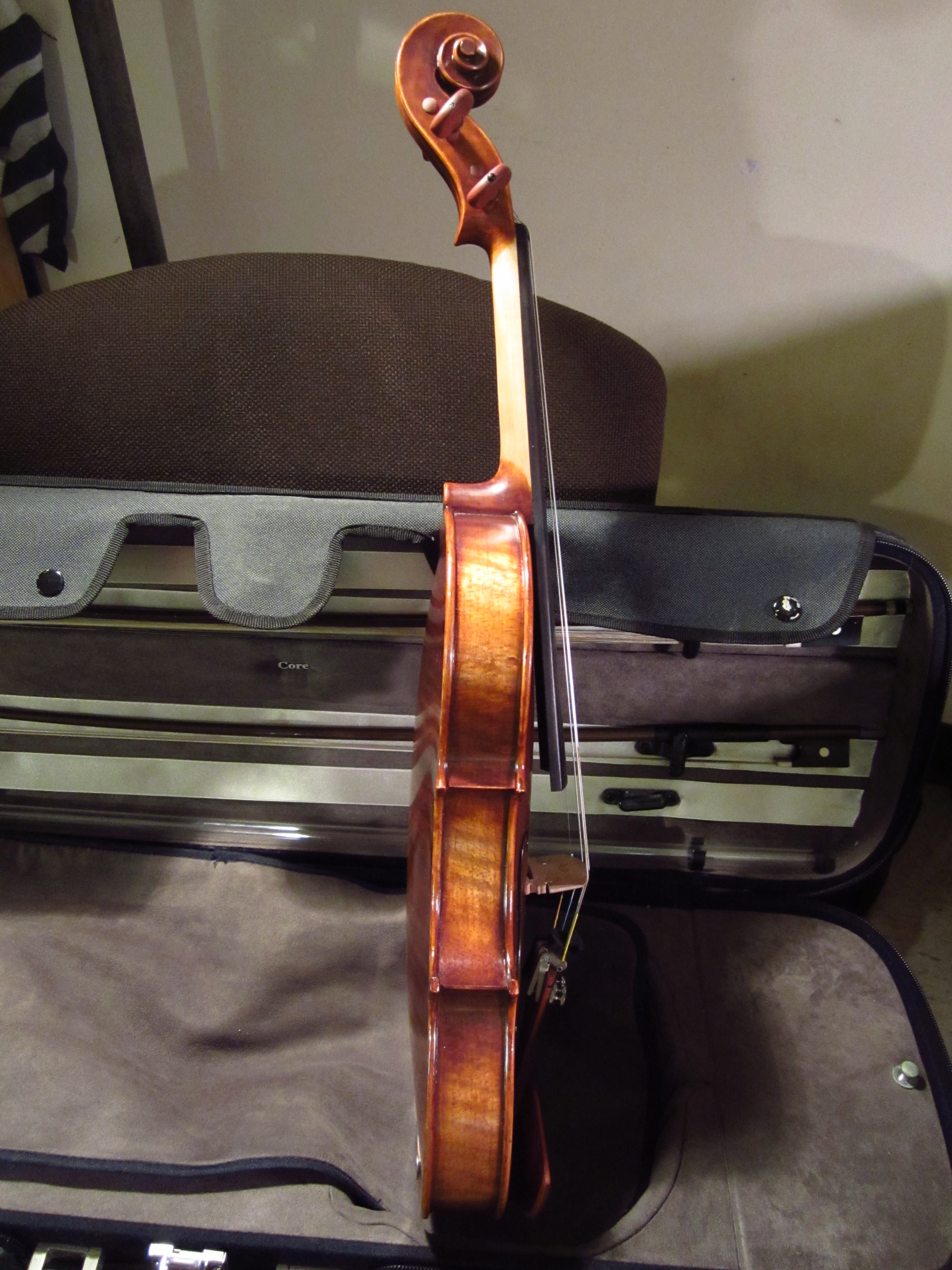
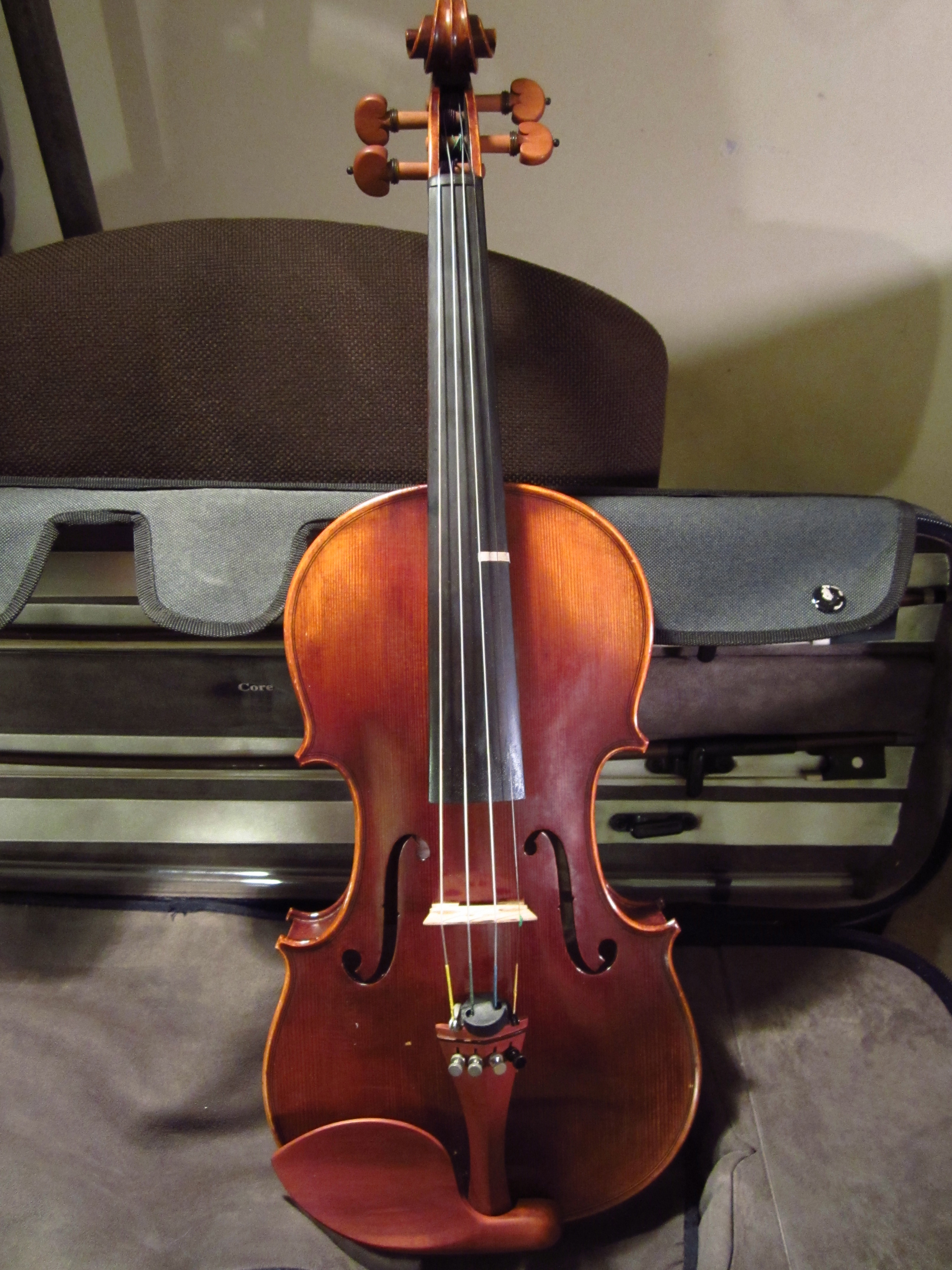
This is my violin. It is a standard 4/4 size, which is roughly 24 inches in height, and about one and a half inches thick. The body has a curved structure, much like the body of a woman. The bottom of the body is widest at 8 inches, where it graciously curves inward to about four and a half inches, and curves outward again to about six and a half inches. On the lower left (facing the violin) of the body you will see a circular wooden chin rest of about four inches. You will see another piece of wood about four inches long which holds the four metal fine tuning gears which keep the strings in place. On the front of the body, on either side of the strings, there are two f-holes about three inches in height through which the sound emerges. There is a wooden bridge about an inch in height and half a centimeter in thickness, which holds up the four strings. Two inches above the bridge, there is a black wooden fingerboard, which extends about eleven inches up the violin. The top five inches of the fingerboard constitutes the neck of the instrument, and above that you will see four pegs, two on either side, which hold the four strings. These pegs, when turned, will pull the string tighter for a higher pitch, or ease them for a lower pitch. At the very top of the violin is an elegant spiral curl, which is most evident of the fine craftsmanship of its creator.
This instrument is a dark honey-colored brown, with vertical grains running across the front of the body, and fine horizontal “ribs” can be observed on the back of the body. The strings are made of steel, and vary in thickness for different sounds. The left most string (G) is thickest, and each string gets progressively thinner until you get to the right most string (E), which is thinnest and produces the highest tone. About four and a half inches up the fingerboard, there is a small white piece of tape. This is to mark seventh position, and it was put there by my ninth and tenth grade Orchestra teacher, Mrs. Sckipp. The bottom half of the body has three small nicks, which were all put there by myself, accidentally. Each one is from my bow, which sometimes smacks against the body of the violin while I am carrying it around casually. It is fragile and surprisingly light in terms of weight, as the body is hollowed out.
Although the first stringed instruments came about in the 9th century, the violin has only been around since the 16th century. It first emerged in Northern Italy and spread throughout Europe. These instruments were handmade for hundreds of years, until the 1940’s when they begun being factory produced. The quality of the instruments suffered from the lack of care put into their creation, and since then there have been some manufacturers who have decided to use the conventional, hand-made method, which gives each instrument a unique look and tone.
My violin was handcrafted by a violinmaker under the training of Andreas Eastman of the Eastman String Company. Qian Ni founded Eastman Strings in 1992 after he moved to the United States from China. He gathered a group of talented violinmakers in order to begin his business, and has since built a very reputable reputation. This particular violin was made in 2004, and eventually ended up at a violin dealer by the name of Laurinel Owen, who works out of The House of Strings, in Bellport, New York. This beautiful instrument found its way to me in the summer of 2006, just before I entered the seventh grade.
I had been playing violin for about four years when my parents decided to grant my wish of getting my own, brand new violin. The instrument I had been using was my sister’s old, cheap violin that was most likely factory made because its quality was quite poor. When I arrived at the home of the dealer, there were 6 beautiful violins laid out before me and I was asked to choose which I wanted. After careful consideration, I chose this particular one, and my parents purchased it for $1100 as a gift to me. I was ecstatic.
This violin has been with me through years of practicing, auditions, and concert performances. It was with me as I played my first NYSSMA solo. It felt me tremble as I nervously prepared to perform in front of a judge for the first time. It was with me for all twelve seating auditions for concert and symphonic orchestra. It was with me as I played Christmas carols for a group of elderly folk at a nursing home. It has accompanied me through numerous school concerts, and has resonated vibrations to the tune of Brandenburg’s Concerto No. 3, Barber of Seville, Schubert’s Unfinished Symphony, Beethoven’s Scherzo Movement, and many more. This violin has felt the misplacements of my fingers, and screeched at me in poor intonation so that I might learn the proper placements. It has resonated with a deep, full, powerful voice as I learned how to help it sing.
This marvelous instrument has not only generated a sound for others to enjoy, but has also acted as a de-stressor for myself; it has allowed me to unwind and forget about the troubles that silence often brings. This violin may not have a very long history, or travelled through many different hands, but that does not mean that it will not create history. I intend to pass this instrument down to my children, and grandchildren, in hopes that it will journey through the lives of many more, creating memories and history as it travels through the ages.
 The Materials of History, Thought, and Art
Maggie, I love your detailed description of your violin. The more I think of them, and look at your pictures, the more elegant they seem to me as objects. They really are beautiful to look at!
I like that your history, in contrast to mine, is quite a short time span. My object lay untouched for over a thousand years, while yours was passed through several hands quite quickly during its manufacture, sale, and purchase. That shows that an object’s lifespan doesn’t necessarily impact how many people have owned it or touched it.
It’s really cool that you’ve had this violin for so long because you’ll most likely have it for your whole life. It’s something that’s constant – even if you take a break from playing it, it is something that you can always come back to.
This is quite random, but do you know why it is called Eastman Strings when Qian Ni founded the company? I feel like it should be Qian Ni Strings!!
Thanks, Eirinn! I believe that Qian Ni gathered up a group of skilled violinmakers, and among that group, there were two brothers by the name of Eastman. I am not exactly sure why it is named after them, but it could be that they are the principal instrument makers and Mr. Ni decided that they deserved the title more so than he.