

The item I decided to write about today is this medal/pendant I have that I wear often on a black string. The reason I picked this object to detail is because I had absolutely no idea what it’s history is, perhaps I enjoyed the mystery of it, but perhaps it is also time to delve into it!
This medal is around the size of a half dollar coin. It is a light bronze color and has a semi-heavy weight. One side of the medal has the image of an angel on it. The angel’s head resembles that of the Statue of Liberty. It’s wings are spread apart and it is clad in armor. In one hand it holds a sword pointing downward and it’s other arm is hidden behind the big shield it bares. It stands face-forward on a small platform. The other side has a logo that appears to be a code of arms with “U.S” inscribed on it. The top of the coin states “The Great War For Civilization”, with the 13 countries France, Italy, Serbia, Japan, Montenegro, Russia, Greece, Great Britain, Belgium, Brazil, Portugal, Rumania, and China inscribed on the sides. There are 6 stars on the bottom and a loop for attachments on the top.
I picked this coin up late 2nd semester of last year at the antique shop in town on Main Street. I went into the shop with my friends one day because we were looking for objects to use in a rather odd art project we needed to do for Design Form. I saw it through glass casing sitting under a shelf and was immediately intrigued by it, but I didn’t buy it or inquire further.
I found myself continually thinking of it shortly after, and decided to go back to buy it. I went into town alone this time and inquired to the shopkeeper about the item. I lied and said it was a present for someone so I could ask more questions about it. Perhaps I thought it was silly to go into an antique shop alone and buy something so random for myself. The friendly, albeit strange, lady handed it to me but did not know much about it. We concluded that it must have something to do with World War I and left it at that. I thought it was curious how the coin has an angel on one side, a symbol of peace and protection, and an inscription about war on the other. I bought it for around twenty dollars and attached it to a black string.
I didn’t know why the coin was so compelling to me, or why I became so attached to it. I hadn’t the slightest clue. One of the more absurd thoughts that when through my head when I was trying to decide why this medal meant so much to me was that maybe this coin belonged to me in a past life (preposterous! I don’t even believe in reincarnation!) I thought of the religious symbolism of the angel and that perhaps it speaks to my faith. I am Jewish and believe in basic Judaic traditions and morals, however my personal beliefs are much more complicated than that and are grounded more in philosophy than religion. It was while I was pondering about this that I came to the (semi-existentialist) realization that this medal is meaningful to me because I decided it is. I imbued it with meaning. It represents the sometimes irrational or subconscious inclinations we have to find meaning or faith or mystery in life. It has meaning to me because I decided thus, and that doesn’t make it any less meaningful. Along with the representation of the side of me that is open to faith or meaning without reason, the coin came to symbolize my own inner strength. I brought it with me to Europe and wore it on all of our travel days (there were a lot of them! Plains, underwater trains, boats).

Sometimes I feel silly about giving this medal so much meaning in my life when it has no “real” significance for me. It was not handed down to me from my ancestors nor a part of my history. Yet I continue to hold it in my possession nonetheless.
I was reading this assignment and my eyes began to search for something in my room interesting to write about. They immediately fell on this coin hanging with all of my other necklaces on my dorm wall. I began to search for the coin online and found many like it, some clad with ribbons.
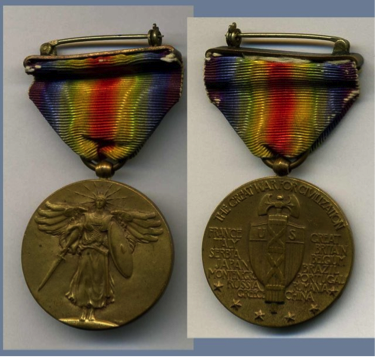
I discovered that this medal is a WWI Victory Medal. The sculptor of the medal is James Earle Fraser (1876-1953), and it is said to be his most important medallic commission. The design is based on the Winged Victory of Samothrace.
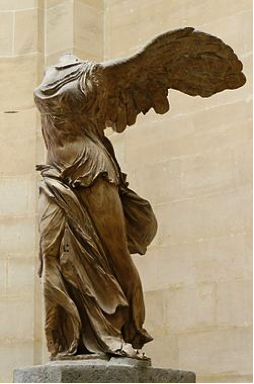
I have studied this statue before and have seen it in person and definitely see the resemblance to it, and the medals ancient Greek influences. The goddess in the medal is pointing the sword downward as a sign of peace, the cessation of hostilities brought about by the Peace of Versailles. The 13 nations on the sides of the coin are the allied nations, and what I thought was a code of arms is a double-headed battle ax surmounting a U.S shield with a bundle of sticks tied together with a ribbon, representing the unity of the Allied military. The nob at the top allowed for attachment of a double-rainbow ribbon, representing renewed beginning.
The 36 millimeter bronze medal is composed of 90% copper and 10% tin. In addition to the U.S. Mint, A miniature version was also issued for wear on formal military attire. Upon the end of the Great War, the victorious Allies decided to honor each other by making this medal a joint award. Each nation created a similar medal with compatible designs.
It was commened on Feb. 3, 1920, at the U.S. Mint. The first medal was forwarded to President Woodrow Wilson by the Secretary of War on Feb. 11. General distribution to soldiers began on June 21. It was the most widely circulated medal of its time. The award was available to all officers and enlisted personnel for honorable service in the Armed Forces between April 6, 1917 (the declaration of war against Germany) and Nov. 11, 1918 (date of the Armistice).
It was fascinating to learn about the history of my coin, and I don’t feel that the mystery of it is taken away, as I still am not sure how it arrived at the antique shop or why I decided to buy it. However, one aspect of it that possibly charmed me is its Greco-Roman influence. I had not known that at the time, but I love studying art history and learning about ancient mythology and perhaps felt its cross-cultural/historical design when I noticed it. I still wonder how it acquired all of its scratches and nicks.
This class is making me realize how rich so many objects are with history, and how layered these histories are. Just like geology and the earth, each time period an object endures is captured into the essence of the object, and we are adding to that very history by having them in our possession.
http://www.pcgs.com/News/Victory-Medal-Celebrates-Victory-Honors-Victors
 The Materials of History, Thought, and Art
For some reason the pictures I attached aren’t posting, but I will keep trying!
I really enjoyed this post, Ally. Your fascination with this medal is something that I’m sure happens to everyone with some object they come across in their lives (I know it’s true for me at least.) Do you feel any sort of personal connection to WWI now after having this medal in your life? Its history reminds us how much work goes into the production of something as small as this medal: to be designed, made, approved, distributed. How many hands have held this medal before you? And why has someone decided to sell it? In the meantime, I think it makes for a great medallion to wear when the mood strikes you.
I don’t feel any particular personal connection to WWI, only what I’ve learned about it in school. You are right, there are so many questions into the origins and stories behind objects that I haven’t thought of before.