This post will focus on the needle case as an example of a shift in our culture. My original object was a handmade needle case dated 1898, which was a cherished object. The stitching was meticulous, the materials special and it was significant enough to the maker for her to bequeath it to her grandneice.

The photo above is a “roll-up” needle case from the same Victorian era. This case was sewn by machine out of fine silk, velvet and leather, with hand-embroidered embellishment. The velvet ends serve as pin cushions; pin heads are visible in the photo. The unknown maker of this object took pride in her sewing skills, as did Ruth Broadwell. She made a practical item to hold pins and needles, but one that would be beautiful and a pleasure to hold and handle.
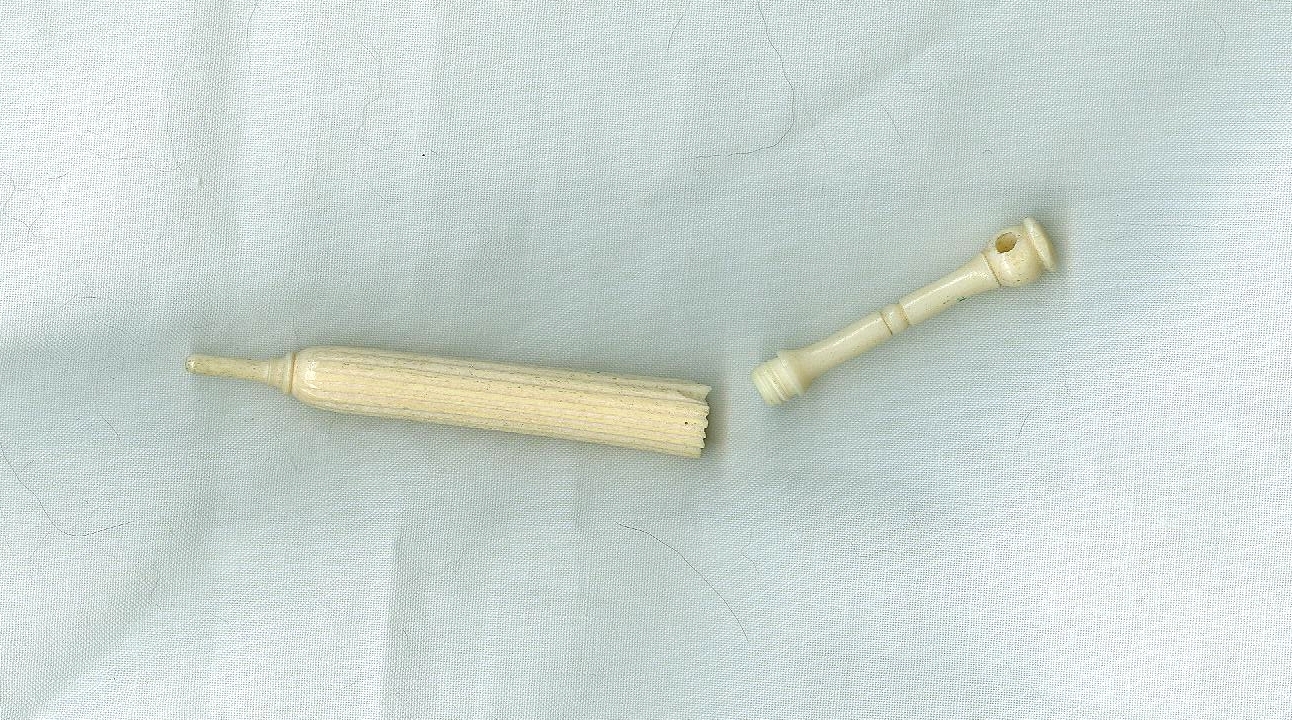
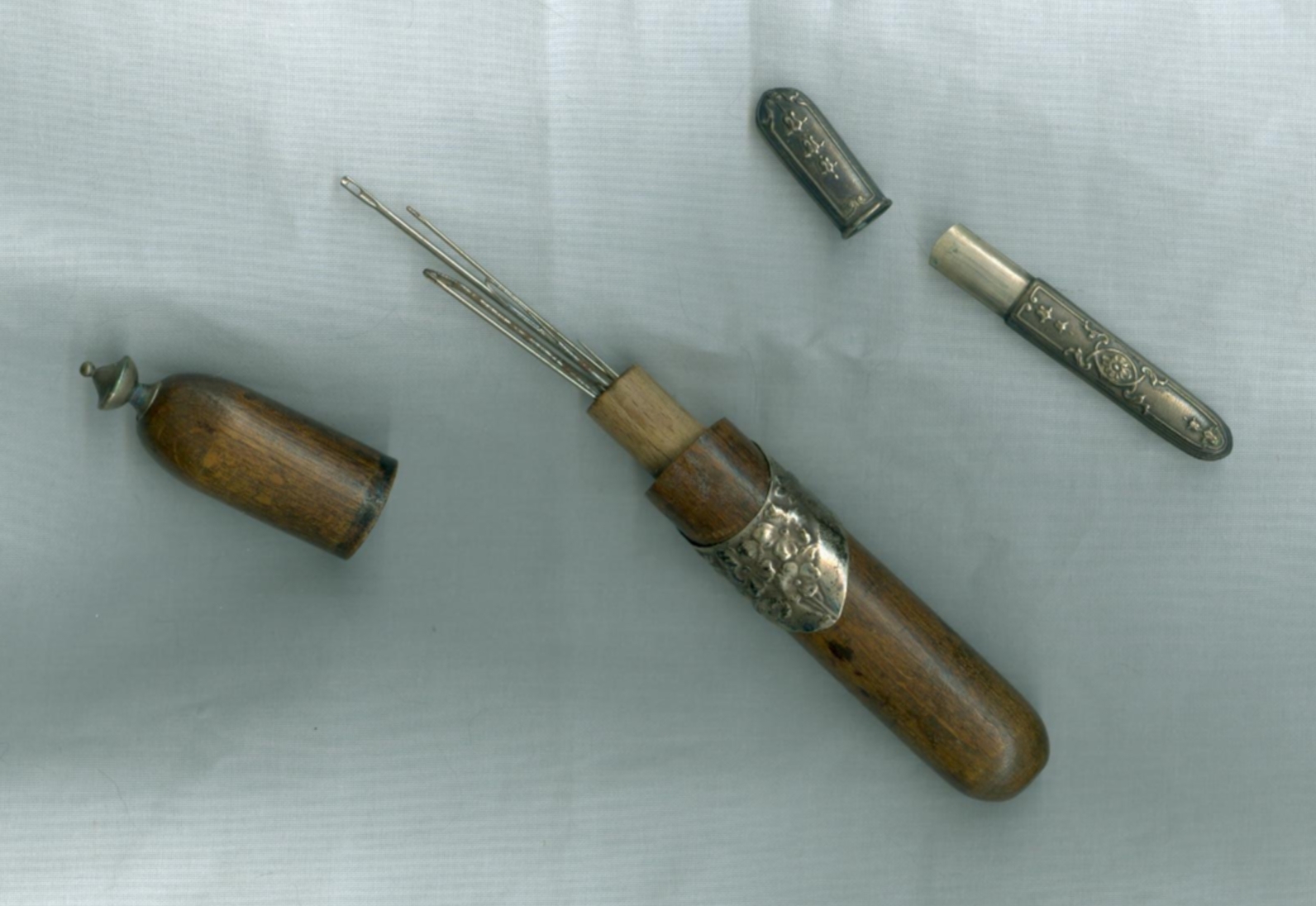
Some women could afford to purchase sewing tools, as the 19th century industrial age ushered in a manufacturing boom. The two photos above show needle cases from the same time period as the homemade ones. Wood, silver and bone are the materials used; the beauty of the items are as significant as the function. I had thought that the hole in the bone needle case was for hanging on a cord, but found out while researching for this assignment that it originally housed a “stanhope,” unfortunately now missing. A stanhope is a miniature magnifying glass with an image inside. While fetching a needle for her project, the seamstress could pause and enjoy the image, wondering at it’s miniscule size, stopping to smell the roses.

The photo above is a 20th century paper needle book c. 1950. Needles were purchased in these, and they replaced the earlier elaborate needle cases to store needles in the home. I found images online of paper needle books with advertising and commemoration of special events. These objects would not have been considered precious in their day, but purely functional. They are now collected as examples of “retro” advertising art.
All of the above needle cases originated as practical tools to hold sewing needles for everyday use, but their function has changed to that of collector’s items. Today, I keep them in a drawer, occasionally to handle and admire. I am a sewer, but don’t use these antiques to house my own needles because I consider them too precious.

Finally, above is the needle case I use today; it is made from cardboard and plastic. The plastic cover has an opening on the edge which allows a needle to be removed by rotating it, keeping the other needles in place. When it is empty, it will promptly be thrown in the trash. The evolution of the needle case from precious and beautiful, to cheap and functional, to ugly and disposable (sadly) represents a corresponding shift in our culture. It makes me think of a shift in communication from the handwritten letter, in beautiful flowing penmanship, to the telephone call, to the text message. Progress.
 The Materials of History, Thought, and Art
I remember my mother (perhaps it was my grandmother’s) having the exact paper needle book you have pictured here! A bit of nostalgia in that image for me!