
When I was little, apparently I really liked Blue’s Clues. I have a replica of the thinking chair sitting in my basement to prove it. It is approximately 4×4 feet and the back of the chair and the arms are leaning outward, stretched and slumped from years of use. The chair has a soft velvet feel to it, with light curlicues against its rich burgundy. It is outlined all around the edges with black that swirls and gets thicker at the front of the arms. The sides are mummified with tape—an attempt to cover the rips in the material, revealing its rough inside skeleton, an unpolished wooden frame held together by many nails with their sharp ends exposed. Who would think that such a lovely children’s prop with soft arms meant for a little prince would be a torture chamber on the inside? Those bits are covered though with duct tape and an affectionate resistance against getting rid of it.
My mom bought the thing from Sears, probably making a scene carrying that ostentatious chair through the lines of people and to the parking lot. It is very small in comparison with other furniture, but I don’t know any mom other than my own who would bring it home.
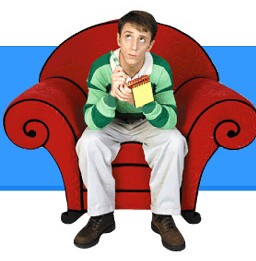
In Blue’s Clues, this red chair was designated to doing some serious contemplation on piecing together clues to solve the weekly mystery with Blue. The main character Steve would sit on it, cross his legs, and bring his hand up to his chin: Rodin’s the Thinker with funny hair and a green striped long sleeve shirt.
Its counterpart was brought to my house, perhaps not to think, but to play. As I got older my family and I used it as a normal chair, and friends would sit on it when the couches were filled up. Bright and red and clashing with the other colors in the family room as it was, it became rather inconspicuous, an accepted part of our space. My two cats eventually claimed it as theirs and it is now decked with little blankets and toys.
As we redecorated the house, we were going to get rid of it, but between our own sentimental value attached to it, and how fond of it my cats are, it is now the designated cat bed in my basement.
This chair has had so many different purposes in its lifetime, from being a space to think, to a space to play, to a space to sleep. Depending on the owner of the thinking chair, it was used in different ways. Much like the Netsuke in the Hare with Amber eyes was used differently depending on their owner.
As objects go through all of their different lives with different owners, they serve different purposes. Depending on the use, the role the owner gives it, the object becomes something new, embedded in it all of its past lives.
 The Materials of History, Thought, and Art
Pingback: Urban Gardening: Designing Creative Space - garrottdesigns.com