
Photography Source: Shelley Weresnick
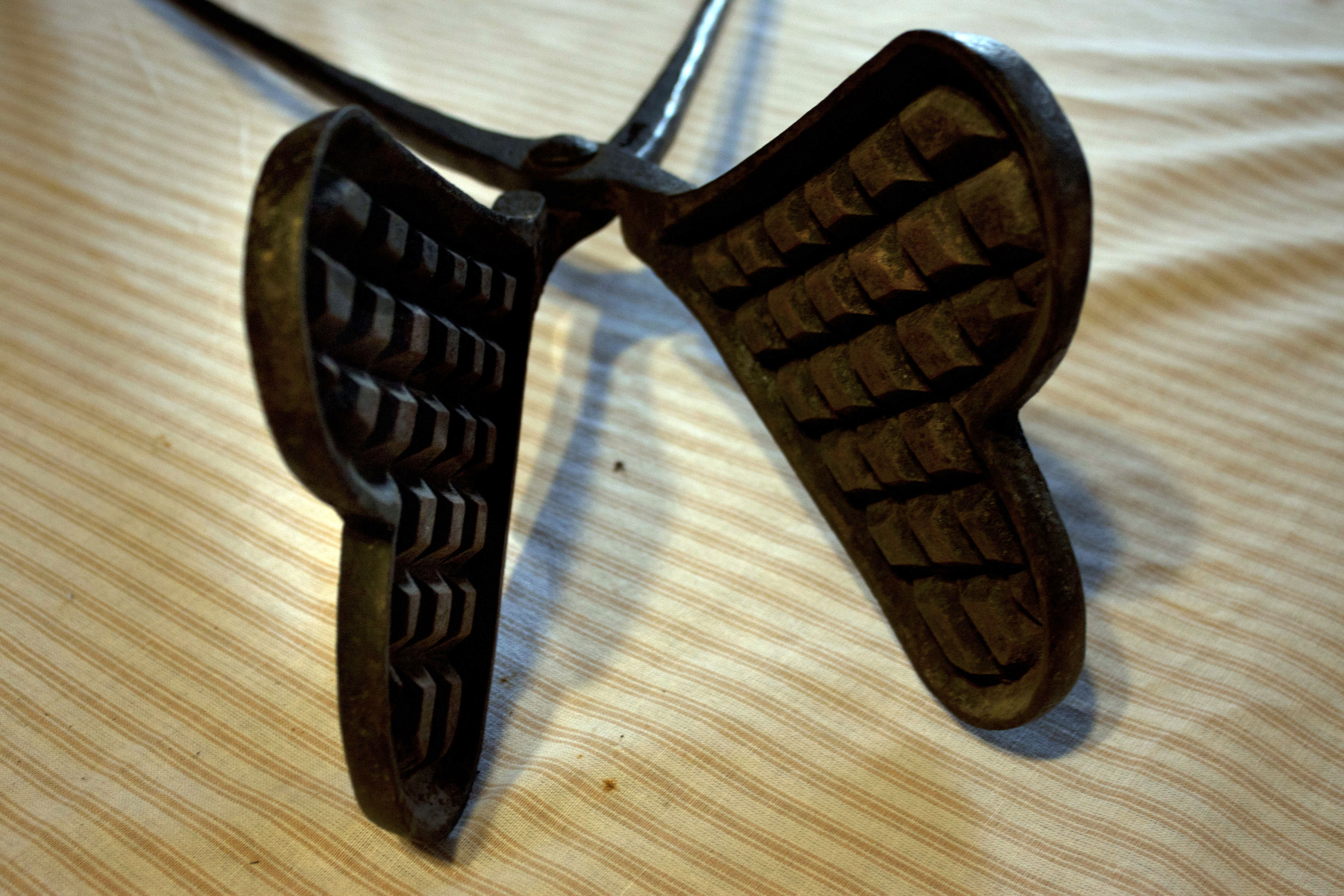
This heart-shaped waffle iron could have been given as a wedding present, and has been passed down throughout generations of the DuBois family. It has felt the heat of an open flame, tasted the batter of home-made waffles, and has provided much insight to the style of cooking in the 18th century and the lifestyle and culture of the Huguenots of New Paltz.
This is a waffle iron. It is adequately named for it is made entirely of cast iron and designed for cooking waffles. It is 34 inches in length, with two long, 28 inch handles to prevent the cook from being burned by an open flame. It has a hinge mechanism where the handles meet the press, allowing the press to open and close. The press itself is heart-shaped, with deep, one-inch square protrusions on both sides of the press. Waffles coming out of this iron would be about two inches thick, with several, one-inch square indentations. This iron is mostly black, but rusty browns can be seen in the inner areas of the press, as they are likely worn with use. This iron is surprisingly heavy, and rough with slight imperfections around the edges.
The DuBois family was one of the twelve Huguenot families who lived in New Paltz during the 17th and 18th centuries. Benjamin DuBois owned this waffle iron sometime in the 1700’s, and it was likely purchased directly from the blacksmith who forged it. However, it is unknown if Benjamin purchased it himself. Waffle irons were typical wedding gifts in this time period, so it is possible that he and his wife Catherine received it as a gift when they wed. It has since been passed down through generations of the DuBois family, going from child to child. The most recent descendant to own this waffle iron was Edsall DuBois Elliott, who died in the late 1960’s. His wife then donated it to Historic Huguenot Street in 1970, along with many other interesting objects.
You may wonder what significance a waffle iron has to the history of New Paltz — and I have to say there is far more to this seemingly insignificant object than you might expect. It has seen hundreds of years of history, and through that, holds knowledge about cooking, culture, traditions, and status.
I’m sure we are all familiar with the smell, taste and texture of a delicious “Belgian” waffle. But this is not actually what a waffle of the 1700’s was like. Think of a wafer- a thin, crispy treat made from a batter. This is closer to what the Huguenots’ waffles were like. The waffles being cooked in this heart-shaped waffle iron were thick, but crispy. These scrumptious treats consisted of flour, butter, milk, eggs, and yeast. They were not served for breakfast, but rather for dessert, and often topped with sugar rather than maple syrup.
This waffle iron not only tells us what delectable pastries cooked within it, but also explains much about the cooking style of the 18th century. All cooking was done on an open flame, within the home; a more dangerous method than we use today. And so, the cookware needed to fit the needs of the cook. The long, 28 inch handles on this iron allowed the chef to comfortably place and remove the iron from the fire without burning themselves or catching their clothing.
Considering that waffles first originated in Europe, this waffle iron provides insight into where the people using it might have come from. Waffles were particularly popular in France, Germany, and Belgium – so we can note that the individuals using waffle irons in the 1700’s were possibly from one of these countries. It is also possible that the waffle iron’s popularity quickly spread to America, resulting in its production and use right in our lovely town of New Paltz.
In order to go from a lump of iron to the strong, sturdy, and lovely heart-shaped waffle iron it is today, it needed the help of a talented blacksmith. The undefined lump of iron was placed into a very hot fire until it became bright red. It was then placed on an anvil and beat into shape with a hammer. It had to undergo this process many times, each bringing more and more definition and shape until it finally became a lump of iron that could now be recognized as a waffle iron. It was likely painted black for aesthetics before being sold. Today, it has been rusted and worn on the inner areas, but still remains the valiant cooking utensil it was meant to be.
Now, 300 years later, this waffle iron is still perfectly functional. It could be filled with batter and placed in a fire to give you a delicious, heart-shaped pastry. Or, it can be placed on display in the village of New Paltz to tell its story. Simple as it may seem, this waffle iron has so much to say, and it will continue to silently observe the world as each day adds a new page to its story.
References:
Bruyn. Family Recipe Book. New Paltz, 1812-1832.
Heidgerd, William. The American Descendants of Chrétien Du Bois of Wicres, France. New Paltz: Huguenot Historical Society, 1968. Print.
Keller, C. Ancient Technologies and Archaeological Materials. Eds. S.U. Wisseman, W.S.Williams. Amsterdam: Overseas Publishers Association, 1994. Web.
 The Materials of History, Thought, and Art
I love this! I’m so glad you were able to write about it. I find it so awesome how it’s not only shaped like a waffle, but was actually used to make a very sugary treat that’s not at all like Belgian waffles as we know it. It is certainly true that this object hints at the heritage of the DuBois; Americans didn’t just make waffles on their own. Really cool stuff.
Thanks Anne! Do you have any suggestions on how to improve it? I have a few more sources I need to cite…but is there anything else you think I should add?
Hey Moogs, I don’t really have much to critique– you have so much great information!! ” In order to go from a lump of iron to the strong, sturdy, and lovely heart-shaped waffle iron it is today”… I like this sentence but I feel like your wording is boring.. particularly the “go”… I feel like “transformed” would be a better word to use. Also, I really want you to use a waffle pun as your last sentence. Like, that can totally happen. Or use the last sentence but somehow sneak in some cooking terms? Yeah now I’m just picking really minute details because this is a fantastic post!!!
IT’LL MAKE THE WORLD A BATTER PLACE AHAHAHAHA
Thanks Eirinn. I like the idea of using “transform” instead of “go”. Good call! And about that waffle pun… I’ll have to think about it… hahaha
Maggie, this is really well-written! I love your narrative and that it includes everything from how the waffles were made to how the actual iron was made. I am thinking you could emphasize its importance to New Paltz history more by using the iron as a way to talk about the Huguenots’ “hybrid” culture. As far as I know, they emigrated from France and relocated all over Europe and into America. So these people were all the more likely to be familiar with European traditions outside of just France. I know you addressed this briefly, but if you work in the history of the Huguenot people more then it might strengthen your case.
Thanks Sam! I really appreciate the feedback! I’ll definitely look into that.
Pingback: A Brief History of Waffles ~ Random Bits of Fascination