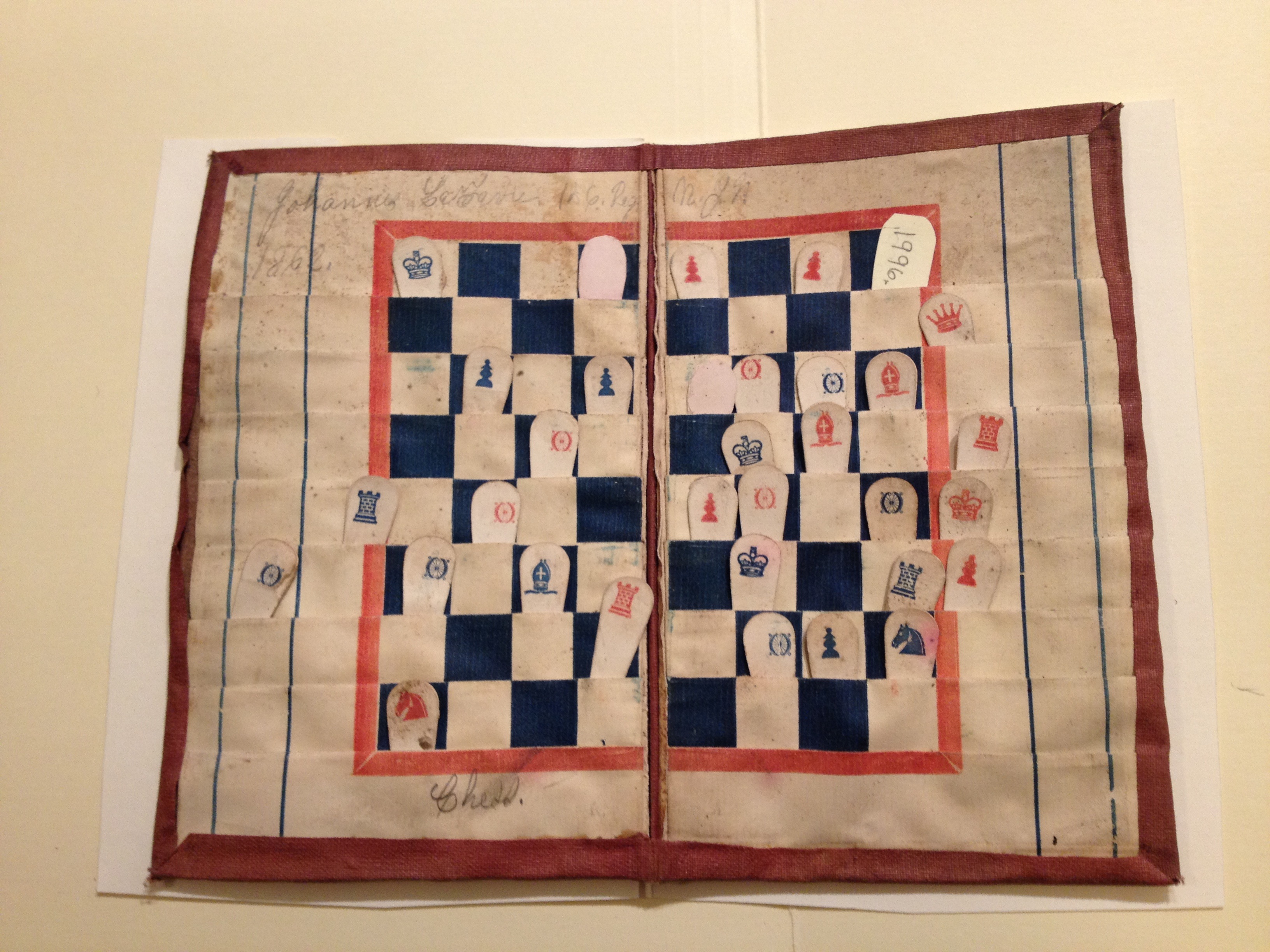
Smaller than your modern chess set, the pocket chess-board was a portable game for travelers to carry from one destination to the next. Because the object was created with a series of slips and paper chess pieces, it was easy to stop at any moment and close the book without disturbing the game.
Description:
The pocket chess-board, when closed, looks like a small hard cover book made out of cloth material. When closed, you can feel the roughness of the object as if you’re touching the cuff of a fresh pair of jeans. There are small bubbles on the back cover where air trapped itself inside the cloth material over time. On the object’s edges, you can see pieces of the cloth are slowly starting to rip off. The word chess is written in pencil at the top left. The chess board is light brown, but was probably burgundy or red once upon a time. Upon opening the small 4-by-6 book, a mini chess board is located in the middle with blue and white squares surrounded by a red-orange border. Below the border are the words Chess written in script again. Above the border reads: “Johannes Lefevre 126 reg. N.Y.R.” and “1862” on the left corner. The chess board is made out of paper with blue lines on the left and right side, creating little slips for small white tear-drop shaped chess pieces. On the pieces there are printed chess shapes in red and blue ink. Some are in chess slots, others are to the side, waiting to be used.
Provenance:
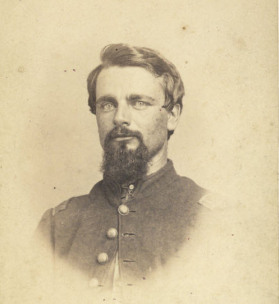
The object was owned by Civil War Soldier Johannes Lefevre of New Paltz. It is believed he carried the object with him during his time in the war. The object was perfect for the life of a solider because of its portability and inability to be disrupted by closing the game at any given moment. Though it is unclear how Lefevre possessed the object, the pocket chess-board was manufactured by D. Appleton & Company in New York City 13 years after its invention by Peter Mark Roget. After Lefevre’s death it was given back to the family and passed down through generations. It presently is located at Historic Huguenot Street.
Dates of Creation:
The object was manufactured in 1858, but was said to be created 13 years ago by Peter Mark Roget (1779-1869) prior to being sold in general D. Appleton & Company shops.
Narrative (VERY ROUGH DRAFT):
In 1858, D. Appleton & Company began selling its first-ever pocket chess-board for all to own. It became a staple for those who traveled because it was a portable form of entertainment for long journeys. Prior to it being sold at the D. Appleton & Company general store in New York City, it was invented by Peter Mark Roget. During the Civil War, its invention was created for the entertainment of travelers, soldiers and sailors who were always on the go during the Civil War. It was during this time period where Johannes Lefevre took ownership of his own pocket chess-board where he used it for entertainment on long travels and nights throughout the war.
It wasn’t uncommon for a civil war soldier to have such an item. For Lefevre, he probably either had the item before the civil war. He was traveling and looking for jobs upon graduating from Union College, where he obtained a science degree. He most likely used the item as a form of entertainment and played with other travelers. If this wasn’t the case, Lefevre mostly likely obtained the item once he returned to New Paltz upon hearing of his brother Peter’s enlisting in the Union Army. He was visiting his uncle in Michigan at the time. Johannes must have received the item as a gift or bought the item before his departure.
On his journey, Lefevre never wrote about his chess-board to his family and friends, but he was surely in possession of it during his duty as a solider. Throughout his journey in the Union Army, Lefevre picked up a pencil and wrote on the inside of the item: “Johannes Lefevre 126 reg. N.Y.R.” He also wrote “1862” on the left corner of the chess-board He wrote “Chess” at the bottom of the page and on the cover of his pocket chess-board too, possibly because of boredom.
Johannes Lefevre had a successful and emotional career in the military, as was depicted in his civil war letters about death, women and family. He soon faced a horrible death when he was fatally wounded during the battle of Cedar Creek. The bullet went into the side of his rear. He was then taken to a Dr. West who was helping him recover. His father, Josiah Lefevre, went south after receiving a letter from Dr. West about his son’s injury. Upon reaching him, Josiah realized his son was recovering and left for New Paltz. However, it wasn’t until his departure that Johannes developed Gangrene disease from the exposed wound. He died in the late fall of 1864.
The chess-board, at that moment, was with all of Lefevre’s things when he died. His brother, Isaac went down to get the body and return it to the family in a coffin, according to Huguenot Street researchers. His belongings, such as the chess-board, were passed down through relatives until finally ending up at Historic Huguenot Street, where it was donated. The chess-board is now part of a larger Johannes Lefevre collection which is split between Historic Huguenot Street and Elting Memorial Library.
Work Cited (More will be added):
Hudson River Valley Heritage, “Civil War Letters of Johannes Lefevre.” Historic Huguenot Street. 1864. Web. 15 Mar. 2013.
Glazer, George D. “The Pocket Chess-Board.” George Glazer Gallery: Antiquarian Globes, Maps and Prints. 1997. Web. 15 Mar 2013.
Sutler Of Fort Scott. “Pocket Chess/Checker Board.” Museum Quality Reproductions. 17 Jan 2013. Web. 15 Mar 2013.
Phillips, Del. “Brewster Viewer By Appleton.” Double Exposure. 2001. Web. 15 Mar 2013.
 The Materials of History, Thought, and Art
A shot in the rear! Ouch! I love this item. It’s seriously a look into the every day life of a soldier, and really places us in the context of what their lives were like. It was not like today, where soldiers are able to Skype with their families – this chess board was probably the only form of entertainment LeFevere had. I laughed when you said he inscribed just “Chess” onto the object. For some reason, I find it funny and random. Like, obviously it’s a chess board. Because he was so bored, he decided to write it anyway. It’s also awesome that he wrote the date; this is precisely why I date almost everything I have, so that if someone picks it up, they can get an immediate sense of context and history!
Your description of the object is great! I love the way you compare its feel to a pair of jeans… it makes the feel of the object so easy to imagine since everyone owns a pair of jeans (or at least, knows what jeans feel like).
I’m a little confused on your “creation” section. At first I thought it was created in 1858, but the following sentence makes me think that it wasn’t. I think I’m misunderstanding what you mean, so maybe if this was reworded I would be able to understand better. That’s the only thing I can think of to make your post better! I love the narrative as well– very interesting!!
I agree that your description is really vivid and well-done! It is also nice to see that you were able to get so much information about Johannes from the letters he wrote. Great use of sources!