Home Economics Workbook by Miss Jennie Lee Dann (Class of 1909)

jennie lee dann_0001

jennie lee dann_0030

jennie lee dann_0031
[There are a total of 41 images for the final submission of this object.]

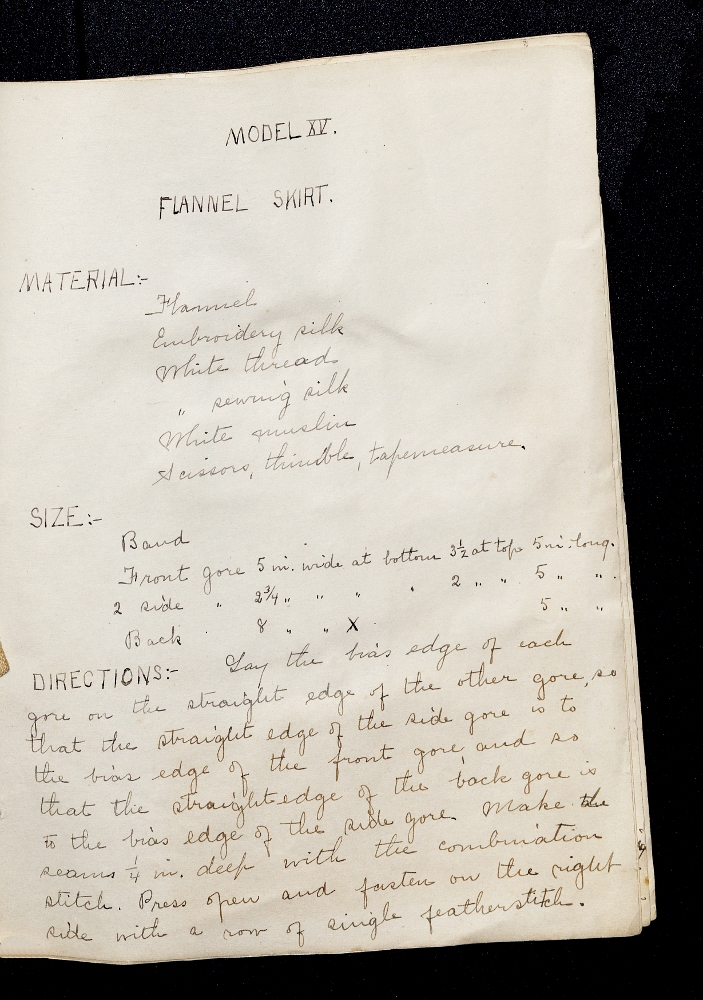
CAPTION: This “Home Economics Workbook” was created by Miss Jennie Lee Dann as a student at the New Paltz Normal School. The piece includes samples of sewing techniques, along with instructions for executing each technique. It serves as a record of course work, as well as a manual for teaching sewing skills to future students.

PHYSICAL DESCRIPTION: The workbook was created with 8 1/2″ x 11″ unruled paper, which has become very fragile over time. The cover page contains a pencil inscription: “J. L. Dann, N. P. N. Class of ’09.” As the pages are turned, on the left, a fabric sample of a specific sewing technique is glued to the paper. On the right is a description of the materials used, the size, and step by step instructions for executing the technique. The book includes eighteen stitching samples, called ‘models.’ Each sample contains a small label with Jennie Lee’s name and the grade received for that item. Flannel skirt Model XV includes a fold-out tracing paper pattern which could be used to duplicate the sample.

PROVENANCE: This object is located in Special Collections of the Sojourner Truth Library, SUNY New Paltz, New Paltz, New York. Presumably the workbook was donated by Jennie Lee Dann to the New Paltz Normal School during her period of employment there (1917-1946.) [I have an appointment with Morgan Gwenwald to check further on this Tuesday afternoon.]

DATE OR CREATION: During Jennie Lee Dann’s student term at the New Paltz Normal School, 1905-1909.

NARRATIVE: Toward the end of the nineteenth century, sewing, cooking and other related domestic topics were taught as part of a new field known as ‘home economics’ or ‘domestic science.’ Girls were expected to become proficient in domestic skills even if they excelled at classical academics. Jennie Lee Dann demonstrated her expertise in hand sewing in her workbook, yet she continued her education and professional development beyond the level sought by most of her female peers.

Jennie Lee Dann was born in Monticello, Sullivan County, New York on November 16, 1886, daughter of George Dann and Minerva Cook Nelson Dann. She attended the New Paltz Normal School, class of 1909. The normal school system of education began in Massachusetts in 1837 and quickly spread to other states. Its purpose was to teach norms, or standards, of education in order to train professional teachers. Prior to this time, the training of teachers was not standardized and requirements were left up to local schools. Normal schools included actual classrooms in which to practice teaching at elementary and secondary school levels.

The New Paltz Academy was a classical college established in 1828 by descendants of founding French Huguenot families. In 1885, the New Paltz Academy became the New Paltz Normal School. In contracting with the state of New York, the school trustees insisted that a classical academic program be offered in addition to the teaching curriculum, unlike most normal schools, resulting in the availability of three distinct degrees at New Paltz requiring two, three or four years for completion. At that time, many universities did not admit women as students. A normal school education provided women with the opportunity to enter the field of teaching, or continue their education, as Jennie Lee did.

After graduation, Jennie Lee taught music in Monticello and Yonkers, and went on to receive her bachelor’s degree in music from Cornell University. In 1917, she joined the faculty at New Paltz Normal school where she taught vocal music and acted as advisor to the Senior Glee Club. She advanced to become head of the music department, and remained at the college until retiring in June 1946.

Jennie Lee became the librarian for the Elting Library in 1948, serving there for nine years. The New Paltz newspaper reported her retirement in November 1957, mentioning that she was also an accomplished painter who had served as president of the local art association. In the article, it states that the Elting Library “Board feels sure the members of the community will want to join in thanking Miss Dann for her outstanding contribution to the betterment of our Town.” A resident of New Paltz for most of her life, Jennie Lee Dann died at the age of 97 on February 11, 1983.

SOURCES:
Cheek, Karen. University of Notre Dame. “The Normal School.” Web 15 Mar. 2013.

Eltinglibrary.org. “About Elting: History of Elting Memorial Library.” Web 15 Mar. 2013.

Familysearch.org. Federal and New York State census records, 1910 through 1940. Web 27 Feb. 2013.

Haviland-Heidgerd Historical Collection at Elting Memorial Library, 93 Main Street, New Paltz, New York. (1) Obituary collection: Huguenot Herald, February 17, 1983. (2) Elting Library collection: Huguenot Herald, November 27, 1957.

Madigan, Jennifer C. “The Education of Girls and Women in the United States: A Historical Perspective.” Advances in Gender and Education, Vol. 1 (2009). Web 9 Mar. 2013.

Newpaltz.edu. “History: 175 Years.” Web 15 Mar. 2013.

Repulican Watchman, Vol. 120, No. 9219, June 7, 1946. Web 27 Feb. 2013.

The Paltzonian, New Paltz Normal School yearbook, 1918 through 1946. Special Collections, Sojourner Truth Library, New Paltz, New York.
Survivor of Lantern Nite

Screen Shot 2013-03-14 at 10.44.31 PM

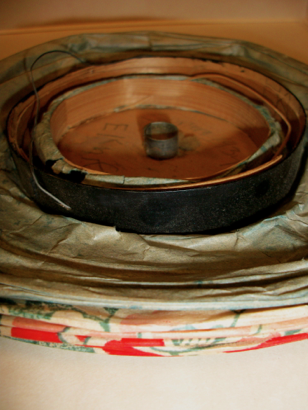
This crinkled paper lantern is a surviving symbol of one of New Paltz’s richest traditions; Lantern Nite. In 1934 this lantern was carried across a night coated New Paltz along with hundreds of others as part of the annual end of the year ritual. Lantern Nite was disappeared since then, but this lantern can still tell the stories of the magical night.

Screen Shot 2013-03-14 at 10.44.39 PM

In its current flattened state, this lantern might not look like much. But in its prime its now faded paper and rusted wire frame would expand to become to beautiful traditional Maru paper lantern. The spherical skeleton is held between a thin circular wooden base and a wooden ring at the top, both painted black. There is a now mutilated wire handle attached to the top wooden ring and some splintering where the handle pierces the wood. A delicate teal paper covers the lanterns bones, erupting with a vibrant red floral pattern along its sides. But like they say, its the inside, not the out that counts. This philosophy rings true for the lantern. On the interior side of the base there is a metal holster for a candle, the light source that brings the lantern to life. There is still remnants of candle wax hardened to the wood, letting us know that this lantern served its purpose. Written neatly in pencil near the candle holder is “Lantern Nite 1934.” And beneath that in rougher scrawled text is the name E. Kniffen. The writing looks as if our lanterns owner signed the bottom when the lantern had already been opened. You can see them extending their hand down into the lantern, struggling to leave their mark, you can feel the presence.

Screen Shot 2013-03-14 at 10.44.48 PM

Her name was Elaine Kniffen, and this lantern belonged to her. My question of who is the “E.Kniffen” that scrawled their name on the lanterns base had been answered. I found her because of an invitation made to look like a paint palette that was in the archive box along with the lantern. The invitation had the name Elaine Kniffen on the front. It is an invitation to join the Arts and Crafts club at the New Paltz Normal School, dated February 11, 1935. Elaine carried the lantern on Lantern Nite in 1934. She was a lantern bearer, a prestigious honor, and hers in the lantern that was kept. Hers was the lantern that was saved all these years in the archives of The New Paltz Library, hers is the name I will remember. Elaine left her mark here at New Paltz, I discovered that the schools still awards a merit scholarship in her name to students the show strong academic performance and contribute to the college community. I want to know the women that carried this lantern and changed her school for the better. I want her to know that she is remembered.

Screen Shot 2013-03-14 at 10.49.49 PM      Screen Shot 2013-03-14 at 10.49.55 PM

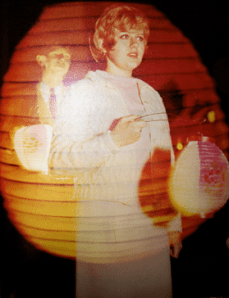
“Lantern Services, one of the mot impressive of all New Paltz customs.” This is a quote from the June 3rd 1937 issue of The Nepano; the school news paper of The New Paltz Normal School. I read through years of articles that begin the same way, praising the rich tradition that is Lantern Nite. As a student here at New Paltz today it surprised me that none of my classmates nor myself had ever even heard of Lantern Nite. I had to know more about this lost tradition, I had to bring it back to life.

Lantern Nite was dreamt up in 1929 by Susan Sposato, Winifred Barry, and Muriel Gregory, who were the presidents of the freshmen, junior and senior classes. Lantern Nite was a ceremony held at the end of each year that honored of all three classes (New Paltz didn’t have a four year program until 1938) promotion to the next grade and their academic progress over the past year. Lantern Nite was a campus wide event, honoring everyone from the seniors becoming alumni to the high schoolers entering their freshman year.

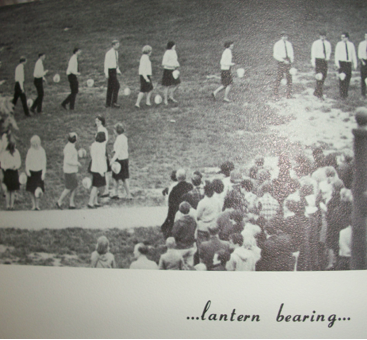
Lantern Nite services would begin with each class entering campus while singing their marching song. Then the Lantern Bearers would form the initials of their class and the students would sing their classes song. In 1930 the ceremony was improved with the addition of the students singing the Alma Mater and the Senior Serenade, and in 1931 faculty began participating in Lantern Nite. The Seniors would march in their caps and gowns, and the remaining students would wear the colors of their respective classes. In later years all participants would wear white as they carried their lanterns across the dark campus, illuminating they night with the celebratory voices and glowing lanterns.

All students were allowed to participate in Lantern Nite, but leading your class as a Lantern Bearer was an honor that had to be earned. Lantern Bearers were chosen by faculty members and class officers and then subject to approval by Dr. van den Berg. Each class is led by a specific number of students that represent the current ratio of men to women at the college. In 1937 twenty-five girls and eight boys from each class received the honor of being named a lantern bearer, but only the girls actually carried a lantern at the ceremony. Joining the selected lantern bearers were the officers of each class who were automatically included. Lantern Nite was a refined, highly practiced event that was part of an elaborate series of commencement week rituals. Each class would have rehearsals leading up to the event, and Lantern Bearers had to attend addition practice sessions.

The tradition of Lantern Nite was a “colorful exercise [that left] a lasting impression on all those who observe(d) it” (The Nepano). For decades Lantern Nite was a beautiful part of life here at New Paltz. Each year in mid June as the sun set over campus, students were preparing for Lantern Nite. I can imagine the scene in all of its grander. The classes excitedly huddled together wearing their designated attire. Whispering and practicing the Alma Mater, recounting their year here at school and getting ready to honor all that they had accomplished. They would hold their lanterns tightly in their hands, waiting to light the candle within and begin their procession around campus. Commemorating the lives that they have led in their time here.

Imagining a scene like this takes my breath away. So then why did the rich tradition of Lantern Nite get extinguished like a used candle? Along with Elaine’s lantern there was another lantern from 1987. I searched through issues of The Oracle, which became the school news paper in 1938, and I couldn’t find a single thing about Lantern Nite after that date. It seems that 1987 was the year that Lantern Night was laid to rest. I can’t understand how such a beautiful tradition that was so ingrained in the history of New Paltz was allowed to vanish. I for one want my chance to be a Lantern Bearer, and my research about Lantern Night has inspired me to revive the tradition. New Paltz students should know of this amazing ritual, and Elaine’s lantern should shine again.

Screen Shot 2013-03-14 at 9.36.10 PM

Sources: The Nepano, established May 1933, published weekly by the students of the New Paltz Normal School

NYC Object Adventure!!!!!!!!!!!!!!!

Hello fellow object enthusiasts! This is Eirinn and Maggie and we wanted to share with you some of the objects that we encountered yesterday at the Metropolitan Museum of Art (if you haven’t been, we highly recommend going!). After talking about objects so much in class, we were able to “see” so much more about the objects and we ended up being intrigued by “stuff” that probably wouldn’t have caught our attention in the past.

The first object that we would like to share is this golden clock (maybe about two feet tall). It’s very sad that the art of clock making is almost extinct now that we have turned digital. In a few generations, it’s possible that the whole idea of a clock will just be something to look at in museums. It just wouldn’t be the same to have a fancy, golden digital clock! Every section of the clock is detailed- covered in tiny designs. It’s hard for us to even imagine someone spending hours and hours each day for weeks just to make one clock. And try to imagine having this clock sitting on your desk! It’s just so elegant.

Image

This picture is a close-up of a guitar. We were both amazed by the tiny details not just on the outside of the guitar, but on the inside as well. You can just barely see the carvings inside the hole— it’s funny to think that so much time and effort was spent on a part of the guitar that can barely be seen. This shows that the design of the guitar was very important. We wonder if it was even played, or if it was purely for aesthetic pleasure.

Image

This beautiful chest reminds us of a wunderkammer. It is fun to imagine what might have been in all of those drawers. If only we could go back in time and snoop through this chest when it was being used! Every single drawer has a detailed image in gold— it’s absolutely incredible. Even the keyholes are intricately detailed.

Image

And last but not least, (inspired by Charles Ephrussi) a ridiculously extravagant bed! We both love this bed (possibly because we both wanted canopy beds when we were ten years old and unfortunately never got to have them). The Victorian rooms at the museum were our favorite. You could stand so that you could pretend to be a part of the room. If only we still had beds like this today!!

Image

So next time you’re in the city, check out the Met. It really is fantastic!