R.I.P. Bille Brown
Actor, playwright, teacher, director, and beloved friend
(11 January 1952-13 January 2013)

Caption
Aladdin by Bille Brown can be found in the special collections of the SUNY New Paltz Sojourner Truth Library. It is in the form of a “working manuscript.” Donated to the collection from Brown himself, Aladdin epitomizes the college’s involvement with the fine and performing arts on not only a local, but also international, level.

Physical Description of the Object
The volume residing in the Sojourner Truth Special Collections contains two parts within a sturdy binding folder. The working manuscript of Aladdin is between approximately 83 pages. Its content is in the classic play format, with Brown’s actively handwritten notes in the margins. In addition to these annotations, one also sees Brown’s editing notes of Aladdin, such as certain lines and words being changed or switched or extended. The play, in this manuscript, even includes Pantomime stage directions for the actors, such as “ad lib till AUDIENCE reply sufficiently.” The volume also includes the 2004 Old Vic Christmas Issue detailing that year’s Classic Family Panto, which was, of course, Aladdin. In this publication there lies information and articles about the 2004 production of Aladdin at the Old Vic Theatre, containing direct quotes from Brown, Ian McKellan, and even an anecdote as to how Elton John became involved with the score of the production.


Dates of Creation/Provenance
The first page of Aladdin says it was written on November 19th, 2004. However, this date is scratched out by Brown and written over it are the words: “JANUARY PERFORMANCE DRAFT,” meaning that although the printed text was written in November, the play became a working manuscript and was edited into January of the next year for performance purposes. This leaves the play being nearly ten years old. Brown gave Aladdin to the special collections in the Sojourner Truth Library as a gift. Such an action indicates that Brown loved New Paltz enough to contribute not a polished, perfect version of Aladdin, but instead a working manuscript. To think that such an accomplished actor would feel comfortable enough to give us an intimate view into his creative process, shows how Brown must have felt that those in the New Paltz community would understand and appreciate his work.
Narrative
The version of Aladdin existing in New Paltz is a work-in-progress of a play, and the fact that SUNY New Paltz accepted the gift into its special library collections tells us that the college values the performing arts in all forms, from an edited-by-hand manuscript to a full-blown production. The object kicks this notion up a notch when one learns that Bille Brown is a respected actor and also an Australian, in fact an AM (Member of the Order of Australia). Brown came to be affiliated with New Paltz under unusual circumstances. The current Assistant to the Dean of Fine & Performing Arts, David Cavallaro, ran into him as an undergraduate theatre student at the college. Cavallaro told his acting instructor that his roommate had someone staying with him that stated he was a member of the Royal Shakespeare Company. Quite quickly, Brown was invited to speak to Cavallaro’s acting class. Soon enough, the former College President Alice Chandler granted Brown Artist-in-Residence at New Paltz.
Brown’s time at New Paltz in the 1980s proved to be quite fruitful. He acted and directed for a number of productions, such as The Fantastiks and The Philanthropist, and even launched the American premier of his own work, including the musical Almost a Joke and an RSC pantomime called The Swan Down Gloves. He is also the man that founded New Paltz’s London Theatre Seminar!
Aladdin is not just any play; it is a traditional English pantomime that was performed at the Old Vic in London in 2004-2005. Pantomimes, usually performed around Christmas time, are defined as “theatrical performances played in the language of action.” Pantomimes usually provide audiences a spin of old fairy tales. With heavy emphasis on audience participation, pantomimes border on the slapstick, valuing heightened bodily expression during the depiction of emotions, events, and dialogs. A line often proclaimed by the audience is the famous “Behind you, behind you!” in relation to some intermittent trouble approaching an actor without them noticing, leaving audiences with the fun obligation of telling the actor themselves.
Another facet of Brown’s editing notes that illustrate a desire to maintain the pantomime ritual is the addition of certain words and actions to increase audience participation, such as changing the line from “Are you having us on?” to “Are they having us on,” in relation to the audience. Soon after this alteration follows the line, “Oh yes they are! (Routine with Audience and DIM).”

Children are indeed welcomed to pantomimes as participants and audience members just as much as adults, thanks to the tradition of double-entendres throughout such productions. Shakespearean cross-dressing is also a trait of the pantomime play. Dominant lady-wives are often depicted by older men, and princely male characters are played by youthful women. Brown’s Aladdin is no exception to this tradition with its all-star cast, with Ian McKellan (yes!) playing Widow Twankey (Aladdin’s mother), and Dim Sum, a male Chinese character, being played by Maureen Lipman. One can see these names written in the margins of the working manuscript of Aladdin, alongside their respective characters.

As mentioned earlier, Brown hosted a pantomime production at New Paltz entitled The Swan Down Gloves, and having Aladdin in the Sojourner Truth Library special collection just further specifies the amount of theatrical variety the college has delved into. Not only are we familiar with musicals, student black box productions, and official main stage shows, but we also do pantomimes, in the tradition of a foreign country. What an assortment! And Aladdin is just scratching the surface, us a peek into just one of the many art forms New Paltz is associated with. New Paltz has the reputation of being an artsy-fartsy kind of school, but it is objects like Aladdin and people like Bille Brown that refute this trivializing label. New Paltz is not artsy-fartsy – it is a cultured and well-rounded institution.
References
Aubert, Charles. The Art of Pantomime. New York: Benjamin Blom, Inc., 1927. Print.
“In Memoriam.” Stagelight, The McKenna Productions Newsletter. Jan 2013: n. page. Web. 5 Apr. 2013.
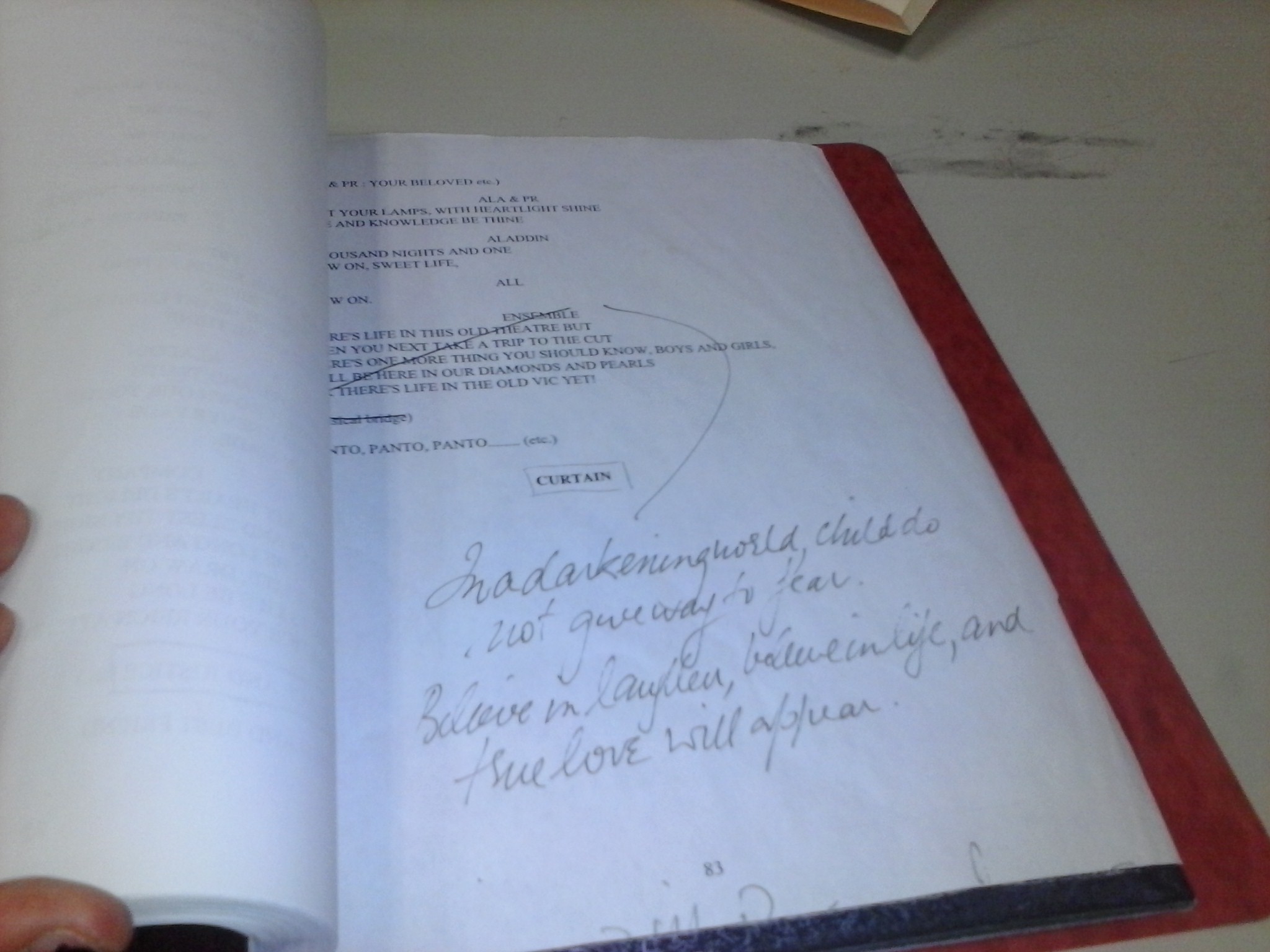
And I just thought this was really cool: Brown’s handwritten ending to Aladdin, edited in silver pen. It states:
In a darkening world, do not give way to fear. Believe in laughter, believe in life, and true love will appear.
 The Materials of History, Thought, and Art
Hi Anne, I feel like this might be a stupid comment/question but I feel like others might ask it as well so I figured I’d just ask- is this the same thing as the Disney movie Aladdin, but adapted for stage production?
I think your description of the object is great. Love this post!
Wow Anne – this post put my post on The Swan Down Gloves to complete shame! Haha just kidding, but I can’t believe the similar content that our posts share. I had quite a hard time understanding pantomime because there were several definitions for it and it was difficult establishing one on The Swan Down Gloves. But I like your description of it and I especially like your information on Billie Brown which I need to discuss further in my post. Maybe you could include more about the play itself in regards to Erin’s question; but I really enjoyed reading this post and I felt like I heard your voice within it. Your pictures are great too – you really gave an incredibly descriptive introduction to your object and its history. Bravo!
Oh my gosh this is so great! I remember sitting next you and we were taking notes and pictures of our items. First let me say I am so jealous. But I have to ask with Eirinn, is this a play off the Disney film Aladdin or is this just a completely different play? I wonder if our school will ever do this play or if they have, will they do it again? Also, I love your physical description. I love that he wrote his own notes in the margins. It’s really authentic and raw. Very cool.