(Photography credits to Shelley Weresnick)
Caption
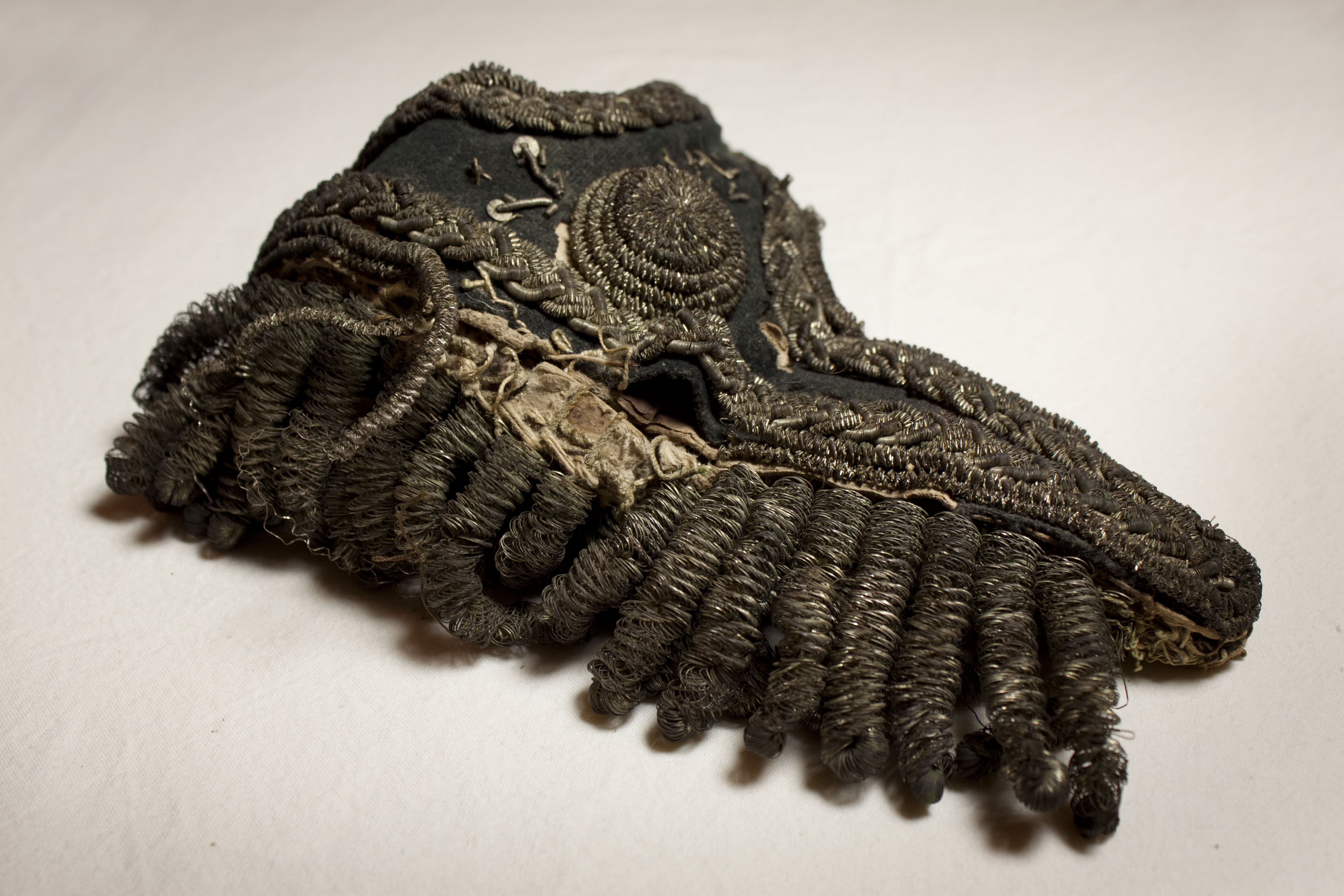
This epaulet belongs to Colonel Johannes Jansen who served in the 4th militia during the Revolutionary war. Much of what is known about Colonel Johannes Jansen comes from his home in Shawangunk, as well as from a popular story about the failed ambush of the Colonel near his home
Physical Description of the Object
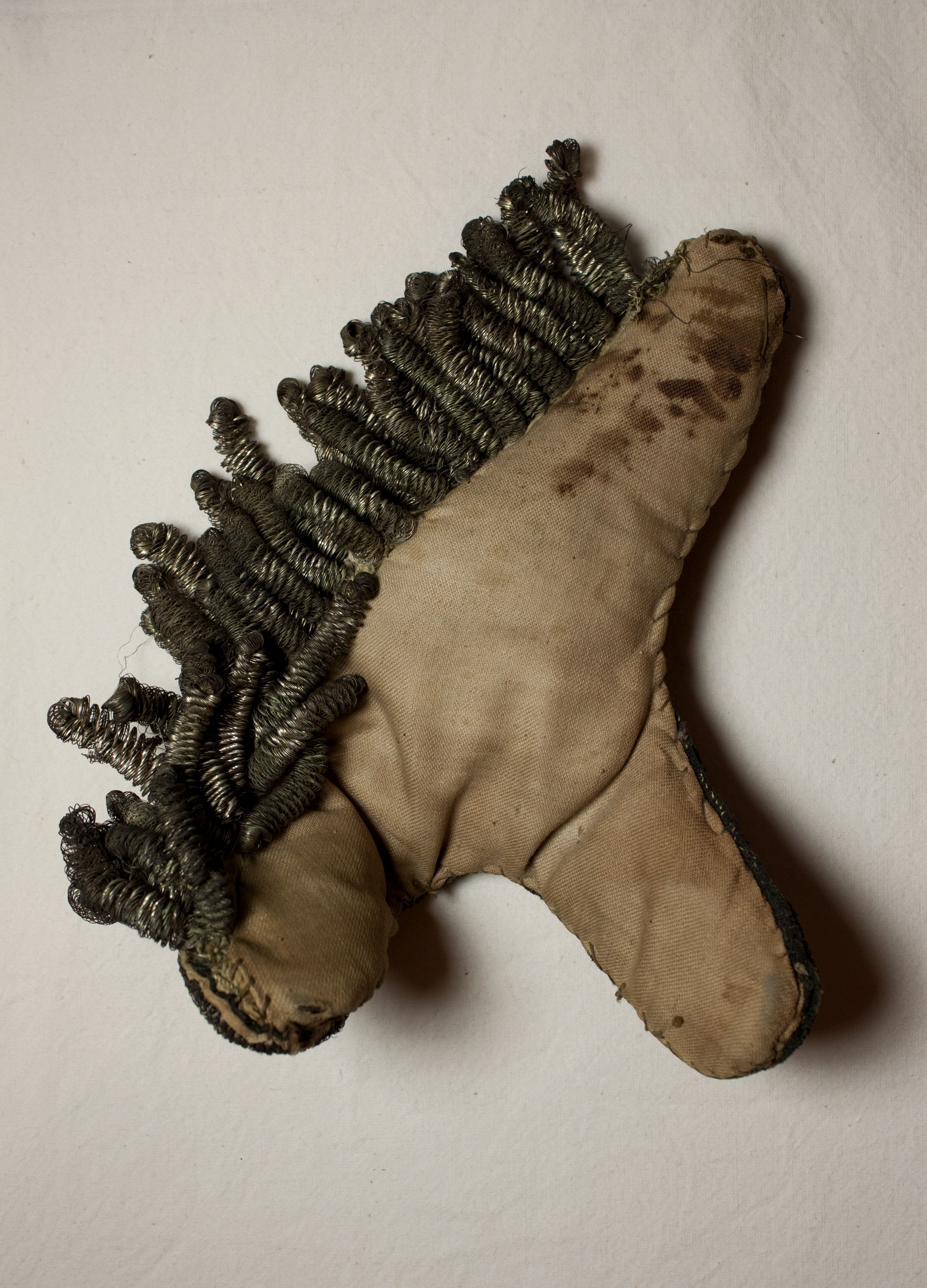
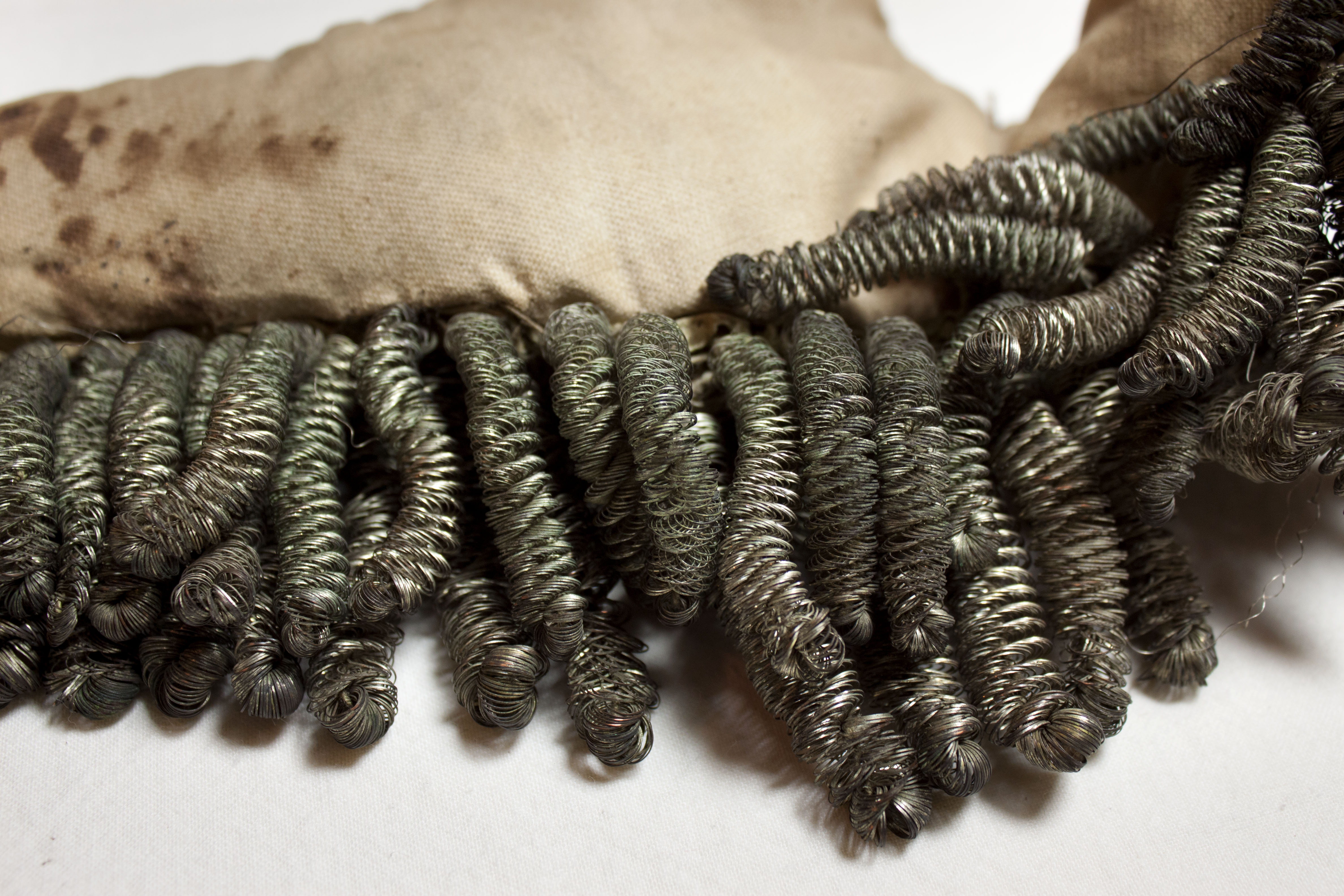
This epaulet measures about 24 cm in length and 14cm in width. The steel or metal wiring hangs in coils about 5cm from the body of the epaulet and runs through the front. A braided pattern and two coiled lines made up of the metal border the edges of this piece. In the center of the epaulet is a ball of coiled steel that wraps around itself. This ball measures about 3 ½ cm in diameter. There seemed to have been more metal decorations, but must have gotten ripped out. The fabric underneath the metal decorations is black wool. Beneath the wool is some kind of paper that the metal was sown into, perhaps for more support. Under the layer of paper is a sheet of metal and under the metal there seems to be a coarse form of cotton that fills the insides of the epaulet. The material at the bottom of the epaulet is a tan colored linen or cotton fabric.
Some of the coils hanging off the epaulet are falling apart and the seam connecting the hanging coils to the body of the epaulet is burst open, allowing us to look inside. On top of the epaulet, parts of the wool and paper have been ripped away, exposing the metal underneath. It seems that the layer of metal inside the epaulet gives it its shape, although a section must be broken because one of the “wings” of the epaulet concaves about 10cm in.
Provenance (about 100 words)
Johannes Jansen was born in 1725. He served as a Colonel during the Revolutionary war and was in charge of the 4th regiment in the Ulster County Militia. He was also part of the Whig party, which caused him to be a target for Loyalist and Native American attacks. Johannes Jansen lived in Shawangunk and is currently buried in the Bruynswick Rural cemetery near the Reformed Church of Shawangunk.
Historical Society of Shawangunk and Gardiner- Volume 2 Number 3
Date(s) of Creation
Circa 1775-1783 (During the revolutionary war)
Narrative
Brief overview of Epaulets
Before the 20th century, epaulets and shoulder straps were commonly used to show the rank or status of an officer. The rank of the officer could usually be deciphered through the insignia that appears on the epaulet strap or near the rounded portion over the end of the shoulder (the crescent). For ranks like ‘Major’ or ‘Second Lieutenant,’ the sizes of the epaulet or the fringes on the epaulets were indicative of the officer’s rank (since some officers did not wear any insignia). The word epaulet is derived from an old French word to mean shoulder; and was first made with cloth straps that were worn on the shoulder to keep shoulder sashes and belts in place. Epaulets are also thought to have begun as protective pieces of armor to shield the shoulders. During the Revolutionary war, epaulets were used both by the British and French. These epaulets were created with gold or silver and started from the collar and ended at the end of the shoulders. They were decorated with heavy fringes of gold or silver wire. The epaulets were very expensive as they were made of silver, gold, solid metal, and or plated metal. Officers started wearing gold or silver epaulets in their dress uniforms from 1780 during the Revolutionary war, to about 1872. For sergeants and other enlisted men, the epaulets were made of cheaper metals or cloth.
http://www.history.navy.mil/trivia/triv4-5a.htm
Johannes Jansen
Johannes Jansen was the lieutenant colonel of the fourth (Hardenbergh’s) regimen of Militia, and represented the people of Shawangunk in the Revolutionary war. In the colonel’s same regiment were; Captain Isaac Davis, Matthew Jansen, Cornelius and Matthew Masten, David Ostrander, Peter Roosa; Lieutenants Jacobus S. Bruyn, Peter Decker, William Ostrander and various others.
(376). The History of Ulster County, New York, edited by Alphonso T. Clearwater
Much of what is known about Colonel Johannes Jansen comes from the Johannes Jansen house, as well as from stories and tales told about the Shawangunk area. The Johannes Jansen house is an example of early stone architecture in the area and it is believed that the west one story wing was built by Johannes Jansen around the 1750s. The main building of the house was built in the early to mid-1800s by the nephew of Johannes Jansen who inherited the house in 1803.
http://www.wallkillhistory.com/Houses/JohannesJansenHouse/JohannesJansenHouse.htm
In the article “Notes of the Ancient History” of Ulster County, published in the New Paltz Times of March 10, 1865 the author writes of Colonel Johannes Jansen. Because Johannes Jansen was a colonel of the militia of Southern Ulster and was part of the Whig party, was very wealthy, and lived so near the mountain, he was thought to be a valuable prize if captured by loyalists. In September 1780, members of the loyalist party Samuel Gonsalus and Ben. DeWilt as well as three Native Americans decided to try and capture Colonel Johannes Jansen. Samuel Gonsalus was the first white man born in the county and was well known as an ‘Indian hunter’ and scout. Ben. DeWilt or ‘Shank’s Ben’ was also well known in Shawangunk and served in the French war, and had often worked for Johannes Jansen. The party tried to ambush the Colonel as he was leaving the house, but a boy raised the alarm and the Colonel was able to run back to the house and secure the door. Because they couldn’t through the door, the party ransacked the kitchen instead (it was the only room that they could enter). A female slave discovered them there and when the party heard Mrs. Jansen calling out to the neighbors, they took three slaves and a girl named Hannah Grunenwalden who was employed by the Jansens. They ended up killing the girl because they were afraid that her cried would lead their pursuers to them. In the area of Scrub Oak Ridge, the party encountered a man named John George Mack, Elsie, his daughter, and John Mentz, his son in law. While Mentz saw the enemy in time and was able to escape, John George Mack and Elsie were slain and scalped. A few members of the militia found the remains of the old man and his daughter while pursuing the party. The bodies of Hannah Grunenwalden, John George Mack, and Elsie Mack were deposited in their last resting place.
History of Sullivan caounty: embracing an account of its geology, climate, aborigines, early settlement, organization with biographical sketches
James Eldridge Quinlan, Thomas Antisell
Pg 395
References
History of Sullivan caounty: embracing an account of its geology, climate, aborigines, early settlement, organization with biographical sketches::James Eldridge Quinlan, Thomas Antisell:::Pg 395
http://www.wallkillhistory.com/Houses/JohannesJansenHouse/JohannesJansenHouse.htm
(376). The History of Ulster County, New York, edited by Alphonso T. Clearwater
http://www.history.navy.mil/trivia/triv4-5a.htm
Historical Society of Shawangunk and Gardiner- Volume 2 Number 3
 The Materials of History, Thought, and Art