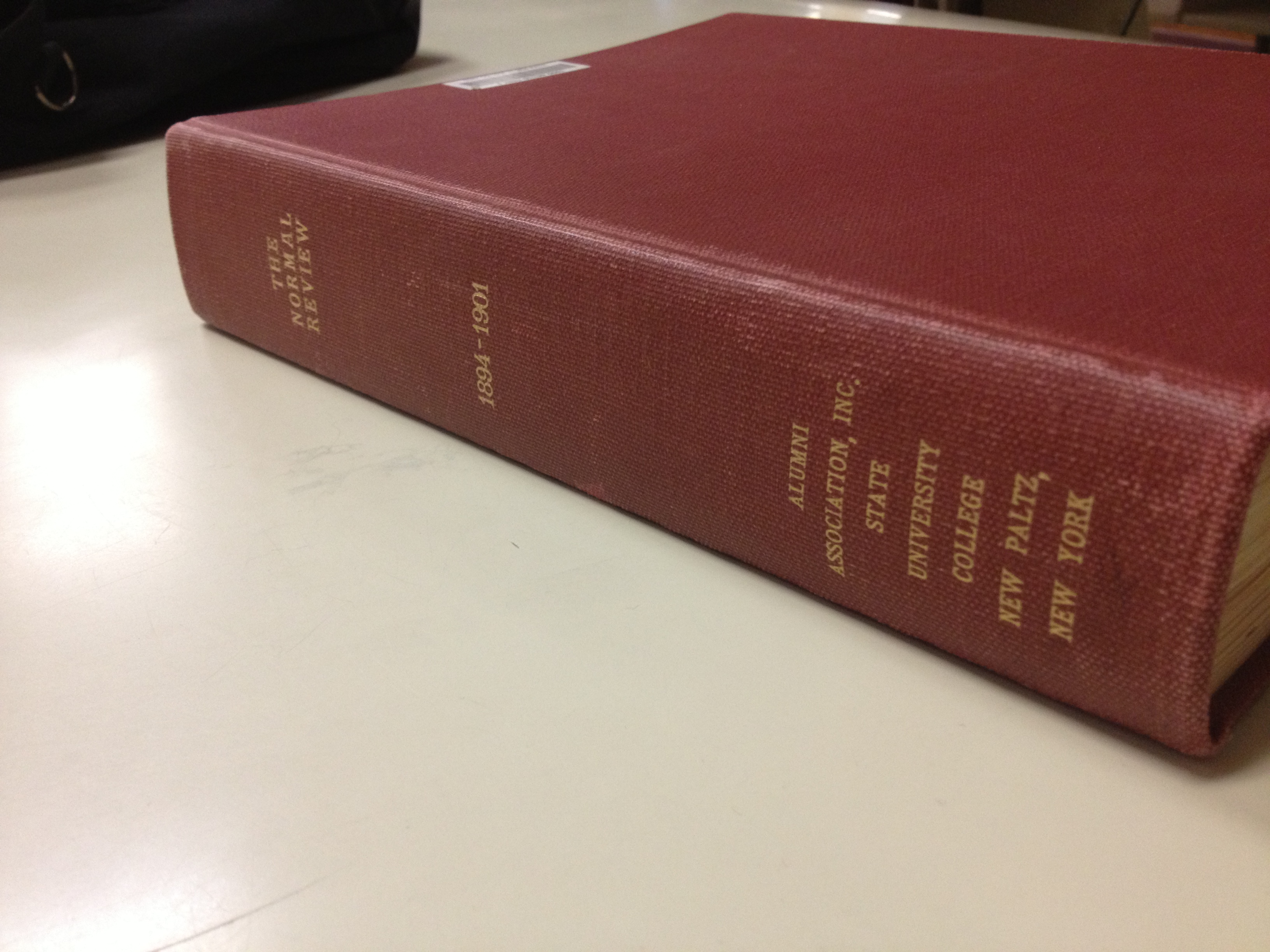
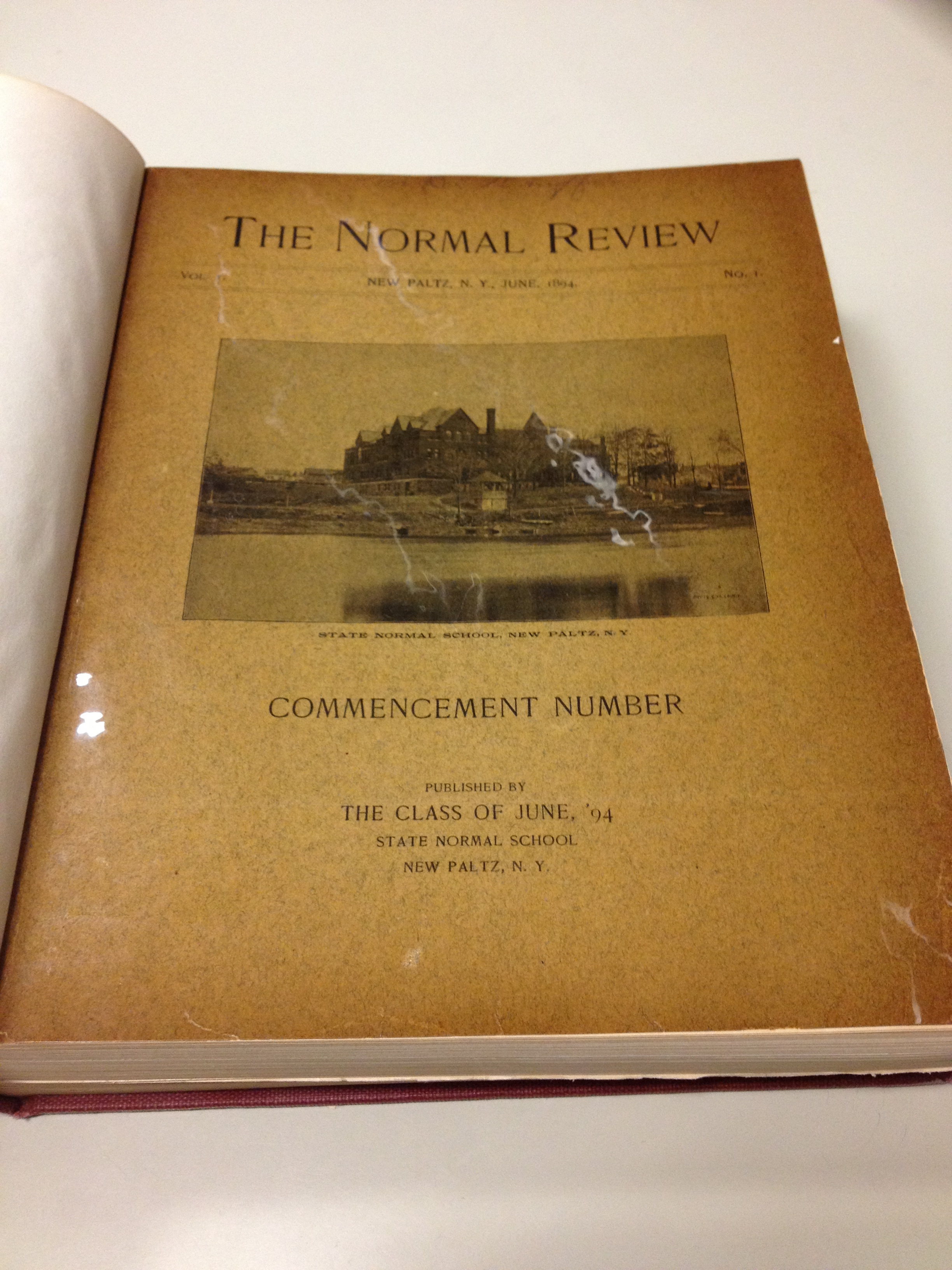
Caption: Distributed quarterly, The Normal Review became the first-ever literary magazine at the New Paltz Normal School in June of 1894. The 26-page publication contained news, poetry, narratives and other forms of writing from students within the school. The magazine folded in 1901 after years of journalistic service to the New Paltz community.
Physical Description: The Normal Review catalog contains a burgundy red hard cover. The 11-by-7 book feels rough at the touch. If you caress the book with your finger, you could feel years of wear displayed as lines on the book. The book also contains gold lettering with the words “The Normal Review” on it’s binding. Below, in the same gold letters are the active years, “1894-1901” On the bottom of the binding reads, “Alumni Association, INC. State University College. New Paltz, New York. The library placed a barcode on it’s top middle corner. When you open the book you’re displayed with the first issue’s cover page, table of contents and words. All written work is in a black san serif font, while advertisements in the back are of different fonts.
Provenance: The book of literary magazines has been in possession of SUNY New Paltz since its creation. However, the magazines were in possession of the New Paltz State Normal School, a new building after the first fire which burned down the New Paltz Classical School in 1884. After the second fire which burned down the Normal School, the issues were moved to “Old Main,” which is currently part of what is today SUNY New Paltz. The book of magazines was most likely created sometime after the magazine’s final issue. The catalog of the Normal Review issues are available today through the Sojourner Truth Library.
Date of Creation: June 1894 – June 1901.
Narrative (Rough Draft):

It was their first meeting. The staff of The Normal Review were sitting in a room with piles of papers in front of them. If they were to succeed this would be The New Paltz State Normal School’s first-ever literary magazine. Before the first editor in chief, Albert C. Mayham, grabbed the first submission to the magazine, he spoke with his staff and gave them requirements of editing. The magazine’s staff must check for spelling errors, grammar and use their own form of journalistic writing, which some of it compares to what is known today as Associated Press style. After a few words, the editing began.
The Normal Review’s first issue became a 26-page issue with combined forms of writing. The staff edited narratives, love being a very common theme. One issue in particular was of a woman who saw her former lover on a train heading south, but she didn’t say where. But, she tried to make her self known. Although she was hoping to never speak with him again, she made herself known and wanted to feel desired. Other literary works contained poetry by students experiencing love, success, hatred, and sadness. These were written pieces seemed like they were submitted by students and faculty who evaluated and graded student work. It’s interesting because it isn’t clear if they submitted students work for the sake of competition and satisfaction of being published, or because alumni would pick up an issue of the literary magazine and see work of current students within the school. Given that the publication includes a alumni section, it can be assumed that they wanted to target alumni—possibly for donations, as well.

However, The Normal Review didn’t just keep to literary work. They succeeded in writing news briefs of events and celebrations taking place in the school and around town. However, the magazine didn’t contain any form of quotes. They mostly used attribution when necessary. For example, “Principle Frank S. Capen said … ” The editorial staff of the publication also incorporated sports within their section publication with references to the scores. However, it wasn’t just literary work and pieces of news which made up the publication. The Normal Review consistently published debates in every issue. A student would take the affirmative and another would take the negative. A favorite was the women’s suffrage where a woman wrote of how women voting could benefit New Paltz and society. In the negative, a male student wrote on how it could be detrimental.
Most importantly, just like any publication, this literary magazine created a sense of community. It was a piece of material which brought the student body together. With about a 12-student staff, the published work would be distributed to students, faculty, and residents in town. Although it cost 15 cents to own, the publication made known to all what students were doing in classes and in their spare time. It made announcements of upcoming events and provided a place for literary expression, not available to students who were strictly learning to write essays and more research based work.
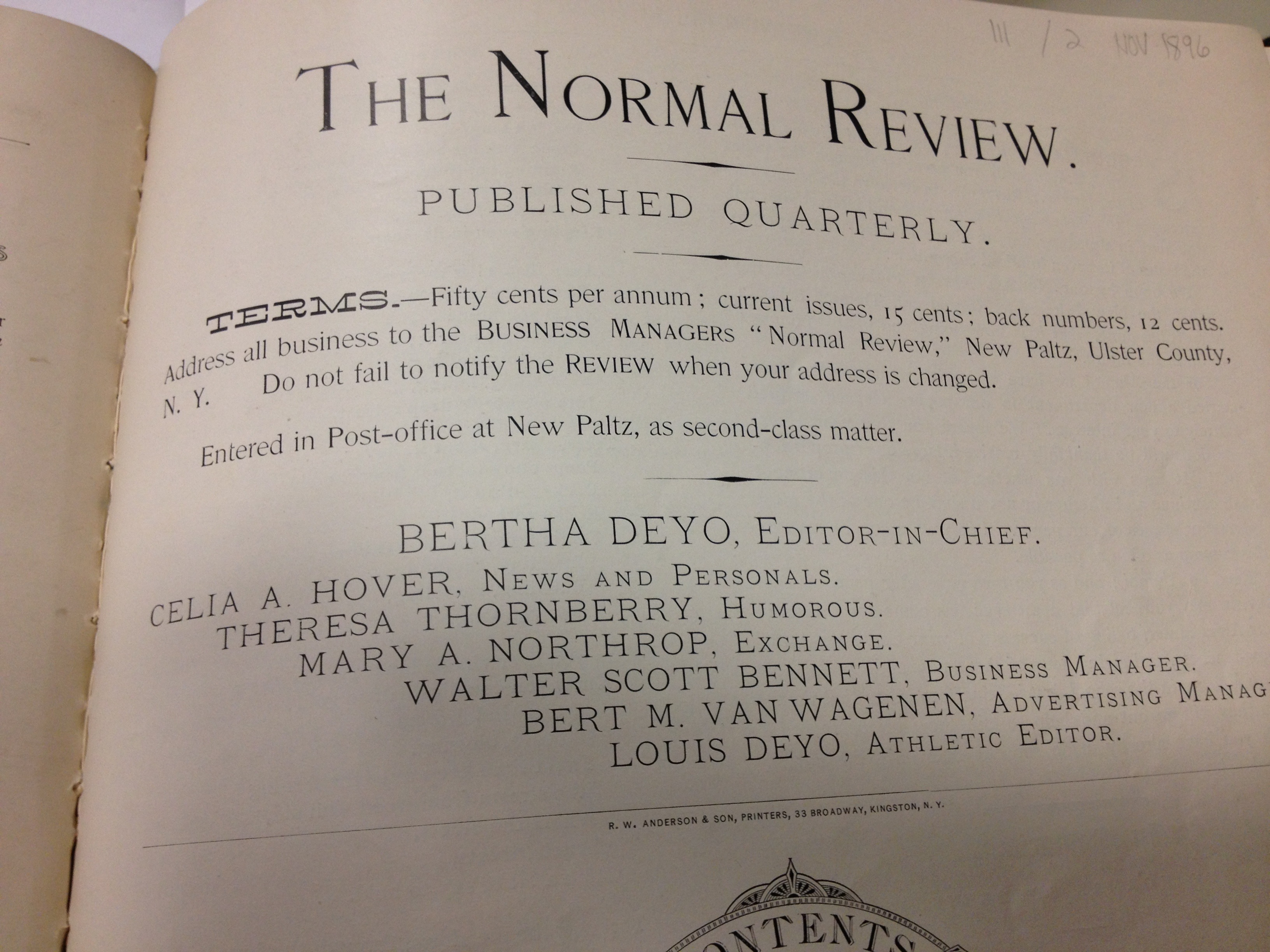
Similar to the Shawangunk Review or the Stonesthrow Review, The Normal Review brought together a “department” of students and faculty to learn and prosper from each other’s writings. Debates such as the women’s suffrage debate were regularly seen. What’s interesting is this sense of women’s rights built up in the school through the editorial staff as well. Since the magazine started, the publication hardly had a female editor in chief. According to the publication itself, the first female editor in chief was a Bertha Deyo of 1896. The last one was Grace B. Travis of 1900.
Research:
English Department. “The Shawangunk Review.” SUNY New Paltz. 1998. Web. 7 Apr. 2013.
SUNY New Paltz English Department. “The Stonesthrow Review.” SUNY New Paltz. Web. 7 Apr. 2013.
The New Paltz Normal School. “The Normal Review.” SUNY New Paltz. 1894. Print. 7 Apr. 2013.
Sojourner Truth Library. “College publications.” College History Collection. Feb 2001. Web. 7 Apr 2013.
State University of New York at New Paltz. “Past Presidents.” Office of the President. Updated in 2010. Web. 7 Apr. 2013.
The New Paltz Normal School. “The Normal Review.” SUNY New Paltz. 1894. Print. 7 Apr. 2013.
 The Materials of History, Thought, and Art
You must be logged in to post a comment.