From the onset of this seminar, I have been focusing on needlework and its significance in women’s history. In a patriarchal culture such as existed in early America, the voice of women was ignored and silenced by the dominant goup: white men. Women used the medium of needlework as a voice with which to express themselves in a society where they were not encouraged to do so. The creation of needlework serves a means to connect a woman with her mother, her daughter and her female community.
I chose an antique needlebook as a material object of interest for my blog post, dated 02/01/13. A subsequent blog post (dated 02/15/13) discussed the evolution of the needlebook from the 19th century until today. For my final project, rather than writing about material objects, I have chosen to make two needlebooks which will be applied to my BFA thesis work in printmaking.
 A sketch for the needlebook design.
 A full-scale mockup in cardstock.
The first needlebook will refer to the 19th century, and include images of patterns from that era, as well as photographs of my female ancestors taken prior to 1900. The images will be printed digitally on fabric, and stitched to background fabrics which include brocades, velvets and silks in a palette of beige, ecru, brown and dark red. I will be constructing the object with hand embroidery, and embellishing with laces, buttons and decorative stitches. In making this piece, I will be focusing on the mindset of women, particularly my personal foremothers, as they strove for a functional means to express creativity in the domestic sphere during the 19th century.
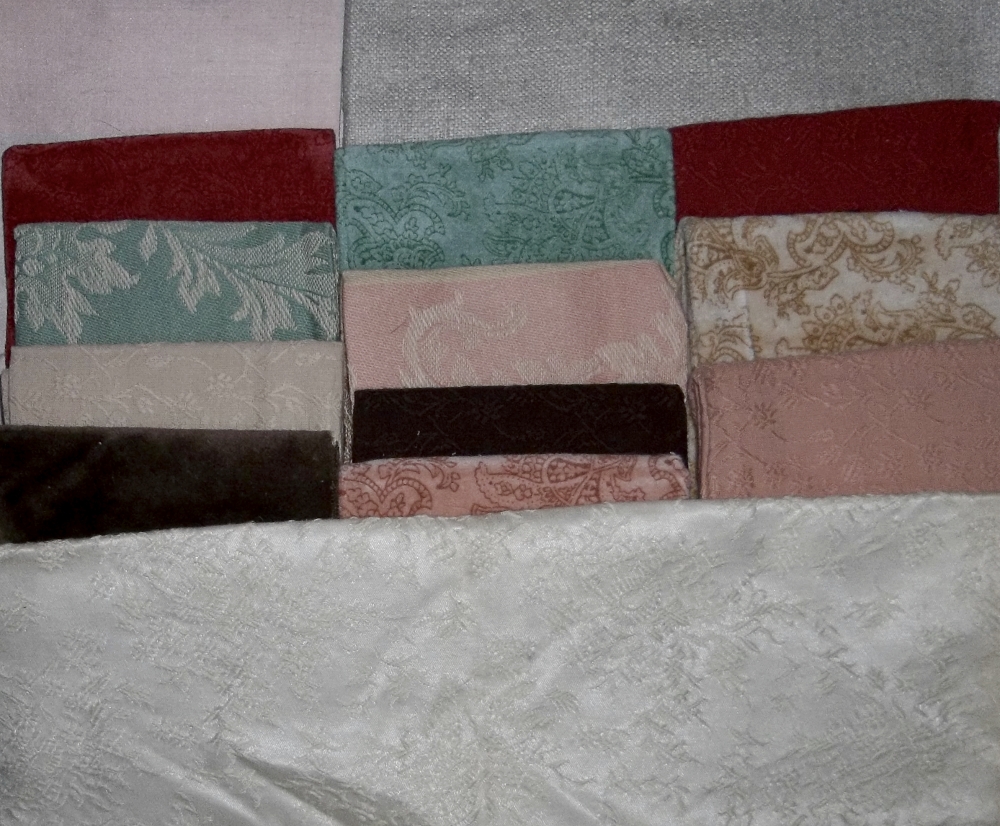 Brocades, velvets and silks.
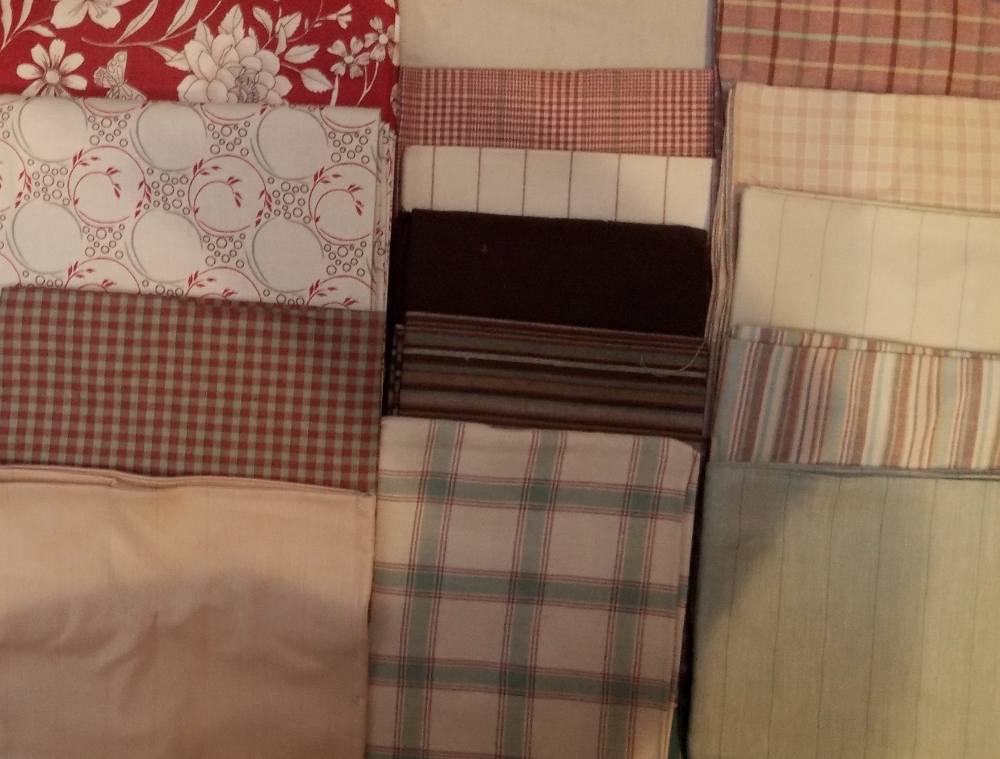 Woven and printed cottons.
The second needlebook will include images of early 20th century patterns, along with photographs of my mother and grandmothers. The fabrics will echo the same color palette as the first needlebook and will be made from printed and woven cotton material. I will be constructing and embellishing in a similar manner, but instead using ‘rick-rack’ and other 20th century trims, rather than antique laces. Making this piece will remind me of my own mother teaching sewing and knitting techniques to me, and hearing about how her mother had taught her the same skills as a girl in the 1920s and ’30s.
 The Materials of History, Thought, and Art
You must be logged in to post a comment.