

My Rider Waite tarot pack travels from location to location within my house. I have had a few decks before this one, but so far it is my favorite. Although I have been interested in tarot since my younger years, it is not until recently that I’ve begun to study them more seriously. The tarot pack comes with a book entitled The Key to the Tarot which was written by A.E White at the time of its creation in 1910. I am still a novice, and like those whose cards I read, each image holds new mystery and discovery.
The Ta rot cards are flat and rectangular in shape. Like traditional playing cards they are made from layering paper, creating a product called pasteboard that is then used to print the cards (madehow.com). On the back of each card is a cerulean blue and white design of roses and tulips. The cards themselves are 5” by 2.5”. As you can tell, the size of a deck makes it very portable. The accompanying book is the same length with a width of half an inch. The cover of the book is deep blue with gold mimicking the design on the cards with an inner rectangle displaying the title and author. Also within this rectangle is the ouroboros, a snake eating its own tail, which is a symbol for eternity. The pages have experienced slight water damage, but are still legible.
The tarot consists of a 78-card deck. These cards are broken up into two groups: The Major Arcana and the Lesser Arcana. The Major Arcana is made up of 21 trump cards numbered with roman numerals. There is another card in this part of the deck that has no number, but is usually assigned the number zero; this is The Fool. The image of The Fool is represented by a fair young man precariously close to a cliff. Behind him, a dog scurries at his heels but it is unclear whether the dog means to harm the man or warn him of the  imminent danger. In his left hand is a white rose and in his right he carries all his worldly belongings. The back drop is yellow with a white sun.
In the Lesser Arcana there are 56 suit cards. Suit cards, similar to a traditional playing deck, are part of 4 different groups consisting of fourteen cards each. These are: Wands, Cups, Swords and Pentacles; each of these suits has their own King, Queen, Knight and Page. On the front of each card is a depiction of a particular scene which conveys the situation at hand and the emotions associated with it. Each suit has its own element and connotations. For Instance, the suit of wands is typically associated with the element of fire and spirituality.
Let’s look at The Nine of Wands, which is represented by a man preparing a battlement. He looks distressed as he holds one staff in his hands and looks on at the other eight which he has positioned to block out enemies. Without The Key to The Tarot, one may conclude that this card signifies strength in the face of opposition on their own. However, not all cards are as straight forward as they seem and for this reason the book is essential for full understanding. Waite also provides instruction on how to position the cards in the traditional Celtic cross method at the back of the book.
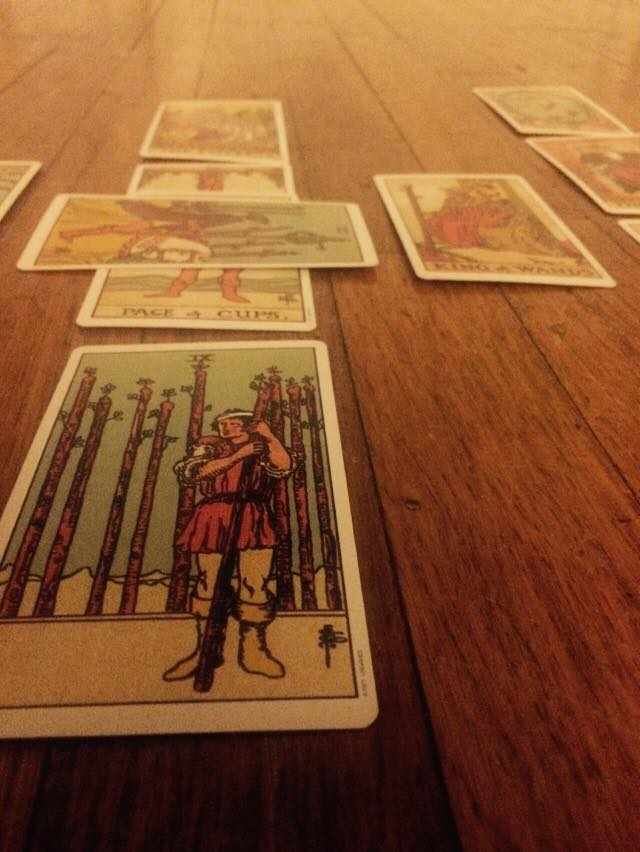 The purpose of a tarot reading is the quest for divinatory truth by the “Querent”, who is the person the cards are being read for. In the time that this tarot was first devised very few people would have owned their own set. The history of the tarot extends before the creation of the printing press. Before then, each image would have been painted on the front of the card by hand (Eden 3). The world has grown smaller since then. A doctrine that Waite says in theory has always existed (Waite 53) is now accessible to the masses for the low price of $20.49 on Amazon.com.
My interest in these cards is not a belief in any real ability for them to predict the future, but in the archetypes and symbols that each card represents, which I find both fascinating and elusive. I do believe most people whose cards I read create their own interpretation of the images. This speaks to the human psyche’s relationship with materials and symbols. Since the dawn of man we have sought to assign meaning to life and all of its treasures and disasters. The tarot cards create a tangible representation of that continuous search.
“Playing Cards.” Madehow. Advameg Inc., 2015. Web. 25 January. 2015.
Waite, A.E. The Key to The Tarot. London: Rider Books, 1910. Print.
Gray, Eden. A complete Guide to the Tarot. New York: Bantam Books, 1970. Print.
 The Materials of History, Thought, and Art
I’ve always been interested in tarot cards but I never knew that they were so complex. I had no idea that there were so many cards in a deck and I had only heard of the Major Arcana. From what it sounds like, you’re definitely not a novice so you should totally give yourself more credit!
First, I really liked the pictures you took of your object. They attracted me to your post instantly. I did not know any of this about tarot cards before reading your post and it was very informative. I also liked how you mentioned that the people whose cards you read interpret the cards they are dealt for themselves and man kind’s continual search for meaning because I had never associated tarot cards with these concepts before. Overall, I think this was a well informed and thoughtful post.
Fascinating. What do the individual cards signify? Are they related in any way to other forms of fortune-telling?
I had no idea that tarot was such a “modern” practice. Perhaps people formed a methodical process for answering such pressing questions as an unconscious response to increased social changes occurring at the time? You might find it interesting to see if any behavioral or psychological commonalities exist among tarot practitioners and recipients.
Each card has it’s own divinatory meaning which can get pretty complex. I can only remember some of the meanings without looking in my handy booklet. If you’re interested there are tons of websites describing in great detail the meanings of each card.
As for other methods of fortune telling, I know the tarot draws on astrology a lot. For instance when doing a reading with the Celtic Cross spread you’re supposed to pull out a card that will represent the “querent” this is called the significator.There are several methods for doing this, one of them is to base it off their astrological sign. While choosing from the Minor Arcana you would pick a suit that shared the same element with that person’s sign and then from their go off age and sex to pick which face card to use. The major Arcana is a little different, for instance, Gemini’s are represented by the Twins in astrology so if you were using the Major Arcana you would pick The Lovers. If you were reading for a Scorpio, they are associated with rebirth so you would use Death. As I was saying in the post, some of the cards aren’t as straight forward, like Death. Because in order for something to be created, something else has to end, so death can mean the end of something but it can also mean a recreation of one’s self.
I like your questions! I’ll have to look into it more. I did come across some historical information while I was doing the post that I would like to read more about.
Your interest taps in on how we each individually shape our world. We look for meaning according to our schemas. This search for meaning is interdisciplinary. In psychology there are theories of dream analysis and certain therapies that acknowledge our roots, our archetypes, and symbolic representations of humanity. You make a brilliant point in your conclusion — we each make our own meaning of life. I wonder if the tarot cards had more power when they were rare? I wonder if they had more meaning because the value was higher? But what really has changed from then to now? We have more access to knowledge, a quicker spread of communication, and a bigger openness to skepticism. Yet we are all still individuals figuring out our life as we always have been. These cards were so interesting to learn about because the images and the meanings of each is still generally understood by people today. Even if we have not studied literature or history, the connotation of Queens, Kings, and Knights is still generally understood.