Starting with a Story

To give proper description of the thought put into the creation of my first object — the recipe on an index card — I must tell a story to give the full flavor of history, time, and love within a family.

A mother and daughter are in the kitchen. This kitchen is made up of delicious smells, creative meals, and the altruistic effort of bringing people together around a table. To my dad and his siblings, their grandmother and mother are the best cooks they have ever known.

The characters in this story are all part of one big Italian family that would take many pages to truly explain. Here are two names to start with:

Big E – My dad’s grandma, his mother’s mom

Nanny – My grandma, my dad’s mom

I have grown up with the stories of how Big E and Nanny whirled around the kitchen throwing together food for hours at end — ravioli, pizzelles, eggplant parm, the list continues as your mouth produces more saliva.

I know my part in the story. I write. I listen and I write down the memories of people over a dinner table. Memories that transcend from dinner to that time my dad had to make peanut butter and jelly sandwiches so that his sister could “neck” her boyfriend in peace and that other time when Nanny packed a frozen leg of lamb in her suitcase because they were travelling somewhere for Easter that possibly would not have the best priced leg of lamb and the stories continue to spill out with the laughter.

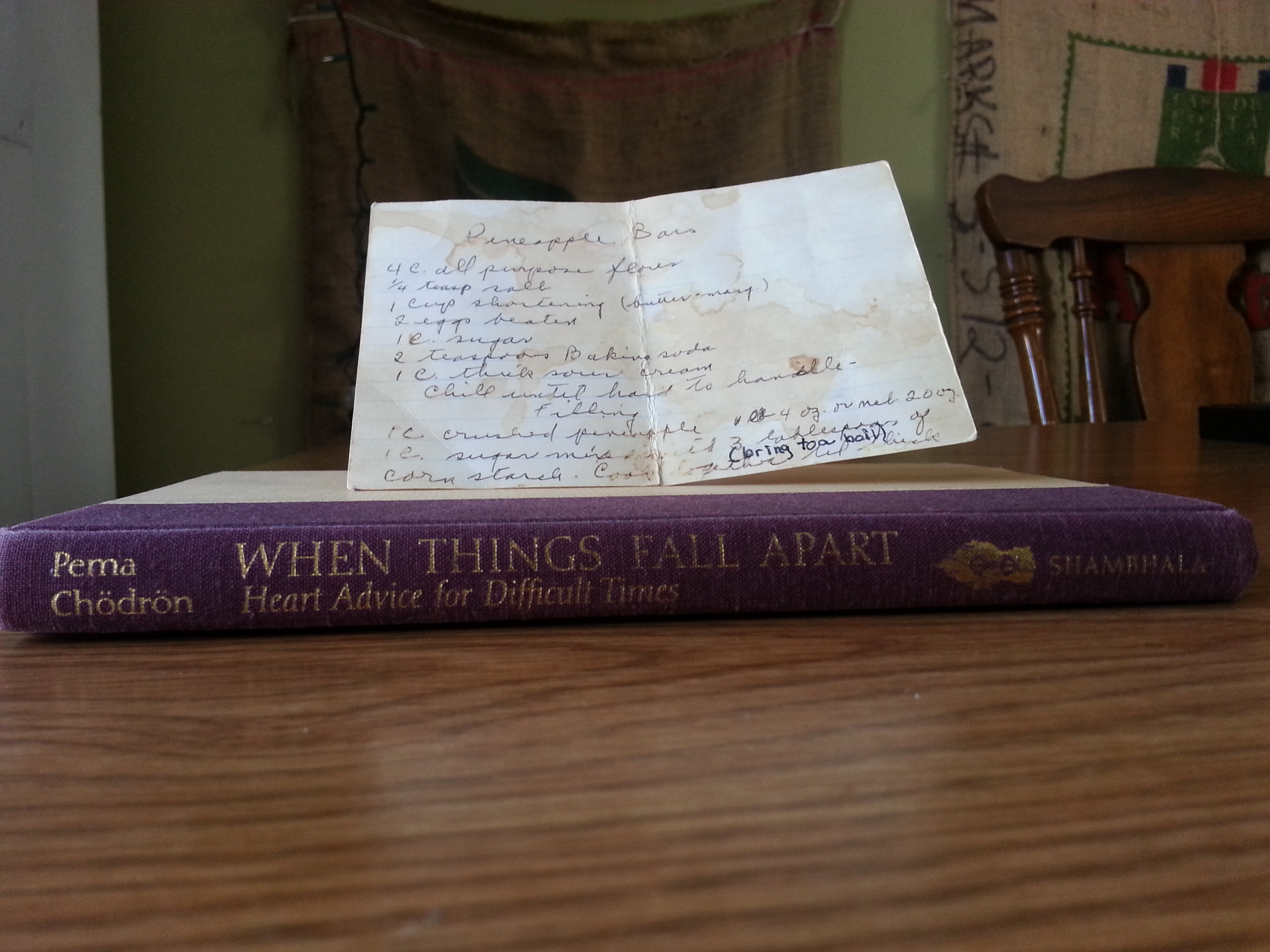
Other than chocolate cake with marshmallow frosting, or carrot cake without frosting, or raspberry rugelachs, really and truly pineapple bars are my dad’s favorite dessert! And so the recipe is recorded on a 4’’ by 6’’ index card. The top red line is faded in more spots compared to others, the blue lines are faded, and the color is browned by time and use. There is a crease down this middle from being folded in half, stored and opened again and again. I love this. It is stained, faded, and creased… yet the words live on. The card is visual proof this recipe has been loved many times by many people.

I chose this recipe for a symbolic reason too. The ink on the slightly stained index card is my grandmother’s handwriting. I chose a recipe because my mom enters the story with the love of learning. She has spent time observing and helping Big E and Nanny cooking, Aunt Carol baking, or even Poppy carving meat. This recipe is a flimsy, old, and dilapidated piece of paper. But the obvious use shows the love and the love reveals the history. Reveals the story.
20150125_122016

My mom gets her love for learning from her mother. My nana is a natural teacher because she is always willing to learn.

The publication date of When Things Fall Apart is 1997. But truly… how do you accurately give a date to ideas that are thousands of years old? In factually describing this book, I can give you details on the tangible material.

AND

I can describe the material contained within the pages. The conceptual material that has affected millions of people for thousands of years.

The golden lettering glistens in the sun when I take the book outside. The maroon line meets a calm yellow color. There are slight smudge marks and the edges are scuffed up a bit. The first chapter is titled “Intimacy with Fear.”

“Fear is a natural reaction to moving closer to the truth.

Pema Chodron dedicated her life to the words held in this book. The significance her words have depends on the life of the reader. To me this object is a gesture. My nana reached out to give me this book. She thought of me and thought of what might help me.

My life is a dedication. That is something my nana has taught me. She has helped me know myself and to not be afraid to continue to learn about myself and about the world. It is scary when things fall apart. It is terrifying to think you know evil within yourself and to get lost in your own head or get lost in negativity with other humans. She has given me the gift of love. Love is truth and truth is beauty. I am dedicated to the ones I love and I can be dedicated when I take the time to heal. This book is a material form of a deeper gift. The gift that cannot be explained or captured in words. My family taught me to be truthful and to truthfully heal. This book represents the love to learn, the willingness to grow, and the fearlessness to be truthful even when the truth seems scary.
The Sammarinese Ring

IMG_3107 (1)

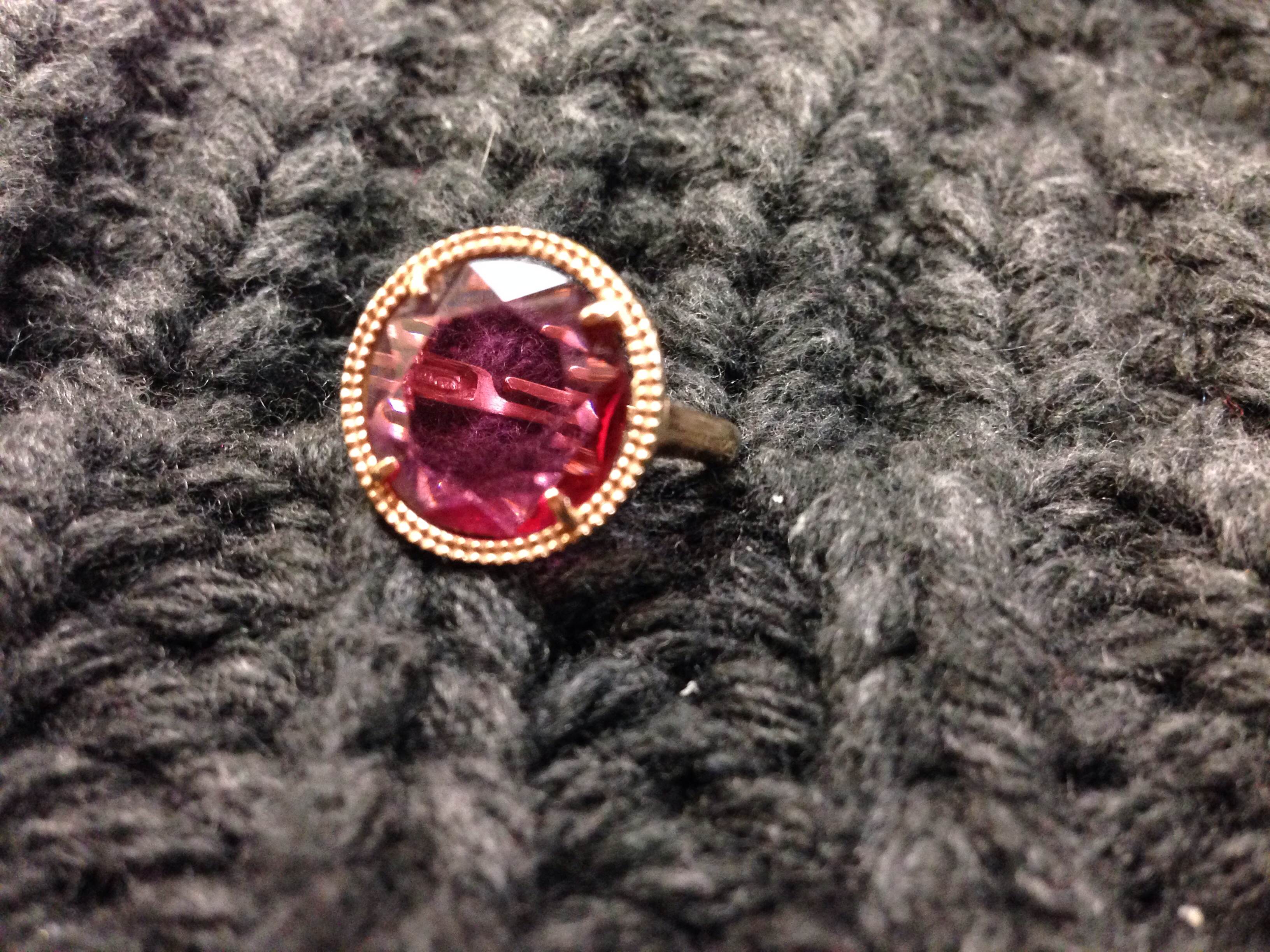
The object I chose that best represents my family history and me is a small ring. It is not an antique having been passed down to me through my family nor does it hold any real worth besides the forty euros I spent on it. But, the memories it holds for me are irreplaceable. I bought it over the summer in a jewelry store in San Marino. When I bought the gold ring with a magenta gem stoned colored focal piece, the adjustable band was sized to fit around my finger perfectly. The thin gold band connects to a gold circular perimeter that encompasses a magenta piece cut into a circle with triangular cuts on its surface. The gold circular perimeter is molded into two circles of tiny beads. The perimeter has four clasps that hold the circular focal piece keeping the ring in tact.

I bought the ring while on a trip last summer. It was a trip I had been waiting my whole life to make. My mother’s parents came to America in the 1950’s from San Marino. While members of my family have been able to make trips back to San Marino, I had never been fortunate enough to visit my grandparent’s homeland. Because I had never been to San Marino and experienced our culture for myself, I always felt this disconnect from my family and our culture.

However, San Marino has a sort of trip available to descendants who live abroad. The trip is sponsored by the government of San Marino making it free for me to make the trip I had been waiting for. So, in June I traveled to San Marino and spent four weeks soaking in the culture and beauty of my grandparent’s homeland. While in the main city center, I came across a few stores that carried Marlú jewelry. I felt as if this ring kept following me around San Marino and finally made the decision to purchase it my last week in San Marino. With the ring and my time in San Marino coming to an end, I could also feel the gap between my family and culture closing.

When I look at the ring, it brings me back to those four weeks. I think of the friends I made from Argentina and France who also participated in the trip. I think of Claudio trying to help me print my train tickets and his hotel where we stayed and ate most of our meals. I think of Sarah, Ava, and Arianna who I traveled to Florence and Venice with after getting no sleep and trying to navigate the European transit system. But, most importantly the ring makes me remember all of the beauty and happiness that San Marino provides in its people and architecture.

Red Wings Jersey

This jersey that sits before me is in near pristine condition, as it is so rarely worn and usually hung back up after being just a few hours off of its hanger. Looking at the jersey straight on, the first noticeable attributes of the thing are inherently very clear; the jersey is a mixed combination of a dark scarlet or bloody crimson with very plain white trappings. The center piece of the jersey is the Detroit Red Wings logo, an antique car wheel, perhaps a wheel from a Packard or another classic motor city car with feathered, elegant wings branching off of the center rim of the wheel. The symbol itself is mainly outlined in that plain white, with nearly every detail like the spokes, the wheel well and the feathered etchings embroidered in such a way that they have a distinct patch-like but smooth texture to them. The scarlet seeps into the emblem and fills in the empty spaces in between the spokes, the rim, and the feathers, creating a very striking image from a distance as in the right light, the wheel looks as if it shines. The emblem is stitched very heavily onto the jersey itself and sits rather high on the chest about four or so inches below the collar. At the bottom of the jersey, a thick white tapering about three inches in length is similarly stitched onto the jersey and the contrast of the scarlet and white again adds to the shimmering effect of the wheel from a distance. The jersey is also porous to allow players to let excess heat escape from the thick cloth and every single part of the jersey, minus the collar and the emblem has these pores.

The sleeves of the jersey are fairly thick and end quite abruptly despite the jersey being made for a large, hockey playing man. The alleged reason that they end mid forearm is to prevent the cloth itself from wrapping around the player’s hands and restricting their ability to play but when you wear the thing, your forearms tend to get chilly. Ironic how that works. Each sleeve features one white stripe roughly eleven inches from the cuff and each stripe is about two inches or so in length. On the reverse side of the right sleeve, is the player number 9 which is another patch but it’s made of a much more silky material and again this patch is the same white color as all the other detailing of the jersey.

Looking into the neck of the jersey is a thick tag that reads “KOHO. AUTHENTIC ON-ICE GAME JERSEY. CENTER ICE AUTHENTIC. CHANDAIL AUTHENTIQUE.” This tag is mostly black with grey embroidering on the edges and the KOHO label is outlined in gold. Attached to this tag is a smaller white one with a Canadian flag on it that reads “MADE IN CANADA. FABRIQUE AU CANADA. HECHO EN CANADA. 48” and underneath this tag is another even smaller one that reads “48”.

Flipping over to the back of the jersey, the final emblems and patches are quite prominently displayed. A large KOHO patch sits less than an inch from the cover and is embroidered with scarlet and white, the letters of the word being white surrounded by a field of scarlet. About an inch and a half underneath the KOHO label is the name of player number 9, “HOWE”. The name is made of the same material as the small arm number and each of the ends of the name are slightly frayed from sitting against chairs. Finally about two inches underneath of that is the player’s number, 9 again made of the same silky material and very prominently displayed against the field of crimson. The patch is roughly twelve inches long and the 9 is cut in such a way that it looks as if it were composed of a bunch of trapezoids.

The reason why the jersey is so significant to me is far more simple than most would think, as it’s become very much a coat of arms of my family and it to me at least represents the relationship between myself and my dad. Like I explained before, my parents divorced when I was about eleven years old and as such I don’t see my dad a whole lot, as he moved to California to work. So in the ensuing decade, any time I got to see my dad was significant to me and through inheriting the replica jersey, it’s like I have a piece of him near me at all times.

IMG_20150124_154517

The Beaded Necklace

The object that I have chosen to discuss is a necklace that was passed down to my family a couple of years ago. This piece of jewelry was unbeknownst to me until a couple of weeks ago.

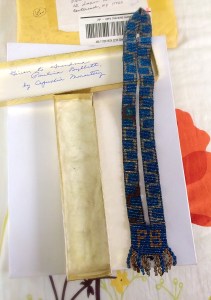
Inside this gold box lay a piece of jewelry that has remained in my family line for little less than a century. This piece measures approximately 8 to 10 inches long and the chain itself is about one and a half to two inches wide. This necklace is entirely embroidered in blue, silver, gold, and hints of brown glinting beads. The necklace Featured imagewas mainly made with blue beads, but alternates in a maze-type pattern of silver beads with minor gaps of brown beads. Toward the bottom of the necklace is inscribed the initials PB, which stood for Paulena Byllott, my great grandmother. Just below her initials, the very bottom of the necklace is lined with beaded tassels.
Inside the golden box writes ” Given to Grandma Paulina Byllott, by Capuchin Monastery.” This necklace was a gift to her from a Monastery in Detroit, Michigan.

Up until the evening after our first class this necklace was sort of mystery to me. I knew it was a piece of jewelry worn by my great grandmother, whom I am partially named after (Caryn Paulena Byllott), but there was not much context behind who had given to her or why she might of received such a beautiful gift. However, through further investigation I was informed that a letter was sent to my family along with the necklace describing just that.

Paulina Byllott, who I mentioned above, was born in 1868 and immigrated to America in 1886 from Germany. She married in 1887 to August Byllott and lived on McDougall ave, which was walking distance from the St. Bonaventure Monastery. Apparently, they were both great benefactors and supporters of the monastery and the Capuchin Friars there as well. For years they walked to the Monastery at 6a.m. for Sunday Vespers and my Great grandfather, August was a occasionally an usher too. Additionally, August was a blacksmith by trade and made iron hooks that were affixed to the church and used to hold the doors open. Around the turn of the century this gift was bestowed upon Paulina by the other Capuchin Friars for her work and dedication to the church.

This necklace was sent to my family by relatives, whom I have never had the opportunity to meet, from Michigan. Two sisters, now in their nineties, who I have been told hold practically hold all the information regarding my heritage on my fathers side of the family.

Up until this point I have been rather blind to my heritage due to early passings of my grandparents and lack of communication among extended family. However, wIth this tidbit of information that I have recently received about this precious necklace, I am inspired to continue to discover more knowledge about my roots! I am planning on writing to these women in Michigan to voice my curiosity and interest in the past with the hopes of learning more and also making new connections with these members of my family.

1937 French Prayer Book

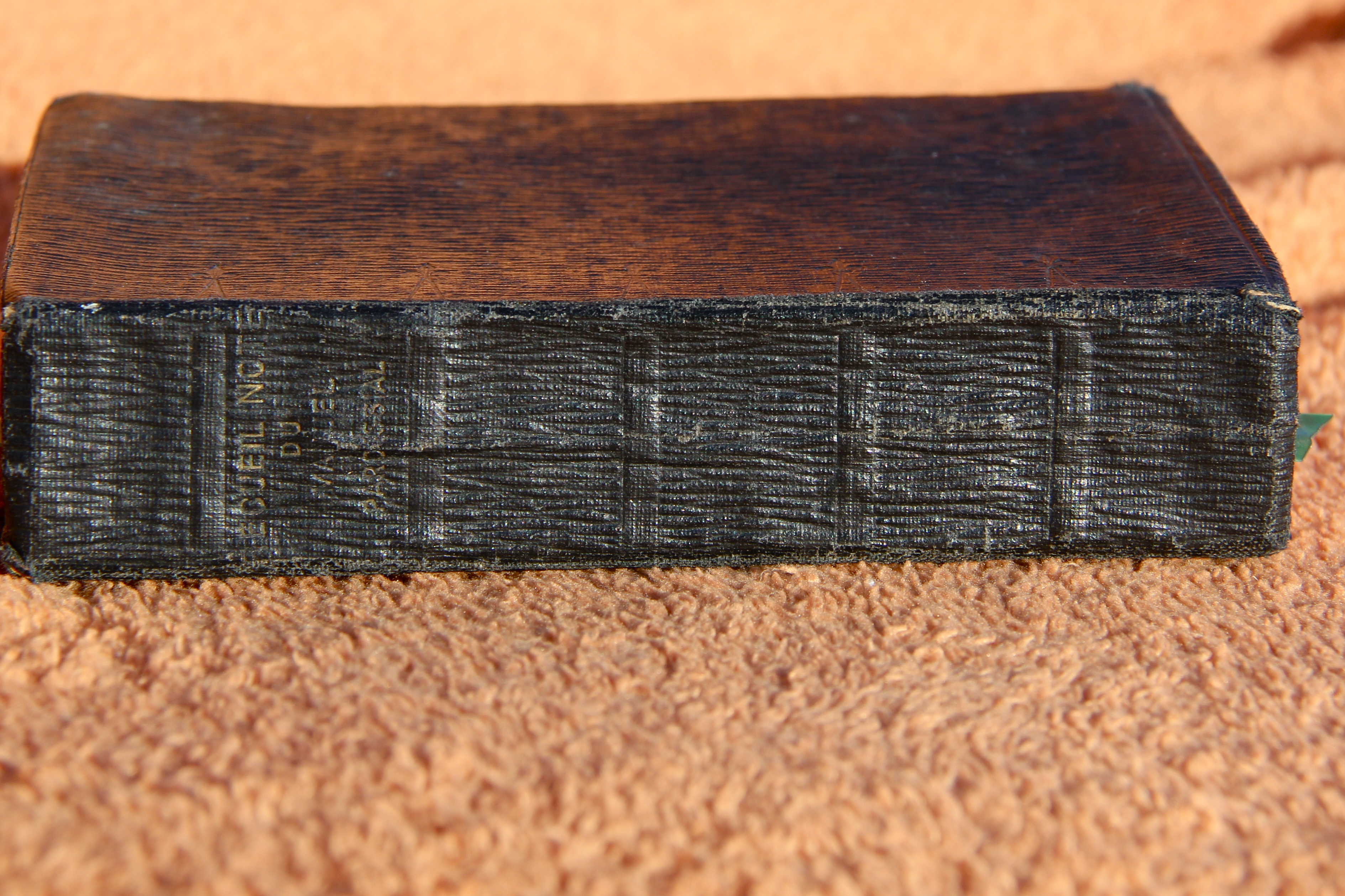
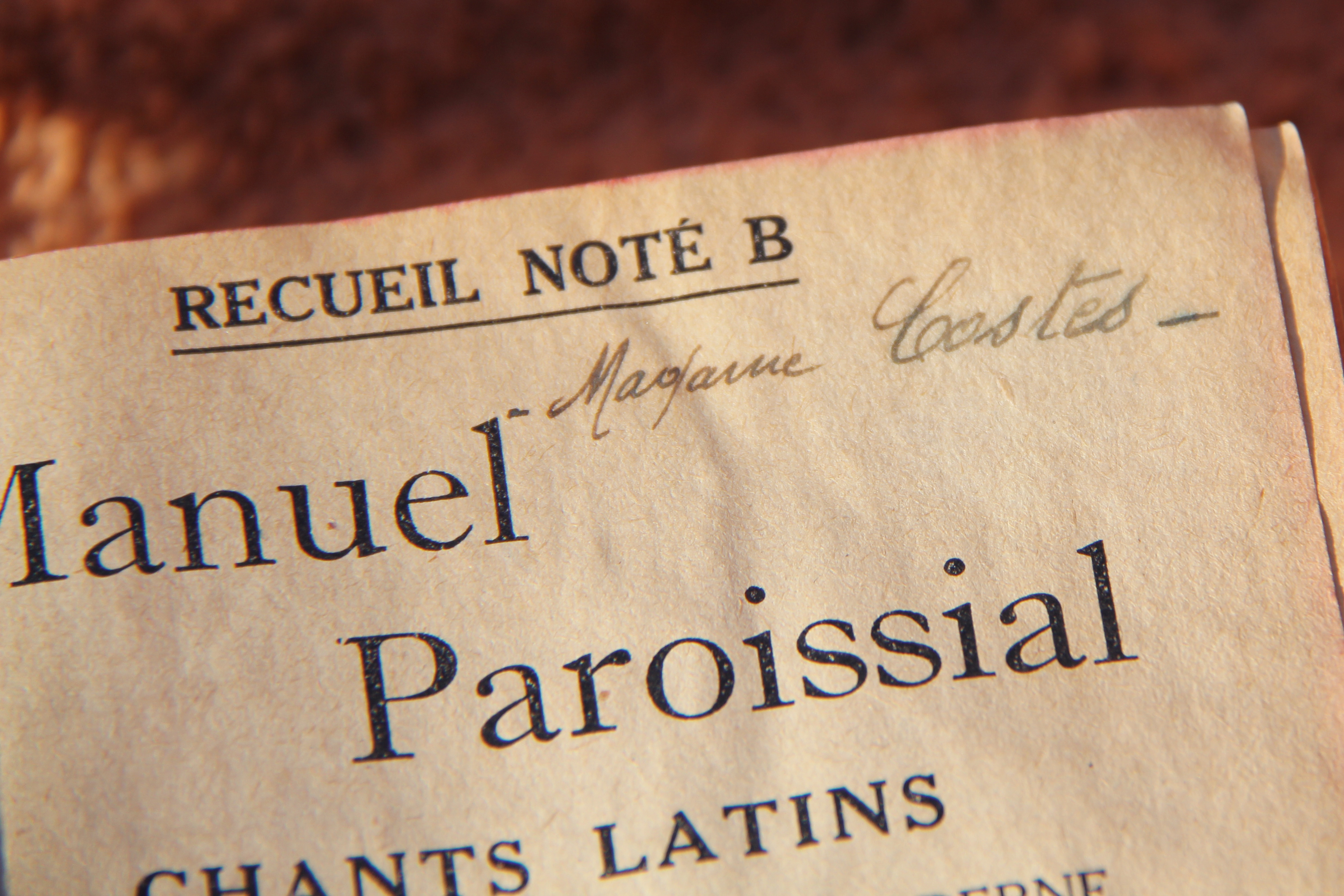
IMG_3715The black leather bound prayer book measures at 6 inches x 4 inches with a thickness of 1.5 inches. The front of the book is a simple, dark black. Adorned with five fleur-de-lis running down the front side of the book, the book shows some wear and tarnish. To any onlooker this book would seem meaningless from the outside. However, engraved faintly on the jacket in grey ink reveals “Requeil Note du Manuel Paroissial” or Parish Missal. The leather book is rough on the outside with vertical lines running across the book revealing a tough texture.

IMG_3753 By examining the book from the exterior, the pages are a bit auburn with traces of red. This prayer book was published in 1937, completely in French. The pages are worn in and seventy-eight later, are all in tact. The interior of the book is a flourishing mystery. This French prayer book belonged to my grandfather on my father’s side, Marguerite Renée  Costes.

Marguerite grew up in a suburb of Paris called Gagny, and this book would have accompanied her almost everywhere as for church was extremely important to her.The prayer book was given to my grandmother as a gift for her First Communion that she received at the age of 12 or 13. I don’t know who gave her the prayer book, but I’m pretty sure, after talking to my dad, that it was a family member.

IMG_3719On the second page of the book, my grandmother signed her name in beautiful neat script “Madame Costes.” The ink reveals perfectly shaped letters, and an air of pride in singing her name: that my grandmother was extremely proud to own this book. I love examining her signature. She put a dash before and after her name, as to proclaim its proud presence.

My father always tells me how beautiful and disciplined my grandmother’s handwriting was. Although only a simple ink writing, my grandmother seems to come alive through her signature.

IMG_3732Inside the book reveals a mixture of hymns and prayers. Within the 636 pages are a plethora of music notes and illustrated images accompanying many of the hymns. When I came across the prayer book, it contained a bookmark that opened to page 436 and this page is so fascinating to me. The page opens up to a hymn entitled Le ciel a visité la terre(Heaven visited the Earth) by the French composer Charles Gounod. After some online research, I came across a YouTube recording of the song from the 1950s that you can listen to here: https://www.youtube.com/watch?v=6dQIpFSTJZs .

I listened to this hymn on repeat as I wrote this blog post, I found it to be very beautiful. Alongside the hymnn lies an etching of an angel playing a guitar. An innocent and serene image, placed alongside a song about the sky and land gives off a very comforting feeling. The amount of detail and artistry that went into these various images throughout the book is striking. My grandmother was a trained concert pianist and I’m sure she played many of these songs at home for my father and his brother.

IMG_3725My grandmother held onto this book for her entire life. During the early 1940s, this prayer book accompanied her throughout her days attending Church. This book survived the Nazi occupation of Paris. My grandmother’s house was overtaken as a base for the gestapo during the Nazi occupation of Paris. My father told me that my grandmother had studied German in school, so when her family came home to discover their house was overtaken by the Nazis, my grandmother went to the Gestapo and demanded their house back in German.

Her courage and strength was monumental. And in the end, the Nazi’s gave my grandmother her home back. The fact that this prayer book accompanied my grandmother during this difficult time in her life reveals so much to me. This book must have provided my grandmother with hope and solace during those hard times, and I can’t imagine what she was going through. Music remained a steadfast passion and love for my grandmother throughout her life. This tiny little prayer book is an extension of that passion for music and song that my grandmother carried with her throughout her life.

By holding onto this book,I love to think about my grandmother’s life and her talents as a musician, mother, and individual.