
The vibrant Latin Quarter of Galway City
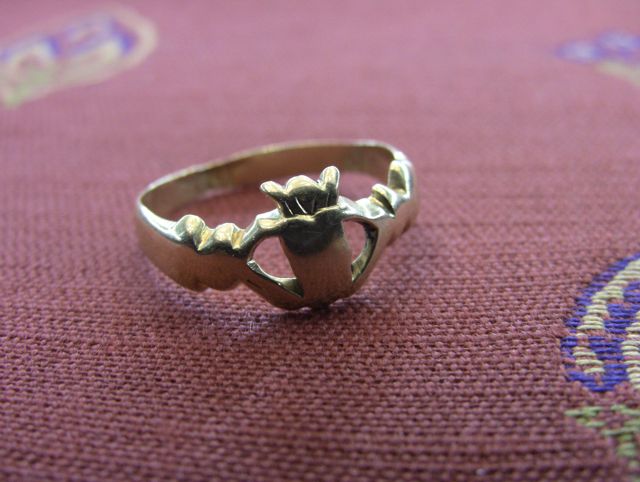
For this week’s blog post, I decided to use my object, the claddagh ring, as a means of transportation. I wanted to explore the origins of the ring style and iconography and how the history of the ring has transcended time. As with much of Irish lore, the stories associated with the origins of such antiquities is a bit fuzzy. Determining a concrete history of the claddagh is a bit difficult but I’m beginning to piece together how the ring and its meaning came to be.

Here’s a shot of Galway Bay from late September–the river was quite low at this time in the day!
Firstly, the word “claddagh” means, “shore”, specifically a flat stony shore in Gaelic or Irish. Claddagh is a small fishing town of Galway Bay, outside the city of Galway in the west of Ireland. Galway lies on the River Corrib and cannels throughout the city allow for the passage of water from the harbor. I visited Galway when I was abroad in Ireland and walked from the city center to the outskirts of the city to the shore of the harbor. The city itself is vibrant and bustling and you can feel the history of the city in the air. I loved how the river was interwoven with the city itself—you could tell that the bay had a strong relationship with the culture of the city. I’m kicking myself a bit for not exploring the history of my claddagh ring while I was there, I even remember seeing a plaque for fishing town of Claddagh and the iconography of the claddagh ring everywhere throughout the city. I guess I was too caught up in the overall experience to even think about the small object on my own hand and how wearing that ring connected me to the foreign city.

Here’s one of the many shops in Galway that sold rings–particularly claddagh engagement rings as seen by the signage painted directly onto the wall of the shop!
One origin story that I read about the claddagh symbol and ring revolves around the Joyce family, a significant tribe of Galway, and their history dating back over 300 years. The story is slightly complicated but it goes something like this: Margaret Joyce married Domingo de Rona, a wealthy Spaniard. His fortune was left to Margaret when he passed and with his wealth she had bridges built in Connacht, the province of Ireland in which Galway is located. Legend has it that Margaret, who later married the Mayor of Galway in 1596, was rewarded for her charitable work by an eagle that dropped a gold claddagh ring into her lap (hmmmmm, curious). Another story that involves the Joyce family comes later in history—Richard Joyce of the Joyce Family, was captured by Algerians en route to the West Indies. In captivity, a Moorish goldsmith taught him the art of metalwork. Richard was eventually released from slavery thanks to King William III of England in 1689. Joyce decided to return to his home of Galway and became a goldsmith (in some stories, a silversmith) himself! The claddagh motif is now attributed to him, as it was a design he created in captivity. His initials appear on one of the earliest surviving claddagh rings from around 1700!
Richard Joyce’s Claddagh Ring circa 1700 http://weldons.ie/rare-claddagh-ring-by-richard-joyce/
In modern time, this particular ring has been acquired by JW Weldon, a fourth generation family jeweler located in Dublin—they specialize in modern and antique diamond rings in other antique jewelry as well as rare 17th and 18th century Irish silver pieces. It’s kind of crazy to think that this ring has survived all this time! What is this Richard Joyce had never been captured and taught the goldsmith craft?? Would the claddagh ring design exist? I also found out that the claddagh ring’s popularity rose so much so that it became the only Irish ring worn by Queen Victoria, Queen Alexandra and King Edward VII! The Royal Patent for the claddagh ring was later issued to Dillon of Galway where it is still made and supplied today at Thomas Dillon’s, established in 1750, located in the city of Galway. I actually went to this shop! There’s a sign on the outside of this bright red building that reads: “T. Dillon and Son / Home of the Original Claddagh Ring / The Hands are for Friendship, The Heart is for Love, And Loyalty is shown with the Crown up above”. Now I’m not sure if he gets the title of “Home of the Original Claddagh Ring” because he patented it and started the reproduction of the ring—it appears the way on the stores website where they do indeed give credit to Richard Joyce as the creator of the claddagh motif. It’s hard to be sure if this is precisely how the claddagh ring came to be but I rather enjoy the story and all its fascinating pieces! It was interesting to learn how it involved people interacting with other cultures but always returned back to Galway. It gives me a curious foundation for the rings iconography and the various peoples involved in its peculiar history.
Here is the citation to the website for Thomas Dillons. It gave me the most thorough and legitimate story about the history of the claddagh ring after looking through other abbreviated stories online.
“History of the Ring.” Thomas Dillons Claddagh Gold. 1 Jan. 2010. Web. 7 Feb. 2015. <http://www.claddaghring.ie/content/7-history-claddagh-ring>.
 The Materials of History, Thought, and Art
I really appreciate the way you have set the geographical setting for us, particularly in your description of the bay. The fact that the bay and the city seem to influence each other reminded me of the motif of the ring itself, adding another really beautiful layer to the story. Despite not thinking to study the ring while you were there, you have put your trip experiences to very good use. I also love that you were able to bring in the more mystical/whimsical origin tale. It really demonstrates the way history is narrativized, and the way it folds into our culture and art. It certainly enriches my sense of the ring.