“I realize how much I care about how this hard-and-soft, losable object has survived. I need to find a way of unraveling its story. Owning this netsuke – inheriting them all – means I have been handed a responsibility to them and to the people who have owned them. I am unclear and discomfited about where the parameters of this responsibility might lie.” – Edmund de Waal [pg. 13]
How do you rewrite a story that’s already been told? Moreover, who am I to take it upon myself to sift through these words, to explain them in any other way than they are already laid out? Everything my Nana has written is fact; these letters were (and still are) a record of her experiences, and unlike movies, books, or lectures, nothing about those experiences was omitted.
“The steak we had was delicious, the waiters wore frog tailed coats, carried huge silver trays, poured wine into delicate, long stemmed glasses, called me, “My lady” and it was all just like the movies or a dream. If this happened to me about ten years ago I would have thought I reached the heights of success, now I can see why everyone drinks too much and all the women are rank conscious (most of the men are too.)” [Sept. 1, 1946]
What then can I, having not even been alive for WWII and the American Occupation, offer to this incredible perspective? I know that these letters have been passed over as my responsibility for a purpose, but my biggest difficulty in confronting them has been deciding what I must do to honor that obligation.
“Marilyn cut her hair and made an awful mess of it. I had to take her to the barber yesterday. She had to have bangs and have it all cut very short. Red [my great-grandfather] hates it, he says she looks like one of the displaced persons or D.P.’s as they are known here. That is no compliment… They go where they please and try to dress like we do but somehow you can always spot them. Many of the D.P.’s coming in now are Jews. We can’t thrust our way of life upon these people because they are still shiftless and dirty. All they look for is a place to sleep, simple food, plenty to drink and lots of love life. Red says there are hundreds of babies born in the camps each week, many of them black. These nigger soldiers can be seen with nice looking German girls all the time.” [Sept. 1]
Initially I thought I would be able to simply cut and paste the pieces of my great-grandmothers story that seemed the most interesting; I was planning on whittling it down to the most historically poignant of comments and then doing research into specific places and people that she mentioned. I figured if nothing else, I could tell an interesting story about the American liberation of Germany and pull upon my family’s experience as textual support; I thought it would be simple, black and white, just like her cursive script against the page. How completely ignorant I was.
“Father O’Connor is having a hard time just now. All the defendants in the war trials are allowed to have their families visit them for the last time this week. He has all these wives crying on his shoulder after they see their husbands. It’s a comfort to those condemned men to have such a fine man as Father to console them. The wives are brave when they see their husbands but break down later and of course Father does what he can to comfort them. I guess his biggest worry just now is, that he will have to go with them to the gallows. Red is having it pretty tough just now too. He has been given the job of protecting each one of the participants in those trials so that they will not be harmed in any way. Not only that, he must see to it that the press does not get ahold of the verdict before the officials say so. If he wanted to, he could make some beautiful money on that alone. Last but far from least, he has under his personal supervision some of the notorious Nazi prisoners who would like very much to commit suicide just now. He also has been given the honor of providing Gen. Eisenhower with a Guard of Honor while he is here in Nuremberg next week. Last week one woman tried to get poison capsules to one of the prisoners. She had the palm of her hand hollowed out so the pellets were placed under the skin. All this is not common gossip but probably will be after the verdict is announced. We certainly live in a hot spot just now. The newspapers would love a story like that but don’t dare give it to them or I’ll lose my neck in a hurry.” [Sept. 21]
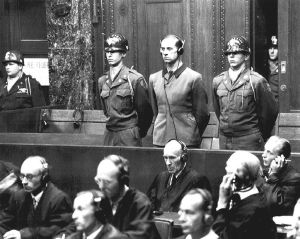
Karl Brandt (standing, middle) was one of 23 defendants in the first trial at Nuremberg (aptly nicknamed the Doctors’ Trial because 20/23 defendants were medical doctors being accused of Nazi human experimentation and mass murder under the guise of euthanasia).The indictment was filed on October 25, 1946; the trial lasted from December 9 that year until August 20, 1947. Of the 23 defendants, seven were acquitted and seven received death sentences; the remainder received prison sentences ranging from 10 years to life imprisonment. Keeping Karl Brandt and the other 22 defendants alive for the duration of the trial was my great-grandfather’s direct responsibility.
With every day I spent poring over this stack of letters, it became more and more difficult to figure out what I could leave on the page, and what I could take for the blog, for my new story. It felt wrong, to separate even one of her sentences from the one before it, as if I were taking her thoughts and ripping them into awkward, incoherent pieces. What I was unraveling here was an overwhelming number of truths that I was not prepared for; the truth that the luxurious lives of U.S. Army Generals bore an eerie resemblance to those of the Nazi’s before their demise, the truth that racism was alive and well even at the center of a culture claiming to liberate Europe from the dangers of prejudice, and the truth that my great grandparents were participants at this pivotal moment in history. I felt as if I had discovered a twisted treasure, a manila envelope full of tainted gold; these words were so abrasive and so honest that to share them would be dangerous…but at the same time they were so important that to hide them seemed implausible.
After days of simmering in self-loathing, pacing my apartment and weighing the morality of each option (do I hide her truth or do I expose it?), I decided I needed to share my Nana’s letters, blaming my duty of inheritance.

The Palace of Justice (“Justizpalast”), Nuremberg, 2012
I called my mom and we discussed a publication. I was immediately shut down. “There are family legalities that you just cannot mess with, Cait. It’s not ours to publish.” Hearing that was discouraging, I will admit. After days of committing to this idea, I was back at the beginning. I still do not know how I will tell my great-grandmother’s story appropriately. I’m unfortunately not satisfied with summarizing it in a few blog posts, and I am certainly not satisfied with my mother’s reaction, but I honestly don’t know what comes next.

The Palace of Justice, Nuremberg, 1946. This is where the Nuremberg Trials were carried out and where Red spent most of his time with the prisoners.
“I don’t expect Red home at all for a few days. This city is closed up tight as a drum. No one gets in or out. We can’t drive or walk within blocks of the Palace of Justice. Whenever we leave the house we have to be sure we have our A.G.O. cards with us. It has our picture, finger prints and name on it and we can’t offer any excuse if we are stopped and do not have it. The verdicts have been announced at last. Until these Nazi’s are sentenced and sent to wherever they are going, this city will be a hot seat. The mystery and intrigue seems to hang over this area like a heavy cloud. Remember how we felt when we were kids and some notorious criminal or lunatic escaped from Auburn or Willard? That’s how I feel now only Ma isn’t around to cuddle me when I get scared. We wives have been staying together nights. We play pinochle until midnight so the night won’t seem so long. This would be an ideal time for another robbery. These Germans know our men are busy and the M.P.’s are all working in the city or on the road blocks. Its exciting to be living where history is being made and even though I sound scared, I wouldn’t miss all this excitement for all of the security back home.” [Oct. 1]
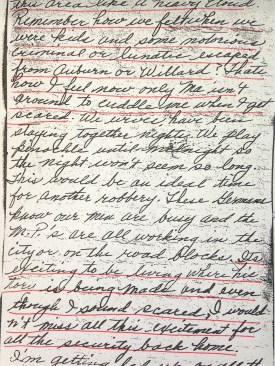
“Remember how we felt when we were kids…I wouldn’t miss all this excitement for all the security back home.”
For now I will immerse myself in the process, get to know my ancestors more deeply, and perhaps even discover my own truth along the way.
 The Materials of History, Thought, and Art
Caitlin, your post really brings home several really important and potentially troubling points. Your first point, how can you tell your great-grandmother’s story, reminds us that we do have an obligation to those who have passed on, that our inheritance is not something that we can place on a shelf. I think you and de Waal really demonstrate how hard it can be to determine what that obligation is. I think you have a particularly challenging job. Not only do you have an incredible body of textual evidence, but it was written by someone you knew and care about. Trying to represent a text authentically is difficult on its own. I cannot imagine how difficult it must be to authentically represent a loved one’s text, especially in light of the various biases that you are encountering. On some level, it must seem like you have to pass judgment on these things, but, as you note, how can you since you were not there…I feel like it would be disingenuous for me to even suggest how this might be done.
Your second point, not being able to publish due to legalities, reminds us that our research is not simply uncovering the past, it is also quite capable of affecting those who are still living. Because most of my own extended family is deceased, I have largely forgotten this aspect of family history. However, I think it is important to remember that our inheritances are not fully our own, further complicating our sense of obligation. Although I was looking forward to hearing more about your findings, I think you have made the right decision given the circumstances. Perhaps at some point in the future things will be different and it will be the right time to present your Nana’s story.
There is a line from “Ode on a Grecian Urn” by John Keats that sums up how I felt while reading your blog post; “Beauty is truth, truth beauty.” The truthful approach to your post is absolutely beautiful. I felt awed by reading your words. Thank you for sharing your thoughts and putting so much energy into what matters to your heart.
I think we live in the time we do now because we are able to share things like this… racism,
the hypocrisy of the U.S. Army Generals (living like the Nazis claiming to liberate Europe), anti-semitism, and many other forms of oppression, hypocrisy, or subjection. Reading your thoughts made me truly think about our approach to history. Why does revealing history have to be good or bad? Why cannot it not just be what it was… what it is… the truth?
Last semester I took a history class here that changed my world. In U.S. Women before 1880 we got an opportunity to change our approach on women in history. We tend to have labels for historical women, yet we learn about men all the same. In some cases maybe we label men as good or bad, but we typically idolize a woman in history as being so incredibly unique just based on the fact that she made it and we were learning about her. But why is she so unique? Hasn’t she always existed — why is she thought of as unique? Why are mothers not as important as the law makers? We did this to our own schemas.
Reading about your grandparents made me think about East of Eden. Most of the characters in Steinbeck’s book are not good or bad. They are fully human. (Well, one character is actually good and one evil beyond tangible belief, but most are imperfectly perfect humans.) I think it is so important what you are doing because telling the truth — straight up, the way it is — is not good or bad. It is important! We cannot be afraid of telling the truth unless we will shy away from true raw beauty. Sharing the truth is an incredible gift to give the world.
I was so inspired by this. Thank you again for your thought and effort.
There is a line from “Ode on a Grecian Urn” by John Keats that sums up how I felt while reading your blog post; “Beauty is truth, truth beauty.” The truthful approach to your post is absolutely beautiful. I felt awed by reading your words. Thank you for sharing your thoughts and putting so much energy into what matters to your heart.
I think we live in the time we do now because we are able to share things like this… racism, the hypocrisy of the U.S. Army Generals (living like the Nazis claiming to liberate Europe), antisemitism, and many other forms of oppression, hypocrisy, or subjection. Reading your thoughts made me truly think about our approach to history. Why does revealing history have to be good or bad? Why cannot it not just be what it was… what it is… the truth?
Last semester I took a history class here that changed my world. In U.S. Women before 1880 we got an opportunity to change our approach on women in history. We tend to have labels for historical women, yet we learn about men all the same. In some cases maybe we label men as good or bad, but we typically idolize a woman in history as being so incredibly unique just based on the fact that she made it and we were learning about her. But why is she so unique? Hasn’t she always existed — why is she thought of as unique? Why are mothers not as important as the law makers? We did this to our own schemas.
Reading about your grandparents made me think about East of Eden. Most of the characters in Steinbeck’s book are not good or bad. They are fully human. (Well, one character is actually good and one evil beyond tangible belief, but most are imperfectly perfect humans.) I think it is so important what you are doing because telling the truth — straight up, the way it is — is not good or bad. It is important! We cannot be afraid of telling the truth unless we will shy away from true raw beauty. Sharing the truth is an incredible gift to give the world.
I was so inspired by this. Thank you again for your thought and effort.
Not only do your great-grandmother’s letters sound beautiful, but your description of them as a “habitus” for the words is truly inspired. I usually consider words something sacred so I can identify with your trouble of separating one sentence from the rest. It would be almost sacrilegious to take them out of the original letter and, of course, it would also take something away from her story. Speaking of your great-grandmother’s story, it really is an incredible piece of history. I think it’s amazing that your family has these letters as both a piece of family history and an important record of world history. Thank you for sharing.