Examining the Nest

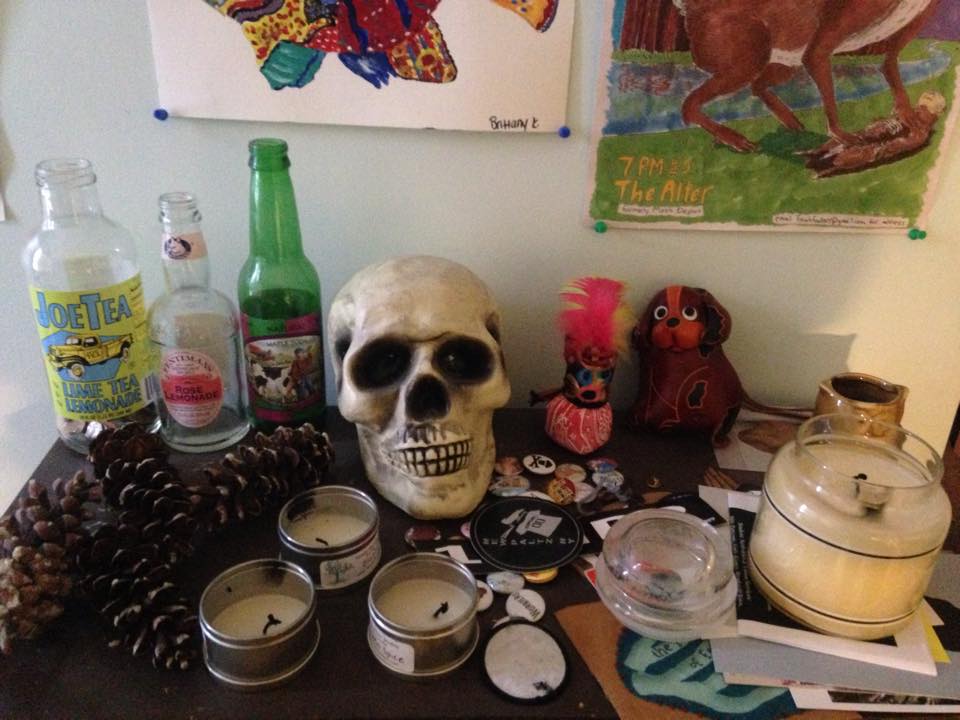
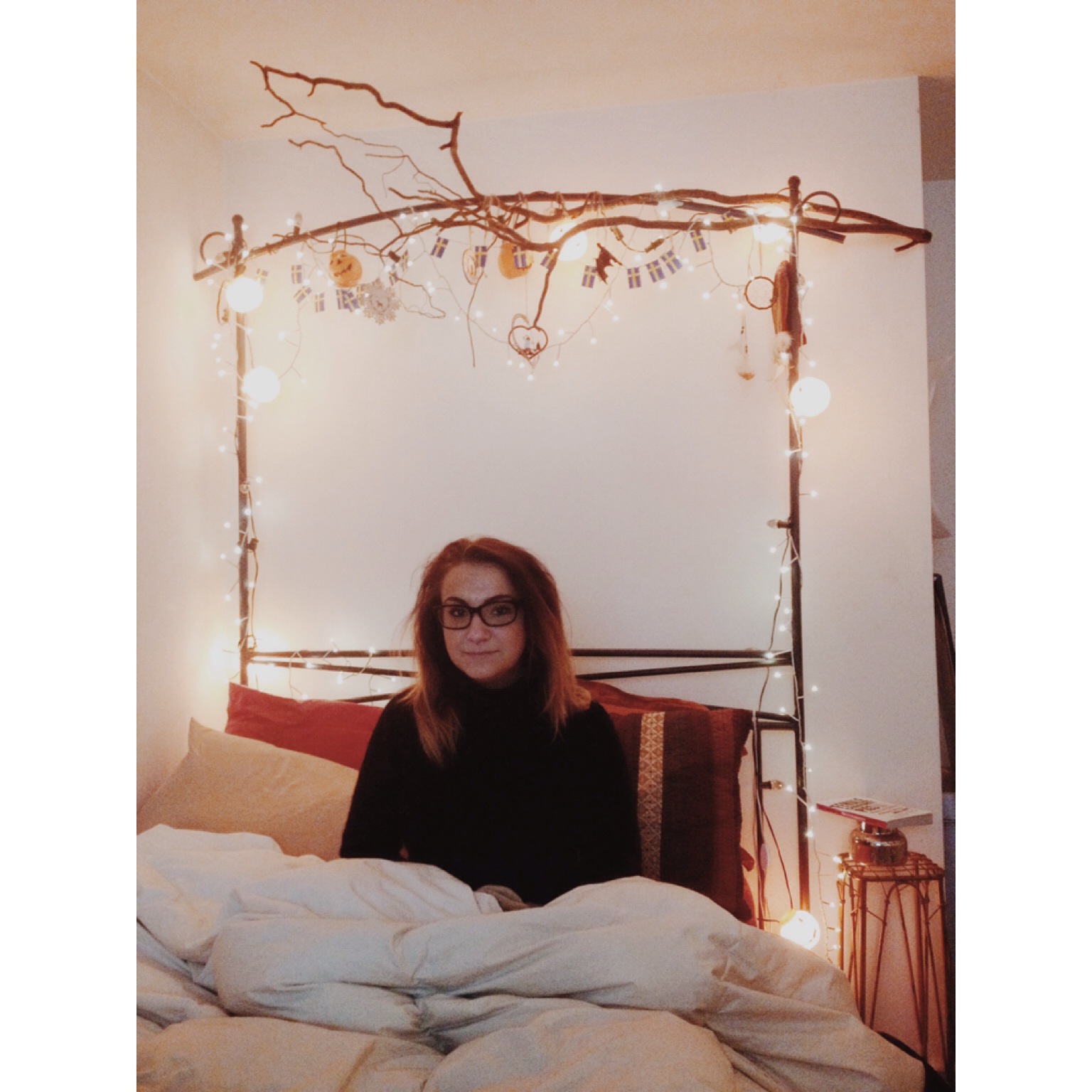
The meticulous mind of an artist, arranges a space unlike any I have ever seen. The inhabitant of this unique, nest like environment is one of my closet friends Alexa. Had I not known her and I walked into her room, I would be wildly confused. Seemingly none of the objects make sense together. There are twinkly lights hanging from branches, that rest alongside tiny Swedish flags and pumpkin lights. Along the walls are dark paintings with obscure subject matter, children of my friend’s vastly creative mind. The room is warmly lit, candles of every color line the book shelves and the distressed armoire. Perhaps one of the more striking ornaments to this living space are the mannequin limbs that hang from the wall and sit on her otherwise pristine and organized bookshelf.The bookshelf itself is full of wicker baskets that house everything from camera film to toiletries. There are book stacks of Renaissance Art and Swedish Folktales. And a record player sits on top. As the Talking Heads vinyl spins slowly, bobbing up and down ever so delicately.  The words “The world was moving and she was right there with it” hauntingly linger in the air as I sat watching this room I have spent so much time in.

Processed with VSCOcam with p5 preset

What may sound like an erratic display of Halloween paraphernalia actually functions as a work space, befitting of a creative and scholarly mind. And amongst the knick-knacks and tree branches is a large bed, that sits like a cloud in the near center of the room. It’s a place friends have congregated to discuss our rather mundane grievances during our college life. A sort of refuge for us all as we’ve filtered in and out of our friend’s home. As the bed is the most normal looking thing in the room it was a good place to sit and take it all in. And as I looked around I realized, everything in here has a purpose. The tiny bats and pumpkin lights that hang from every corner of the room, serve as a reminder of Alexa’s love for the whimsical and perhaps the spooky. The small Swedish flags and wicker witches that hail from the same country are telling of her heritage, and the love she has for those family members that come from Sweden. As far as the rather psychotic sounding mannequins that live in her room, her grandfather does sculptures from these very items. It’s safe to say my friend lives among these items, not the other way around. She explained that although these things seem like they have no use, they do for her. They are all, in some small way a part of her which she projects into her living space. There is a certain darkness to the room, it’s true. But there are points of the romantic throughout. Lace curtains, nostalgic photos and large earrings hanging from a heart shaped holder also live here. It’s a kind of representation of the many sides of Alexa, The seemingly rough exterior houses a more delicate side. Perhaps I can only take this away from the room because I know her well. As I said, the room as a whole, may be confusing if you don’t know her. It’s just fascinating how much a living space can say about a person.

Processed with VSCOcam with g3 preset photo(2)

The Shift to the Vernacular: From Church to Home, a comment on the French Missal

For this week, I chose to focus my research on my objects and ‘habitus’ by researching the greater history of missals in France. Since I don’t have the privilege of visiting my great grandmother’s apartment to view the habitus of her French Missal, nor do I have access to photos of her apartment, I can only imagine where she kept the missal. Most likely, she kept the book in a very special place. I imagine the leather-bound book resting in the living room, atop a table. Easy to get to but not in harms way. I also imagine the Missal by her bedside. Maybe she enjoyed reading prayers before bed. The Missal must have provided some level of comfort  and security to her for she lived in the apartment alone in her later years. Alas, that is just speculation.  So, I’ve decided to research in what is factual and known about the greater history of liturgy moving from Church to home.

The Council of Trent (1543-1563)

The fact that my great-grandmother held this Catholic Missal in her home, did not strike me at all. Until, Professor Mulready pointed out that this symbolized quite a phenomenon in Catholicism. Professor Mulready suggested a text that provided of great assistance with my research, “The History of the Vernacular and the Role of Translation” by Keith Pecklers and Gilbert Osdeik. Prior to the rise of the vernacular and translation, missals strictly only included Latin texts. Mass was said in Latin, for it was seen as the pure and old language of the Romans. The Church viewed mass and the text of mass to be a hierarchal and unchanging fact. There had been several attempts throughout history to shift mass to the vernacular and promote translation. At the Council of Trent in 1545, bishops split over the proposition to translate missals into the vernacular. Surprisingly, a majority of bishops accepted the translation of the liturgy into the vernacular but the proposal ultimately was shot down. The extremely important council of Trent concluded that “out of pastoral concern for the faithful, it was not the proper moment to shift from Latin to the vernacular; more time for catechis would be needed.” The liturgy and the Mass was viewed by the Church in a hierarchical order. The word of Jesus could not be translated–that was sacrilegious. Change, no change.


http://www.youtube.com/watch?v=Ms9axxojhpk

Fast Forward to 1937, where my great-grandmother was living in a suburb of Paris in Gagny. To view the world my great-grandmother grew up in, view the video about which features footage from the turn of the 19th century. My father sent me this video the other day as a resource because he knows I’m doing this project on the French missal. For my great-grandmother to own a missal truly represented a major shift in the Church’s view of the liturgy. Caught in a world on the eve of a second World War, and a complex and changing society, the word of the Lord was translated into French. The liturgy moved from closed off and intangible, to a very fluid and open text. The significance of my great-grandmother’s missal involves the fact that the majority of the text is in French. A major shift is happening here in 1937: faith and religion for Roman Catholics was becoming personal, in a tangible and physical way. The greater context of the missal, being incorporated into everyday life and easily accessible by the greater public is momentous.

The 1937 World Exposition in Paris. The increasingly international city my great-grandmother lived in.

The missal, in it’s small dimensions, was widely available at this time. It could be brought around and easily fit in a pocketbook. Rather than having one habitus, to borrow from Miller, the book was constantly on the move. The habitus of the missal was vast and endless. The novelty of the French missal in 1937 reflects the international shift and increasingly world view of Paris at the time. Housing a major international arts exposition in 1937, Paris was continuing to be a city of arts and culture. The popularization of the missal reflects the modern city where no longer could bishops in antiquated dress dictate faith for those city dwellers. For my great-grandmother, the missal did not sit in her apartment but rather accompanied her to mass and into the city. Fitting perfectly into her hands, the book was picked up, touched, and used for song and prayer. For my great-grandmother, a woman who valued her faith so strongly, the missal must have provided great expression. The increased availability of the French missal is something that is hugely important for process and intimacy of faith. I’m humbled to know that such a small object provided my great-grandmother with such inspiration and strength.


The Books’ Niche on the Shelf

I am continuing to investigate the four little Shakespeare plays I have for this post. They currently rest on the second shelf of my bookcase (the middle shelf) in the front. I specify “in the front” because I have acquired too many books for the sanity of my tiny yard-long, foot deep, and yard-high bookcase. I have begun “second” rows in front of the first rows on both the bottom and middle shelves. It is on this middle shelf, in the front, towards the right hand side of the shelf that my plays rest.

Their placement is quite important. They are nestled in among the rest of my Shakespeare plays, and my small collection of “the classics.” Namely, between T.S. Eliot’s The Wasteland and The Tempest (a Norton edition). Ironically, I did not place this eloquent collection with my complete collection of Shakespeare’s plays – the Norton Shakespeare – which is similarly bound in red cloth and also has the thinnest paper imaginable. Instead, it is placed with the other individual editions of plays, most of which are used Signet editions – how fitting considering I originally purchased the collection in a used section of a bookstore as well. The other end of my Shakespeare collection is marked by a playbill of Othello – the play I saw on opening night of The Hudson Valley Shakespeare Festival this past summer (it was June 28, a Saturday night). That is the only other *important* piece of writing on that shelf.

This spot on the bookcase does hold some value, however. The books that I place in my created front row are ones that I am either currently working on, or I wish to see as a reminder to read them. For instance, Daniel Deronda and The Grimm Fairytales are a few books down on the same shelf, also in the front row. I haven’t reached past page 24 of the first, and have only glanced at stories of the latter. Quite honestly, I am not all that intrigued by Daniel Deronda, but I would like to return to it someday, and so, I must remind myself that I have it.

The top shelf of my bookcase only has one row of books, mostly hardcovers, and all ranking top on my list of novels. The entire Harry Potter series takes up about half of the shelf. I chose this because the weight of the hardcovers is heavy enough to steady the overused lower shelves without causing the shelves to become top heavy and tip forward. You see, I am cautious about this for fear of my books becoming damaged in the case that they should topple forwards.

I believe that the placement of the books reveals a bit of my personality, but mainly my reading interests – I like the classics and I like used books. It makes the classics seem a little bit more realistic in my mind as the older editions help to bridge the gap between the time the books were written and the year in which I am reading them. It almost tells me that the books have lived.

Another aspect of where the books rest has to do with where the bookcase is. It sits in the corner of my bedroom, between the two outer walls, is at the foot of my bed, and is nestled between two windows. I call this my reading corner because the natural light is always best here. The windows face south and east, so morning light is ideal. And I actually considered this when rearranging my furniture a few months back. My bookcase used to sit next to the door of my bedroom, which wasn’t very inviting.

I am partial to morning light – sunrises are beautiful, and the light is much stronger than afternoon rays to me. Allowing the sun to shed light on my books keeps me looking at them, my eyes follow the sun’s rays.

I also chose this corner of my room because of the height of the bookcase. As a mentioned, the bookcase is about three feet high. I have painted my walls, and the wall that sits behind the bookcase is painted sky blue with brown tree branches that only have a few leaves on them. Also on the branches are funky owls that I hand-painted in a modernist interpretation of Athena’s symbol (the owl). The lowest branch is three feet high, and I didn’t want to block the branch from my view, so I placed the bookcase in front which sits perfectly below the branch. It has become a bit of an ode to her, being that she was the goddess of wisdom, it’s fitting that books should rest below her.

The entire corner that houses the Shakespearean play collection is evidence of my interest in literature, especially the classics. From my ode to Greek gods (I have another tribute to Neptune on another one of m walls) to my unread copies of classic works that are begging for my return, I have undoubtedly created a challenge for myself – to expand my knowledge. This is quite telling as I love challenging myself with books I hope to eventually read, or with learning new painting techniques and interpretative skills, or simply with engineering my arrangement of books to obey the laws of physics.

I think that most of all, this corner reveals that I like to give things a purpose – my walls are for self-expression, for remembrance; my books are for enjoyment, yes but also to repurpose (since a great deal of them are used), by bookcase is being pushed to its limits rather than me just throwing it out for a larger one or adding one to my room. Perhaps it’s evidence of my ability to adapt – making the bookcase work for me, or adopting someone else’s books into my own hands and having them adapt to a new life, or making my walls personal and making the room m own (my brother and I switched bedrooms a few years back). The placement of the Shakespearean plays is one of my own – they aren’t given special privileges over the other books – they are still housed on the same bookcase, with the other editions of used Shakespeare plays. They are being used as partly as a book should be, but partly as this particular edition was intended – for collection. I recognize their nature as gifty, but have made them part of my own collection.

Vassar Hospital Room 436

Considering how much I have been in and out of Vassar Hospital this past weekend, I’ve decided to use that as an inspiration for this week’s blog post. My grandmother entered the hospital early last week, which was enough time for her to make the space her own. Her hospital room consisted of a single bed, two chairs and a bathroom. Over the course of a few days, my grandmother managed to make it her own.

She had the comfiest chair in between her bed and the windows, so that she could look out at the view of the Hudson River. That chair, although already lined with cushions to make it as comfortable as possible, was then covered with various blankets that she would use to drape over herself for warmth.

For most of her visit, the food tray was in front of that one chair by the window. It held all of the necessities like a tissue box, a water pitcher, and sanitary wipes. However, it had also accumulated various items that she determined necessary for life. This included Hershey’s chocolate bars, sugar packets (hidden of course), and Mallomars. The essentials were always hidden in the various drawers of this tray table. Although this table was mostly stationed in front of her window seat, it traveled over the bed for the occasional breakfast.

Now, the bed was definitely her personal space by the end of her hospital stay. At the foot of her bed we tied extra slipper socks around the bed handles to make sure that she always had a pair available. At the head of the bed, which only ever had one pillow, there was also a lengthy scarf that I gave her for her birthday last month. When I went to visit her on Valentines Day she was wearing it around her neck and although she did look a little ridiculous draped in this long red, white and green scarf, it brought color into the otherwise white hospital room. When she the scarf is not keeping her warm, it remains at the top of her bed with that single pillow and somehow manages to brighten up the horribly drab room. On top of both the scarf and the pillow rests a tiny plush puppy that she recently received as a gift for Valentines Day. The small dog barely left her pillow in the day or so since she got him except to follow her to chair this morning. Regardless of its placement in the room, it also seemed to lighten the air in the room.

This morning when we packed all of these individual items into a plastic hospital bag they lost some of their importance. Then the room became just another messy, unoccupied room on the fourth floor of the hospital. While her stay may have been short, thankfully, my grandmother made the small space they gave her into her own personal living area. Now that room is just another blank slate, waiting for someone else’s relative to lie in the bed and move in their important belongings.

I hope that once this week is over I will not have to step foot in Vassar for a fairly long time. However, if another one of my family members goes in, I have already compiled a list of the essential items they will need with them during their stay in the hospital.

Passatini Press

The passatini press currently lives in the kitchen cabinets of my mother’s home on Long Island. Other cooking tools surround it within her white cabinets. Now, it is used in her kitchen on Sundays to make soup for my grandfather who misses my grandmother’s cooking more than anyone. For years, a passatini press was used in my grandmother’s kitchen to make traditional Sammarinese meals. In San Marino, I realized how the passatini press had made its way through not only two generations of my own family but through generations of so many other Sammarinese homes.

While in San Marino, I went on a couple of hikes. On our last hike, our coordinator, Leopoldo, took us to see the old water mills that had run down and we ended our hike with a tour of the Museum of Agriculture. The museum was established in what is assumed the oldest house in San Marino dating back to 1770. The house had been restored to display the way of life from the past. The museum contains hundreds of ancient items that relate to agricultural life and work such as copper pots, flat irons, looms, and so much more.

The museum preserves these items that relate to the Sammarinese customs and traditions of rural life in the past. When walking through the museum, I remember seeing certain items in the historical kitchen that looked familiar. I saw an old cheese grater similar to the one in my grandmother’s cabinets. On the mantle of the museum, it was placed with others of varying sizes with wooden drawers to catch the cheese and a handle that turned the grater on the cheese. On the opposite wall of the mantle, I also saw an assortment of passatini presses hanging. They looked a little different from the one I have today because it was more of a flat iron sheet with holes and handles on the side. It was explained to us that all of these kitchen tools had been used in Sammarinese households for centuries to make the traditional Sammarinese meals.

I really enjoyed this museum because it showed us the way that our grandparents lived and generations before them. The press has lived in the homes of Sammarinese for centuries. In their kitchens, it waits amongst other cooking tools to bring the flavors and textures of a home cooked meal to a family just as mine does. Without certain kitchen tools, cooking these traditional Sammarinese meals would be impossible. While I know my press is only one of many,  the museum made me realize that the passatini press has been a staple in the kitchens of Sammarinese homes for generations and will keeping being in them through the efforts of the new generation.

Where the jersey sleeps…

When i’m at home for the summer, I typically take all of my sweaters, jackets, jeans, pants, robes, etc. out of my closet here at school and stow them away in my weird attic closet at home because for the past couple of years I’ve always had a lease that was up or I couldn’t stay in the dorms because I was transferring schools. But for the first time ever, I now have a place where all of my outerwear and other accouterments can hang and sleep forever. Or at least until my lease is up here at this apartment too.

Right now, the double-doored sliding closet that’s to my left is seven feet tall on the outside and about nine or so on the inside and each of the doors are offset from each other so they can easily slide back and forth. Inside the closet are like I said, a good portion of my jackets, sweaters, robes and whatever else I happen to have brought up to New Paltz. Being that I wear alot of sweaters, I’ve had to leave some at home so my closet is currently a little lean but from where I’m sitting right now, the left door is open and everything seems to be perfectly in place; my jeans and pants are all hung accordingly in how often I wear them, then there are a few unused plastic hangers, then of course my red wings jersey, next to that is an incredibly itchy sweater that I got from a roommate, and as far as I can see right now, my “dad” robe is clinging to the wool sweater. Below those things are my laundry basket which I’ve had since the beginning of college and next to that are my current pair of jeans that I’ve been wearing for the past few days.

In the closet there are two shelves, the one closest to the hanging stuff has my laptop case, a pair of relatively unused track pants, and my also relatively unused winter hat laid on it. Above that is a shelf with some shoe boxes which I should really get rid of at this point and a terribly uncomfortable “summer” backpack that my current roommate convinced me to buy. As of writing this, all these sit comfortably in their respective places and “sleep” until I decided to wear them or pick them up. As a kid, I always personified objects in this way and for whatever reason, I never really questioned it. I never really named any of my possessions and oddly enough I always thought it was weird when people did. As I got older, I always was worried that things like that; the personification of objects I mean, was a sign of some weird neurological disorder but apparently it’s a relatively normal phenomenon.

Besides all this, I like to imagine that all these objects in my closet are just like I described, sleeping until I choose to pick them up or use them. In some bizarre way, it encourages me to wear everything I have here with me and never neglect what’s all but three feet away from me.

Sargent Joseph M. Chodrow

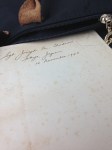
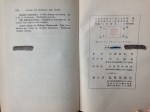
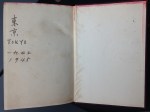
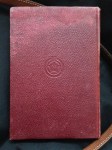
I have a new object. It’s an old smelling, maroon, hardcover book with faux leather patterning titled Poems on Evening and Night. It’s small, about an inch shorter than your standard Moleskine. Upon opening the cover, on the first page inside, written elegantly is “Sgt. Joseph M. Chodrow / Tokyo, Japan / 14 November 1945.” The inside pages are annotated in pencil, not with personal notes, but with definitions of words copied from the glossarial notes in the back of the book. These same words have been checked off in glossarial section, definition read and learning accomplished. Also in the back of the book is a page in Japanese, the only one in fact, which i suspect is a copyright page since there is none in the front. On this page a price of ¥3-00 has been crossed out with black ink, which bled onto the page before when the book was closed before it had a chance to dry. Opening the back cover, on the last page, is “Tokyo” in both Japanese and English, along with the date 1945 in both Arabic and Sino-Japanese numerals. Finally, on the back cover, is The Hokuseido Press logo.

My roommate bought the book in Boston after she saw the inscription. When I told her I needed a new object, I thought it was funny that she gave me this one, since both Febergé eggs (the subject of my last post) and WWII Soldiers in Japan were mentioned in DeWaal’s book. I had a hard time finding information on this book and it’s owner. At first I assumed Joseph was an American, but as we were looking through the poems we noticed the authors were mostly English, so we tried looking at U.K. data bases too. The U.K. sites turned up even less information than the American ones, so I believe that he was in fact American. Here is a possible profile of Joseph based on my research:

  • Name: Joseph M. Chodrow
  • SSN: 106-12-0340
  • Last Residence: 8816 Saturn Street. Los Angeles, CA 90035-3320
  • Born: 15 Dec 1920
  • Died: 20 Apr 2003
  • Bank: First Republic Bank (He filed a claim for $136.80 from lost interest checks)
  • Phone: (310) 277-6606

His wife (most likely) was:

  • Ruth Rebecca Chodrow
  • Born: 1 Apr 1923
  • Died: 30 Apr 2009

And that’s about it. I tried calling the number and all I got was weird tones. The publisher and author are also shrouded in mystery. According to imcbook.net The Hokuseido Press, “established in 1914, is one of Japan’s oldest publishers of English books” which today focuses on textbooks to help Japanese students learn English. The height of their publishing occurred during the late 1930s to the late 1980s. The author, or compiler, does not give a first name, and signs only Y. Otagiri or Y.O. The prefatory note to Poems on Evening and Night states that the book had it’s origin in the lectures delivered on the same subject at Hōsei University, Tokyo, during the third term January-March 1926. Otagiri intended it as a study guide of texts to be finished in one or two terms.

In terms of changing use, instead of ending up in the hands of a Japanese student, this book lands in the ownership of an American soldier. Possibly, like Iggie, Joseph was deployed in Japan, and unable to read Japanese, he finds (and can pay for) the available books in English. As we read, wartime inflation hit the Yen hard from 1941 to 1949, and the internet tells me no true exchange rate existed. Then, in 1949, the U.S. gov. fixed ¥360 to equal $1. Using the 1949 rate, ¥300 is equal to 83 cents, which with inflation rates is equal to $8.31. Not bad for someone who is well off, but maybe too expensive for the Japanese who were selling off their precious belongings just to survive. Or maybe the Japanese didn’t need so many books to learn English anymore with the influx of English speaking soldiers during this time period. Either way the book seemed to fulfill it’s purpose. Otagiri wanted people to learn from his book, and I think Joseph’s notes show his wish came true. I may not be learning about William Blake, Henry Wadsworth Longfellow, or John Keats (who was possibly Joseph’s favorite), but I sure am learning something.

Our Father

The object is held by a voluminously looping gold chain; each chink taking on a rounded rectangular shape. The chain connects to a golden cross that is shaped liked logs rather than flattened wood and gives off a glassy sheen. A forlorn man, cloaked in silver, is pinned to to the cross by spread limbs with minute detail; including a downcast forsaken head. This crucifix has had many owners, most of whom are unknown, but now rests forever around my grandfather’s neck. The only known origin of the cross can be tracked back Emmanuel Gonzales; a Jersey City Resident, railway worker, and an unknown illegal immigrant. Emmanuel met Mary Scirocci  in 1932 and immediately became amorous. It took only two years for them to get married and be expecting a baby boy, which they would name Emmanuel after his father. They suffered together through the horrific ebb of the Great Depression, when neither of them could find permanent vocational positions. Both being immigrants and having no educational experience made it extremely difficult for them to find adequate work. Emmanuel would stay out at odd hours gambling and nursing a horrible drinking habit, while Mary was left alone to raise young Emmanuel. They would gather as a proper family only once a week; on Sundays Emmanuel would don his only suit and kneel soberly and solemnly on the church’s pew with the rest of his family with the gold cross hung around his neck. By 1937 prospects took an auspicious turn for the Gonzales family; Emmanuel was given a low paying job working to realign the Hudson and Manhattan Railroad to Newark Penn Station. Despite the somewhat promising circumstances, Emmanuel began to drink heavily again and disappear for weeks without work only to come home disparately to yell expletives at his wife and show her cheek the back of his hand. Mary, frightened, started to look into her husband’s disappearances only to find life shattering discoveries. Emmanuel had been gambling their family money away to the New Jersey mafia, hanging around and indulging in prostitutes, and, most shockingly of all, was in this country illegally. On one night of extreme physical and verbal abuse, Mary called the police on Emmanuel. Emmanuel woke his little son, now around 5 years old, to tell the story of his cross’ history and upon finishing he took the cross from around his neck and slipped it over his son’s head. Emmanuel patiently awaited the police, was arrested, and never seen or heard from again.

Emmanuel grew up to cherish the crucifix. He found solace in his weekly participation in the church. He found virtue, guidance, and forgiveness from Our Father to replace the father he was now bereft of. The crucifix followed him to Seton Hall where he played baseball and studied theology. It followed him to the military, where he served for four years; all the time writing love letters to his future wife Lois. It followed through his wedding day, the birth of 5 healthy kids and one sorrowful miscarriage, and, despite his attempts to pass it along through the family tree, it follows him to church every single day at the age of 80. My grandfather gives the crucifix for all of his descendants to wear for one year following his or her communion, so the crucifix has been made into an important family tradition which imbues it with so much meaning. And despite my complete lack of faith, I still feel a sacred aura emanating from this crucifix.

Capturing a Moment: The Image and the Written Word

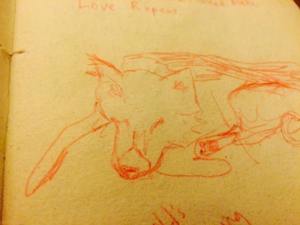
dog drawingA moment must be captured swiftly lest it be taken away with the waking of the dog, or the sudden rush of an autumn
storm that changes the landscape and blows away all your materials. Intention, deft and dexterity must be observed when lifting paint from the pallet. In art you must choose what to keep and what to leave out. Writing is this way too, like the painter whose every move will be documented on the canvas, the poet must be careful about the words they choose and how they will arrange them. These choices will be cretinously examined by critics and peers alike. Disaster or Infamy hang in the balance.  The private journal leaves more room for error and mulling over the most absurd notions. You can draw funny faces of your friends in here or phallic images and none will be the wiser of your still juvenile tendencies.

My leather bound journal has pages made of linen, inspiring both the written word and the art of drawing. Arielle, my little sister, is an art major here at SUNY New Paltz. She gave me this journal for this past birthday. In my mind I want to say something short and profound about the relationship I have with her. It is strange how when we need to say something important the words are hard to come by. Maybe I chose not to write about this object originally because in my writing I’ve journal6been trying to get away from the personal. I wanted to step back and leave myself out of my objects. Bringing myself into them and into my writing makes me vulnerable, a feeling that I’ve been trying to get away from my whole life and one of the reasons I began writing in the first place. I try not to take words for granted, try and put them in their proper place at the right time. They are not objects themselves, or are they? They are brought into being and then erased, re-written. Aloud, they exist in air for a nano-second and disappear. I sweat over them, rubbing my hands beneath the table, chewing on a nail, wanting to speak but never wanting to say the wrong thing. Misunderstanding and failure are too close at hand for me to voice an opinion. It is only through many years of practice have I learned to overcome this.

journal7With the pen it is different. Here, you can speak up, work through your thoughts before presenting them. The details of a life are mundane to those who stand outside its sphere. You must choose carefully what to write to make it true, or else it’s just another slip of paper being put away in a draw. What you leave out becomes more important than what you keep. I have been writing in journals since I was a little girl drawing in them, pressing flowers and writing poetry. In this private place however, you can write as much as you want about whatever you want. I knew I wanted to be a writer before I turned thirteen. My sister followed my lead; the books I would read would become hers, but more often she would use my paints and art supplies to make her own creations. We flourished in our shared little world of imagination.

I’ve been told not to talk vaguely of experience. Seek truth. No one will ever experience the exact same things that my sister and I did. There is a great Tolstoy quote: “All happy families are alike; each unhappy family is unhappy in its own way.” In my family, our father was prone to lighting things on fire, not out of anger or for the love of the flame, but out of sheer drunkenness. The garbage can was a victim often, but mostly the couch felt the brunt of it. He ate, read and slept there every night and would fall asleep with a cigarette in his hand. Next to him were two kerosene heaters he used to heat the house. The heaters themselves, if left till the wick burned out, would fill the house with smoke. Arielle and I would wake up in the mornings and there would be soot on our faces. It looked like you were rolling around in dirt.  The windows were lightly coated with the stuff. If you wanted to look out through barren trees and see the frozen lake clearly you’d have to get a wet towel and clean off the glass.

I broke my little sister’s heart when I left that place behind, she was only fifteen and would spend another year there before moving in with an Aunt. Our relationship suffered for a while, but recently we’ve grown close again. Her gift was a reminder to me that no one else will ever get that close to understanding who I am than her. I didn’t think I could give an object that much importance and meaning until I set down to write this.

babypic

My Voodoo Doll

For this weeks blog post, I decided to write about an object that I purchased myself. This is a voodoo doll that I procured from a gift shop in New Orleans, when I went during Spring Break last March for a volunteer trip with friends from a club that I’m in (SASS, or the Student Alliance for Social Services). After watching American Horror Story: Coven, we were all pretty excited to be going to such a spooky, fascinating, culturally rich place.

10968173_10206052284855887_406591647_n

This voodoo doll was handmade in the city itself, and I was told by the shop owner that my money would go directly towards the locals who crafted the doll. Since it is an authentic voodoo doll, some would believe that it actually has power, if you actually use it for it’s magic. This particular doll is supposed to be a “Goddess to Dominate Your Man”, and inside the tag if gives specific instructions on how to use it. Supposedly, you can personalize your doll with hair, a small photo, or any small personal item by tucking it (or pining it) on to the doll. It says to make a ceremony every morning and every evening by lighting a candle or incense, sticking a pin into the heart for good, stomach for bad, say aloud your desires or intentions and concentrate on your objectives for three minutes. If you repeat this process for nine days, your wish is supposed to come true. This doll was an interesting discovery for me because before actually going to New Orleans and looking at the huge assortment of voodoo dolls, I had thought that they were always used with evil intentions. I looked up history of voodoo dolls and found out: “the voodoo tradition was brought to the New Orleans region by African slaves, often via Haiti and other islands in the eastern Caribbean. Voodoo’s arrival in the Louisiana region caused it to interlope on other traditions already in place, such as Native American and Atchafalaya Gypsy nature and rootwork practices. Ultimately, African Voodoo’s assimilation into these practices resulted in a potent regional hoodoo tradition that persists to this day. Popular among slaves, some speculate that making voodoo dolls and sticking them with pins was one method by which the slave could exert some control over the master: from the very start white plantation owners, mostly of European descent, feared this and its obvious connection to the more familiar poppet magic of their cultures. More often than not, however, the voodoo doll was employed as a weapon against other believers in voodoo, or vodusi, who did not hesitate to use it and immediately recognized its consequences.”

10958561_10206052284375875_78410055_n10984933_10206052284735884_124874553_n10966706_10206052284135869_1459355669_n

I have never actually done the ritual that is explained on the tag of the doll, although I did choose this particular doll for a reason. Around the time I was in New Orleans, my (now ex) boyfriend was planning on moving to California and I did not want him to go. Perhaps if I used the doll and held a ceremony when I woke up and before I went to bed for nine days, it would have actually stopped him from moving! Though he did end up returning, with no help from the doll, we still broke up…

Maybe one day I will learn if the voodoo doll truly works if I ever feel like I need to use it again, but for now it sits as a decoration in my bedroom. I also think that it’s quite beautiful because of the colorful feathers, fabric, and glitter, so it’s not like I bought it for nothing!

10966505_10206052283535854_1757449929_n