My Little Red Box

After my last blog post, I feel that I have exhausted the topic of my ring from San Marino. As a result, I have decided to choose a new object to discuss. My new object was given to me as a gift from my Uncle Rob and my new Aunt Kathy. I refer to her as new only because this is how I had first started to refer to her when my Uncle Rob married her. I was in the eight grade when they decided to get married and for most of my life I had known my Uncle Rob to be a bachelor. So his pending nuptials was a very big deal for my family.

In the eighth grade, my Uncle Rob and new Aunt Kathy asked me to be in her wedding party as a junior brides maid. I felt very honored to be included in the wedding party. With the wedding day being a very big day to the bride, I felt honored that Kathy made an effort to include me and all my other cousins with in her ceremony. I was a junior brides maid, my younger cousin Mellina was a flower girl, my brother and my cousin Evan read during the ceremony. When my Aunt Kathy asked me and my cousins to be a part of her wedding, it felt like she was making an effort not to have anyone left out of the big day or their new life together.

IMG_3136After their honeymoon in Mexico, my aunt and uncle presented me with this red box. It is a ceramic circular box with a lid that opens. When my new Aunt Kathy gave it to me, she said, “When I saw it, the box reminded me of you in every way.” Around the sides yellow swirls are hand painted and on the lid a multi colored flower is designed. I have kept this box in my room back home, in my dorm, and in my apartment off campus. It has followed me through the years holding miscellaneous objects and reminding me of my family. Currently, it holds my quarters for doing laundry.

I always had a great relationship with my Uncle Rob growing up. Whenever he went on trips to San Marino, he would always bring me back a little something. I received a Snow Globe of La Plaza Publico, costume jewelry from Venice, and a glass figurine of a gondola man. All of these objects are still in my room back home. I was very pleased when this tradition did not stop but instead included my aunt Kathy’s opinion as well. Now, they have two sons who are amazing and exhausting. My little red box is a symbol to me of their constant love and generosity.

A Day at the Bullfights: Connecting the Dots of Family History

IMG_0572

The OED defines the word “ticket” as a “short written notice or document.”  As I continue to research the ticket stub handed down by my matrilineal great grandparents, I realize just how apt this definition is. As I noted in the last post, a ticket offers proof of one’s presence in a particular place and a particular moment in time. It is a wonderfully specific little record. Unfortunately, not all records are so specific. While the ticket still stands like signpost, pointing me towards my family history, I find that the roads around the signpost have been obscured through disuse, forgetfulness, and, in some cases, calculated destruction. In my attempts to discover who exactly this ticket belonged to and what it was for, I find myself treading heavily into speculative territory. I hope that at some point, I can come back with a more definitive story. However, for now, I think I have just enough information to get a sense of what happened in San Sebastian on September 6, 1931.

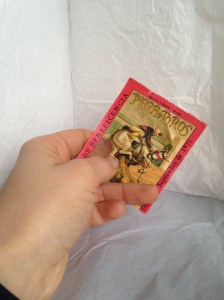
Like most family histories, my mother’s family history is a murky mix of sometimes whimsical, often embellished stories and old photographs with the occasional date and name on the back. So, before attempting to answer the much more difficult question of who the ticket belonged to and why it was saved for so many years, I decided to figure out what the ticket was for. The eye-catching image of the man on horseback fending off a bull suggested that it was a ticket for a bullfight. Testing this hypothesis seemed like a good place to start. However, I soon found that despite the marked popularity of bullfighting in Spain, it is not easy to find information on the Playa de Torros in San Sebastian. This difficulty is due partially to my very limited ability to read Spanish which was, inevitably, the language of many of the web sites turned up by Google Search.

The scarcity also comes from a tendency to pass over San Sebastian’s bullring in order to praise Spain’s more widely venerated rings including those in Madrid and Pamplona. This tendency extends even into more academic writing on the topic. For example, San Sebastian is mentioned only a handful of times in Adrian Shubert’s rather helpful history of Spanish bullfighting, Death and Money in the Afternoon, and none of these reference the ring itself. However, he does note that San Sebastian was a popular summer destination for the Spanish as well as other Europeans, particularly people from France who arrived by trains “bursting at the seams” (Shubert 118).
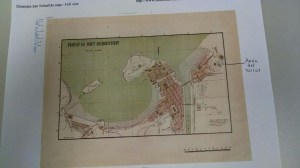
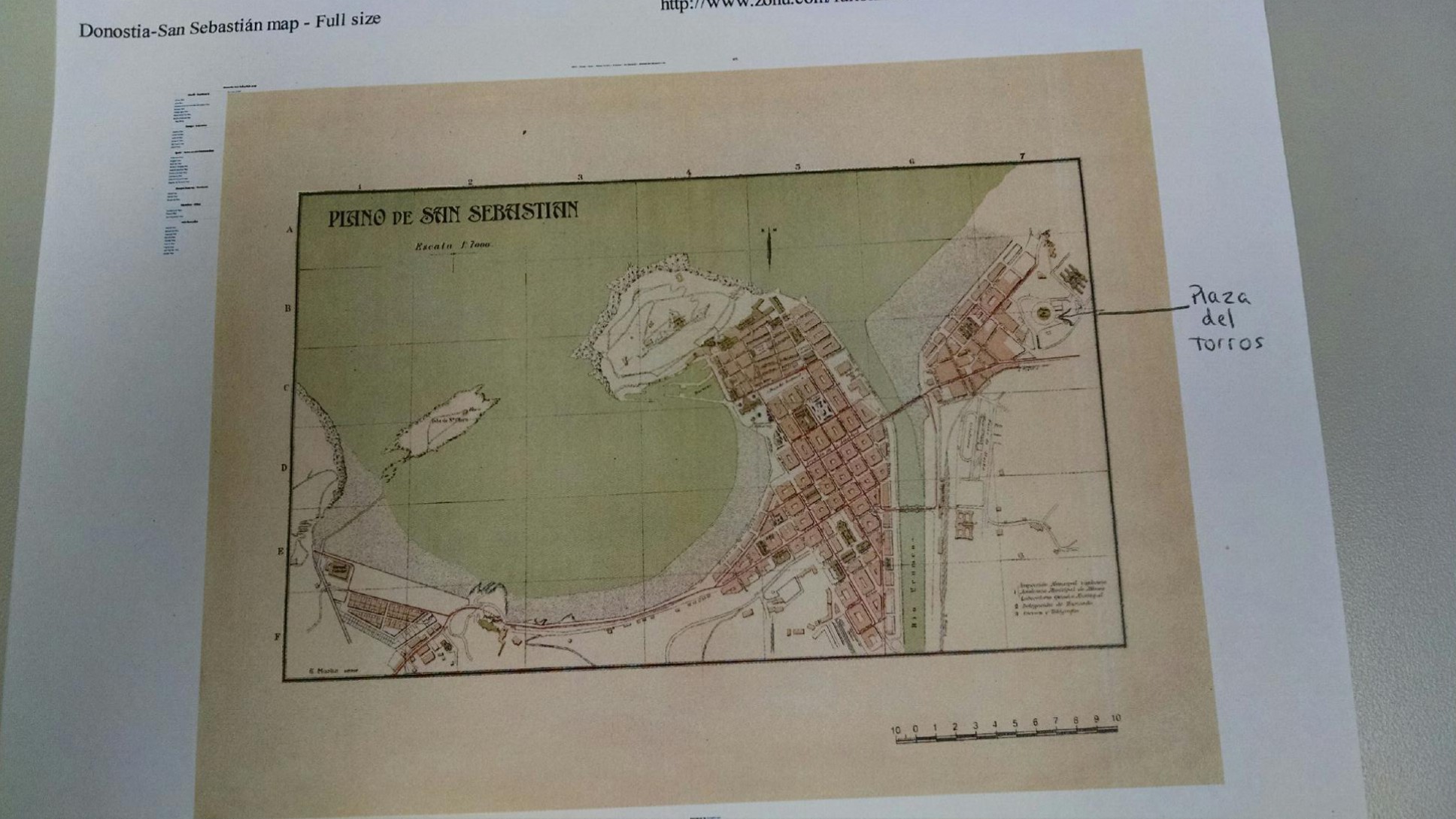
A map of San Sebastian. The Playa de Toros is located on the right.

A map of San Sebastian. The Playa de Toros is located on the right.

Located on Spain’s northern coast near the border with France, San Sebastian is graced with beautiful beaches ringed with mountains, making it a breathtaking vacation locale. However, Shubert argues that it was its bullring that really gave San Sebastian a competitive edge over other similar cities. He cites one source who remarks that cities like San Sebastian “understood that to attract the largest number of visitors it was necessary to include the bullfight among their attractions” (30). San Sebastian had it all, making it appealing to a wide range of people, including celebrities such as Charlie Chaplin.

Charlie Chaplin, at the Playa de Toros (aka El Chofre)  in San Sebastian on August 9, 1931. See citations for hyperlink to original article.

Charlie Chaplin, at the Playa de Toros (aka El Chofre) in San Sebastian on August 9, 1931. See citations for hyperlink to original article.

One newspaper article I found reports that Mr. Chaplin observed a bullfight for the first time at the San Sebastian arena  just a month before my great grandparents attended (ABC foto). Bullfighting seems to have functioned as one the city’s primary social focal points, offering a center that allowed the city’s visitors (including my great grandparents) to gather and mingle with the noteable and famous and the not so notable and famous. Yet, while Shubert’s depiction of San Sebastian offers some clues as to why Emilio and Stella would have chosen to vacation there, it does not offer much information about my ticket stub. After much searching on my part, it is my sister, Holly Bruce, who makes a breakthrough, turning up a poster advertising a “Gran Corrida de Beneficencia” in San Sebastian on September 6, 1931.

My sister's find: A poster adverting the bullfight attended by Emilio and Stella (and possibly their children). Found on a French auction site.    http://www.briscadieu-bordeaux.com/index.php?resultpage=14&action=fiche_vente&langue=fr&id=149

Lot 408 or My sister’s find: A poster advertising the bullfight attended by Emilio and Stella (and possibly their children). Found on a French auction site. See citations below for hyperlink to original page.

Setting aside my affronted sense of sibling rivalry, Holly’s find answers all of the questions I raised in the last post about the ticket.  Not only does the poster fill in the words missing from the front of the ticket, but it reveals what the ticket was for. The word corrida, which so prominently occupies the lower left half of the poster, translates to “bullfight.” Meanwhile, the phrase A favor de la Casa de Misericordia y Hospital de San Antonio Abad, written in thin black script underneath the date and the time, roughly translates to “In favor of the House of Mercy and the San Antonio Abad Hospital.”  The text in the bottom left indicates that there will be eight bulls (8 Hermosos Toros) at this event while the text in the right hand corner lists the names of the matadors in the order that they will appear. Now the only question is, who did the ticket belong to and why did they save it?
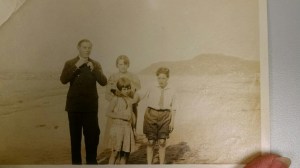
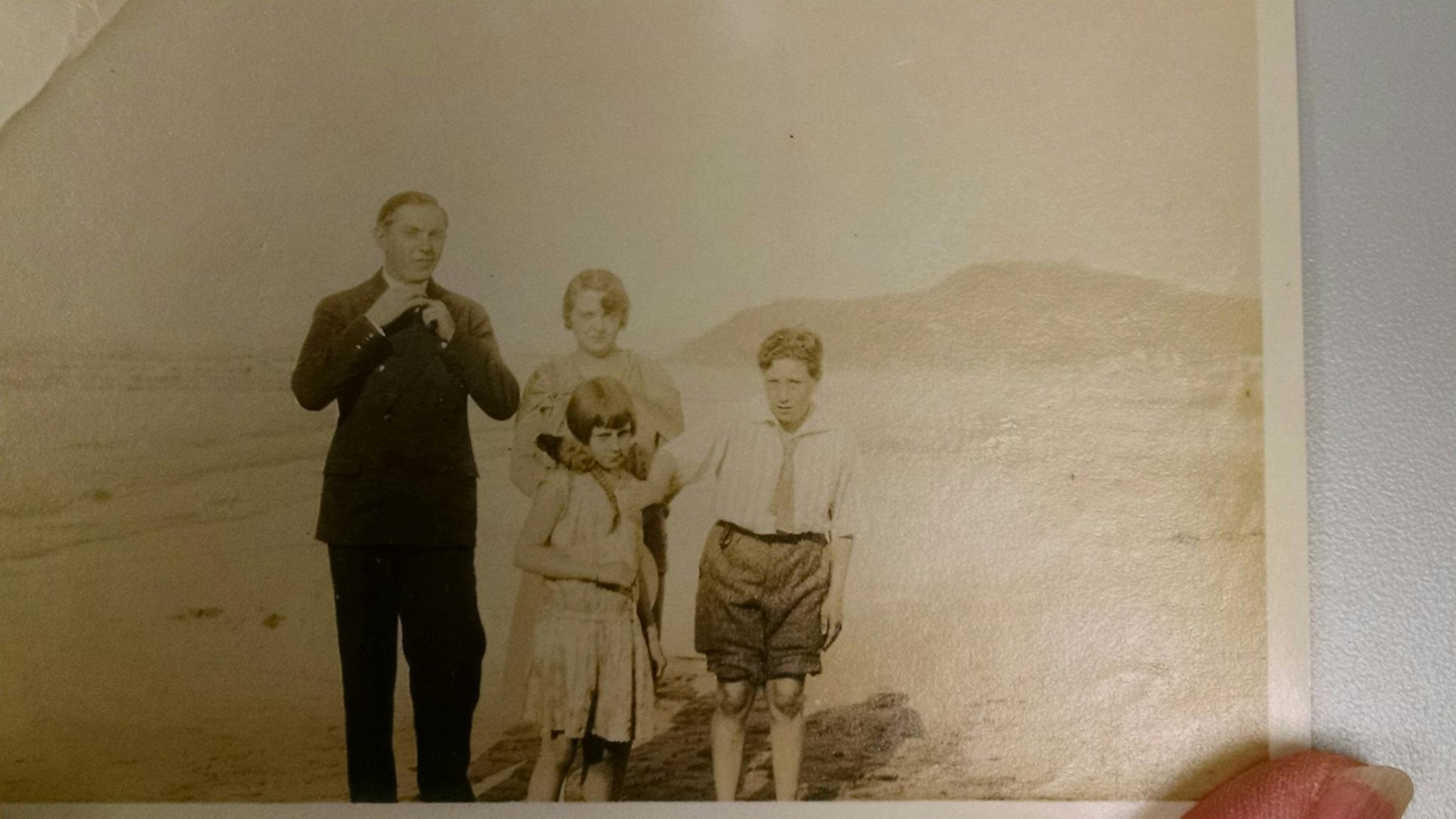
Emilio de Jauregui, left, and  Stella de Jauregui, back, and their children Emilio Ricardo , right, and little Stella, center. Thought to be a beach in San Sebastian

My Great Grandparents: Emilio de Jauregui (left) and Stella de Jauregui (back) with their children, Emilio Ricardo [my grandfather] (right) and little Stella (front). Thought to be a beach in San Sebastian

    Here is where we step into the speculative realm of family history, a place ripe with the potential for error. Indeed, I have already stumbled across one error in my last post. In a recent discussion with my mother, she mentioned that her father, Emilio Ricardo de Jauregui, was born in 1917. I did some math. That would make him fourteen in 1931, certainly old enough to attend the bullfight. Similarly, his little sister, Stella, (my great grandparents were perhaps not incredibly inventive when naming their children…) would have been eleven, perhaps just old enough to attend as well although the bullfights could be particularly gruesome making this seem a little unlikely. Still, it is possible than that this Sunday outing might have been a family affair.

It is also possible that my great grandparents attended the event on business rather than pleasure. According to my uncle, Philip de Jauregui, Emilio Senior served as diplomat for El Salvador during the family’s time in Paris (a space of about six years between 1928 and 1934) although the position might have been more ceremonial than political. If this is accurate, then it would certainly make sense if the Salvadoran diplomat attended a charity bullfight, a move that would certainly be noted and probably positively received by the French and Spanish alike. Yet, the stern man featured in the photo above does not seem like the type to save a ticket stub. Perhaps it was my great grandmother, the serious lady standing to his left. My mother has her own supposition. She believes that it was the little girl in front, my great aunt Stella. Even if she did not attend the event herself, it is possible that her mother, father, or, even her brother gave the stub to her to make up for what she had missed. Or, perhaps she was simply drawn to the ticket’s aesthetic qualities. It is certainly beautiful enough. While there is no real evidence to believe she was the one who preserved the ticket all this time, it was little Stella that kept most of the family lore, collecting photos, mementos, and documents and stashing it in her California apartment. With Stella’s death in 2004, my mom’s connection with her past was significantly weakened, leaving us all to connect the dots on our own.

Perhaps we have connected the dots wrong. However, this seems to trace a tentative path back to that ring, back to the crowds shouting, and the dust rising off the arena as the matador dodges another thrust of bull horns. It traces a path back to the frozen faces of that little family huddled together on a beach, squinting at the camera, waiting for the flash so they can move again.

Works Cited

ABC foto. “Charlot va a los toros.” ABC foto. DIARIO ABC, S.L. 22 July 2014. Web. 28 Jan. 2015.

http://www.abc.es/abcfoto/anverso-reverso/20140721/abci-chaplin-charlot-toros-charles-chaplin-chofre-201407181827.html

Gran Corrida Poster. Briscadieu Bordeaux. http://www.briscadieu-bordeaux.com/index.php?resultpage=14&action=fiche_vente&langue=fr&id=149 Web.

Martin, A. “Donostia-San Sebastian.” 1.700 “Zonu.com” http://www.zonu.com/fullsize-en/2011-02-08-12920/Donostia-San-Sebastian-map.html#.VM2zqgcpk10.email (30 January 2015).

Shubert, Adrian. Death and Money in the Afternoon: A History of the Spanish Bullfight. New York: Oxford UP, 1999. Print.

“ticket, n.1.” The OED Online. Oxford University Press, December 2014. Web. 1 February 2015.

There Is More to the Story

Another story with one old index card.

Old. How old? Old enough where it is safe to write about Three Finger Luis?

I cannot say too much… I know Big E would not have wanted me to write explicitly about this man.

Three Fingers? It is true, and probably one of the best mobster names I have heard yet.

If you asked my godfather’s father — the District Attorney of Westchester from 1968 to 1994 — he would have told you Three Finger Luis was definitely not a myth. In fact, Carl Vergari — the father of my godfather (my godfather who was also my uncle because he married my dad’s sister…. yes, one big Italian family) — came to Big E asking her to reveal the whereabouts of Three Finger Luis and she would not say. Luis gave her the good bread, she wouldn’t be disloyal to him!

All of this from one index card. Yes.

How?

Because you talk while you cook. You talk while you eat. You talk about eating while you eat if you are in my family. Nanny and Big E would plan out what they would have for dinner while still eating breakfast.

pineapple bars


A recorded recipe straight from my grandma is rare.

This index card — when not in my room here at New Paltz — is stored in a box in my kitchen closet. The box is deep in width, but small from top to bottom. It is on the top shelf. If you are my mom, sister, or me we pull up one of our broken kitchen chairs to get to the top shelf. It seems we are always pulling the chairs across the floor to the closet to get a recipe… maybe that is why they are broken. There are many other recipes in the box. Recipes my dad has written down, or my aunts have added, or my mom taken the time to record, to print ideas from online, or to cut out of a magazine. Some of these are recipes are the collaboration of family members recreating a recipe that was my grandma’s and some are just part of the overall collection.

Pineapple bars are best frozen. You take them out of the freezer, unfold the tinfoil, and bite into a sweet bread base topped with a soft pineapple mix. Online you will find recipes for pineapple coconut bars, lemon bars, pineapple, coconut, and oatmeal bars. But this, this recipe recorded on the stained old index card, is the real deal.

I called my dad to solve the mystery of the origin of Pineapple bars. His first response was telling me to be careful with the recipe because “it is the only we got.”

My dad knew exactly where the recipe came from, but not the exact person. He recalled for me the two years they lived on Buckingham road in Yonkers. One of their neighbors gave my grandma the recipe because my Nanny liked it and so did the rest of the family. Of course this lady was an Italian lady, but the recipe itself is not specifically Italian.

The next step that I see, is to start spreading this question to the rest of family to figure out the name of the Italian lady who lived on Buckingham road that gave my family the recipe that is now being discussed in 2015 through a class at SUNY New Paltz. This opportunity to go back leads to more questions. And these questions are important. Knowing the history gives a fuller present, a deeper sense of here and now.

The Misleading Wedding Ring

ring

I had to hear this week’s object described to me by my mother, so bear with me! When prompted to uncover a family heirloom, she immediately thought of my grandfather’s wedding ring, which she now carries. She described the ring as yellow gold that almost looks like brass. 14k gold and very plain looking on the outside, the ring is inscribed: “Yours Forever Marie, 9/23/51” My mother told me that his father, my great grandfather, was a barber in Ridgewood, Queens and a customer that came into the barber shop was the jewelry salesman who sold him the ring. Money was tight and the ring was more affordable because they bought it from a family friend. My grandfather couldn’t even tell me how much he actually spent on the ring.

Now what I find most interesting about my grandparents is their names. Both of them come from Italian families, and my grandmother’s birthname is Maria Olivia Carbone. My grandfather’s name is Angelo Ales. For some strange reason, the names that most people actually refer to them as are not Maria and Angelo, but rather Marie and Al. My grandmother had more nicknames than just Marie. Her siblings actually called her Mary, her driver’s license said Mary, and her extended family called her Mimi. She referred to herself as Marie and signed her name as Marie, even though her mother apparently had given her the name Maria. This ring is inscribed “Marie”, so that indeed seems to be the name she wished to be refered to. However, when she was alive and I was around both of my grandparents, Al called her “Honey” so much you’d think that he would have had that petname inscribed on the ring. She called him “Albert” when she was mad. No one ever refers to him as Angelo, except for legal forms.

My grandmother died in 2009 at 83 years old. Their marriage lasted for 58 years. My grandfather is still alive and obviously does not wear the ring anymore, since my mother has it. My aunt wears my grandmother’s matching wedding band around her neck and my mom keeps my grandfather’s, and one day it will belong to me. Unfortunately the words inscribed on the ring did not really hold up to their promise. Even though the marriage lasted for almost 60 years, my grandfather was most certainly not Marie’s forever because a year after her death, he bought another woman flowers on Valentine’s day. I don’t really blame my grandfather for wanting to move on with his life, I just find his word choice for the inscription quite humorous. It’s interesting that the inscription of the ring was so wrong on so many accounts, not even having my grandmother’s actual name inside of it.

Image001Image000   Image004Image002

Discovering the Rubáiyát

Feeling, that I had already touched on the history of my two objects from the first class, I chose another object that has a great significance to me. For this particular assignment, I turned to my favorite collection of poems, the Rubáiyát of Omar Khayyám. The book was originally given to me, by my brother, for what occasion, I can’t remember. However, I had first been introduced to these works in English class, my Freshman year of high school. And, despite my lack of enthusiasm for my teacher at the time, I never forgot the work of Omar Khayyám. It stood out to me as the most interesting and beautiful piece I had read up to that point in my life. The particular version that I have contains the 1st, 3rd, 4th and 5th editions of these poems, translated into English Quatrains by Edward Fitzgerald and published by Random House Inc, the date of Copyright being 1947. As a whole, this collection of poems discusses the brevity of life and the need to find the joy in it. What more, it gives this sense of hope, through a lens, which brings us into the fantastic and colorful world in which both Omar and Fitzgerald have strung together, centuries apart.

Processed with VSCOcam with c1 presetScreen Shot 2015-02-02 at 4.20.06 PM

Examining the information in the preface of this collection, I learned that the title of the book, the word,  Rubáiyát translates to “collection of rhymes” from Persian, self explanatory for sure. The original author, whose full name is, Ghiyathuddin Abulfath Omar bin Ibrahim al-Khayyami, which translates to Omar, son of Abraham, the tent maker, studied with the wise men of the Sultan. He was a mathematician, philosopher, astronomer, and obvious poet, who created work throughout the 11th and 12th centuries. The thing I find most fascinating about this particular work is the ability Fitzgerald possessed to bring to life the words, that were separated by geography, time and language. What is more, Omar apparently created a disjointed and somewhat haphazard collection of thoughts, which Fitzgerald, during the 1900’s wove into a series of some of the most revered poems in history. Perhaps the most interesting part of this collection is that Fitzgerald, originally from Ireland, found a connection between his home of Erin, and Omar’s Iran. Believing himself to connect as the “forgotten poet”. While the content of these poems may not have fit the “Victorian priggishness” of the time, Fitzgerald felt so passionately about this work he decided to publish it himself. To connect so fully to a place and time you haven’t experienced yourself, except through another person’s work, is a beautiful idea. And, I guess if you think about it, many of us have felt the same when reading some of our favorite stories.

Processed with VSCOcam with c1 preset

As I am taking a translation course this semester, I’m learning very quickly the layers upon which a good translation is formulated. Not only is there a need to have a familiarity with the language, but it is necessary to take into account, culture, context and idiomatic phrases that may be culturally specific to that language or time. When reading anything that has been translated, it is always a wonder how much of it is true to the original, and what ideas have been lost in translation. Obviously, with this work, we will never really have an answer as to what was lost, but the way in which Fitzergerald has constructed these ideas, along with the help of beautiful pictures, created by Mahmoud Sayah, what was lost, may not be missed. Altogether this piece of art has surpassed the ages of time to be loved and read by the contemporary world. And, although I have taken only a few printed books with me to college, the Rubáiyát was the first one I packed away. In closing, I’d like to share one of the poems with you guys that I’ve always found thought provoking:

I sent my Soul through the Invisible,

Some Letter of that After-life to spell:

And by and by my soul return’d to me,

And answer’d “I myself am Heav’n and Hell:”

The Wooden Box

This small wooden box, no larger than my open hand, is somewhat trivial at first glance. It is 5 inches in length, 4 inches in width, and 3 in depth. Although I’ve never thought about the type of wood that my box was crafted out of, I’ve always loved the smell that drifts out when you open the lid, and upon presenting the task of “let’s identify this type of tree” to my friends recently, they all cited the sweet smell of pine as their main clue. On the back of the box, about one inch below the lid are two brass hinges that join the top piece to the bottom. Similarly, the clasp on the front side is also made of brass, and has a hinge and a hook that once allowed me to lock the box closed. These brass pieces also gave us a definitive clue in identifying the type of wood; one of my friends made the point that they were not attached to the box with glue or screws, so they must have had pins on the back that were pushed into the surface, which tells us that a soft wood like pine makes sense. On the surface of the wood is a carving of a wolf howling at the moon set against a dark circle (presumably the moon itself). Below the howling wolf is a series of three wolves, running through the snow and following very closely behind one another. The exterior of the box has been sanded down and coated in a layer of polyurethane, which makes it smooth to the touch and shiny to the eye.

IMG_3776

The box has no engraving or stamp as to indicate where or by whom it was made. It is smooth polished wood all the way around.

I was seven years old when I pulled this box off of a shelf for the purpose of using it to protect more precious items. It was July and I was visiting the family camp in the Adirondack’s, enjoying time with my cousins in a little town called Cranberry Lake. The plot of land located on the water had been purchased by my Grandfather in 1962 from the State for $2000 and had been passed down to his family when he died in 1968. In 2000, his twelve adult children came together and built a camp on the site, making Cranberry Lake one of the most important places in our family’s history. With a year-round population of about 450 people, Cranberry Lake, very much like this box, is a seemingly small and inconspicuous part of the larger environment around it. But for my cousins and I growing up, this sleepy town was the eighth wonder of the world; the vast expanse of untouched forest and the single dirt road that ran all the way around the lake were ours to explore.

IMG_3778

The box is now home to letters, love notes, and other girly trinkets that are generally embarrassing to admit that I own.

That July, my cousin Holly and I would walk two and a half miles down Colombian Rd. into town at least five times a week. Mostly it was because we had specific activities that needed to be carried out (we often brought chalk down to the Oswegatchie River and colored the tops of the large boulders, or caught salamanders on the bank of Matilda Bay and set up a ‘Natural Habitat’ for them), but the other half dozen times were because we simply liked to day-dream. By this time in my adolescent life, I had the fondest interest in collecting things; snow globes, stuffed animals, stickers, and whenever I was up at camp it was usually rocks, feathers, and everything that I wasn’t allowed to bring inside at home. I carried a small bucket and Holly wore her overalls with the deep pockets, and we would walk and talk, stopping any time we pleased to pick up a stone off the side of the road or reach for a particular leaf on a branch. By the time we made it home my bucket and her pockets would be full and our feet would be tired, but our minds were satisfied.

At the end of the month, when Holly and I had to say goodbye to all of the discoveries we had made that summer, she said we should find something to protect our most favorite objects. I remember taking our very last walk into town and venturing into one of the only two stores there. The Cranberry Lake Gift Shop was right across the road from the Lakeside General Store where we usually got our ice cream. The Gift Shop was full of a bunch of garbage (or at least that’s what our dads told us) so Holly and I nIMG_3780ever much bothered to go in. For the most part, it was exactly that; a souvenir shop with wind chimes, floor mats, ironic bumper stickers, and “Cranberry Lake, ADK” t-shirts of every size and color. I quickly gave up on the place and was turned towards the door when Holly called from the other end of the store. I met her all the way in the back where there were two glass shelves with these wooden boxes. We were immediately attracted to the shiny wood grain and polished knots that reminded us of the thousands of trees we had walked past that summer. We were drawn to these boxes because there was something about the howling wolves and the sweet smell of pine that breathed life.

Even now, thirteen years later, the box fills my nose with that scent and fills my heart with nostalgia. I’ve long since gotten rid of the objects I initially put in it, and I’ve long since forgotten what they were. That Gift Shop in Cranberry Lake closed five years after I bought the box in 2002, and the building itself came down not too long after (the owner cited a mold infestation). The Lakeside General Store is the last man standing in the Town of Cranberry Lake, and it looks as if it might stay that way for a long time.

Trip July 8 to July 10, 2012 - A 465-1

This is a photo of the Lakeside General Store taken in 2012. It has looked the same since 1994. Across the street (to the left of the ‘Hershey’s’ sign) was where the Gift Shop once stood.

I have gone back to the Adirondack’s many times since I was young and I have ventured into dozens of souvenir shops, looking for a box that is similar to mine, only to be disappointed each time. I want to feel that sensation of being immediately drawn to an object and I want to get excited all over again. More importantly, I think I want to find a way to re-live that beautiful period of my childhood; I’ve been searching for an object that makes me feel as accomplished and adventurous as I felt when I bought that box at the age of seven.

Claddagh Ring Update: The Tale of Tipperary

ireland

Tipperary is a bit southeast of Limerick, which is where I studied last semester. http://www.worldatlas.com/webimage/countrys/europe/ie.htm

My claddagh ring is an object I realize to be quite common—it’s a piece of jewelry that has been manufactured many times to be sold in “traditional Irish shops” across the states and in Ireland. I decided to look into the shop I knew my grandmother purchased the ring from. tipperary-logoThe shop is called “Tipperary” named after the town and county in Ireland located in Munster province and was founded in 1979. Tipperary is known as the “Celtic Jeweler of Irish imports” and according to their about section on weddingwire.com, “stock the widest and most extensive selection of Irish hallmarked gold, silver and fashion jewelry anywhere including Ireland itself. Really no other Irish shop even comes close”! I’ve been in this shop and I mean, yeah sure it had a lot of Irish-y things but that seems like quite a lofty claim for a shop located in the middle of nowhere, Brunswick New York to be making in my opinion.

So I decided to pop on over to their website and have a look around to see if I could find anything about manufacturers and companies they partner with for their imports. I knew going into it I probably would not be able to find my exact ring because it was purchased nearly ten years ago but I set out to look at the rings that would perhaps most closely match the style of the one I own. I began looking under “Rings” and selecting “Sterling Silver Claddagh” but that proved to be an overwhelming search on the site since there’s just so many option that the store sells. Instead I looked by brand to narrow down my search and came across the company “Facet Jewellers” which is a “luxury diamond jewellery store” that was founded in 1978, located in Dun Laoghaire, Co. Dublin.

9360_b_635373703193485742

This is what’s called the Sterling Silver Maids Claddagh ring by Facet Jewellers, Co. Dublin http://www.shoptipperary.com/sterling-silver-maids-claddagh-ring

9964_b_635373715630942113

This is Facet Jewellers 14k Yellow Gold Diamond and Emerald Claddagh Ring priced at $1,987.50 (an internet special for the store! Get it while you can!) http://www.shoptipperary.com/14k-yellow-gold-diamond-and-emerald-claddagh-ring

Now, I can’t be sure as of right now that this is the same brand that my claddagh ring came from but in comparing the style of my ring to one I found on the site, they are similarities and differences but it seemed plausible! I suppose the most helpful thing I could do would be to go to the shop itself and have it looked at so maybe I will do that at some point this semester! The ring I found online is a bit more ornate than the one I possess but it is still quite simple in its design compared to others sold on the site. This one is priced at $69.99, which is modest in comparison to rings I saw for hundreds of dollars, some even over $2,000. Depending on the material used to make the ring, the price obviously skyrockets. Some of the rings sold on the site are white gold or yellow gold; some have gemstones embedded into the heart or along the band.

It’s interesting looking at all the different styles because it makes me appreciate the one I have even more. I love how simple my ring is—its something I feel comfortable wearing every day. It’s an unassuming piece of jewelry that still holds a story and carries significance to me. I definitely want to go to the shop and have someone take a look at it but in the meantime I think I should give my grandmother a call and ask her why she chose this as a present for my thirteenth birthday. There’s still lots more to discover about this humble ring!

The small cross, examined more closely

I mentioned at the end of my last post that I was hoping to take my grandmother’s necklace to a jeweler to see what I could learn about it or its origins, and this is what I did over the weekend. I took it to Hannoush Jewelers in the Galleria and asked the woman behind the counter what she could tell me about it straightaway. I was, as it turns out, correct in assuming that the metal is not real silver. According to the jeweler, it’s likely a composite metal, as all precious metals are stamped (many with a maker’s mark as well as with the name of the metal), even when the piece is only plated.

The jeweler also told me that the stone in the center of the cross is likely either aventurine or a dark jade. Not knowing much about jade and having never heard of aventurine,  I decided to do a Google image search for both (links to results below).

Aventurine: https://www.google.com/search?q=aventurine&client=tablet-android-samsung&espv=1&source=lnms&tbm=isch&sboxchip=Images&sa=X&ei=IrrPVPK2L4eNsQTJl4LADg&ved=0CAgQ_AUoAQ&biw=800&bih=1280

Jade: https://www.google.com/search?q=jade&client=tablet-android-samsung&espv=1&source=lnms&tbm=isch&sboxchip=Images&sa=X&ei=RrrPVIOgOvePsQTEsoDABw&ved=0CAgQ_AUoAQ&biw=800&bih=1280

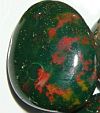
Aventurine seems to have a higher mica/reflective mineral content (and thus a more “sparkly” appearance) than the stone in the cross, and the jade seems much brighter in color. Digging a little deeper (I actually did a Google image search for “green jade with red flecks), I found this image.

bloodstone(Unfortunately, I couldn’t zoom in on the necklace close enough for a comparison shot. Sorry.)

This stone is actually neither aventurine nor jade, but rather green chalcedony flecked with iron oxide or red jasper/piedmontite, commonly known as “bloodstone” or “dragon’s blood jasper”. (I can link to some information I found about bloodstone if anyone wants it.) Given that this stone looks strikingly similar to the one in the cross, I think it’s a safe bet to say that the stone in the cross is the so-called bloodstone. Ironic, isn’t it?

In short, the jeweler informed me, it’s just a piece of costume jewelry. I think she (and my dad) thought I would be disappointed at the fact that it isn’t valuable in a monetary sense, but that actually isn’t true at all. Finding out what I did about the necklace revealed something about my grandmother; that is, that she was very frugal and worried about money constantly. I mentioned in class that she had a hard life growing up–she actually ended up needing to quit school to work so that she and her mother could bring in a livable income after her father died. Even after she got married and was able to stop working to rear the children, she always worried that the money would run out. Even during their older years, after my father and aunt had moved out, she worried  about how they would afford things like home repairs, insurance, and maintaining their property. Although the cross symbol (and little accessories as well) attracted her, she wasn’t going to spend inordinate amounts of her/her husband’s hard-earned money on them when that money could be put toward savings or practical expenses. In a sense, I’m very similar in that I try to be as practical ad possible with money. My family has never had to worry about money the way my grandmother did (thank God), but my parents always made sure to model fiscal responsibility for my sister and me growing up, and I’ve sort of taken that to extremes now that I have a job. I think it’s interesting that we’re kind of connected in that way.

Making Meaning Through the Tarot

“Madame Sosostris, famous clairvoyant,Tarot and book

Had a bad cold, nevertheless

Is known to be the wisest woman in Europe,

With a wicked pack of cards.” – T.S Elliot’s The Waste Land

Where does the drive to know the truth begin, and where does it end? How do we find the words or images to make meaning out of our seemingly meaningless existence? Philosophers, poets, and artists (if not all the same being) have sought to bring to light these questions, but often their answers provide little solace for those on the receiving end. Who do we trust to make such meaning, a friend, a stranger, a wise man, a fortune teller? Despair in the modern world led T.S Elliot to write The Wasteland, and in his epic poem, he references the Tarot several times, using it to relate back to his own life and create a masterpiece. The deck whose cards he references is the Rider-Waite Deck (Leavitt, 14). His poem would be considered one of the greatest poems of the twentieth century, but with countless literary, philosophical, and spiritual references would only be completely understood by a small population. Still, without comprehension of every footnote, much like the tarot cards themselves, the poem can be appreciated and loved by many who read it.

Pamela Colman Smith

Pamela Colman Smith

Most occult historians surmise that the beginnings of the Tarot are shrouded in mystery. Some say it originated in ancient Egypt and then traveled to the Levant and onward to Greece and Europe.  Others insist that it did not appear until Renaissance era Italy (Gray 6). There are many conflicting hypotheses of why exactly it was created in the first place,
making it a hard craft to study. During the mid-15th century the tarot pack would have been used for playing card games by nobles, and even specially painted to resemble the families that were given. Although Edward IV had outlawed the importation of decks into England, the tarot still made its way into the country with the help of traveling gypsies (Gray 8).

Golden Dawn

Hermetic Order of the Golden Dawn

strength-tarot-of-the-cat-people

Cat People Tarot: Strength

In 1886 the Hermetic Order of the Golden Dawn was formed in England. Many celebrities were part of the order, including W.B Yeats (Raine 6). In 1910 Arthur Edward Waite enlisted the help of Pamela Colman, another member of the Golden Dawn and renowned artist of the time, to paint seventy-eight allegorical paintings using Waite’s descriptions of the Tarot pack (Gray 9). These images have served as the standard for Tarot packs in the English-speaking world and have influenced the creation of thousands of different unique decks since then, which include subjects from “Cat People Tarot” to “Zombie Tarot” and beyond.

Those who study the occult often make a business out of it. A haggard man on the street in Woodstock once offered to read my sister her cards for ten dollars (or “whatever you have to spare”). In my imagination, I concoct elaborate images of gypsies and magi who studied the tarot hundreds of years ago. I do not know of any others in my own life who practice the art themselves but have tried to reach out to those in the community to learn more to no avail. Until recently, there was a shop in town called “The Silent Muse” that advertised on their website psychic readings, antiques, and items of the occult. If one was to peek in the dirty windows of The Silent Muse, they would see an old Knight’s suit, glass displays containing different spiritual stones, and dusty tapestries hanging on the walls. Although the owner had a list of available hours on the door, they were never open. Recently the sign was taken down, and the inside of the store was cleaned out.

Celtic CrossIn 1971 The Rider-Waite Tarot deck copyright was purchased by U.S. Game systems Inc. The new world merges with the old, and those who can strike the balance are left in the dust. There is no concrete evidence to support the accuracy of fortune-telling. One thing is for sure, the images of the tarot will continue to delight, inspire and confuse for a long time to come. More than anything, the deck serves as a way of connecting with archetypes of the past rather than a method of predicting the future.

Works Cited:

Gray, Eden. A complete Guide to the Tarot. New York: Bantam Books, 1970. Print.

Leavitt, June. Esoteric Symbols: The Tarot in Yeats, Eliot, and Kafka. Lanham: University Press of America, Inc. 2007. Print.

Raine, Kathleen (1976) [1972]. Liam Miller, ed. “Yeats, the Tarot and the Golden Dawn”. New Yeats Papers II (second ed.). Dublin: Dolmen Press. p. 6.

Italian Cross

While gathering items for the first day of class, I searched my keepsake box to see which items I had set aside some years ago for safekeeping, and I came across this metal cross. It wasn’t kept in a jewelry box, or a plastic bag, but was just laying there beside a small rosary case. In more recent years, as I’ve gotten older, I’ve taken more care in storing valuables, especially jewelry, so I’m almost certain that I placed this cross in my keepsake box some years ago when I was in elementary school. Given that it was next to a set of rosaries given to me by my grandfather and most of the other items in the box were mementos of him, I figured this was probably from him, too.

Oddly enough, I know origin of the rosaries that were next to the cross – they were a gift from my grandfather when he returned from Italy (specifically the Vatican) when I was about four. The cross, however, was more of a mystery. There is tiny print on both sides of the cross, but it is quite minuscule. So I broke out my magnifying glass and in a tiny corner of the cross, on the side with the “M” for Mary, the word “ITALY” was inscribed. The other writing (on what I perceive as the front of the cross since it has an image of Mary on it) pertained to Mary and her immaculate conception – no further information on the origin of the cross.

cross 1cross 2

With the information inscribed on it, the cross was probably made in Italy, and I thought it was probably purchased there too, considering I stored it with other items from Italy. I asked my mother if she remembered any more of the history of the cross, and she confirmed my suspicions of my grandfather bringing it back for me from his trip to Italy, which we devised took place after we moved out of his house in 1998 and before his death in 2000.

I returned to the rosaries for some more clues, noticing that the rosary case had an image of a pope on it. With Google confirmation, it was an image of Pope John Paul II who was pope from 1978 until 2005. Those dates were not helpful, but another image I found online, quite similar to the one on the rosaries, was taken before 1998, so it that was a dead end, too. In conclusion, the cross was purchased in the Vatican between 1998 and 2000, by my grandfather. The rest is still a mystery.