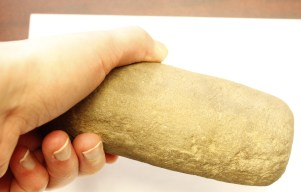
Pestle found in August, 2012 on Historic Huguenot street between the Deyo and Bevier houses; this tools have been used for cooking, medicinal purposes, and spirituality dating as far back as 2500 B.C. Photo Credit: Julia Ponder

Bee Balm, a red flower with medicinal properties that grows in the Hudson Valley. Photo Credit: herbsguide.org
The Sandstone Pestle found on Historic Huguenot in August of 2012 is an object that dates back as far as 2500 B.C, and shows us how valuable sturdy tools were in a time that lacked modern amenities. Pestles are representative of cultures that relied heavily on plant matter as a source of food, and its second life as a nutcracker indicates a people who had a strong relationship to their objects, even after they were broken.
There is an old folklore told among the Muncee people of the story of the maiden Lanawee and her lover, “The Arrow.” Before the night of their wedding, the two lovers’ families met and were getting ready for the following day when The Arrow was taken sick by small pox, which had been plaguing the local people. Within the night the Oswego bridegroom died of his ailment. Lanawee was so stricken by grief that she in turn killed her self in the very spot that her betrothed had met his end, meaning to sacrifice herself to the Great Spirit in exchange for the good health of her people. Lanawee held a knife to her chest and shouted to the sky, “Lay me with The Arrow, I am but a blighted flower!” before taking her own life. The next morning when their families returned both bodies had disappeared, and in the place where their bodies had been grew bright red flowers, which are today widely called by the name Bee Balm. After finding the bodies, the relatives of Lanawee and The Arrow decided to hold a celebration in honor of the departed and used the Bee Balm to decorate their clothing and hair. Later on, tea was made out of the plant, and was named after The Arrow’s place of origin, Oswego, and therefore become Oswego tea which was said to cure smallpox (Pritchard 298).
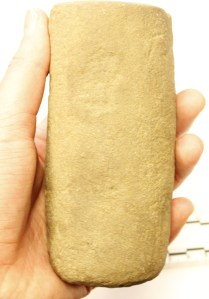
Photo Credit: Julia Ponder
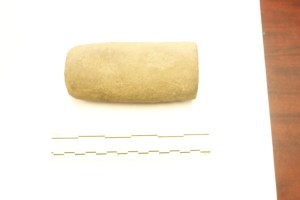
Photo Credit: Julia Ponder
A mortar and pestle would have been used to crush and grind the flower that made Oswego tea, this pestle would have been very similar to the one found on Historic Huguenot street in 2012 by SUNY New Paltz Professor, Joe Diamond and his crew.The pestle is made of sandstone and has a cylindrical shape with a flat bottom, which is slightly rough, and has edges that have been worn dull with age. It is heavy in the hand, a completely solid item that is not easily broken; its smooth and rounded top fits nicely in the palm, while the bottom flat part of the pestle indicates its original form was different, and that we are actually only holding part of an original piece. Most likely at some point in its history this tool was broken in half, but was kept still after it was broken and used. The pestle is hypothesized to have been at least twice as large when it was first made, currently its size is about five inches in length and three in width. There is indication that the pestle served another purpose in its second life as nut cracker, due to the indent on its upper left side where it was most likely used to crush acorns. Although it is impossible to tell the story of a single individual who might have owned this tool, we can let our imaginations make inferences as to where and when it belonged, and what significance it had to a culture which lacked all modern amenities.
Today, Pestles are usually seen with a mortar, but the one found by Professor Diamond’s crew was alone. Archaeological digs on the North East coast have many times discovered pestles that have attached effigies, most commonly a bear’s head, but also that of phallic symbols. Bears were sacred spiritual animals to the Algonquin people (Diamond). Pestles with bear effigies most likely did not serve the purpose of grinding, but were “fetishes or the guardian spirit of women” (Lenik 141).
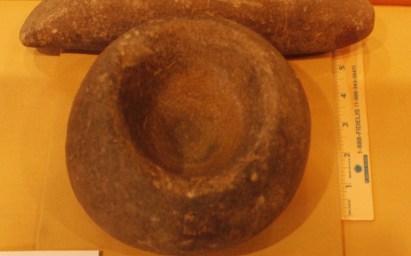
Complete Pestle and Mortar on display at Historic Huguenot. It was found in Hurley, NY and donated by Reuban B. Crispall, October 1965. Photo Credit: Julia Ponder
The tribes of the Munsee were predominant in the New Paltz area, conducting trade and having confrontation with the setters (Grumet 48-49). Is it possible that this pestle could of traded hands between the Huguenot’s and the Muncee, and that an effigy could have been broken off in order to use this tool for other purposes? This question is quite possibly unanswerable, and expert Joe Diamond believes that this was just your ordinary everyday pestle; an object of simplicity, yet at the heart of traditions like cooking, medicine making, and spirituality. These objects are used still today for the same exact purposes as they were centuries ago.
A complete pestle and mortar can be seen on display on Historic Huguenot street. In proportion to the number of pestles found in the Hudson Valley, mortars are more scarce. This is due to the difficulty it took to hollow out the stone to create the mortar (Parker 60). Other’s speculate that the mortar was more easily used over again and again, therefore they were less likely to be discarded and harder for archaeologists to find. When they are found, pestles and mortars indicate that the culture that once used them was relent on plant foods, where a lack of such objects indicates a more hunting oriented culture. Not only does the pestle serve for crushing herbs for medicinal purposes, like the families of Lenawee and The Arrow, the pestle offered a way to eat plant foods, and smash grain that would have otherwise been inedible proving to be an essential tool in the lives of ancient peoples across the globe. In a world where common cooking objects are considered disposable, the Huguenot Street pestle reminds us that every day objects can still be reused and have value even after they are broken.
Works Cited:
Diamond, Joe. Personal Interview. 13 April 2015.
Lenik, Edward J. Picture Rocks: American Indian Rock Art in the Northeast Woodlands. Lebanon: University Press of New England, 2002. Print
Grumet, Robert S. Manhattan to Minisink: American Indian Place Names in Greater New York and Vicinity. Norman: University of Oklahoma Press, 2013. Print
Parker, Arthur C. The Archaeological History of New York. New York: The University of the State of New York, 1920. Print.
Pritchard, Evan T. Native New Yorkers: The Legacy of the Algonquin People of New York. San Francisco: Council Oak Books, LLC, 2002. Print.
 The Materials of History, Thought, and Art
You must be logged in to post a comment.