
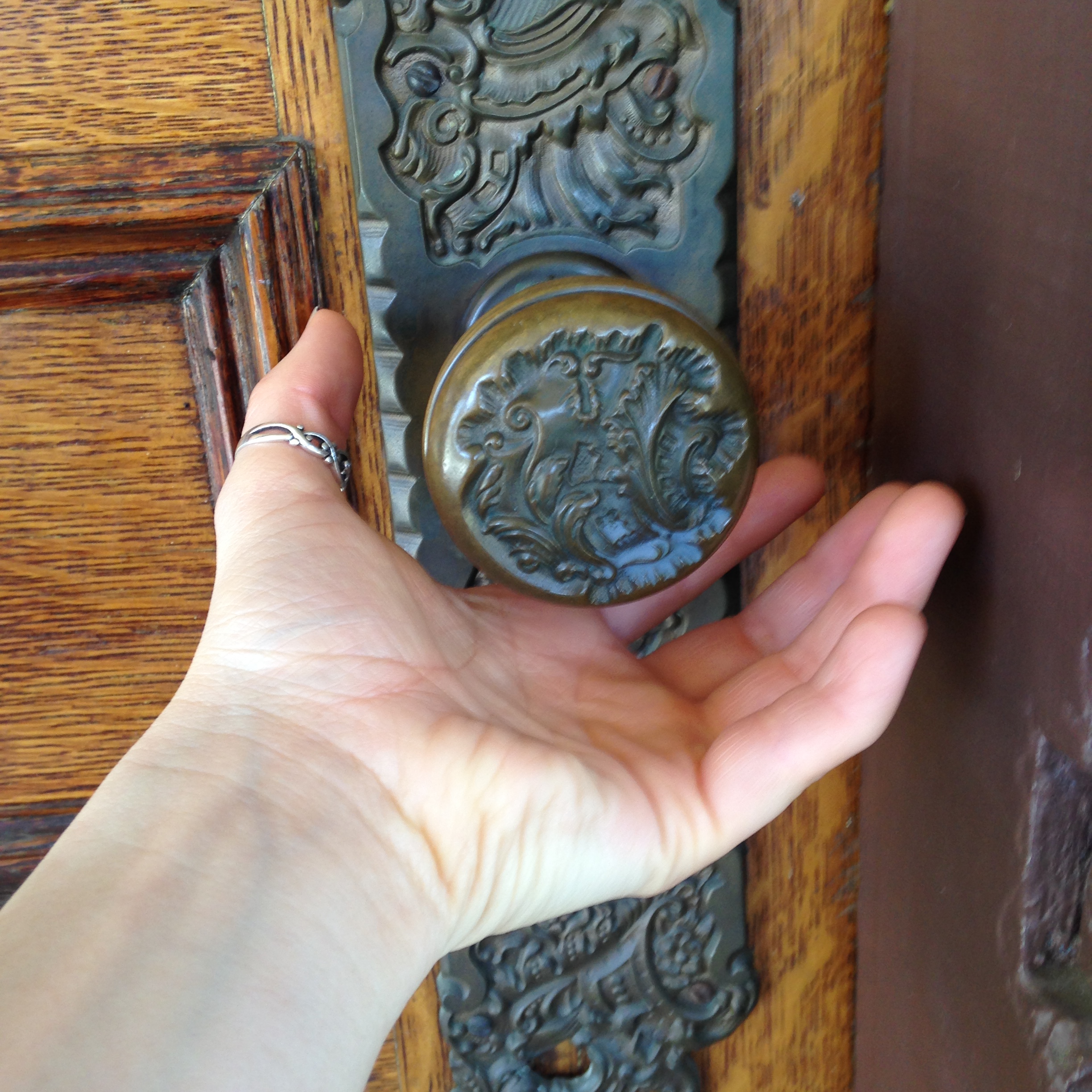
This iron object may be a simple screwdriver or part of an old shutter fastener. Although its age and exact purpose are unknown, it is clearly the work of skilled blacksmith who poured time and sweat into its crafting. In contrast, the bronze door knob and escutcheon on the Deyo House, made in the late 1800s, were likely machine cast and mass-produced. Together, these objects chart the economic and cultural impact of the Industrial Revolution on the New Paltz community.
Roughly three and a quarter inches long and three inches at its widest point, the iron object resembles a rusty capital “T.” A close inspection of the wide bar indicates that the object was formed by hammering a single piece of iron into shape, making one end of the bar a little thicker than the other. It also reveals a small maker’s mark on one side, a little cross engraved into a circle, so small it is almost lost in the rust. Extending perpendicularly from the wide bar is a long shaft that spirals into a long flat point similar to the tip of a flat head screwdriver. The similarity has raised the possibility that the object is an unusual but well-crafted screwdriver. However, the spiral of the shaft and the delicate taper of the wide bar also resemble the decorative elements found on wrought iron shutter fasteners. Attempts to establish a more concrete identity for the object have been foiled by its sheer uniqueness.
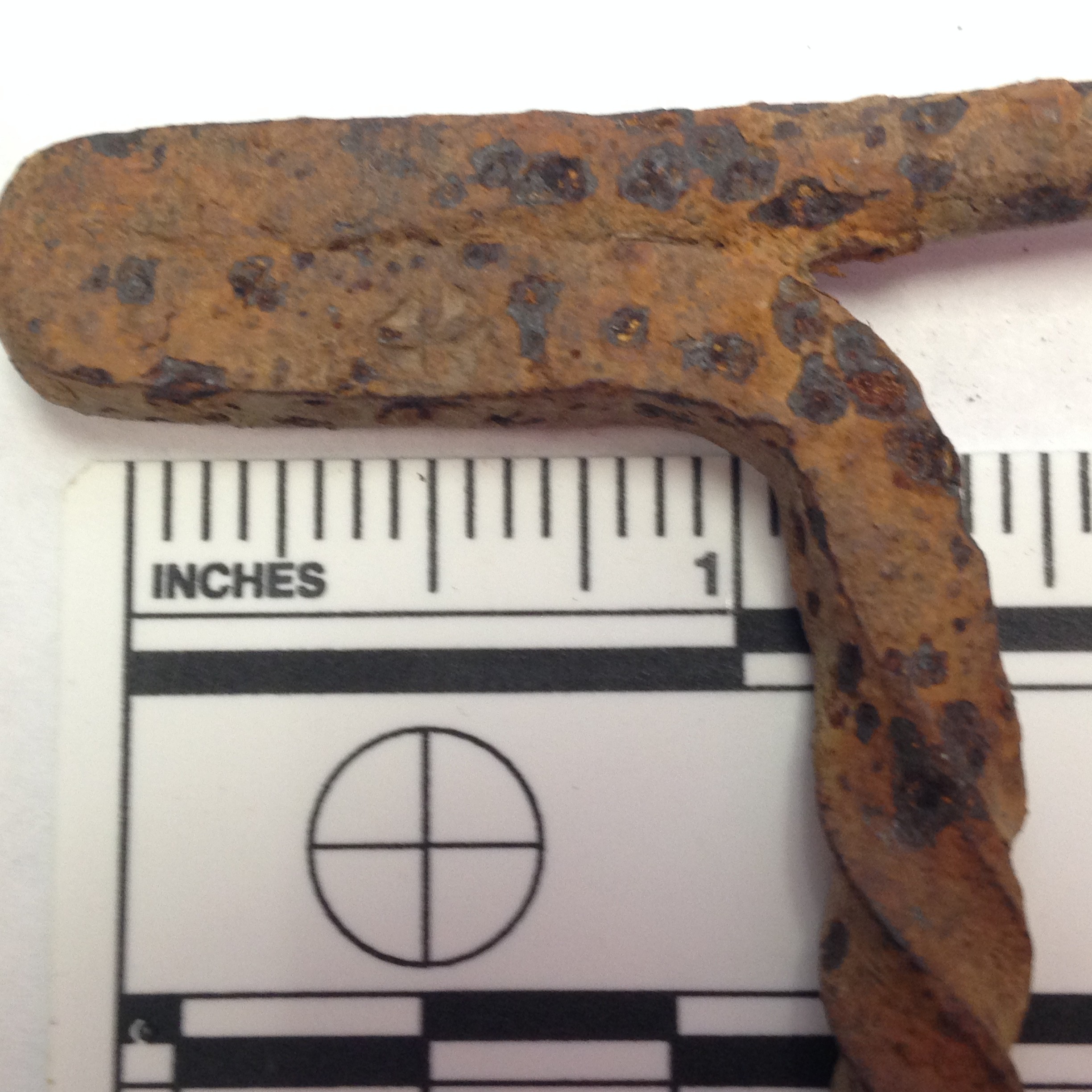
Just above the half inch mark on the ruler lies the faint imprint of a maker’s mark.
If the iron object is too unique to be defined, then the bronze door knob and escutcheon (the decorative plate around the keyhole) are perhaps too common although they might not appear so at first. Both the knob and the escutcheon have an elaborate floral pattern cast on the surface, giving the set an elegant, eye-catching air. The escutcheon is especially attention-grabbing. Measuring sixteen by three inches, it is a roughly rectangular shape. However, the top and bottom have been molded into the form of acanthus leaves, creating an asymmetry that draws the eyes away from the relatively simple wood door to the more impressive hardware. Although the bronze has become dull and tinged with verdigris, one can imagine that its original burnished gold color would have made the set even more beautiful. While there is no visible indication of who made the set, Weston Davey, Historic Preservationist for the Historical Huguenot Street, suggests that it was probably machine cast (Davey).
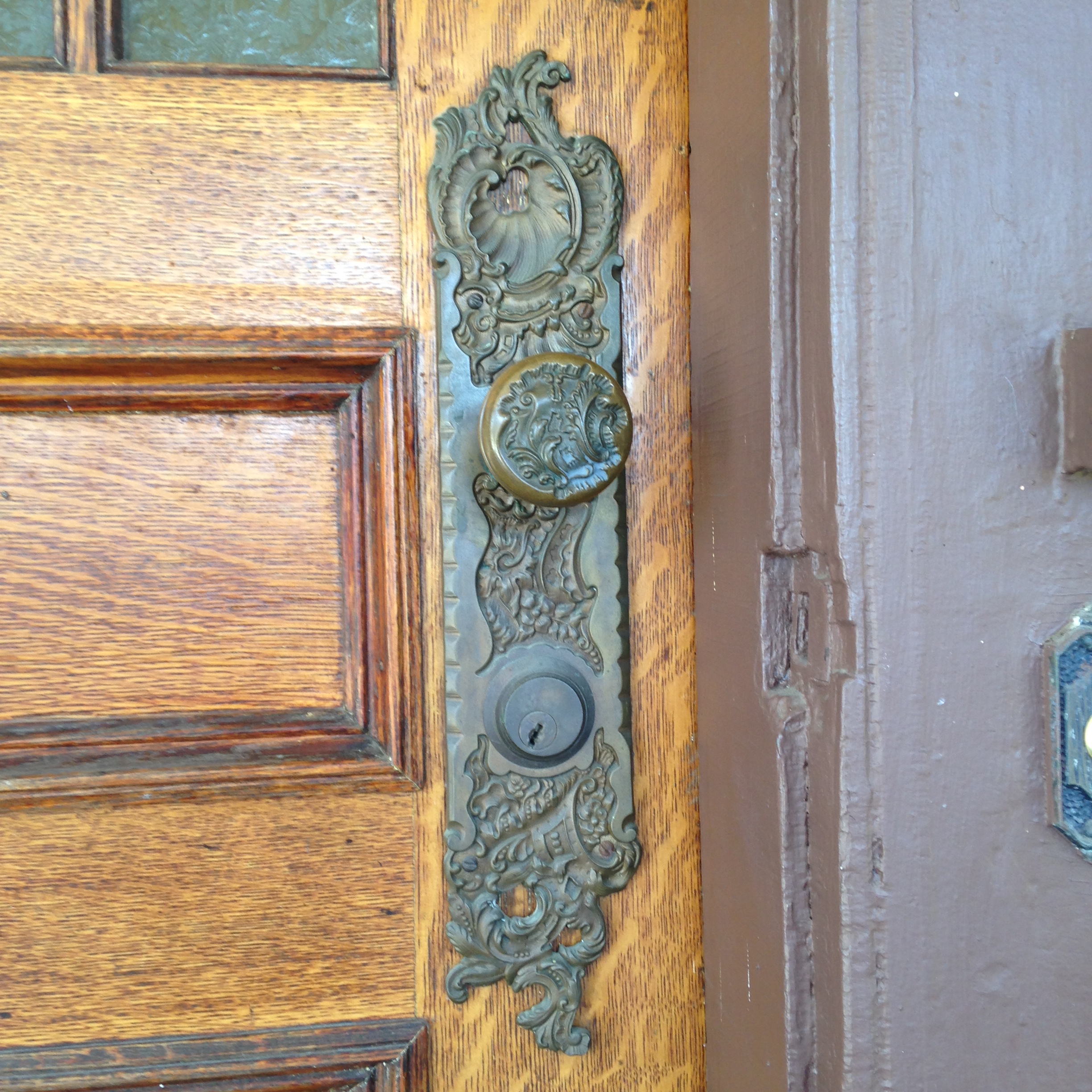
The acanthus leaves at the top and bottom of the escutcheon are beautifully molded, giving the otherwise rectangular shape a fluid appearance.
Found during a recent archeological excavation near the Deyo house, the iron object’s ownership remains as much a mystery as the date of its making and its true function. However, Joseph Diamond, a professor at SUNY New Paltz and the head of the excavation, notes that if it is indeed a screwdriver, it is possible that it came from a kit used to maintain muskets (Diamond). If this is true, then the object would likely be carried around with its owner in times of conflict or on hunting trips in order to make potentially life-saving adjustments. Yet, it is just as possible that the object was once attached to one of the several structures that used to exist on the lawns between the Deyo house and the Bevier-Elting house, making it a far more stationary, and perhaps less dramatic object. Regardless of whether it was a tool kept close at hand or a piece of house hardware, it seems likely that the object served some functional purpose in the daily life of an early New Paltz resident. Perhaps even more importantly, the maker’s mark on the side indicates that it was the work of a craftsman who took pride in his work and wanted it to be recognized.
In contrast, the door knob and escutcheon, were likely purchased from a catalogue by Abraham and Gertrude Deyo-Brodhead when they chose to renovate the Deyo house in 1895. They have remained there ever since although the house has changed hands three times. The last owner, Harold L. Wood, sold the house to the present owner, the Huguenot Historical Society, in 1972.
The tension implied between the handcrafted, locally made iron tool and machine produced, nationally distributed door knob comes to a head in the 1895 renovation of the Deyo house. Built by Pierre Deyo around 1692, the original Deyo house was modest stone structure not unlike the neighboring Bevier-Elting house. While later descendants added a wing to accommodate the growing family, the exterior of the house otherwise remained relatively the same. This changed when the Deyo-Brodheads inherited the house in 1893. Abraham and Gertrude were proud of their Huguenot heritage (both could trace their family line back to Christian Deyo, patriarch of the Deyo family and a signer of the original patent), but they nonetheless desired a grander space than the stone house built by their ancestors. In her summary of the Deyo house history, Jaquetta Haley suggests that their ambition was curbed only by a lack of funds. Most of the couple’s income was drawn from relatives or revenue from the horse racing track that Abraham had built across the Wallkill. However, in 1890, Abraham’s paternal great uncle died, leaving the family a substantial amount of money. Almost immediately after taking ownership of the house, the Deyo-Brodheads began making plans to renovate, transforming it from a simple stone house to a Queen Anne Style manor.
Almost every feature of the house is meant to impress even, as we have seen, the door knob on the front door. Yet, the grandeur rests on a certain superficiality made possible in part by the relatively new ability to mass produce luxury items using machine labor. The result was seemingly elegant items that could be afforded by the rich and the aspiring rich alike. The bronze door knob and escutcheon are an excellent example. The beautiful acanthus design gives the impression of being well-crafted. However, a quick scan of the door knob and lock section of the Montgomery Ward and Co.’s Catalogue and Buyer’s Guide for Spring of 1895 (around the time the renovations began) reveals several similar knob and escutcheon sets all selling for around a dollar (approximately twenty-five dollars today). This reproducibility signals a changing dynamic for the residents of New Paltz. Not only were craftsmen such as the blacksmith who made the iron object rendered obsolete, hastening a shift in the local economy, but the culture had also shifted from the practical aesthetic of the early settlers to an aesthetic of ornate imitation.
Reference
Davey, Weston. Personal Interview. 9 Apr. 2015.
Diamond, Joseph. Personal Interview. 13 Apr. 2015.
Haley, Jaquetta. “Furnishing Plan: Deyo House.” New York: Huguenot Historical Society, 2001. Print.
 The Materials of History, Thought, and Art
You must be logged in to post a comment.