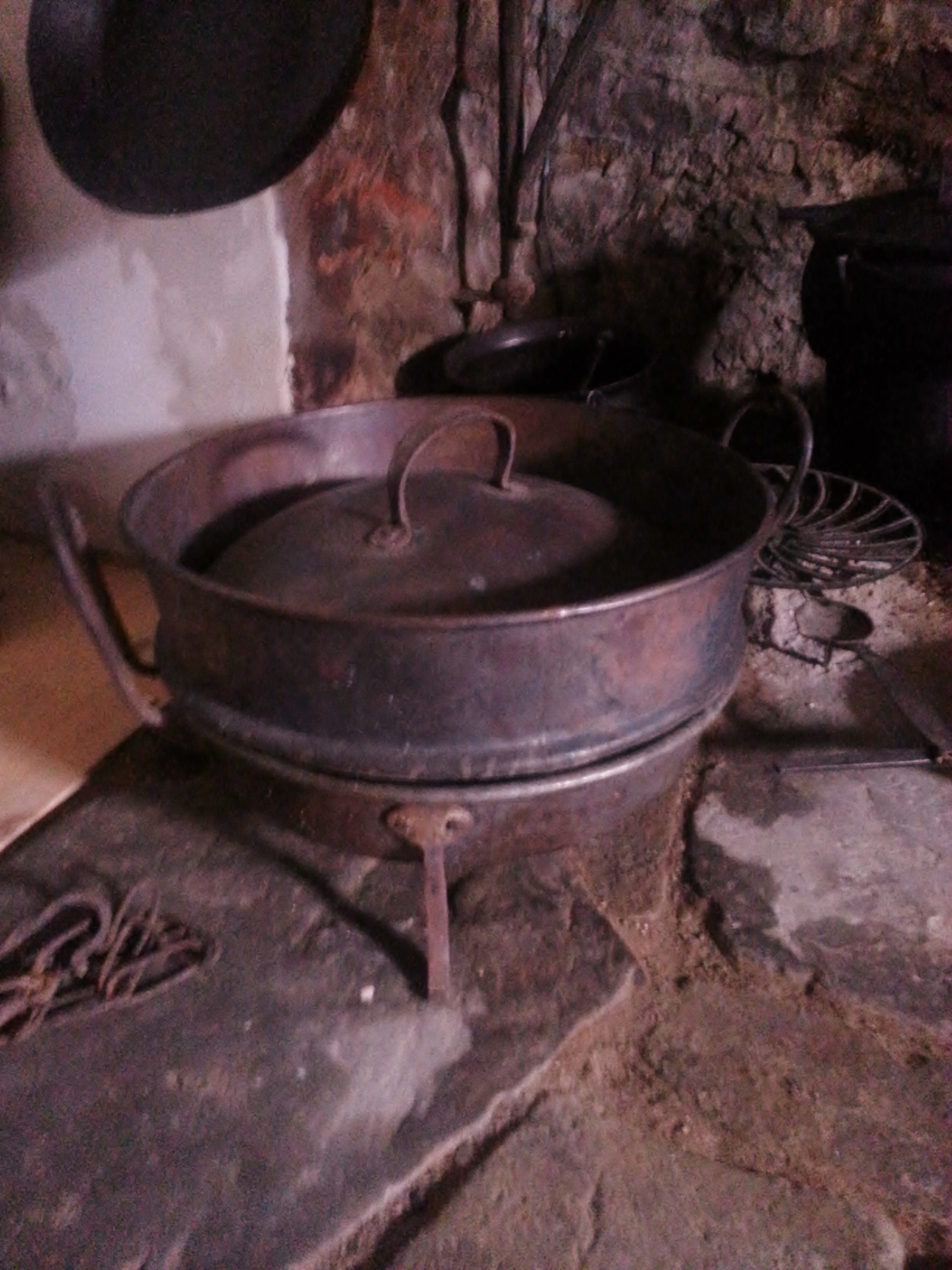
The Dutch Oven currently residing in the Abraham Hasbrouck house, is just one of the many cooking tools that were used by the female slaves. We can use this object as a clue to help figure out the untold stories of the slavery on Historic Huguenot Street.
Physical Description:
The Dutch Oven in the Abraham Hasbrouck house is 12 inches in height and 20 inches in diameter. There are two pieces; the lid and the base. The lid has one main handle in the middle on the top and the base has two handles across from each other on the sides. The base also has three legs on the bottom which allows for heat to be placed underneath. The handles and the legs are made of wrought iron. The shape of the Dutch Oven is circular and the base and lid follow this shape in unique ways. The lid slightly raised in the middle and dips down closer to the edge; however, the lid is mostly a flanged for heating purposes. The base caves in a tiny bit towards the center. The copper on this structure has been oxidized and the surface feels gritty to the touch.
Provenance:
The female slaves in the Hasbrouck households would have frequently used a Dutch Oven for its wide spectrum of capability. This particular example of a Dutch Oven is borrowed from Locust Grove. Locust Grove is a historic estate, museum, and nature preserve. The Mansion on Locust Grove was built in the mid-nineteenth century. It was built for the artist and inventor, Samuel Morse. This property was then handed down to the Young family and from there has been “protected in perpetuity” since 1953 (lgny.org). When the Young family first moved in, the house was prodominately redecorated. If the Dutch Oven currently residing in the Abraham Hasbrouck house was originally from the Morse family or brought in with the Young family, it cannot be older than roughly 150 years.
The Dutch Oven can be used in both an outside fireplace and inside fireplace. The aged and weathered texture shows how used this particular piece has been. The idea of the Dutch Oven exists in many cultures all over the world. The original prototype is not clear; however, the impact of the Dutch Oven is very relevant. There are different names for this one idea, but labeling this oven “Dutch” circulates in literature during the 18th century (Evans). The first Dutch Oven to be brought or made in America is yet unknown. One hypothesis suggests that an Englishman named Abraham Darby went to Holland and observed the techniques for making these ovens, then spread this information (Evans). Whether the oven is Dutch or from another culture — this invention is able to travel well and is used for incredibly interchangeable ways of cooking food.
Narrative:
In the Hasbrouck households of Abraham and Jean, the most used rooms were the slave quarters. The slave quarters in each house were comprised of one cellar room. This one room would transform from a bedroom at night to a kitchen during the day. The female slaves were the ones who ran the kitchen. Their tasks were centered around the fireplace because the fire was the source of life for the food they produced for the Hasbrouck households. The slave quarters in the Abraham Hasbrouck house had low-ceilings and little ventilation. The smoke and soot from the fire defined the quality of air the women were breathing all day as they worked. The fireplace in the Abraham Hasbrouck house has a huge hearth which made space to orchestrate many forms of cooking at once.
There are no records of what a day was like for female slaves because there are scarcely any documents giving any sort of context about their lives. The only documented clues we have to their lives are in wills and runaway notices. The wills connected to the two Hasbrouck brothers give the possible opportunity to find any mention of the female slaves they owned. Mary Hasbrouck, wife to Abraham, left in her will to her son Daniel two slaves; “I give and bequeath to my son Daniel… gold, silver and negro and negress” among many other things she names (hrvh.org). Jean Hasbrouck left his daughter Elizabeth the slave named Molly; “I give to my daughter Elizabeth… my negro woman named Molly” (genealogy.rootsweb.ancestry.com). Molly enters the story around the early 18th century. Her name represents countless other slaves who have never been written down. All of the tools used for cooking hold some aspect of an untold story of the female slaves who have handled these objects. As the Dutch Oven helps us dissect just one part of a greater whole — Molly helps us by standing for the female slaves. She represents the endless possibilities of stories we will never know.
The Dutch Oven has a perfectly fitting name in French — “faitout” — which translates “to do everything” (Chappell). During the time this type of oven was used by Molly and the other female slaves of the Hasbrouck households, it certainly did live up to its French name. This invention has an incredible spectrum of versatility. Depending on where the heat is placed, this structure can perform multiple different tasks. The oven then receives heat from a ratio of hot coals. Molly could use the Dutch oven for roasting, baking, making a stew, frying, etc.. If she wanted to roast meat, she would have to fuel the oven with heat from both the top and the bottom. She would place coals underneath the base and on top of the lid in a one-to-one ratio because roasting requires relatively equally dispersed heat. If Molly was baking bread, she would have to place more coals on top because most of the heat should come from the top while baking. If Molly was making a stew for the day or simmering some soup, mostly all of the heat would come from the bottom and so she would place the hot coals underneath the base.
In order for each meal to be cooked well, Molly would have had to develop a sense of balance for how many coals go on top or bottom and how the ratio affects the meal. Molly also had to be aware of avoiding hot spots. About every ten minutes or so she would have had to stop what she was doing and rotate the pot and lid in opposite directions (Evans 78). This would prevent the food from heating up in just one spot.
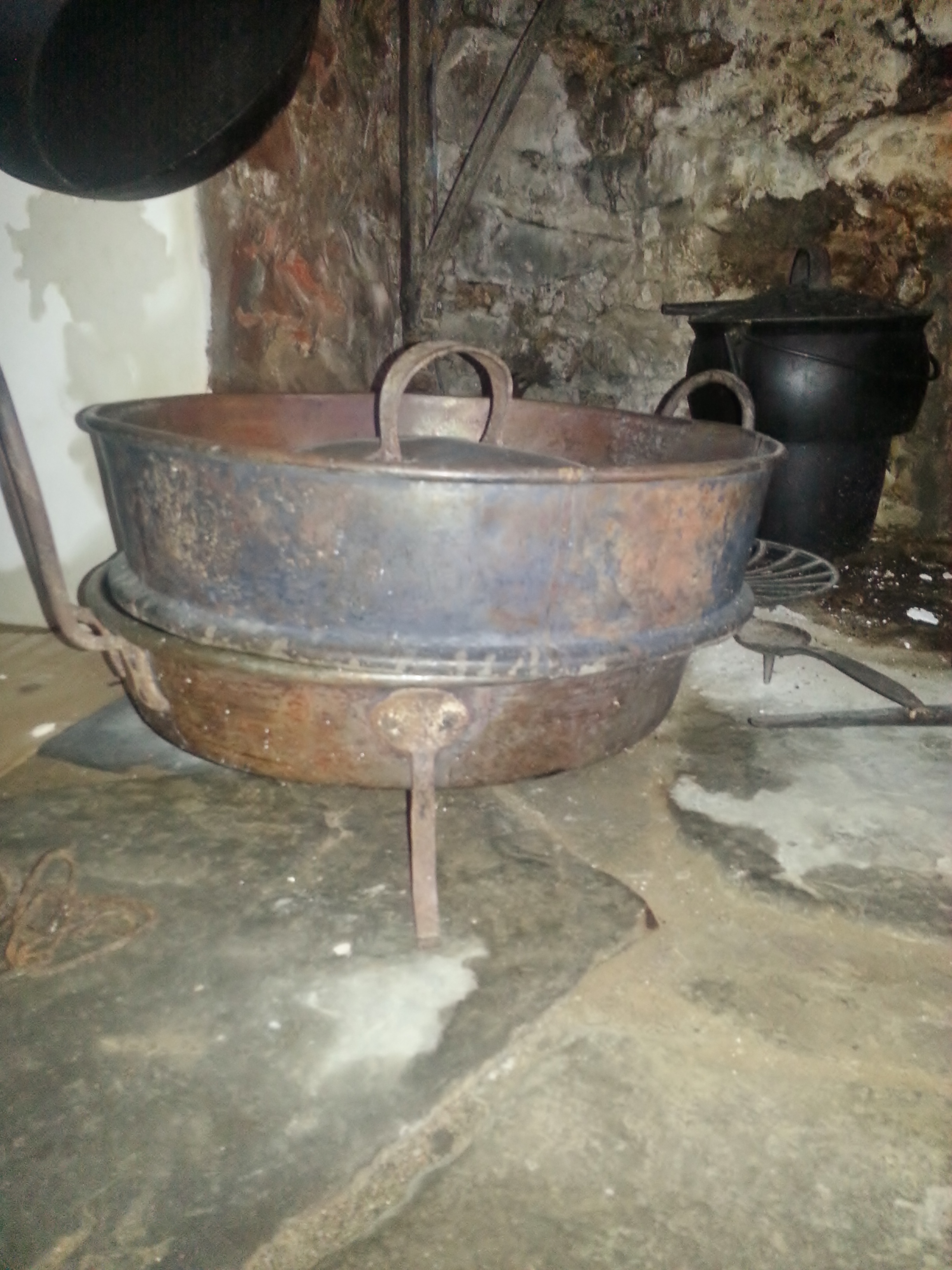
The oven currently in the Abraham Hasbrouck house is made from copper. Other Dutch Ovens were made from cast iron. Both materials are metals and therefore the heat conducts throughout the structure making both just as precarious for burns. The hot coals combined with the steadily heated oven, procures a chance for danger. The only descriptions we have of the slaves in New Paltz are from runaway slaves notices. Some descriptions include pockmarks and hunched backs because the living conditions were awful. The ceilings were low and they were expected to travel all day throughout these rooms (Weikel). For a small room with a huge fireplace filled with many different sources of burning metal, hot coals, flames, and boiling water… it is difficult to imagine that nothing happened.
How do we know what the day of a female slave was like? How really do we know what they did? The jambless fireplace of the Abraham Hasbrouck house gives us clues and the exact implications of using the Dutch oven gives us even more context. Even still, the amount of attention that went into one appliance is only a small fraction of the work completed in the kitchen on any given day. Besides the actual task of cooking, there is preparation and clean-up. The Dutch oven needs consistent attention after careful consideration of where to place a certain amount of heat for each specific dish. This gives a glimpse of how much interaction all of the materials on the fireplace might have had. There are so many other cooking tools and this one example of a Dutch oven is just part of a bigger whole.
References
Chappell, Mary Margaret. “The everything pot: there’s not much a Dutch oven can’t do.” Vegetarian Times 2014: 38. Academic OneFile. Web. 27 Apr. 2015.
EVANS, MATT, and JOHN EVANS. “The Dutch Oven.” Countryside & Small Stock Journal 94.3 (2010): 78. MasterFILE Premier. Web. 19 Apr. 2015.
“Hasbrouck Douments.” Hasbrouck Documents. Ancestry.com, n.d. Web. 24 Apr. 2015.
Kelly, Shirley. “History of the Dutch oven.” Countryside & Small Stock Journal 2013: 56. General OneFile. Web. 23 Apr. 2015.
“Mary (Deyo) Hasbrouck Will of 1729 :: Historic Huguenot Street.” Mary (Deyo) Hasbrouck Will of 1729 :: Historic Huguenot Street. Trans. David Wilkin. Hudson River Valley Heritage, 10 Nov. 2010. Web. 23 Apr. 2015.
“The Mansion | Locust Grove.” Locust Grove The Mansion Comments. Locust Grove Historic Estate, 2011. Web. 13 May 2015.
Weikel, Thomas. Personal Interview. 8 April 2015.
 The Materials of History, Thought, and Art
You must be logged in to post a comment.