Although the contents of this simple table are unassuming and seemingly unimportant, the table actually displays a piece of technology that would become an important token household item during the establishment of the colonies. This tabletop hand loom consists of a sturdy, hollow wooden base about one to two feet in length. Inside of the base is a thin board with slots cut out of it at perfectly even intervals to create little bars; on these bars is cast a newly-begun fabric tape. On both sides of the board are rotating wooden dowels, one of which holds the thread being fed into the piece, and the other of which is empty but may very well have been designed to have the finished tape wound around it.
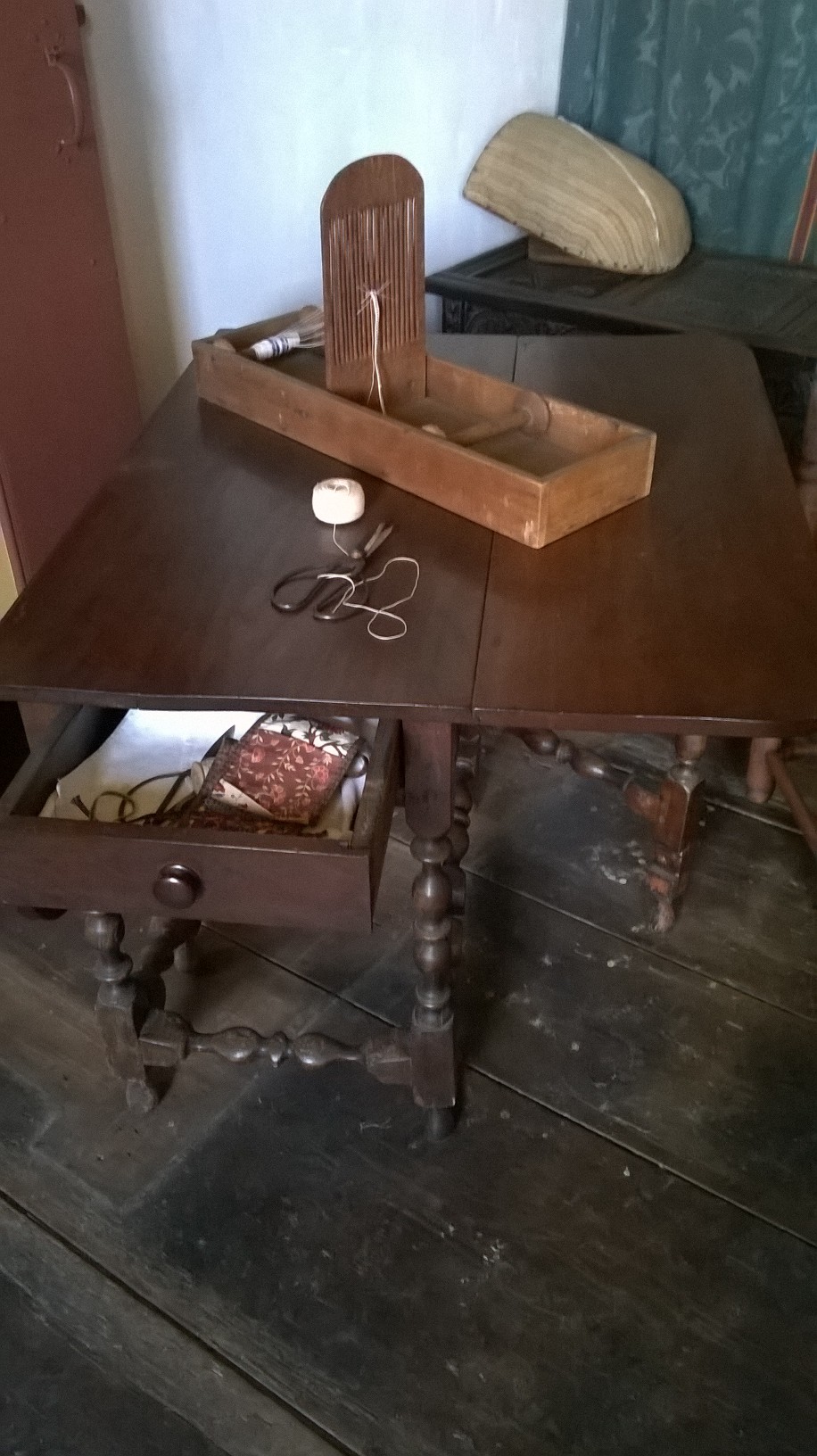
3/4 view. A finished tape is faintly visible, draped across the cushion on the trunk in the background.

A back view of the loom. The weaving would actually be done on the end where the thread was being fed into the work, and the finished tape would gather at the back.
During the mid sixteenth century, the textile industry thrived in Europe as well as in the colonies. The demand for trained textile workers was so great that, despite its being a predominantly Catholic nation, King Edward VI actively encouraged foreign Protestants to come and find work in England in 1549; the result was an influx of Protestant immigrants primarily from France and Germany (AFM 214). In 1598, with the passing of the Edict of Nantes, Protestants were officially recognized and given a much wider range of religious and personal freedom; this cessation of the religious wars in France caused the textile industry there to grow significantly and, by 1646, French Protestant textile workers were known for their fine woolen fabrics (216). In 1685, when the Edict of Nantes was revoked and persecution of the Huguenot people resumed, the majority of them fled France in a panic, many relocating to England and other parts of Europe, and others settling in the New World.
The tabletop hand loom pictured here would have been used by a young girl. In the colonies, like in Europe, the majority of work to be done consisted of manual labor, a task considered unsuitable for women of the era. However, the need for more income was apparent to the Huguenot settlers, and as a result, women took up spinning and weaving (also referred to as knitting)–the typical “women’s work”–as a source of income. Family workshops became the norm throughout all of the colonies, to such an end that almost every household contained at least one “knitting frame” (loom) and one spinning wheel (217). The youngest girls would first learn the basics of weaving on miniature looms like this one, making long woven tapes that could then be used for a variety of household purposes, such as tailoring clothes or binding together items. As they grew bigger and their skills matured, young women would learn to weave cloth, some of which was used in the home and most of which was sold for profit both domestically and overseas. 
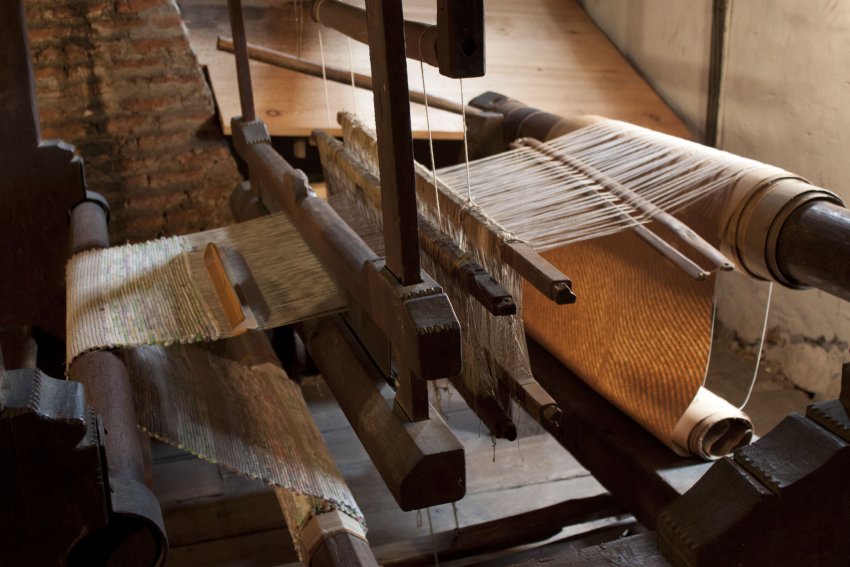
An example of the weaving process on a large adult-sized loom
 The Materials of History, Thought, and Art
You must be logged in to post a comment.