
The Jean Hasbrouck Family Bible, dated 1650. Belonging to one of the original patentees of New Paltz, the leather bound French bible includes a listed genealogy of the Hasbrouck family and conveys the importance of religion to the French Huguenots who fled France from religious persecution. (Photo: © Miriam Ward)
Physical Description of the Object
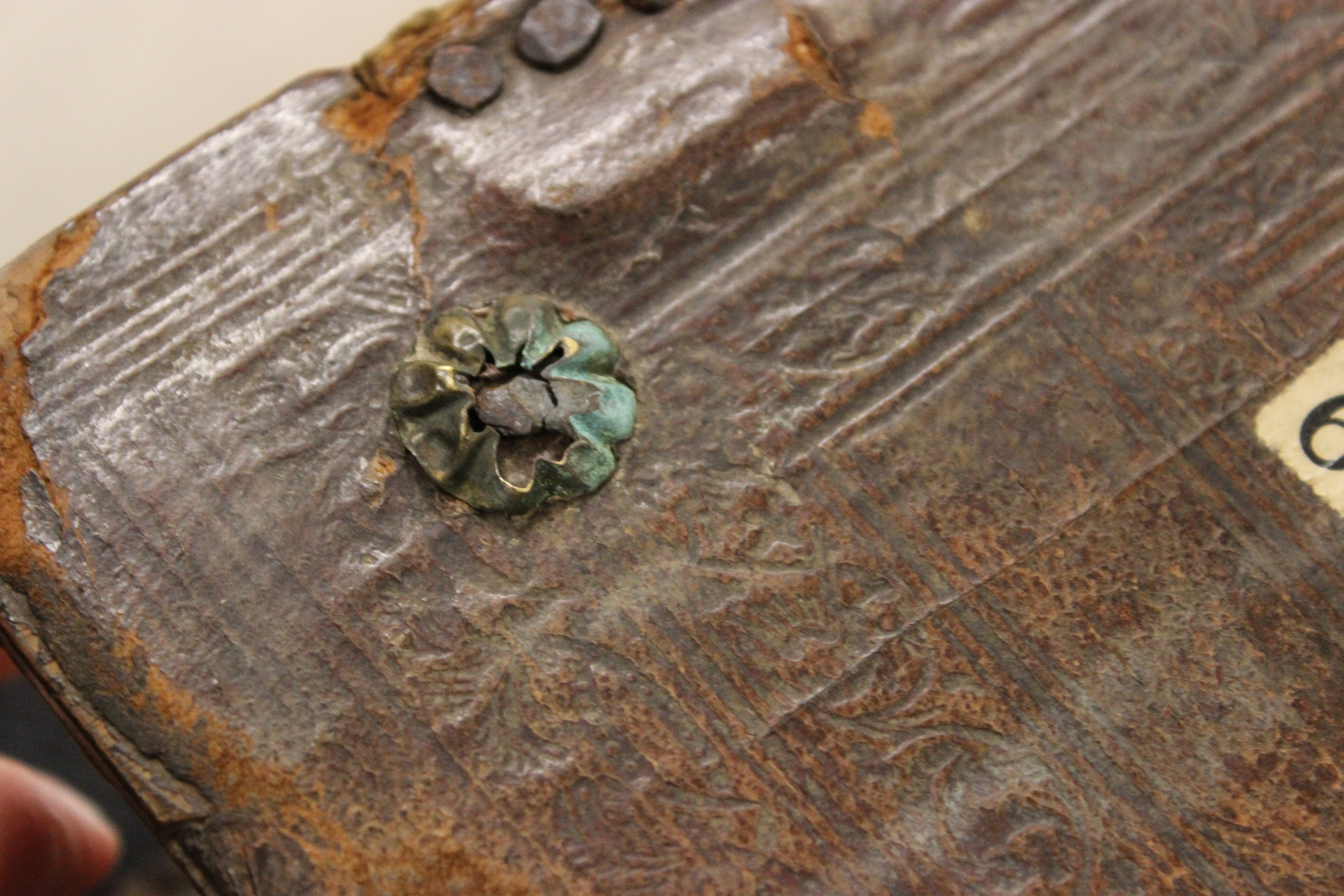
Jean Hasbrouck Family Bible, 1650. Detail showing copper ornament and leather bound cover. (Photo: © Miriam Ward)
The Hasbrouck Family is synonymous with Historic Huguenot Street and with the French Huguenots. An object of great interest to the foundations of Historic Huguenot Street and one if its founding families is the Jean Hasbrouck Family Bible form 1650. This leather bound bible is extremely large and ornate. With over 500 pages, the bible remains almost in entire original form. With some restoration work done, the bible has a new bounding done by the historical society that reads “ Jean Hasbrouck French Bible.”
The cover and back of the 1650 Bible show wear and tear, revealing a strong wooden interior bound over the leather. Also, the front and back reveal copper straps that would have held the locks for the book. The first 11 pages of the Jean Hasbrouck bible are missing, including the important copyright page.
Provenance

Jean Hasbrouck Family Bible, 1650. (Photo: © Miriam Ward)

Interior of the Hasbrouck Bible, including a handwritten genealogy. (Photo: © Miriam Ward)
The Jean Hasbrouck Family Bible holds a rich and telling history of both the Hasbrouck Family and the greater religious identity of the French Huguenots who settled in New Paltz, NY. According to the Hasbrouck Family Website, the family name Hasbrouck is derived from a location, near the Ville d’Hazebrouck in Flanders (near Calais), France.The bible belonged to Jean Hasbrouck, one of the original patentees of New Paltz. His exact birth date is unknown, but family histories put it at around the 1630s-1640s, outside Calais in France. Records show that Jean Hasbrouck died in 1714. The history of the Hasbrouck Family comes to life when the bible is opened. Alongside the front cover and the back cover, lay hand written scripts detailing genealogy of the family. Unfortunately, many of these entries have given into deterioration and time, but many can be read. The eligible entries reveal to be the names of the children of Jean Hasbrouck and Anna Deyo. Their children were: Maria, Anne, Hester, Abraham, Isaac, Elizabeth and Jacob. Jean married Anna Deyo in in 1676 in Manheim, Germany. Jean Hasbrouck, left France and ended up in Mannheim, Germany alongside many other refugees. The bible stayed in the Hasbrouck family for years but the exact donor is unknown to Historic Hugeunot street, lost in time.
Narrative

Inside front cover of the Jean Hasbrouck Bible. (Photo: © Miriam Ward)
The Jean Hasbrouck Family Bible is essential to the history of New Paltz. First of all, the bible reveals the incredible and rich religious history and ties that New Paltz was founded on. The bible, surviving and in the hands of Historic Hugenot Street today, shines immense light and importance of religious ties to the identity of the French Huguenots.
According to a family history compiled by descendant Kenneth Hasbrouck, the protestant church in Marck France burned around 1640 and the protestant population was forced to flee. Many French Huguenots at this time, fled to Mannheim, Germany for protection and with this haste transition could not bring many belongings with them. Even though it is not certain for sure, we can be fairly certain that Jean’s bible was made in France and that he brought it with him to Manheim, Germany. Of the many objects to save and which to leave, the sheer fact that Jean saved this bible through such a tumultuous and changing time is very important.

Jean Hasbrouck Letter of Recommendation, 1672 (Photo: © Historic Huguenot Street, Hudson River Valley Heritage)
Jean Hasbrouck, a founding patentee of New Paltz, received a ‘letter of recommendation’ from the French Church in Germany, confirming his and his wife’s good standing in the church, in preparation for his voyage to New York. The so called ‘letter of recommendation’ is striking. Written in 1672, this letter confirmed the relgious identity of Jean Hasbrouck and his wife. The fact that such a letter even existed gives us tremendous insight into not only the chaotic world that Jean Hasbrouck and his family lived in, but the importance of their religion to their life and identity.
The 1672 letter of recommendation shines a great light on the story of Jean’s bible. First off, it’s of importance because the weight and influence of such a letter of recommendation speaks to the importance of religion in the colonies. Further, the letter of recommendation speaks to the identity Jean and Anna Hasbrouck: that of French Protestant. The letter reads, “Jean Hasebruck and his wife are members of the Church Christ, and have lived among us during the time that they spent here, honorably & in a Christian way, attending the holy services, and taking Holy Sacrament of the Supper of our Lord Jesus Christ without scandal known to us. Thus we recommend them as such to our brothers in the Church where God will send them. Written at Mannheim in the Lower Palatinate this 17 March 1672 The leaders of the French Church in the said place & in the name of all…..” The letter of Recommendation from the French church in Germany cemented Jean Hasbrouck’s place in the colonies. The corelation between the family bible and the letter of recommendation goes hand in hand: the certificate allowed Jean and his family to join the church in the colonies by establishing their faith. The bible, materializes this faith.
The identity of French Protestant was central to the identity of Jean Hasbrouck, manifested in the family bible. On May 16th, 1672 Jean Hasbrouck and his wife Anna left Mannheim and sailed to Wiltwyck, New York in the Spring of 1673. In 1675, Abraham Hasbrouck sailed from Mannheim to Boston and ended up in New York to join his brother Jean and their small group of French Protestants. Jean and Abraham ended up becoming founding patentees of New Paltz, NY where they eventually settled.From a journey from Calais, France to Mannheim, Germany on a boat to New York Jean held onto his family bible. Jean and Anna ended up having seven children that they raised in New Paltz, NY. The names of the children are written in beautiful handwriting on the insides of the bible: Maria, Anne, Hester, Abraham, Isaac, Elizabeth and Jacob. In 1701, Jean Hasbrouck received permission from the Colony of England to “buy, sell, and trade lands, tenements, and hereditaments in this Kingdom…” The 1701 edict reveals the merchant nature of Jean Hasbrouck and how involved his family was. Jean, as a founding patentee of New Paltz, was extremely involved in the community. Along with his brother Abraham Hasbrouck and Louis Bevier, he served as the founding commissioners of the early courts of New Paltz. Serving in the court as a commissioner, Jean Hasbrouck held a very high status in the town.

Jean Hasbrouck will of 1712. (© Historic Huguenot Street, Hudson River Valley Heritage)
In 1712, Jean Hasbrouck died. His last will and testament survives and has been translated by Historic Huguenot Street. The will, written in Dutch, reveals how Jean and his family were fluent in both French and Dutch. New York, after being a Dutch colony, certainly held onto its Dutch roots. The will conveys extremely devout and emotional language, conveying the importance of faith to Jean Hasbrouck. Jean writes, “…so I commend my Soul To God almighty my Creator and To jesus Christ my redeemer and To the Holy Ghost my sanctifier And my body to the Earth whence the same came from to be buried in A Christian fashion And rest there until my Soul and Body will be united upon the day of resurrection And receive the Eternal Bliss of salvation which God of his grace through the One merit of our savior has promised and prepared To all who have sincere and complete faith In him….” Jean Hasbrouck’s will of 1712 conveys how important and essential faith and religion were to his life. His bible reveals just that.
The Jean Hasbrouck Family Bible of 1650 conveys the centrality of faith to the life of the French Huguenots. In settling, and fostering, a community fleeing of religious persecution, Jean and his family were guided through faith.
Special thanks to Carrie Allmendinger of Historic Huguenot Street.
Works Cited
Fosdick, Lucian J. The French Blood in America. London: Flemming H. Revell, 1906. Print.
Hasbrouck, Jean. “Jean Hasbrouck Will 1712.” 1712. Handwritten text. Historic Huguenot Street, New Paltz. Hudson River Valley Heritage. http://hrvh.org/cdm/compoundobject/collection/hhs/id/1491/rec/11
Hasbrouck, Jean. “Jean Hasbrouck Letter of Recommendation 1672.” 1672. Handwritten text: Manheim, Germany. Historic Huguenot Street, New Paltz. Hudson River Valley Heritage. http://hrvh.org/cdm/singleitem/collection/hhs/id/16/rec/2
Hasbrouck, Jon. “Hasbrouck, Our Family Name.” Hasbrouck Family. Web. http://www.hasbrouckfamily.org/name.htm
Hasbrouck, Kenneth E. The Hasbrouck Family in America with European Background. Vol 1. New Paltz: Hasbrouck Family Association, 1961. Print
Lawrence, Thomas. “Notary- Certificate to Jean Hasbrouck.” 1701, London. The Hasbrouck Family in America with European Background. Vol 1.
Roth, Eric. “New Paltz Town Records (1677-1932).” Historic Huguenot Street. Web http://www.huguenotstreet.org/new-paltz-town-records/?rq=jean%20hasbrouck
 The Materials of History, Thought, and Art
You must be logged in to post a comment.