
A grandfather clock that served to keep time but also served as a decorative piece of furniture, this 19th century clock belonged to Dewitt Chauncey LeFevre’s aunt and was passed down to him. This elegant clock not only functioned as a timekeeper and a living room furnishing; it’s uniquely patterned wood symbolizes the wealth of the LeFevre family.
Caption: A grandfather clock that served to keep time but also served as a decorative piece of furniture, this 19th century clock once belonged to Dewitt Chauncey LeFevre’s aunt and was passed down to him upon her death. This elegant clock not only functioned as a timekeeper and a living room furnishing; it’s uniquely patterned wood symbolizes the wealth of the LeFevre family.
Physical Description: The grandfather clock is about eight feet tall and it’s casing is composed of Tiger Maple wood. Tiger Maple wood is commonly referred to by many different names such as flamed maple, curly maple, ripple maple, fiddleback or tiger stripe. These names are derived from how the wood looks: the growth of the wood fibers is distorted in an undulating chatoyant (cat-eye) pattern, producing wavy lines known as “flames”. This type of wood is known for it’s beauty and is often used in making instruments. This clock’s wood is very noticeably striped and stained a golden hue. The face of the clock is white with a red, yellow, and green flower design and black numbers. According to Huguenot Street’s file, it once could have been a “Wag on Wall” clock – meaning before it was a grandfather clock, it did not have a base and the face of the clock probably hung on a wall on it’s own at one point. It is also said to have been reconverted from an electric clock, and while it looks like it is in good condition it has been repaired several times.
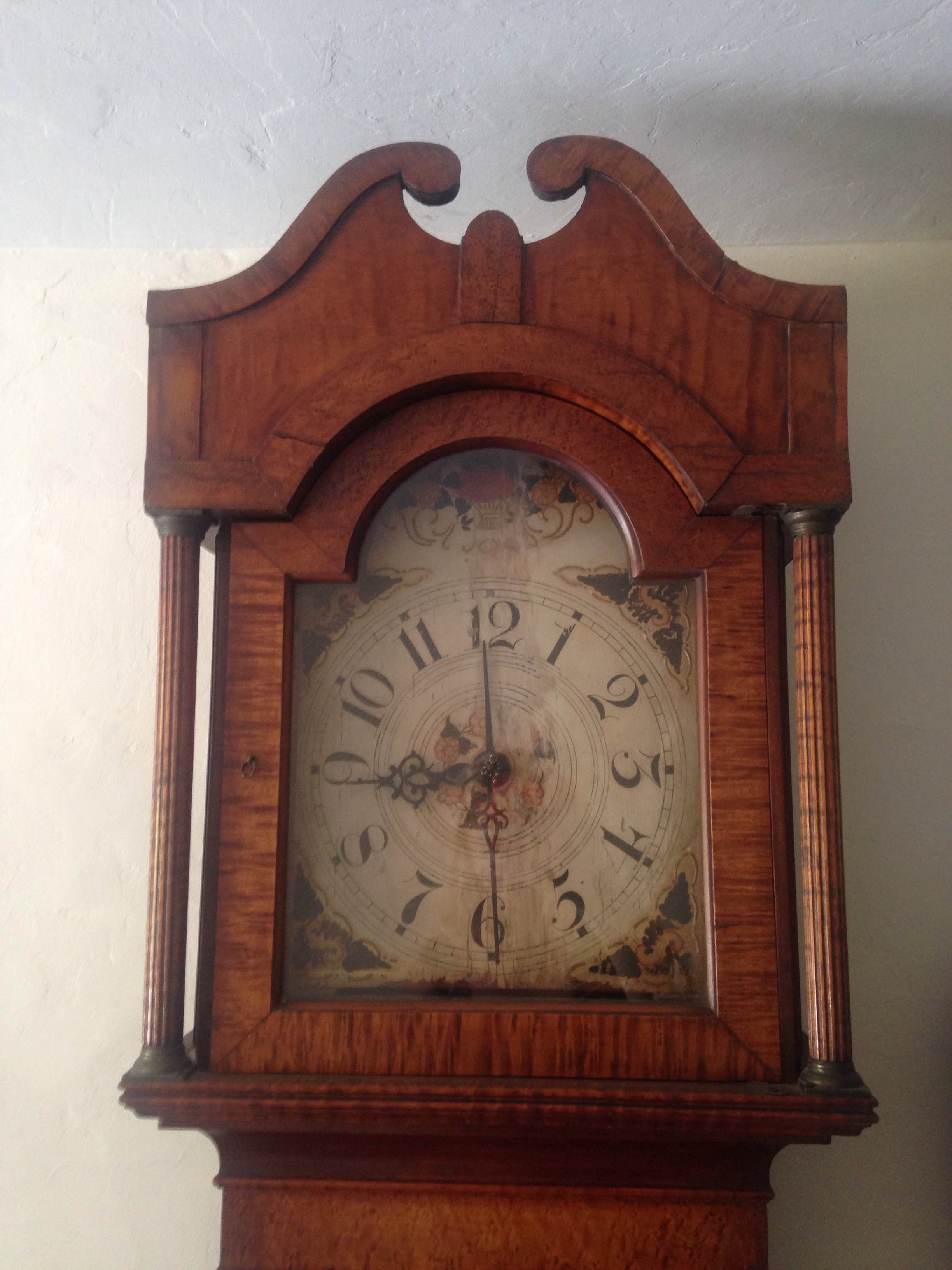
Provenance: The Tiger Maple Grandfather clock is currently in possession of Historic Huguenot Street. It was gift to the foundation by DeWitt C. LeFevre, and in the archives it says that this clock was once his aunts. DeWitt LeFevre was the first president of the organization. I believe that the aunt it belonged to originally was Minnie Mariah LeFevre Jameison.
Narrative: On April 28, 1677, twelve Huguenots were granted a license that allowed them to purchase land along the Wallkill River for a settlement. The original Patentees of New Paltz were: Louis Bevier, Pierre Deyo, Christian Deyo, Antoine Crispell, Louis DuBois, Abraham DuBois, Isaac Dubois, Hugo Freer, Abraham Hasbrouck, Jean Hasbrouck, Andries LeFevre, and Simon LeFevre. Simon LeFevre was born in France around the year of 1640.
“Simon and Andries LeFevre, brothers and very much alike, were most likely the scholars of the group. From the records we would assume them to be quiet, somewhat withdrawn, giving the group of Patentees a touch of refinement, which love of books and study can bring. They were not fond of labor like some of the group, but did their share because it was the honorable thing to do. Both brothers died before old age came, so that we must draw most of our records from the children of Simon. Andries never married. By nature easy-going, they believed in peace and harmony. There has always been a tendency toward frugality. By tradition, the ancestors of the LeFevre family were scholars and most closely allied with royalty by blood and position.”
A descendant of Simon himself, DeWitt C. LeFevre also held a position of power and scholar as the first president of The LeFevre Family Association. One could say that he is almost a grandfather of the society, and the clock symbolises his family’s wealth and longevity. Bestowed as a gift by DeWitt, the clock resides in the LeFevre house on Historic Huguenot Street.

The LeFevre House
My grandfather’s clock was too large for the shelf,
So it stood ninety years on the floor;
It was taller by half than the old man himself,
Though it weighed not a pennyweight more.
In watching its pendulum swing to and fro
Many hours he spent when a boy
And through childhood and manhood, the clock seemed to know
And to share both his grief and his joy.
“My Grandfather’s Clock”, a song written in 1876 by Henry Clay Work, from which the term Grandfather clock came into existence.
References:
Gannon, Peter Steven. Huguenot Refugees in the Settling of Colonial America. New York, N.Y. (122 E. 58th St., New York 10022): Huguenot Society of America, 1985. Print.
“History of Grandfather Clocks.” Klockit. Klockit, Inc., 2010. Web. 09 May 2015.
LeFevre Wright, Diane. “DeWitt LeFevre – The First President of the LeFevre Family, 1967 – 1973.” LeFevre Family News [New Paltz] 2002, Summer 2002 ed.: n. pag. Print.
 The Materials of History, Thought, and Art

You must be logged in to post a comment.