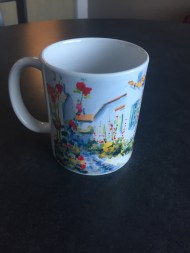


The item I’ve chosen to analyze is my Ile-de-Ré mug that I got as a gift from my boss upon completion of an internship I did on the French island, Ile-de-Ré, in the summer of 2015. This is the same mug I brought in on the first day of class as an object that makes me happy. The mug is decorated with an image depicting a typical street on the island, and whenever I look at it, the corners of my mouth involuntarily start to curl up to form a smile. I recall the gentle, ever-blowing breeze, the wide open sky (no building there was taller than three floors high), the scent of the ocean, and the color scheme to which nearly all houses on the island adhered: white walls, a terra-cotta, shingled roof, and a pair of shutters for every window, each painted some shade of turquoise. This last memory—that adorably ubiquitous color scheme—is rendered in a faux-watercolor on this elegantly crafted, albeit cheap mug, so I never forget how Ile-de-Ré island looked (as if I could really forget such a place). In addition to the beauty of the island, the mug brings to mind memories of how independent and capable I felt when I was in France: I learned to cook for myself, I explored unfamiliar places by myself, and I traveled a good bit, sometimes alone. I associate those feelings strongly with these more sensory memories.
At home in New York, the Ile-de-Ré mug resides with all our other mugs, in a cupboard in the kitchen. When I’m on campus, however, its place is not in hiding, but on my dorm room desk with two other mugs I’ve collected since my time abroad. I typically place these three mugs together in a cluster, and together they stay unless I happen to use one, which, as I am a fan of tea, is relatively often. I’ve noticed that when I make tea, I’m more likely to pick up my Ile-de-Ré mug than my other two; I credit this to its unparalleled ability to calm and console me when I need it, evoking the memories mentioned I’ve described above. Reflecting on the mug reinforces what I already know—that I am a particularly sensitive and sentimental person, the kind of person who cherishes items like a souvenir mug because of how dearly they cherish the memories associated with them. Unlike the other two mugs, the one from Ile-de-Ré is special in that it reminds me of a particularly special point in my life. While it offers physical comfort when used as it was intended, even just looking at the pictures on it can do the trick. Maybe that’s why I keep my mugs on my desk, but all my other tableware in my closet: when I need to center myself, I just look over at it. When I need a cup of tea to relax, I need not search for it in my closet because it’s already out, on my desk, front and center. Admittedly, I’ve never questioned my choice of placement of these mugs until this assignment. Still, the more I think about it, the more it makes sense why I chose to keep them there. After all, what’s the point of owning a comforting item if it’s potentially a pain to get to?
 The Materials of History, Thought, and Art
I love that your “habitus” is one of sensory memory! It’s very interesting that sometimes what we consider home is something that reminds us of a place very far away. I have a magnet from a trip I took to Italy a few years ago. Every time I look at it I can recall the grand times I had and how happy I was. Sometimes I think I can even smell the hand rolled cigarettes and coffee that surrounded me every morning. I love the concept of sensory memory and how you connected it to your mug.
I find it so interesting that you your mug has to two functions: to remind you of your time on the island of Ile-de-Ré and to drink tea. A lot of the times we think of souvenirs as physically functionless but emotionally fulfilling; yet, here you have a mug that is a souvenir that you actually use, and quite often as you state. I love how writing this week’s assignment has made you realize how central your mug is to your life and your living space. I can definitely relate to how with just a few weeks of being in this class I have come to realize that the objects I surround myself mean more to me than I know or understand.
This is more of an open ended question that you do not have to answer: why do you think that when you’re home you place your mug with other generic mugs, but when you’re away from home it is front and centre in your living space?
I sat back for a moment after reading this being able to feel the breeze you were describing in your post. I have many objects from my travels and from times past that produce that same sensory memory. Those sensory memories are the most poignant for me. I can feel every part of that memory when I am interacting with an object from that particular time. It sounds like a very meditative experience you have when you choose to drink tea out of that mug–being able to sit and drink tea which in itself is comforting but having the physical and visual sensation of this memory simultaneously sounds like it has the capacity to bring you the greatest/relaxing of exhales.