For this blog post I will discuss and describe an antique box that I own. Let me preface this by saying that this box, despite my having owned it for several years, is still quite an enigma: I know little more about it now than I did when I procured it. Speaking of which—I did not obtain this box by any conventional means: it had been abandoned by its previous owner and, for some unknown reason, was neglected by many different and unconnected people who had the opportunity to take possession of it. Nevertheless, I seized the opportunity when it arose, and here we are. Anyway, all I know about the box is that it sports an alligator skin exterior and is wooden—and seemingly old. Not exactly a gold mine of information. There is nothing – no company or personal name – inscribed or printed anywhere on the box. As a result of this lack of search criteria, the best I was able to do was to find some obscure online Chinese antique seller who had boxes that were similar to mine; so, I suppose mine may be of Chinese style or origin, but who knows. As for its value, again, I do not know. I once took it to a pawn broker along with some other objects, and, upon seeing that I was probably ignorant of its value, he quickly offered me twenty dollars for the box, ignoring everything else I had with me—so I figure that it’s worth maybe fifty to eighty bucks, depending on how bad the pawn guy was trying to screw me. Regardless, I declined his offer and have no plans to sell it.

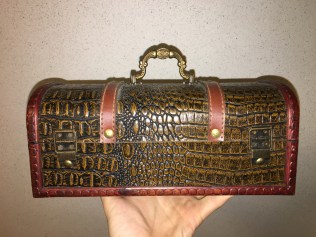


Over the years – in addition to its unwavering role as a decorative conversation piece – the box has served a couple purposes: first it held cables for various devices, now it sits on my desk and holds miscellaneous objects; I should probably think of a better use. Anyway, on to its description. Firstly – from a frontal perspective – the measurements of the box are 12” wide, 7” front to back, and about 6” tall, excluding consideration of the handle. As mentioned previously, the box is wooden – cedar, perhaps? – and is outfitted with alligator skin. Additionally, it is fitted with straps made of leather, which, I presume, lend support to the structure and prevent the skin of the murdered alligator from lifting off of the wood. The straps are riveted to the box quite effectively; it is evident that the box was made by hand—and rather expertly, at that. The trimmings seem to be wood, and are affixed to the box with very small nails. At the front of the box is a screw mounted latch with a swivel mechanism that I am very much a fan of: it allows for swift unlocking, but, when locked, keeps the box firmly closed. On the reverse of the box are two metal hinges, each fixed in place with four Philips head screws and a single rivet.
The top of the box is fitted with a metal handle, the bases of which are attached to the box with a total of four Philips head screws. I do not know which type of metal the handle is made of, but my guess would be brass. The style of the handle is rather ornate, and at its focal point is what appears to be – at first glance – a star with eight points; however, if you’ll allow me a moment of wild speculation, I think that this “star” is no star at all. Now, we’ve already established the somewhat remote possibility that the box – at least as far as its style goes – is of Eastern, particularly Chinese origin; and, upon closer inspection, it appears to me that the “star” looks more like a flower. In the Buddhist religion (as well as in other Eastern religions), the Padma (lotus flower) is a very important symbol. The lotus is an aquatic flower which often grows in swampy, muddy waters; however, the flower itself is divinely beautiful, and the vulgar murk and mud of its birth never adheres to its petals, and this effects a striking and symbolic contrast between the gorgeous brilliance of the flower and the aesthetic dearth which surrounds it. As a result of this peculiar nature, the Padma has come to represent purity of being and freedom from attachment to the world, and the unfolding of its petals symbolizes the expansion of the soul toward enlightenment. In Buddhism, the lotus is often depicted with eight petals, each corresponding to a step in the eight-fold path to enlightenment. It is my conviction – despite how incorrect it very well may be – that the “star” symbol present on the handle of my box is, indeed, a Buddhist lotus flower. Compare below:


 The Materials of History, Thought, and Art
This is such an amazing object! I really do love alligators in all shapes, forms, and repurpose. I really enjoyed the way you examined each part of this piece. Knowing it’s possible origin really makes the ornate handle much more interesting and meaningful.
What a cool box! I love the fact that its origin is somewhat of a mystery, and that you’re slowly figuring out what, exactly, it is. I wonder how difficult it would be to get it examined by an expert. (I assume you’ve considered doing that by now, especially since it excited that pawn broker like that.) If I were you, it’d be really hard for me to be so uncertain about it, but that’s because I’m one of those people who always has to know “the answer.” Anyway, what is certain is its craftsmanship is excellent, and that it definitely deserves to be displayed in a special place in your home!