I brought this ring in on the first day of class as one of my “happy objects.” I have decided to think about and reflect on its history and use.
This ring is made of sterling silver, as indicated by a “925” stamped on its inner circular wall. More specifically, this number means that the metal is an alloy of 92.5% silver and 7.5% other metals, which help strengthen it (pure silver is a very “soft” metal and can get banged up shockingly easily) and make it more resistant to tarnishing (that is, the blackening of the surface as a result of interacting with oxygen in the air, also known as oxidation). Though I did have knowledge of silver and I understood the last links in the chain of the ring’s history, the origins of the raw material were beyond me. I had no idea where silver-mines are located or which countries are the world’s major producers of silver. Admittedly, Natalia’s silver earrings from Mexico definitely should have given me a clue because after a quick Google search, I learned that Mexico is the world’s leading producer of silver, and that the US is among the world’s top ten, with silver mainly coming from Alaska and Nevada. I am going to assume in this post that a scrappy, Hudson Valley-located artist would be more likely to purchase materials made in the US.
So, this metal is mined out west somewhere, and then it finds its way across the country, probably by way of an online supplier because there does not appear to be a single jewelry supply store that would deal in raw metal in the Hudson Valley. The jeweler makes a wax carving exactly like the silver ring on my hand, and then goes through the long, delicate process of creating a mold, into which liquid silver is eventually poured and then shock-cooled in water to complete the casting. After some cleaning up and detailing the three bands, which I have always assumed to be patinated (patina is a catch-all term used to describe a thin layer on metal or stone that is of a color different from that of the base), the jeweler sells it to Crafts People, a local art gallery, and on my first visit there, this ring catches my eye.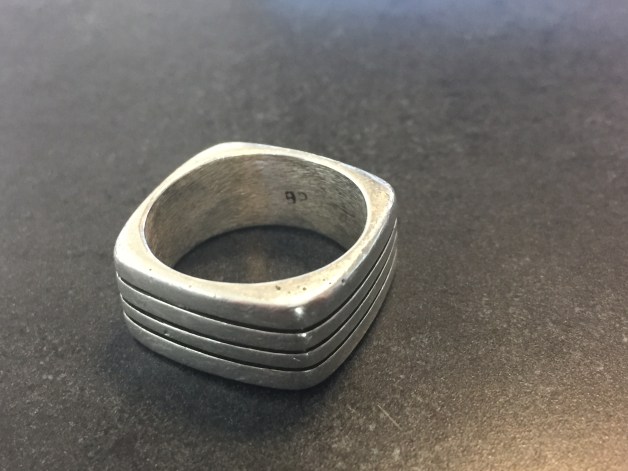 As I believe I mentioned on the first day of class, my knuckle was too fat because I broke my hand when I was younger, so one of the gallery directors—herself a jeweler—ground out the inner wall just enough to make room for my finger. Thus the ring was, in a sense, personalized for me. As I also admitted on the first day of class, I have lost it a good number of times in the three years since I purchased it. Because soap can be abrasive, I try not to wash my hands with it on; however, this means that I often put in on the first shelf or surface I see next to the sink I am about to use, and then I absentmindedly walk away without remembering to put it back on. This being just one example of the way I treat (or rather mistreat it), it is no surprise that despite my taking attempts to keep it away from the harmful effects of soap, it has accumulated a good many scratches and nicks in its surface. I have contemplated sanding it back to its original smoothness, but part of me knows that that would essentially erase the character it has picked up by being worn so frequently and cherished so much by me.
As you can see, the purpose of my ring has yet to change, though I imagine that if I needed to, I could melt it back down and get a good amount for the silver. If I had a scale, I would let you know how much it weighs; nevertheless, I can tell you that for an object of its size, it has quite a bit of heft. Though now it is purely ornamental, in its raw form, the purpose of this ring would shift to a much more utilitarian one. If I pass it down to a child who does not break their hand or have atypically fat knuckles, though, it might one day be worn as a pendant, thereby remaining ornamental, or be repurposed in some other way I cannot imagine at this time.
 The Materials of History, Thought, and Art
I think it’s strange and also wonderful how this ring had become such a part of your life. The dichotomy between having it always and losing it is fascinating, as well as the compulsion to have it refinished despite all it has experienced. Something so personalized like this seems to provide you a good deal of comfort.
I love how you thought about the ring in its raw form of silver and how it was made. Also how smoothing it back to it’s almost original way would make it loose its character; it’s like you wearing it and making the scratches is what really makes the ring for what it is.
I do the exact same thing when I wear rings! I leave them on the counters and always forget them. I am petrified to ever get a wedding ring. I found it fascinating that most silver production is done in Mexico. I’ve never stopped to think where the things we use or have come from. It’s actually so much cooler thinking thought our silver items are from another country. Obviously most are because our economy is global one, but usually my thoughts never think past the store I buy the item from.
I love your imagined/researched history of the ring, and the story of how it came to be at the particular store at which you bought it. It really has the effect that a lot of De Waal’s writing has, which it to make the history come alive for the reader, who doesn’t necessarily have the same attachment that you do. I also love your thoughts about how you could sand the ring down to make it look aesthetically pretty, but that would take a lot of the meaning out of it. Awesome job.
I’ve always been fascinated by precious metals such as silver, so I very much appreciate how you trace the journey of the metal itself all the way back to the mine it was removed from. I also relate with what you say about the personalization of the ring and the character it has obtained since you’ve owned it. If I had to make a guess, I’d say that it weighs somewhere between 15 and 22 grams—but I could be wrong.