Can a Watch Tell More Than the Time?

My wooden watch is a timepiece constructed of wood, glass, metals, a strap, and some batteries working to keep time.  It has a brown, leather strap that is loose fitting and comfortable, and as you can see, it has clearly been worn many times.  At its core, it is just a small, wearable timepiece. However, it means much more to me.

This was my “object that gives me joy” for the first class session. It is difficult to explain completely why it gives me so much joy, though I’ve often referred to it as the greatest gift I’d ever gotten. Perhaps it’s just the romantic in me, but I seem to have this grand appreciation for anything my girlfriend gives me. The watch is brown, a color I hate, and it doesn’t have any numbers, which would normally be a horrible feature for me (I often will make a mistake and say that the watch reads 7:22 as opposed to 7:27 in the picture above).  However, the watch seems to goes well with just about everything and I don’t seem to mind the lack of numbers. So why does a silly timepiece, less functional and harder to read than my cell phone, mean so much?

Perhaps it is what it means.  The watch obviously is what it is, but it serves as a symbol, as the date in which we started dating is engraved on the underside of the face.  Maybe it’s because I never imagined wanting it, I’m really not sure.  What I do know, is that I love the watch, it means more to me than what a normal watch does, and yes, it does serve as a nice accessory.  It gives me a tremendous amount of joy, and of course to me, it’s far more aesthetically pleasing looking at it in the picture above, than I really think.

I Need ’em to See

Besides needing my glasses for practical uses, such as seeing everything, I am also using it for this blog entry. Running about five inches across the face, they are jet black there and along the sides. A small curve of clear plastic along the rear of the face gives it a little more reinforcement.


I have had these glasses since I was in the tenth grade. My fifteen year old self wanted glasses like The Doctor from Doctor Who, and after a long stay at the Lenscrafters at some mall, she ended up settling on these ones. They have held up well over the years; never cracking or breaking. They’ve been through a lot.

There is casual wear and tear, but some of the coloring on the inside, when they’re on my head it’s directly beside my left eye, has rubbed off never to return. On the left and right of the inside, there are the small metal hinges that allow them to fold up and go into their case at night, and then unfold once again in the morning. From the hinges come a longer metal piece that extends all the way back. At first glance, they seem to be sparkly silver decorations. As I looked closer, I realized they are the entire side piece, and the black design of the plastic my glasses are made of are molded completely over the elongated metal. On the inner right piece, there are numbers: 52, a square, 17. A large space. 14, and then everything is faded beyond that. I’m only assuming these to be something about the certain style of eyeglasses I have because I cannot find anything about the brand online. I did get them nearly 6 years ago at this point. Things change.

lenses

As I said earlier, these poor glasses have been through a lot. At this very moment, there are fingerprint smudges, dust in the corners of the lenses, and scratches that are clearly visible. They also have nearly flown off my face in the midst of coughing fits these past few days. The scratches pictured in the middle of the right lens are the results of my poor decision to wear them to the beach. Or, that is what people told me. Do they not want me to be able to see? In 2015, I was on a month-long trip to Italy, the area my group and I were staying in was about one hour away from the beach town, so on our first weekend there we decided to go. I thought I was being careful, putting my glasses away so I could lay my head back and relax, but as I was putting them away, they fell out of my hand and into the burning hot coast of Rimini, Italy. So, there is some sentimental value to them because of how long they have been with me. They have obvious signs of wear simply because I’ve worn them so much and for so long. They have gone through everything with me from age 15 onward; high school graduation, high school itself, falling outs with friends, the making of new ones, two loves, my first job, family deaths, and now, they’re going through college with me.

It’s strange to think about an object you never usually think in depth about. My immediate thoughts when I realize I don’t have my glasses on are, “whoa, everything’s pretty blurry.”

Not a Spoon You Eat With

For this blog post I decided to use an antique item that belongs to both my sorority and my grandmother.


What you are looking at is a 1-inch tall, sterling silver spoon pin, reminiscent of a sugar spoon.  At the top of the handle is a crest with a Greek inscription as well as some symbols. A long, sharp needle is fastened on the back of the spoon, starting from the top of the handle and going down the entire length of the object. At the sharp end of the needle is a clasp and hook that can be opened or locked to secure the spoon onto clothes as a pin. It is a simple design and its most obvious function is clear.

What is unclear is where or how it was made. It is impossible to know just by looking at the object where it was made, as the only inscription on it (other than the crest) is the word “sterling,” indicating that it is sterling silver. No company, brand, town or location has claimed this particular pin, other than Alpha Kappa Phi.

My grandmother was a member of Alpha Kappa Phi, Agonian Sorority, Incorporated at SUNY New Paltz between 1950 and 1954. The spoon pin was the sorority’s traditional sister pin that is bestowed upon you when you officially “cross” or become a member of Alpha Kappa Phi. It becomes your first set of letters and proves to everyone that you really belong to this organization. Presuming this pin was brand new at the time she became a member, this pin must be at least 63 years old. My grandmother owned this pin until I also became a member of Alpha Kappa Phi. She passed this on to me, along with some other sorority paraphernalia. When I became an official member of my sorority, I also received my own pin. It is very different than my grandmother’s; the pin I received is teeny-tiny with just the letters “ΑΚΦ” in gold. The reason for a spoon pin is that, traditionally, sororities were supposed to maintain and provide hospitality. Thus, the spoon serves as a symbol of this hospitality and a signal to others that that is what this sorority stands for. Other sororities also founded at a similar time as mine (around 1880) feature almost an identical spoon pin, with the particular sorority’s crest on the top of the handle. So, the spoon pin serves a couple of functions. One, as said before, is as a symbol of hospitality. The second function is that the pin serves as a method of proudly displaying to the public that my grandmother and I are a part of Alpha Kappa Phi, and we alone are given the unique privilege of wearing this pin.

I can tell that this pin has received much wear and tear throughout its ~63 years of life, as it has several scratch marks all over it. However, it is still going strong; the clasp and the pin itself are in good shape, and I am able to wear it occasionally. It is always pretty funny to see people’s reactions when they realize that I literally have a spoon on my shirt! While my grandmother has a whole host of other Alpha Kappa Phi things that she plans to give to me someday, this spoon pin is by far the most historically and personally significant. It represents not only Alpha Kappa Phi as an organization and sisterhood, but also that even though traditions may change, it isn’t always for the better or worse. We certainly have come a long way since the 1950s, and hopefully have even more of a ways to go.

My teeny-tiny sister pin, 2015

My teeny-tiny sister pin, 2015

Terracotta Tile Fragments

For this blog I will be analyzing two fragmented ceramic tiles I found while I was hiking on Elba Island (An Island off the coast of Piombino, Italy–also the Island that Napoleon was exiled to in 1814, fun fact!). These were also a part of my objects that I brought in on the first day that bring me happiness.

These tiles tend to dance around my room. Sometimes they are sit on my night stand, inside of my memory box, or on my desk. I handle them quite often reminiscing– especially during this time as it has been about a year since I traveled abroad. I came across them while a friend and I were entering a town on the other side of the island from where we were staying. These pieces were on top of a pile of rubbish in what seemed like the outskirts of someone’s backyard–I promise I wasn’t committing an act of larceny. Nonetheless, I grabbed two as a souvenir.

I can only assume that this was not the creator’s original intention. To be quite honest, I’m not sure exactly where these tiles were being used. There are a couple of places I could guess based on my surroundings–either accenting the outside a home, above an outdoor sink/well, or in a bathroom. I’m not sure if these tiles were mounted in the same room or even house.

Based on the size of these fragments, I would presume that the tiles were originally 5in x5in squares. The first tile has more or less a triangular shape. The edges are jagged in some places but smoothed out in other areas. The top has a white glaze with yellow and green line work as well as what appears to be a half of a floral design. The pattern appears to be minimalist in comparison to the second. The the surface of the glaze is surprisingly not chipped other than a small dink on one of the corners.  On the back side of the tile is coated in a some dry cement that was used to adhere the tile to a wall. Engraved on the back is an “S” outlined by a triangle and along one side of the triangle says “S.Marco.” Based on a little Google search , this might be a marking of the tile company/designer called “Terreal:San Marco.”  

The second tile, which is a slightly smaller fragment does not take on a specific shape. The patterning on the white glaze seems to take up more space on this tile. Red circles, blue dots, and blue teardrop shape that arc over the red circles. This tile has a much larger chip on one of its corners. The texture of the edges is basically the same as the first–kind of rough but also smooth. The back side of this tile does not have any cement residue on it. On this side is an engraved grid, the number “1077” and the name “Marazzi.” After looking this name up, I found that this is an international tile company with stores in Italy, USA, Korea, China, and Spain–and after looking at this site, it seems like this tile is quite outdated in comparison to the selections they currently have.

Although I looked at and handled these tiles pretty often and I never paid much mind to the back and more so the names on the back of them. In hindsight I wish I grabbed more of these tiles, in either fragments or whole tiles to have and to analyze.

My Favorite Oxford

For this week’s blog post, I decided to analyze my favorite Oxford shirt as a follow up to my original blog post on the Konmari Method. After reading the “describing objects” article for this week, I sat down with my Oxford and asked myself the various questions posed in the article.


What is it?

My object, most generally, is an Oxford shirt. A button down, which has the shirt divided down the center, and with a buttoned collar that rings the Oxford’s neck area. Made of cotton, the shirt is a checkered plaid in navy blue and sandy brown. Each square of the checkered pattern is about an inch-and-a-half by and inch-and-a-half in area. There is a single pocket on the left chest of the shirt with another button centered in the top of the pocket, to close and secure it. There is a velvety, and oval shaped elbow patch in a dark brown on either sleeve. The shirt is sewn together at its seems by a sand colored stitching, which lines the inside of the shirt. The shirt is a size medium. The textile the shirt is made of is moderately thick, which helps retain heat. The shirt has long sleeves that cuff at the ends, each with a single button to close the cuffs. The shirt tapers off with a circular shape, perfect for tucking into pants.

Where is it now and how did it get there?

My shirt tag says it is made Mauritius originally. I happen to have bought it from my local J. Crew store in the Columbus Circle Mall in Manhattan. When I’m not actually wearing it, it sits in my closet in my dorm room.

What is the object’s function?

The object is a business-casual shirt. It is used to cover the upper half of the body. Stylistically, it is worn in casual social environments. It contains a decent amount of functional qualities that are worth noting as well. The first one is the array of buttons that are all over the shirt. There are buttons lining the center to close the shirt all the way down. There are buttons on the collar to fasten the collar’s corner to the body of the shirt. There are also buttons on the cuffs and pocket of the shirt, to fasten those as well. There are also sizable elbow patches on either sleeve, which provide a heavy-duty work function to the shirt. The pocket itself also helps hold small objects like pens and coins.

Who made, owned, or used the object?

Since I have owned the shirt since I bought it, so far I am the only one to have used it. I am assuming the shirt was made in an industrial factory like most other ready-to-wear pieces, this one specifically in Mauritius. The person who made it was most likely an industrial worker, who was probably getting paid a bare minimum wage. The shirt will most likely be passed on to my younger brother when I grow tired of it, like so many other pieces in my wardrobe have.


Just to mention, after answering all of these analytical questions about my piece, I understand it now more as an object with its own unique story, rather than just something I wear. The shirt has traveled long distances, has sat on a shelf in New York City, until I happened to have picked it up and purchased it. Having analyzed the shirt in detail, I realize the significance of the shirt, even if it is mass-produced and fast-fashion. It is still my own, and part of my own individual story, not to mention part of the stories of all the other people whose lives it’s crossed on its journey to my closet.


Venetian Mask

venetian-mask

This is a Venetian-style mask my mother bought when she worked at Spirit Halloween. It currently hangs on a curtain rod in my bedroom, and its color scheme matches the rest of its surroundings.

The mask is relatively cheaply made, fashioned from a plastic mold and artificial feathers. Two almond-shaped eye holes were cut into the mask; the left eye hole is the only part of that side of the face. Most of the mask is sea-foam green; the paint has been artfully cracked. Some of the paint has brownish discoloration as well. I can’t remember if the mask was originally like this, or if it’s due to the cheap paint oxidizing.

Silver is a big component of the mask as well. The right eye is painted completely, with a border of swirls which protrudes from the surface. Other swirls are on the cheeks and forehead. The lips are painted silver too, giving the mask a creepy smile. Nostril holes provide the wearer somewhere to breathe through. The face has a rounder, feminine look to it.

Next to the right eye are several layers of feathers; all of these are artificial by touch. Peacock feathers are arranged in a set of three, with blue feathers as a background; all of this is held in place on the back with hot glue and white felt. On top of this is a plastic blue diamond bead, which has holes on either end for string. If you look closely, you can actually see the blob of hot glue holding the diamond in place.

In lieu of feathers, the other side of the mask has black and silver looped trim. This trim covers the rest of the mask, and feels somewhat itchy to the touch. It is held in place with a thin layer of transparent glue, which can just barely be seen around the edges.

The mask has a relatively thick, stretchy elastic band around the back, in order for the mask to be worn. Like the feathers, it is held in place by glue and white felt, in order to provide a level of comfort to the wearer, I suppose.

The back  of the mask is white, and it has a matte texture to it. The “forehead” of the mask, while not painful to wear, protrudes far into the hairline. It has sat in my room for so long that it does not have any kind of scent to me. While trying it on, the wearer quickly notes how awkward it is to breathe, and how much heat quickly builds up. It seems almost as though the piece functions as wall art, rather than a piece to be worn as part of a costume.

From far off the mask appears beautiful and eerie, but up close you can see how cheaply it was produced.


The Shogun

I’m going to write about the living environment of one of my roommates, Shogo; hopefully he wouldn’t mind. I live in a Lenape suite, so I have another roommate as well. The latter roommate is very similar to me in a lot of ways: we grew up in similar settings, have similar ideas about things, and live within object environments of similar magnitude. Even though we try to limit the amount of objects that we bring up to college with us, it never works out, and we always end up with more crap than we wished to bring. Our spaces begin neat and then slowly degrade, and after a little while we get tired of the encroaching chaos and clean up—this repeating inexorably. Shogo, on the other hand – though he has slowly adopted some of our living practices – still differs greatly. He is an international student from Japan (and yes, his name derives from the feudal position of Shogun). As a result of this, he was constrained to severely limit the objects that he brought with him, and this has led to his space being populated by the things that are most important to him and most integral to his functioning and happiness.

A little more background on Shogo. Firstly, his work ethic is impeccable: he is awake every morning by 7:30, regardless of whether or not he has class; and, once awake, he immediately gets on his laptop – his portal to the realm of incessant scholastic exertion – and starts getting stuff done—sometimes even before he is fully awake. The stuff on his desk is (almost) exclusively school work related, and it can sometimes seem like he is working perpetually, merely suffering to take food, sleep, and friend/fun breaks; while my other roommate and I seem to do, perhaps, the opposite. Secondly, he’s a stylish dude. His wardrobe is one of the object networks that is most important to him. In the past, when I’ve commented on his dope ass style, he has claimed that it’s a Japanese thing: apparently in Japan his sense of style is average, and we think he looks good because Americans, in general, are lacking in the style sense department. I was going to argue with him on this point, but a quick glance in the mirror disarmed me. Anyway, as I was saying, his wardrobe is important to him. All three of us are moving off campus next semester, and though Shogo is by no means whatsoever a picky person, when we were looking at apartments it was obvious that closet space was a significant selling point with him—even more so than personal space itself. He didn’t care too much about the size of the room he would be living in, just as long as it had a decent closet to house his superior threads. I mean, don’t get me wrong, I love nice clothes—and when it comes to suit attire I’ll give the Shogun a run for his money; but as far as the remaining clothing categories go, I suppose I am indeed afflicted by American stylistic inferiority. Oh well.

Our objects – just by our being related to them – reveal an incredible wealth of information about us as people. As seen in Miller’s The Comfort of Things, the information broadcast into the world by our objects is often so substantial that, with careful consideration, it becomes possible to paint a portrait of us based almost entirely on information discerned from our relationships with objects.

Having come to know Shogo pretty well now, I think the objects that are important to him speak very much about him as a person. His wardrobe, the centerpiece of his palace, displays a taste that fits his kind personality, intelligence, and strong character beautifully. Shogo is also one of the most hardworking people that I know. His laptop is one of his most used objects – perhaps even rivaling his phone – and its screen is nearly always filled with something school related; he even leaves it open with the screen on when he leaves the room, as if he wouldn’t be able to return to the task he was working on if he were to shut the lid.

Moving and How it Shapes Our Possesions

The sentence that really struck me the most on a personal level in the reading was,”Moving house allows for a kind of critical realignment of persons with their possessions.”Since I’ve been slowly moving out my my home on Long Island, and preparing to move to New Paltz, I’ve felt this realignment that Miller is talking about in the past few months. I’ve realized how many things I own are simply in my room taking up space; they have no actual function nor bring me any sort of happiness. I started feeling overwhelmed by this thought. “Why do I even own this and where did this come from?”, I kept thinking to myself. After filling bags and bags of garbage and stuff to donate I felt more connected to my room and the stuff in it. I became aware of what the things I decided to keep, actually meant to me. Looking back I practically used to Konmari method without even knowing what that was at the time. Everything that was left was either for functional use or what made me happy. While doing this, I also picked out my objects to use for the first day of class, which were my boots and stuffed animals. Connecting these objects to my room now makes a lot of sense. These two things I picked out, specifically my stuffed animals, were my comfort objects and my room has always been a place of refuge and comfort. My room contains now mostly, lots of stuffed animals, memorabilia,pictures of friends, posters; practically everything that makes me feel happy and comfortable. Outside of my room, these objects separated wouldn’t create that same feeling. Yet together, they encompass me as a person. It shows my interests as a person, my background, and what I value. This shows specifically by my stuffed animals Sparkles and Sam. Out of context they’re just stuffed animals, but in my room they have a completely different meaning. They always lay right next to my pillow, being right next to me while I sleep. It shows their importance to my life and the comfort they bring me. The rest of my stuffed animals are shoved underneath my bed or tossed around and the juxtaposition of how I treat them in my room shows the value I put on them.

Millers explanation of accommodation also hit me personally cause I’ve always felt a sort of frustration with the objects in my room, practically the furniture because I’ve been accommodating living within my parents house. I’ve had to keep my brothers and sisters furniture in my room and it’s obvious that it wasn’t my choice. The stark white dresser that had been once been my sisters I attempted to make mine by covering in band stickers, which didn’t make my mom too happy. I tried covering the bright blue walls with millions of posters to personalize that too. Yet they’re was always still the frustration that my room could never fully be mine. I’m super excited to move and finally get furniture of my own that I choose and hope that my room and the objects in it will finally “feel” me.

Daniel Miller’s “Habitus”: A Reflection on My Mug

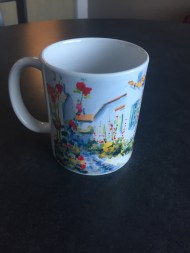
IMG_4007.JPGIMG_4011.JPGIMG_4010.JPG

The item I’ve chosen to analyze is my Ile-de-Ré mug that I got as a gift from my boss upon completion of an internship I did on the French island, Ile-de-Ré, in the summer of 2015. This is the same mug I brought in on the first day of class as an object that makes me happy. The mug is decorated with an image depicting a typical street on the island, and whenever I look at it, the corners of my mouth involuntarily start to curl up to form a smile. I recall the gentle, ever-blowing breeze, the wide open sky (no building there was taller than three floors high), the scent of the ocean, and the color scheme to which nearly all houses on the island adhered: white walls, a terra-cotta, shingled roof, and a pair of shutters for every window, each painted some shade of turquoise. This last memory—that adorably ubiquitous color scheme—is rendered in a faux-watercolor on this elegantly crafted, albeit cheap mug, so I never forget how Ile-de-Ré island looked (as if I could really forget such a place). In addition to the beauty of the island, the mug brings to mind memories of how independent and capable I felt when I was in France: I learned to cook for myself, I explored unfamiliar places by myself, and I traveled a good bit, sometimes alone. I associate those feelings strongly with these more sensory memories.

At home in New York, the Ile-de-Ré mug resides with all our other mugs, in a cupboard in the kitchen. When I’m on campus, however, its place is not in hiding, but on my dorm room desk with two other mugs I’ve collected since my time abroad. I typically place these three mugs together in a cluster, and together they stay unless I happen to use one, which, as I am a fan of tea, is relatively often. I’ve noticed that when I make tea, I’m more likely to pick up my Ile-de-Ré mug than my other two; I credit this to its unparalleled ability to calm and console me when I need it, evoking the memories mentioned I’ve described above. Reflecting on the mug reinforces what I already know—that I am a particularly sensitive and sentimental person, the kind of person who cherishes items like a souvenir mug because of how dearly they cherish the memories associated with them. Unlike the other two mugs, the one from Ile-de-Ré is special in that it reminds me of a particularly special point in my life. While it offers physical comfort when used as it was intended, even just looking at the pictures on it can do the trick. Maybe that’s why I keep my mugs on my desk, but all my other tableware in my closet: when I need to center myself, I just look over at it. When I need a cup of tea to relax, I need not search for it in my closet because it’s already out, on my desk, front and center. Admittedly, I’ve never questioned my choice of placement of these mugs until this assignment. Still, the more I think about it, the more it makes sense why I chose to keep them there. After all, what’s the point of owning a comforting item if it’s potentially a pain to get to?

A Reminder of a Former Home

One of the objects that I brought with me to class on the first day was a picture that my sister drew. An eight-year-old girl with a hugely active imagination, my sister is constantly drawing. I have a million drawings that she’s given me, but when faced with the decision of what object to bring that really says something about my family, I snuck this one of my mother’s wall in her office. Part of the lure is that the picture contains all of our immediate family members, but even more than that, the picture contains an eerie sense of who we are as an entity. img_20170210_162525
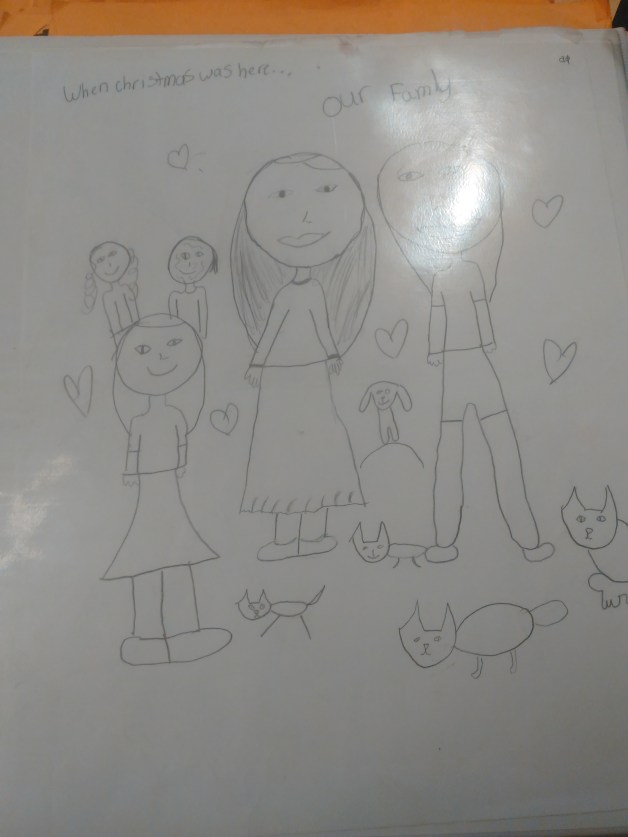
In the foreground, there’s the artist herself and our four (now three) cats–who, if you ask my mom, actually do run the house. Right behind the five of them are my mother and stepfather. These are the people that my sister sees every day, so she’s obviously made them the biggest. One of the cats, though the photograph I took doesn’t show it, is actually in the process of peeing, since that particular cat likes to pee on things when he’s mad at us. In the background, my grandmother, who’s identifiable by the wrinkles on her face that my sister kindly drew in, standing next to me. My grandmother and I are, I suppose, more further removed from my sister than the rest of our family members. My grandmother lives next door, and I live all the way in New Paltz.

What’s interesting to me in regards to this picture as it pertains to a “habitus,” however, is that this picture never leaves my person. I have fitted it into the back of my binder, opposite a schedule of all the assignments I have due that week. img_20170210_162956

In the binder, I keep all my syllabi for classes and manila folders in which I store my readings for each class. I had first put the picture in there as a way to make the binder as a whole feel less daunting, but now I am more interested in this idea of the picture as a transient object in my habitus, just as I am a transient object in the unit of our family.

I didn’t frame the picture and put it on my wall, or skip the framing all together and take it up there like a lazy, broke college student. Instead I made sure that it would come with me wherever I went, that when I was in the library working, all I had to do was look over and be reminded of where I came from, and of whom I’m always trying to make proud. What does that say about me? I’m not sure, except that my whole habitus has become a habitus of convenience. Living in a dorm room, one is always aware that one’s living space isn’t permanent, isn’t even theirs. There are so many restrictions to what we can and can not put in our space that it often feels sterile and lifeless. The furniture is hard and uncomfortable, and we’re not allowed to bring any extra in (though I’ve cheated that rule and brought a folding wood bookcase for the past two years). I’m always aware that my area is one of transition. I’m never stopping for long there.

And even when I go home, I’m aware that it’s not really my home anymore. There’s my family, of course. And I have my own room. I’m lucky enough even to have my own office. But there’s always a sense that it’s a place I’ve left, and that in doing so I’ve also left an irrevocable chasm between my family’s space and mine. So perhaps the conclusion is that, without even knowing it, I’ve converted my entire habitus into something transient, that can be moved when I need it to. It follows, then, that the most important things follow me around, even in my micro-travels across campus from day to day. Maybe the object of the picture itself shapes the way I interact with this transience, letting me leave behind the anxious nature of never having anywhere permanent by allowing a physical representation of those I love come with me to all places. That picture is the thing that’s permanent, and maybe it makes every space a kind of home to me.