My Pens (?)

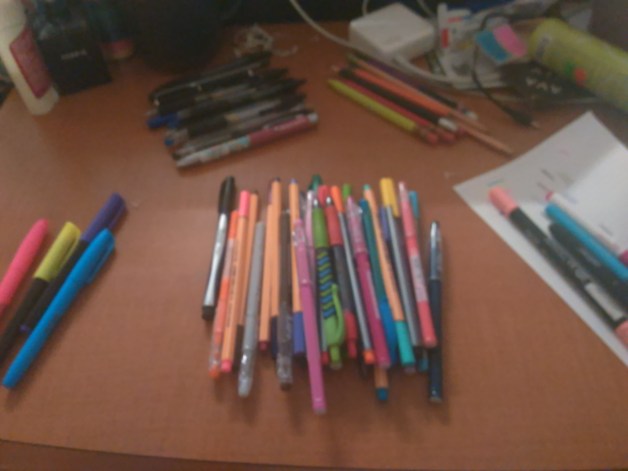
I have moved from room to room and building to building so many times in the past two semesters that currently my room is filled with unpacked boxes and empty drawers and because of that for this exercise I have decided to sort through my pens. I chose my pens because I always have at least five with me at all times and in my room I have all of them in my pencil case on my desk. My pens are accessible to me at all times so I figured why not choose a category that means a lot to me, but at the same time something I don’t think much about unlike my clothes for example. I started off with 54 pens which when I thought of just in terms of the number 54 I did not think that it was a lot, but in comparison to how much it looked when I had it laid out on my bed it felt like there were a lot more pens. I should perhaps also mention that I chose to sort through my pens because I was aware that out of everything in my room they were the things I was willing to part with if needed be. In a way, I did it to intentionally save myself from the pain of either sorting through my books or clothes or perfumes. By the end of going through my pens I had decided to throw out 8 out of the initial 54 and the ease with which I was ready to part with them was striking. I felt no pain or loss or happiness or fulfilment while choosing which ones were of no use to me anymore and I think this ease is because the reason I had for discarding them was practical and logical: they had no function anymore because the ink had dried out.

I honestly expected going through my pens to illicit more emotions from me but I only realized things or vaguely remembered some memories that are now long faded and some non-existent as I was sorting. One of my realizations was that whenever I was testing out which pens had dried out ink I wrote “hello” on the notepad placed next to me. I had vaguely noticed this habit in the past, but this time it was noteworthy. It is as if I am introducing the pen to the pages and myself; a first impression of some sorts. I am not entirely sure why this became a pattern but it did and I thought it was so interesting that out of all the words I know the one word I would constantly use was “hello.” Another thing I noticed was the way in which the colours of pens I own are the same repeating colours: blues, greens, oranges, reds, and blacks. While I have a reason for buying different coloured pens (to colour coordinate my planner and get creative and colourful notebooks) I still expected more variability in the colours I chose. The most important thing I noticed, however, was that most of the pens I own are not really mine to begin with. The pens were either given to me or I had taken it from a friend or something. The ones I bought or remember buying are so small compared to the ones I got from people or from events I have attended in the past couple of years. It is almost mind blowing to think of owning so many pens and giving them each a function or saving them for a function would turn out to be pens that I got from other people. I find it puzzling and almost disturbing because here I am placing so much pride and value in the amount of pens I own yet I barely really own any of them.
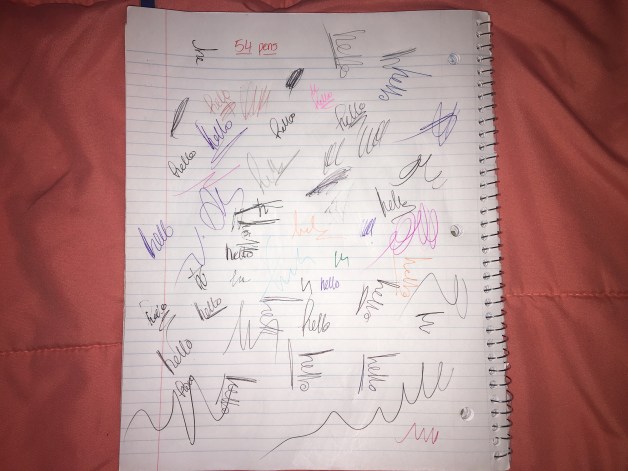
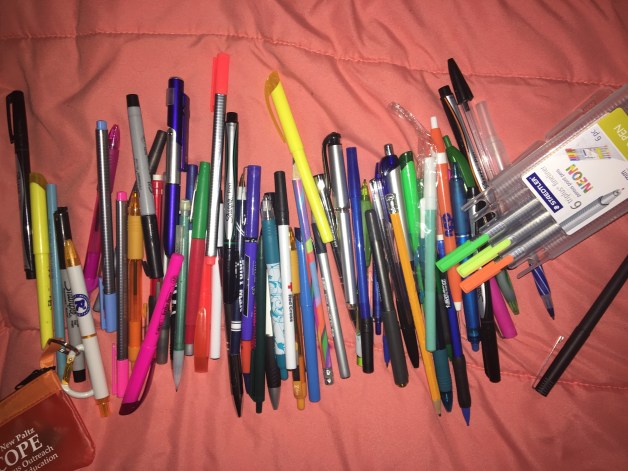
img_1737img_1733

While going through my pens I realized that they serve a purpose of just existing and for some reason that is comforting to me. Why would pens give me comfort even though I do not feel any particular emotion towards them? I wish I knew but I think finding out will say a great deal about me and how I collect and store objects.

Papers: The Kondo Method!

For me, cleaning is an ongoing process. I am naturally a messy person, but I don’t actually like living in a disorganized environment. It makes me feel less put together. Unfortunately, my cleaning tactics have not actually helped me sustain a tidy environment. I used to do a little bit every day, but this wasn’t successful because as the day progressed the part I had cleaned before had gotten messy again. Thus, I would only end up cleaning the same portion of my room over and over again, while mess would continue to accumulate everywhere else.

I chose to use Kondo’s approach to go through the papers in my dorm room. I did not start with clothes because all the clothes I have in my room has already been sorted out from what I have left at home, and I like all of it. In contrast, I have papers from this semester and last semester which have accumulated all over my room. It has come to the point that I didn’t even know what I had in the piles of papers, and so I thought it was a good place to start.

I was surprised with how many things I had kept that I forgot about. I had playbills from on-campus productions, study sheets, cards, receipts, and the like. I took all the papers and put them in one pile on my bed, which is something I normally wouldn’t do, but was a necessary step in Kondo’s tidying process. It turned out that most of the papers in the pile were useless. For example, I had a whole stack of flyers representing a club I was barely a part of, and which I had no intention of handing out. Why was I keeping all these things? It was eye opening to really get a good look at the objects I kept around me.

Overall, throwing out papers unneeded papers was easy. But I was drawn to the ones which held memories, like the cards and the playbills.  They reminded me of my friends and the experiences I had. I decided it was okay to keep those because I didn’t have too many. Did I need them? No. But they gave me joy and I could always put them on my wall and use them as decorations. This is what I did for some.

But there were some moments during this process that I did find oddly difficult. For instance, it was really hard for me to throw out a Spanish grammar sheet. I knew I was never going to need it because I decided not to take Spanish in college, and because I could look up the information if I did need it for some reason, and yet, it was hard to let go. I kept thinking about the possibility of needing it later. But, eventually I realized I was being silly—it was just a grammar sheet!—I threw it out.

I liked using Kondo’s method because it helped clean out parts of my room more efficiently, however it was still hard not to get distracted. It’s a big process and it takes a certain amount of time that I may not have had, if this wasn’t a homework assignment. Thinking back, I didn’t experience too much “joy” with my papers, because they were, well, papers. However, there were a couple of momentos that made me happy to reflect on. This project has made me realize that I keep a lot of things around me that I don’t need in the slightest. I hope to be more mindful with the objects I collect in my future. And now, I have a clear desk! It’s a nice feeling!

Valued Vinyl and Bad Break-ups: On Nostalgia and Moving On

I’ve moved a lot throughout my life. From San Diego to Bayonne, from Bayonne to Fair Lawn, from Fair Lawn to New Paltz, from New Paltz to Madrid, and soon I’ll be moving from New Paltz to New York City. This has taught me a lot about what material items I value most; the things that truly depress me to live without.

In my past apartments, I made decorating in order to claim whatever space I was inhabiting via my personal style an essential task. Incense holders and my gargantuan The Smiths poster were things that I felt grounded me to the room I was living in. But with my new landlord’s stance on hanging up posters and having open flames in the apartment ($500 fee and an automatic loss on my security deposit), those things quickly became non-essential parts of my decorating habits.

file_000-1

Excuse the sheet-less bed, it was laundry day.

Looking at my current room, it’s very easy to see what means a lot to me. My bass stands proudly upright next to my record player, my vinyl copy of Pavement’s Crooked Rain, Crooked Rain prominently displayed on my tiny mantel.

Basically, you can see how little I have to work with. My record collection is measly, my taste in clothes has been refined throughout the years, and I realized it was NOT worth the effort to bring my personal library up to New Paltz when I moved in for the Fall ’16 semester (finally admitting to myself that leisure reading was not going to be a real possibility during my last year of undergrad).

Nonetheless, it was clear to me that going through my record collection would probably elicit the most joy as well as internal conflict if I were to adopt KonMari’s method.

file_005

Right at the front of my humble little milk crate was my 7″ version of New Order’s “Temptation”.

“Duh, I’m going to want to keep this,” I said to myself. But then it occurred to me that this record made me happy because I love the song and think it’s an amazingly rare find for my collection, but the person who gave it to me is currently blocked on all fronts (phone, Facebook, Tumblr, you name it). Did I really want to hold on to something that was given to me by a an ex-boyfriend who ended up detesting me? Well, yeah, because it’s a great piece of media to own as far as bragging rights go. But maybe that’s because I’m valuing the material object over the personal history associated with it.

I continued to trifle through my collection.

Fugazi? Keep. Pixies? Keep. WHY?? Keep. Unknown Mortal Orchestra? Eh. Maybe not. The Grateful Dead? Please, I’m over that hippie bullshit.

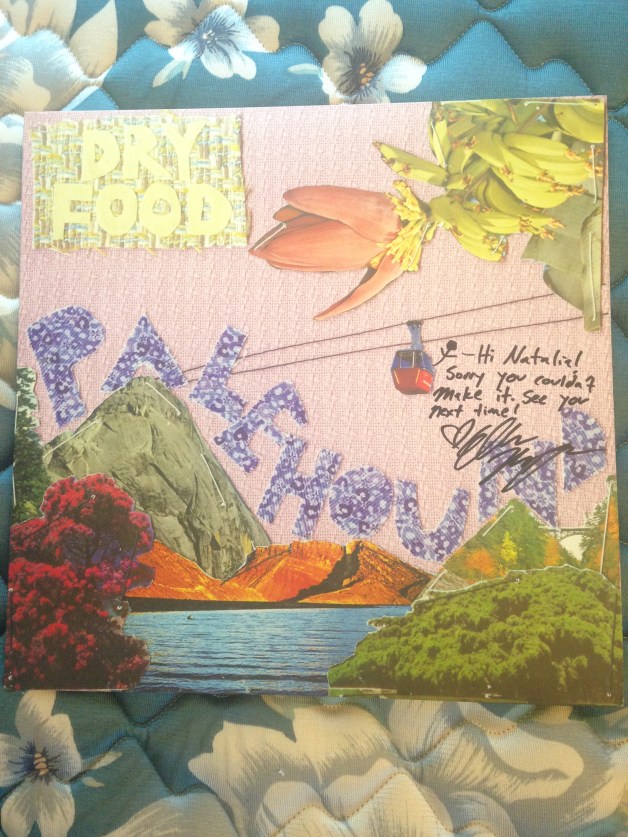
Suddenly, the record that I knew would trip me up the most came to the front. It was Palehound’s Dry Food. I ran my fingers over the small note that the front-woman had scrawled onto the cover at my ex-girlfriend’s request. She had seen the band perform in Brussels, where she lived, and brought it on her trip to come and visit me in Madrid. I hold no animosity against her, and we only broke up due to logistical reasons, but it still gives me such a pang of melancholy when I listen to it and the song “Seekonk” comes on.

file_004

I decided to keep it, anyway.

This is where I find KonMari’s method to be flawed, because it does not account for the many emotions that can be entangled within a memory. Would I be better off  having never met either of my exes, without ever having the opportunity to be loved by someone enough that they track down my favorite song on a 7″ record and have it shipped to me from Iceland? Or fly to a different country to give me a vinyl of one of my favorite bands? It stings knowing that things often don’t work out, but at the same time these records are tokens of proof that I’m a lovable person, and that in itself makes me happy although neither of my relationships were instances of infallible love in the end.

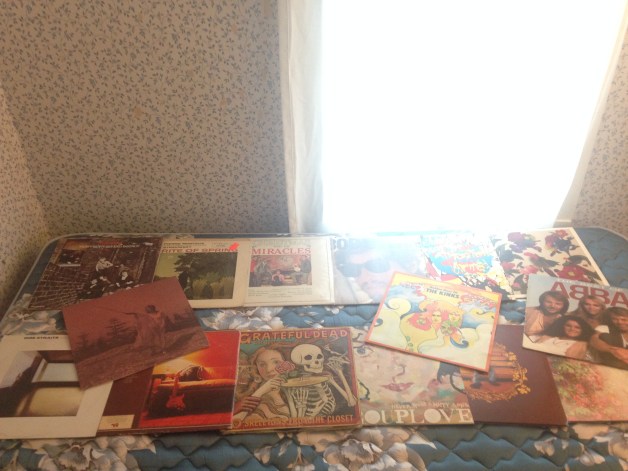
This exercise was interesting though, because I realized that even when I allowed things like nostalgia and sentimentality to be integrated into my decision-making process, it became clear that I really had outgrown a lot of my records. For reference, the first picture is of the records I decided I would absolutely need to keep, while the second picture is of those that I feel anywhere between “eh” and “ugh” about:

file_001

file_002-1

But this also might just be a lesson in why I shouldn’t let my romantic partners buy me vinyl.

The KonMari Method of Tidying Up

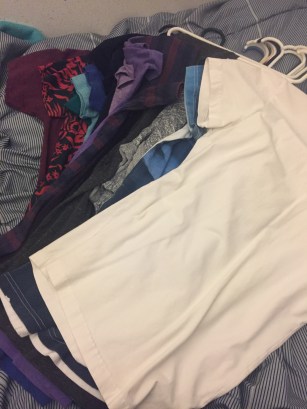
When I did the KonMari Method, I decided to follow Kondo’s advice and started with clothes that are out of season, my t-shirts. I do not have an abundance of t-shirts because in recent years, I have tried to be conscientious of my purchases and have aimed to only buy items I really love; I do not to let myself make excuses. In addition, if I can tell that I am not going to get much use out of an item, I do not make the purchase, even if I really like it. Consequently, I started the exercise with just fifteen t-shirts, total.

IMG_3994.JPG

My starting point

Initially, I was convinced I would not remove many shirts because of how picky I try to be when shopping, but as I started performing the exercise, I realized that I had been mistaken.


IMG_3995.JPG

Halfway through the exercise: the pile on the left has shirts that have yet to be held, the pile on the right has ones that give me joy, and the rejects are back in my closet.


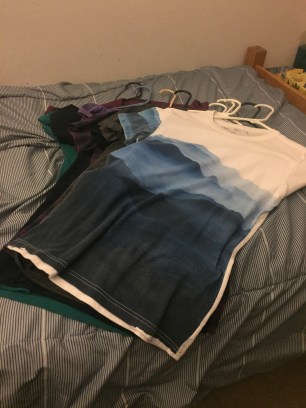
By the end of the KonMari Method exercise, I was left with nine t-shirts that I decided give me true joy—about two-thirds the number I started with.

IMG_3996.JPG

The final nine


When I held most of my shirts, I smiled involuntarily—sometimes triggered by a memory, sometimes by a particular shirt’s color or texture. These undoubtedly give me joy. For six of them, however, my reaction was positive, but not as strongly positive as for the other nine. Without overthinking or making excuses in their defense, I hung them back up, out of sight in my closet. Of these rejects, there were a few for which I realized my feelings are more mixed. One t-shirt, for example, the pattern and color of which I liked so much that I went to several locations searching for one in my size (size XS, which can be hard to find), has started to fade, rendering it increasingly apparent how cheaply it was made. Another has a very unique design that caught my eye in the store, but has never fit me quite as well as I would like.

Overall, I admit that it was difficult to be strict, vetting my t-shirts as if my intention really was to purge them, particularly because I did not start with that many. Throughout the entire exercise, I remained conscious of the fact that I could not afford to whittle them down much without having to constantly do laundry in the summer months. This means that despite the fact that I have practice using the unapologetically decisive mindset necessary to successfully perform the KonMari Method, it was difficult to keep myself from overthinking. Nonetheless, I believe I was quite successful in forcing myself to differentiate between the desire to keep a shirt out of authentic joy and the compulsion to keep it out of necessity.

I think that my attitude about some of my t-shirts comes partly from their look or feel; I love touching a soft fabric, and I love beautiful, vibrant colors. It is really exciting for me to find an article of clothing that has both of these, particularly because men’s clothing is usually limited to dark, somber shades. However, aside from the material of the shirts, what makes some of my shirts special to me are, of course, the memories I associate with them. When I hold certain articles of clothing, I have flashbacks to when and how I got them—running around with friends to find a certain shirt in my size, finding a shirt while bonding with my brother (we used to fight a lot but have more recently started getting closer), and so on. These sorts of associations cause the shirts to give me joy, and so I cherish them that much more.

You’ll Pry My Pens from These Cold, Dead Hands

IMG_20170130_202802.jpg

Pens galore. And this is after I did an exercise in tidying á la Marie Kondo in The Life-changing Magic of Tidying Up. I thought pens would be an easy category. They’re fairly cheap (unless you’re a pen snob like me) and they’re easy to come by. There’s no scarcity of pens in my little part of the world. But, for many reasons, I found this process surprisingly anxiety-producing.

I wouldn’t say that I necessarily have sentimental attachment to many of these pens. My reluctance to throw ones out that “didn’t bring me joy” stemmed from a few reasons, one of which was practicality. While pens are not expensive, they’re not cheap either—for someone who makes as little money as I do, anyway. I find that my writing process is incredibly different based on what pen I’m using and my weapon of choice is almost always the Pilot G2 pen series. It’s almost painful, when I need more, to pay almost ten dollars for four pens. Especially when, in my world, ten dollars is incredibly hard to come by. While not every Pilot G2 pen I have brings me joy—I dislike the 0.7 and 1.0 widths, while I used 0.5 and 0.38 depending on my mood/how fast I need to write/whether I care, at that moment about being neat, etc.—it would have been incredibly impractical for me to throw any of those away. They aren’t just going to sit there. They may not bring me joy, but eventually I will use them. And while Marie Kondo might say in her book to throw them away now and buy more later, I’m never sure if I’ll be able to buy more later. This was one of the largest reasons I disagreed with a lot of what she said. I took a lot out of it and there’s much of value in the excerpts we read, but she’s largely catering here to a certain class and I’m not part of that. Constantly being reminded that what she has to say in a large part doesn’t include me is incredibly off-putting as a reader. While my emotional response to this in particular is silly, I find it hard to get past.

I also found that because pens are in some way a temporal item, in the way that the ink runs out, and because I use them often—if sometimes not often enough to warrant keeping them by Kondo’s standards—it just seemed impractical to get rid of them. Because I often splurged for fancy pens, like fineliners from Staedtler or Stabilo, it seems incredibly dumb for me to throw them away. When I bought them, I knew it was a splurge. I knew that they weren’t practical on a day-to-day basis, but I bought them in spite of that. It seems silly to me to then get rid of them on the same grounds.

But at the same time, I do understand that a lot of what Marie Kondo has to say does have value. There are many things I took from the excerpts that I really want to continue putting into practice in my own life—such as, when applicable, doing the joy test to get rid of things that are really superfluous. But I do think that my standards of what is necessary and what is not are different than Marie Kondo’s, based on the fact that we clearly occupy different class structures and the fact that we come from different cultures. I do think she has a lot to teach me about being a more mindful consumer, or simply confronting what it means to be a consumer.

Curating and curtailing.

I like to consider my living space interesting (and adaptable). It has been referred to as “lived in,” “interesting,” and “museum-like.” In other words FULL. The book the life-changing magic of tidying up and KonMari method has sparked a change in me and the way I regard my “stuff” and collections.
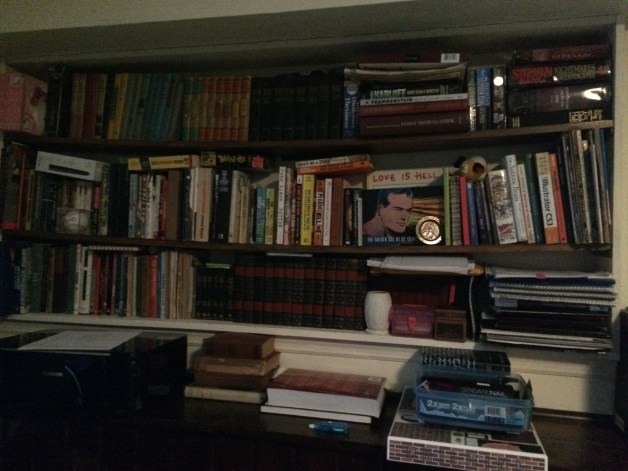
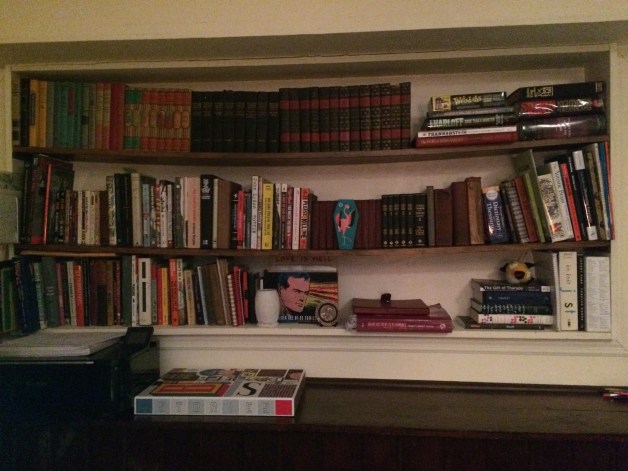
BOOKS: I am very protective and miserly about my books. I have dreams of my future where I peddle a ladder like a skateboard across a room to find a dusty book for reference and wield it like a sword of knowledge, knowing it’s exact location. Due to lack of funds and disgraceful housekeeping, I have resigned to Marie Kondo’s visualizing and decided I want to live in a world where I only keep the books that “spark joy,” or hold some possessive power over me and my need to preserve the historical value of good book binding. This visualization lead me to my collection becoming a “Curation” rather than a book rescue home.

I started with an estimated 350-400 books. I lost count and forgot around the 200 mark.
This was probably the first sign I’d have too many to justify keeping them all. img_7299
Admittedly, some of the things here aren’t even books. They’re things that ended up with books because there was a space, or a nook, or I was using it as a reminder of a book, or even an implement to inspire me to write. I left what I had on the now emptied shelf to make sure I was keeping them for a distinct purpose. Textbooks for this class, art I’ve JUST made (it’s a coffin, with a flamingo on it), an empty bottle of holy water (doesn’t matter why- trash), some Lady of Guadalupe devotional items (a growing collection), and a digital recording pen (voice and ink) that I use with a person for collaborative writing, currently.

This is my empty shelf and this is my PILE. I thought to pile because the task seemed less daunting and for motivational purposes, less than 350-400 squats. Standing over it and picking them back up to replace them was eased by categorical organization once I’d sorted them. I had two discard piles initially and decided to make a separate mountain to create the same effect of horrifying accumulation.

img_7346In this pile I will identify some things that are definitely worth throwing away, selling/donating (which I will revisit in a minute), and (re)gifting. I’m not entirely sold on throwing things out. I love having extra cash, maybe even to buy some new books, but I plan on parting some to my niece, who is in the process of learning to read. I have also discovered a useful app called “Decluttr” which takes your unloved medias (including books!), pays you (without a shipping charge!), and they are never to be seen or heard again.
•The Atlas: it is a Nascar atlas, which I choose to hide in the photo. My mother gave it to me in 2002 when I had embarked on a 23 hour road-trip after graduating high school. I kept it. it’s falling apart and has post-its of things she thought would be good ideas. I haven’t used an atlas since. I appreciate but almost never use maps now. The memory is so ingrained that I will never need to use it to remember.
•A tiny pink case containing an incomplete set of Garbage Pail Kids collector cards. Why? They’re funny. Why did I keep them? No idea! It’s got the location of where they’ll be going right in the name.
•Stephen King and Tim Dorsey paperbacks. I’ve read them about 20 times each if I had to low-ball. I still love them, I kept the signed hardcovers for apocolyptic trade value. Maybe I can wear the covers out on those next to show how much I truly love them.

This was probably the most emotionally strenuous tasks I have ever shared with books without actually reading them. I had held so much value in books that changed my life that I could quote verbatim. I kept books mostly for reference in things I am currently interested in. Heirlooms for future purge. I put them in a prominent place I cannot reach, but always have to look at so I can constantly ask myself if they are of value. I got rid of the rescued tale of two cities that had been attacked by rot and bookworms. I gave up the 5″ thick home medical reference that I have NEVER USED, accompanied by a funny little gift book about hypochondria.

img_7347

Rather than having books shoved on top of books competing for space, I have a half of a shelf to spare. What I had initially thought would be the tossing of 10-20 books, I counted a full 70 books I will parting with this round. In this process, I remembered that a part of my makeshift art studio is a hidden 50+ reference books. I am hoping this weekend to tackle that secret trove and aim for this empty space to be full, and my supply cabinet to become more functional. This to me is in fact, joy.  It only took a few hours to do. I got a decent workout by trying to lift each category in one stack. I can see the titles. I know where things are. I know that owning them contributes to my life.

I realize my foolish emotional attachment to books I had only read once, perhaps for a class, because they were a gift, because so and so gave it to me, etc.. I found that it’s the paper, the cover, the image of who I imagine myself to be. The books are proof of the journey that has landed me in the present. It’s the preservation that life I’ve lived that I’m really curating in the form of books. Books I’d never read were wasting space, much like the tasteless people who’d given them to me. I should instead be presenting and representing a better, more positive aspect of myself, and be an advocate for the things that do remain in my life because they make me happy, rather than justifying it as “experience” or an excuse to one day own a rolling ladder. I’ll probably buy that anyway.

Tidying Up: Konmari

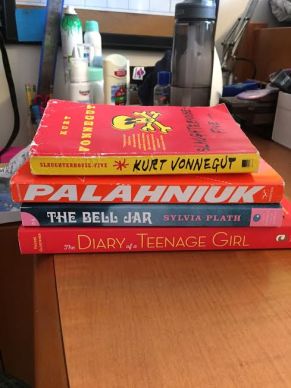
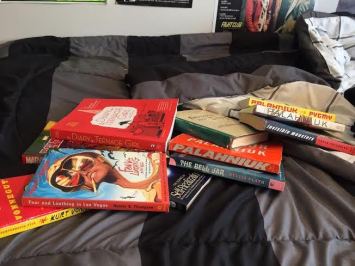
I don’t have much in my dorm room to begin with since the space doesn’t really allow me to, so most of the items contained in my room are “necessary” items such as clothing/ toiletries. When I was looking around my room to choose a certain category of items to use the Konmari method on, I reflected on my bookshelf. I had just recently discarded many unneeded lotions and perfumes before break so it remained only half full of a couple things such as two things of lotion, some facial masks, one bottle of perfume, a bowl, some utensils, and a stack of books. The section on books within the reading had caught my attention and when I saw my own books on my shelf, taking up much more space than the more functional items, I reflected on what she said. I have a pretty large book collection in my room at home and when coming to college I took a few in case I got bored and wished to read them. I only brought about ten with me, but when I grabbed them all off the shelf and onto my desk I realized there was only two books there I had actually completed. I love reading but for some reason it always came with this weird anxiety; I always feel like I missed something, when I didn’t, and i’ll re-read paragraphs over and over. It leads me to consistently only read the first 30 pages of most books I pick up. Most of the books I had are Chuck Palahniuk cause I’ve had a goal to read his entire collection of works. It made me disappointed in myself that I never actually did it, considering I had been collecting his books since I was 14. The two books I had fully read were Survivor and The Bell Jar ( I was probably 50 pages away from finishing SlaughterHouse Five).

unnamed-1.jpg

My copies of both Survivor and Slaughterhouse five were very beat up, and when I picked them up I actually laughed. I read them the summer going into my sophomore year of high school. I had to go to sailing early so I brought them with me every day and would just sit on the beach, eat, and read.  I was always scared of people looking at me when I was there and I think that the time I took being alone to calm down and read allowed me to be more content with myself. Because of this I put those books in the “joy” pile. The Bell Jar was the third book I put in the joy pile. I don’t remember much, considering I read this book when I was 13, which was 7 years ago now, but there’s something about it. It’s not necessarily joy, more of nostalgia. I was an angsty kid who thought “no one understood me”, so of course I would have gravitated towards this book when I was that age. It really makes me want to re-read it and reflect on it now at the age of 20. The last book I put in the joy pile was The Diary of a Teenage Girl, which was a 19th birthday present from someone who I’ve been friends with since I was 10. It’s a important object for me cause I know a lot of thought was put into it and It was given at a time in my life when I was going through a lot. Its one of those books you can pick up and read parts every now and then, and that’s exactly what I’ve been doing with it. All of the other books in my pile are just books I’m sure I would enjoy, but I have no special connection with, at least yet. I put them to the side, but I don’t feel the same way about books from what was stated in Konmari Method. I cannot simply just toss those other books because although it may take me a while to pick them up, I eventually will. I feel there is a time a place where those books will bring importance to my life, and I hope I will be determined enough to actually finish the Chuck Palahniuk collection.

unnamed.jpg


A Woman and/in Her Closet

I chose to use the KonMari method on my closet, focusing on the clothes hanging both inside and outside of it. This is not the first time I have used this method–  I have been using some form of the  KonMari method over the years to tackle the constant accumulation of clothes whether in my closet or my dresser. This exercise was approached with some resistance as I felt like I was not ready to purge. I find myself periodically binging and purging on clothing. I did not feel like it was time to go through this process yet. However, for the sake of this exercise it had to be time.

Certain times I feel comforted by the abundant selection of clothes that I have. Clothing has been a means to express myself over the years. My shirts, pants, skirts, dresses, etc have allowed me to take on a chameleon form. Everyday of the week I have the opportunity to reveal different parts of my personality. I have been mindful and sometimes obsessive about what I am wearing because there is a large part of me that believes in the idea that clothing guides people’s interpretations of one another. I believe this attitude toward clothing is a byproduct of having four sisters- each with a completely different style. Throughout middle school and high school I was constantly face first in their closets looking, touching, and taking their clothes. Also I am fourth in line so clothing would also trickle down and I would be given massive amounts of hammy-downs. I started doing this biannual purge in the beginning of college. With minimal space in dorm rooms, I felt extremely overwhelmed by the amount of clothing I owned especially because I didn’t wear a lot of it. This clearing of clothes, in the beginning, just gave me more room to fill my closet back up until I reached that same point of angst. As I get older and continue this process though I refill less and less as clothing does not play as significant of a role in my life as it used to.

img_1135

“Inhales”

Although I have been going through this process for a quite a while, I still seem to take away something new from the experience. This time it began with me noticing the shear amount of things that I have hanging outside of my closet. The outside of my closet is filled with hoodies, sweaters, scarves, jackets, towels. I had a hard time getting rid of these items especially during the winter months.  These items are what get me through this season and with that bring me joy.  Additionally, I find that i keep extras of these items just in

img_1136

Inhales even deeper

case a friend is over and cold or wants to change into something else. Being able to provide that article of clothing for that person is meaningful to me and brings me satisfaction/joy. I was apprehensive to go through these items but, I had to be realistic–whether you have five sweaters or twenty, you can let a friend borrow a sweater and since that’s the case, I would rather I have only five. Also going through this process, both inside of the closet and out, I did not realize how many articles of clothing I completely forgot I owned. That sort of stupefied me and informed a new relationship to my objects–Only own the things you can recall/remember.  I loved getting to interact with these items again and being reminded of the times I spent wearing them but realistically they were forgotten for a reason in many cases– something was too small, had a stain, doesn’t really match anything else, etc. That was a key indicator for the things I knew I needed to get rid of. Also another indicator is the “6 month rule” meaning that if I haven’t worn it in six months then it’s time to depart with it. (this is taking into consideration the seasons) The more I continue to narrow down the selection of clothes I have the more relaxed I feel I am finding. I feel much more transient and in touch with the style I want to portray at this current stage in my life. Now what is left is a big white bag filled of clothes that will either find their way into the homes of my friends or goodwill.

img_1140Exhales with joy

img_1144

Exhales feeling accomplished

Joy Test Report; Discussion of Object Relationships

img_4255

Before. Sorry for the crappy lighting

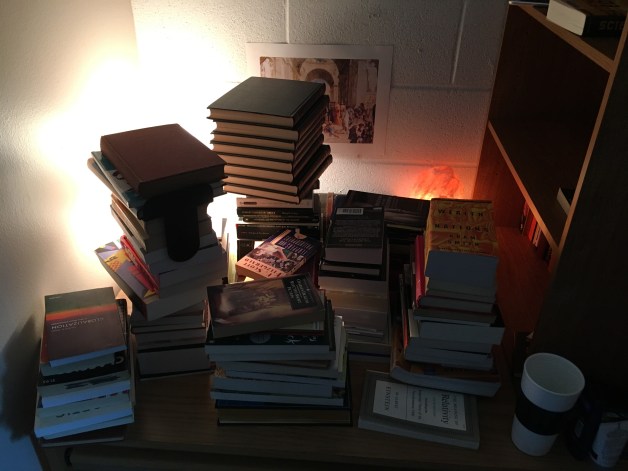
Like many other students, I decided to use KonMari’s joy test on my books. I removed all books from the three tier shelf on my desk, gathered the stacks in the other room, and piled everything on my desk: in total, they numbered about one hundred and fifty volumes. Now, as there was never any possibility that I was going to dispose of any of them, my only purpose in this exercise was to isolate that specific group of books which I would like to keep on the shelf that I stare at every day­­—as KonMari would say, those which gave me a “tokimeki” (props to my Japanese roommate for knowing the word for “spark of joy”) and move all others to a different location. I broke this down further, dividing tokimeki books into four categories: principal characters—this includes volumes that I engage with very often, such as Cooper’s edition of the Platonic corpus, a collection of Jung’s writings, Shakespeare’s Sonnets, and perhaps a dozen or so others; auxiliary characters—this being the largest category, incorporating all books that I engage with often to semi-often, and which round out the different sections of my library; present engagements—i.e. books that I am currently reading, but which may not necessarily be returned to regularly once I have finished them; and, lastly, books that are in semi-dormancy—i.e. books that I am reading, but at super-snail pace, sometimes with weeks between readings. Books that fit any of these categories were maintained on my shelf; all others were relegated to stacks in another room.

img_4256

After

The process of filtering out books that gave no tokimeki was somewhat familiar, as I had unconsciously used similar techniques in the past; but employing KonMari’s method consciously was interesting nonetheless. I will say, however, that, while books are certainly objects, I disagree with KonMari’s seemingly commonplace characterization of them: I think that books are particularly peculiar objects with which we form equally peculiar relationships. I will now attempt to explain what I mean by this in a long, drawn out, painful fashion:

No relationship that a person may have with any object is static: this would require that both parties to the relationship remain entirely static, which ­– considering that one party is living – is impossible. All objects that we acquire ­– or meet somewhere – begin either as strangers (when we have no familiarity with the object itself or with its essential characteristics), or from some level of familiarity: say, perhaps, that a person has never encountered pen X before, but is familiar with pens in a general sense: thus, pen X is not entirely foreign to the person. This external general familiarity is automatically imported to the relationship that the person forms with the specific pen X. From here there are, again, two options: first, the person may never encounter pen X again—this would seem to indicate that the relationship with pen X would remain static – in limbo, so to speak – but, in reality, the relationship on the human side will alter and degrade with time as the person changes and as the characteristics of pen X are slowly forgotten; second, the person may re-encounter pen X—it may be generally stated that the person who encounters pen X again will encounter it n times, n being the number of instances in which the pen is encountered before the person never sees it again. Now, each time that pen X is encountered, the relationship (insofar as it is dependent on the ever-dynamic human system) will update to integrate the circumstances of the newest instance. For the vast majority of objects, each update is minuscule, with the change between some instances even approaching negligibility (some updates, of course, may be significant, but this is uncommon and is more dependent on typically unpredictable external happenings involving both us and the object, than on the interaction based evolution of our relationship with the object itself); but, nevertheless, the relationship will not remain static—we may notice changes in the way that we feel about an object when considered over medium to long time frames. However, there is, of course, a minority of objects which do not correspond with the characterization that I just explained: these include, for example, computers and books/documents. Objects such as these are still objects, but our relationships with them have the potential to change far more rapidly than can our relationships with objects such as pen X. Why is this?

Here I will illustrate by considering an arbitrary relationship between a person and a book. First comes initial contact: the person is drawn to the book, perhaps because s/he has heard of it, or of the author, or is merely interested in the topic (the other option is that the person encounters a book about which nothing is known, but I will not consider this option here); let us say, for simplicity, that there is nothing printed on this book except for its title and author, so this is all that is readily discernible about the book without opening it. The person buys the book, brings it home, and it is placed onto a shelf where it resides for some time. As long as the person sees or touches the book, but does not read from it (and hears nothing regarding the content of the book from external sources), the relationship will proceed as would a relationship with a typical object—that is, at an almost negligible rate; however, once the person begins to read, the course of the relationship is altered drastically. From thereon out, the book becomes a medium for a relationship between the reader and the thought and feeling of the person who wrote it; but the information that is gleaned from the text by the reader also becomes inextricably related to the object that is the book itself: thus, each time the book is read from, the relationship that the person has with the book is updated, and these updates have the potential to be quite significant in comparison with the updates discussed for typical objects: perhaps this is why relationships that people have with books can become so intense. Further, information that we learn in a setting entirely removed from the book may also, upon a later reading of the book, give new meaning to text within the book that we did not initially recognize as significant: thus allowing for an even greater alteration of our relationship with the thought of the author and with the object that is the book.

So, even though books are technically objects, the relationships that we form with them seem to occupy some finely integrated grey area between an object relationship and a personal relationship—something that cannot be said of pen X. It is for this reason that I call books peculiar objects.


Oxford Mania

Over the past few years, my affinity for preppy clothes has grown immensely. Since my freshman year at college, my collection of band t-shirts and tattered jeans has slowly dissipated and turned into a wardrobe filled with twill slacks and J. Crew Oxford button downs. I hadn’t really thought much about this casual aesthetic progression before, but after our discussions in class, and sitting down in my room to analyze my surroundings, my eyes went straight to my overabundant closet and the significance of the clothing I now possess.

My clothing and the way I dress have always been things I have been extremely cognizant of. Growing up in a relatively poor family in an upper-middle class area, I was always judged, and even bullied, for the clothes I wore. Subsequently, I have become extremely meticulous of how I present myself to the world through my clothing choices, and now use my clothing as a medium of self expression.

The J. Crew Oxford has consequently become a staple of my wardrobe, primarily because of the intrinsic aesthetic significance of the Oxford style shirt, but also because of the ascribed status of the J. Crew brand. (I am admittedly not immune to the trivial associations of brand named goods and status, like most people in society). I chose to work with my collection of Oxfords because of what they mean to me now, and how they resonate with my experiences as a poor kid in my past.

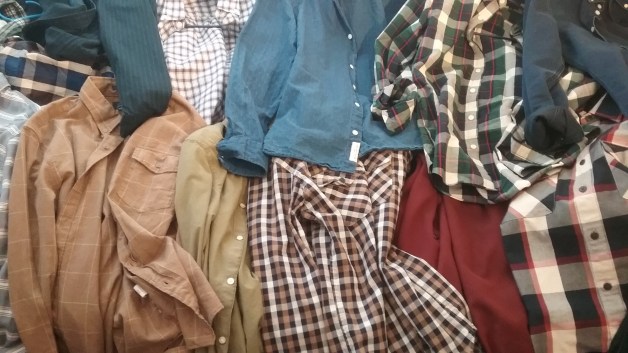
At first glance, my closet can be a tad overwhelming. After counting the shirts lining the span of it, my collection came to a total of 29 Oxford shirts. I was actually a bit surprised by this number, not realizing how many shirts I had accumulated over my past few years of sporadic online shopping sprees. After recognizing this number, I was eager to get rid of some of the shirts that I wasn’t too crazy about. I ended up finding 5 shirts that I’m going to be giving to my younger brother; freeing up some space in my closet, while also having a stash of birthday gifts for him for the next few years.

Emotionally, I was a bit torn. Even though many of the shirts I was willing to give away didn’t ignite the “spark of joy” Marie Kondo spoke of, I was still a bit reluctant to get rid of some of them. I thought about how important my collection of shirts was to me; how they helped me present myself meaningfully to the world, and how I used them as an extension of myself and my desires. I was however glad to recognize this unreasonable attachment to my shirts, and quickly bagged them up before I could change my mind. The collection I was left with was a bit smaller, but I honestly felt better getting rid of the Oxfords I wasn’t too crazy about. I feel as if my downsizing did help me hone my “joy” for my better shirts, and I ended the downsizing ultimately feeling more organized.

The most significant part of going through my shirts was in fact the thought processes I underwent throughout the haul. The main themes I thought about were regarding image and self-extension, both of which pertained highly to my collection. I thought about how society’s perception of people based on the way the dressed stylistically was so arbitrary, and how the association of style and status has defined generations for centuries. I also realized that my relationships to my objects were rooted in self-loathing, self-consciousness, and memories of bullying from my past. I used my J. Crew Oxford collection to detach myself from the poor, fat kid I used to be in middle school, and to obtain self-worth and pride from a silly label every time I button myself up in one of my pieces. I thought about how I use my Oxfords as a shield from people’s negative perceptions of me, because how can anyone think negatively of a boy in a nice plaid Oxford, right? My relationship to my shirts is subsequently dichotomous, serving as both a way to make myself feel good and clean and worthy, while also serving as a harrowing reminder of my past.

20170203_133554

A small snapshot of my shirts