


This week I decided to write about something I have always seen in my house but knew little about: my mother’s Bolivian wooden sculpture. The only way to explain this object and its chain of ownership is through telling a brief part of my family history.
Both of my mother’s parents were teachers. After getting their degrees in education at SUNY New Paltz in the mid-1950s, they took on the real world and joined the workforce. My grandfather, William Gumm, eventually wanted to move up in the ranks and become a principal. However, in the 1960s, one could not become a principal without experience, but one also couldn’t get experience without the job. To get out of this catch-22 situation, he applied to work as a principal for schools affiliated with American companies in developing nations. Gulf Oil Company had offices in Bolivia and their own school for the American children of Gulf Oil’s employees: the Santa Cruz Cooperative School. It was this school in Bolivia that my grandfather became a principal of, and my grandmother taught there as well. Their three kids – my mom, my aunt and my uncle – naturally went with them. They lived there comfortably for three years before heading back to the States, and my grandfather achieved his dream of becoming a principal.
The small wooden statue in the photos above was made especially for my grandfather. On the bottom of the statue, the carving reads, “To Mr. and Mrs. W. Gum, with all our heart Juan S[illegible] and family, SC 24-V-69.” I presume that “SC” stands for Santa Cruz, the city they lived in, and that the date means May 24, 1969. On the bottom left of the base of the statue, there are the initials “WBC,” of which I don’t know the meaning. I truly wish I could discern what Juan’s last name is, but it’s hard to read. Regardless, it was clearly a personal gift. When I asked my grandmother if she remembers who Juan was or how they got this statue, she said she thinks he might have been a gardener (not sure if he was the family gardener for the house or a gardener in the community). She told me that many of the locals there were extremely talented and great craftsmen, which would explain why we have so many wooden statues within the family.
This statue currently sits on our wall unit next to two Bolivian wooden heads (another set of wooden statues my mom inherited). Although these have not yet been passed down to me, they still sit in my house and I consider them half-mine. The Gumm family’s move to Bolivia was significant for so many reasons. It taught the family Spanish, which would be especially important in my mom’s and my uncle’s lives (my mom studied Spanish Literature in college and my uncle married into a Cuban family). Their experience with Bolivia, its culture and the Spanish language also led me to learn Spanish throughout my entire life, and while I am in no way fluent I do consider it my second language. The experience created this story, connecting a relatively average, middle-class American family to a South American culture. It affected the entire family’s future up until the present. The carvings on the bottom of the statue by the person who made this wooden Bolivian woman shows how much the Santa Cruz community knew and loved my grandparents.
I think this story really relates to Edmund de Waal’s connection with the netsuke. Although he is certainly not Japanese, the netsuke are a huge piece of his family history and had a significant impact on the family’s future. Stories and history are totally related to objects. If my mom never went to Bolivia she may not have learned Spanish and therefore neither would I, and a huge piece of my life history would be missing. My family history is intertwined with this object. Its passage down from my grandparents to my mom to me demonstrate how history can also be passed down the same way. While I’m no descendant of the elite Ephrussi, I’m proud to be connected to the Gumms.
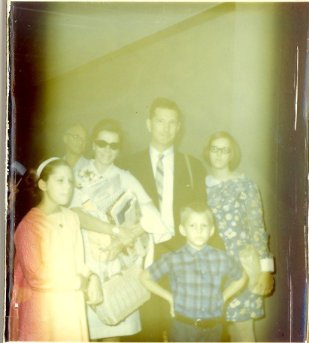
Slightly awkward family photo, 1970s
 The Materials of History, Thought, and Art
You must be logged in to post a comment.