The Tale of the Cutty Sark

This week I’ll be discussing a bit of an odd family heirloom.  Perhaps heirloom is the wrong word, as basically I was asked if I wanted it, otherwise, it would be thrown away.  For some odd reason, I felt a strong urge to keep it, and so now, it sits in my room, sort of on display, sort of just in there.
img_2507

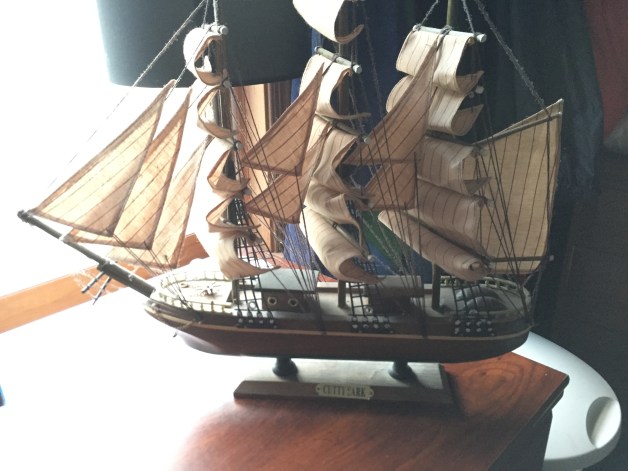
The replica model of “Cutty Sark”

This model, weighing somewhere around 3 pounds, it’s awfully light, is about 18″ long and 18″ tall (it doesn’t look that way but when you factor in the whole length and the tallest point, that’s a fair approximation.  Regardless of its dimensions, what I find additionally puzzling about the model is why it exists, or even more importantly, why my grandfather had it.  I researched the original Cutty Sark ship and it was a tea clipper constructed in 1869 that became a wool transport ship as steam technology was making sailing ships slow and outdated.  This was a fairly fast ship for a sailer, as it held the record from Australia to Britain for ten years; obviously the record was broken by a steam ship.  After its transport value diminished, the Cutty Sark exchanged hands and names a few times, lasting two generations in Portugal, but was finally repurchased for preservation in 1953 and has officially been out of service since December of 1954.  It would be important for the family ties to share that no one in my family is British nor Portuguese.  My honest guess for why my grandfather had this was that he was a history buff.  He was exactly one of those people that every time you saw him, he had read a new book about World War II.. I was always surprised with how limited his readings seemed to be, yet how extensive his knowledge of world history was.  He and my grandmother were world travelers, having been to dozens of countries, from Britain to France to Prague to Spain and quite possibly everywhere in between.  So as an honest guess, my grandparents were in Britain, and he had either known about or seen signage for the Cutty Stark museum, and bought this replica as a souvenir, perhaps the start of a collection that never got off the ground.  Maybe I’m mistaken, maybe it was a gift, or something given to him by a friend, I couldn’t possibly know.  I could only make the assumption that this wooden vessel is around or less than 60 years old, as that was when the ship was retired to be preserved.

Regardless of this, I still have no idea why I was so fascinated with it and wanted to keep it.  I’d never heard of the ship before so there certainly wasn’t any rationale for me to keep it due to my fascination with it.  Perhaps the thought of throwing it away was too painful.  Maybe I too want to preserve the Cutty Sark.  Personally, I wouldn’t find that true, and I’d probably place a lot more value on nostalgia, as my grandfather didn’t have many positions of this nature, and I wanted to maintain it for his sake.  Regardless, it sits with me, continuing to serve no functional purpose, just leaving me a memory, and a reason to wonder.
Still Writing About My Alarm Clock

(Since my alarm clock was a gift and not an heirloom the history of ownership is limited to me.)

As a continuation of last week’s blog post, I decided to look more into the history of alarm clocks. Interestingly enough, there is some dispute on who created the first alarm clock. My last post mentioned an American as the first person to patent an alarm clock. However, I am reading conflicting stories about the first alarm clock originating from Ancient Greece. (Why does it seem like everything was created when the Ancient Greeks walked the earth?) Some of these sources claim that the first alarm clock was created nearly 2,000 years ago. I am careful not to mention these sources because I do not find them to be credible enough after doing some research on the supposed inventor of the first alarm clock, Ctesibius. I realize that these conflicting speculations on the creation of the first alarm clock speaks to a much bigger issue than alarm clocks itself. It reveals the issue of ownership, entitlement and cultural dominance. The issue of ownership is hard to determine in many cases because objects are always in constant motion from place to place or person to person. Then there is the issue of entitlement that somewhat overlaps with ownership. Being entitled to an object does not necessarily mean ownership of that particular object. By cultural domination, I am referring to the fact that because the world is Eurocentric we often trace inventions back to Ancient Greece/Rome and mostly in European nations.  I bring up these issues because clearly in the case of the invention of the alarm clock these are issues we are forced to stop and think about because of the disputing claims we are presented with. Then we also have to take into consideration the possible invention of an alarm clock during the Nok Civilization in present day Nigeria, for example.

As I stated in my last post, I am curious to know about how people who needed to wake up early woke up. Luckily for me, as I was reading an article about the 2,000-year history of alarm clocks I came across the term “knocker-upper.” Indeed, I was just as puzzled as you probably are right now. Apparently, knocker-uppers were people who were hired in Ireland and in Britain to wake people up. This trade started during the Industrial Revolution and continued through the 1950’s because alarm clocks were not as cheap or as reliable then as they are now. Sometimes these jobs were carried out by older men and women and constables making patrols early in the morning*. It is unfathomable for me to even think of being a knocker-upper as a real job. I find it funny to think of, but I also find it profoundly fascinating. To think that there was period of time when people hired other people to wake up for them leaves me speechless. However, it also makes me question how those knocker-uppers woke themselves up. It could be argued that these people had become so used to waking up early in the morning that their circadian rhythm changed accordingly. As of now, I cannot think of anything free of tangled questions that could answer this question.


*All this information was gather from Wikipedia.

Beaded Necklace Revisited

Before I begin this blog I must inform you all that I tried to take this class a couple of semesters before this, however was not able to due to schedule conflicts. When I originally took this class I decided to explore a beaded necklace that was passed down to my mother and father many years ago from distant relatives in Detroit.  I look to revisit it because I found out more information about this necklace. Additionally, it is currently being passed down to me. So this post will be a conglomerate between what I had already learned previously with some new tidbits mixed in.

This necklace was sent to my family by relatives, whom I have never had the opportunity to meet, from Michigan. Two sisters, now in their nineties, who I have been told hold practically hold all the information regarding my heritage on my father’s side of the family. After writing and speaking to them on the phone multiple times (even after I dropped the class) more information began to come out about the movement of this necklace, contributing to the history of this object.  

The necklace that is contained inside of a long gold box has existed in my family for little less than a century. This piece measures approximately 8 to 10 inches long and the chain itself is about one and a half to two inches wide. This necklace is entirely embroidered in blue, silver, gold, and hints of brown glinting beads. The necklace was mainly made with blue beads, but alternates in a maze-type pattern of silver beads with minor gaps of brown beads. Toward the bottom of the necklace is inscribed the initials PB, which stood for Paulena Byllott, my great grandmother. Just below her initials, the very bottom of the necklace is lined with beaded tassels.

Inside the golden box writes ” Given to Grandma Paulina Byllott, by Capuchin Monastery.” This necklace was a gift to her from a Monastery in Detroit, Michigan.

This is a  piece of jewelry worn by my great grandmother, whom I am partially named after (Caryn Paulena Byllott). I had not known much when I first came across however, through further investigation at the time I was informed that a letter was sent to my family along with the necklace.

Paulina Byllott, who I mentioned above, was born in 1868 and immigrated to America in 1886 from Germany. She married in 1887 to August Byllott and lived on McDougall ave, which was walking distance from the St. Bonaventure Monastery. Apparently, they were both great benefactors and supporters of the monastery and the Capuchin Friars there as well. For years they walked to the Monastery at 6a.m. for Sunday Vespers and my Great grandfather, August was a occasionally an usher too. Additionally, August was a blacksmith by trade and made iron hooks that were affixed to the church and used to hold the doors open. Around the turn of the century this gift was bestowed upon Paulina by the other Capuchin Friars for her work and dedication to the church.

With this object resurfacing I decided to take a look at the St. Bonaventure Monastery. This Monastery was founded in 1883 and is home to many of the Detroit Capuchin friars, which are spoken about above.  The Capuchins  themselves were founded in 1528, emphasizing prayer and contemplation, preaching, and physical care of the needy.

As I spoke with these women more they informed me about how this necklace was an icon of Paulina. It was so important for her to wear it all times, they described it was her way to further represent the faith she was apart of. This necklace traveled with her I found out. Her and August did quite a lot of traveling through the midwest and somehow made it to New York for a bit. These women were constantly emphasizing that no matter where she was the necklace was always with her. Also this necklace was one of many gifts from the monastery she received. Those items still remain with the sisters in Detroit, however, they may send more items to my mother soon!

I have been rather blind to my heritage due to early passings of my grandparents and lack of communication among extended family. However, these sisters have been the key into my heritage. Being able to develop a relationship with them over the past two years has been so insightful as well as very grounding. I am feel very honored to be the next owner of this necklace and more so now that I have been able to learn so much about the history of the necklace. Unfortunately I do not have a picture of the necklace at this time. I will see if I can have a picture sent to me soon.

Stress Relief – For a Very Good Cause

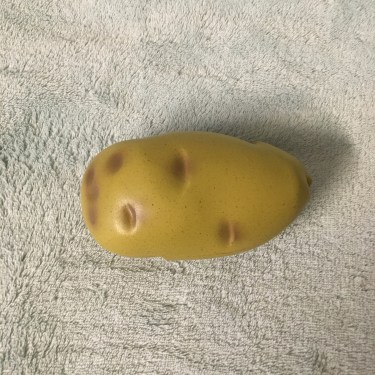
This week, I have decided to examine a potato. Not a real potato; a stress potato. It is a stress ball in the shape and color of a literal potato. Though the color is more green than a perfect Idaho potato would be at the store, it has a realistic representation of dents and eyes on real potatoes.

IMG_1437.JPG

I received this potato from my neighbor, Heather, who my mother is good friends with. They moved in next to us when I was 5 years old. They have been next to us so long that I remember when they brought their baby daughter home from the hospital, and this year, she’s turning fifteen. The potato is four to five inches in length, and on one side it says “green chimneys” with a drawing of a house containing a plant, pet, and two people. The sun is shining down on the house.

I was over at their house one day having dinner. I spotted it on their kitchen counter and immediately picked it up. I was just staring at it, and I heard Heather say, “Em, you can have that if you want. Carter doesn’t use it anymore!” So, of course, the stress potato was mine.

After doing some brief research, I discovered that Green Chimneys is a learning environment dedicated to special needs children who have emotional and mental health disorders. It is centered around animal assisted therapy. It is located in Brewster, New York, and it began as an “unusual boarding school,” as the biography puts it. Sam and Myra Ross are the creators of what Green Chimneys is known for now, but in the beginning, it was simply a boarding school with students between the ages of three and six. It opened in 1948. The home like setting of this boarding school, prepared by Sam’s father, was only part of the unique environment; attending school here came with the opportunity to interact and care for animals.

As Green Chimneys’ history goes on, in the 50s, it gained a reputation of helping students with special needs, and thus blossomed into what it is today: there are more than 200 students attending Green Chimneys today compared to the 11 when it began in 1948. It hosts therapeutic day programs as well as their residential year round school programs, and of course still has the innovative animal-assisted therapy. The Green Chimney’s Farm and Wildlife Center houses three hundred domesticated farm animals and wildlife.

Green Chimneys expanded in 2008 with a brand new campus in Carmel, New York, showing that their services are extremely beneficial, and will continue to be in the future.

Heather’s son, Carter, had serious trouble attending school when he was young. I assume this is one of the places he attended, and it has very clearly paid off. He can function in a learning environment, and is even on his college search right now. After knowing him for basically his whole life, I’m very proud to say the least. I’m really glad my stress potato has come from such a loving and caring place which focuses on emotional well-being while learning, as it has genuinely aided me in times of stress.

Another Piece of Clothing

I decided for this week to change directions, and analyze an object other than my Oxfords. Looking around my room trying to find something worthwhile, my mind drifted towards my closet yet again. My consistent predilection toward the items in my closet seems to be a common theme; something I never expected to realize from this class. I’ve been drawn most strongly towards my clothing consistently throughout the semester, something that has both surprised me and worried me. Anyhow, perusing through my closet, I was drawn to my plaid scarf out of everything I saw, and decided to write about it in depth for this week.

My plaid scarf has always been a mystery. I had only recently acquired it over this past Winter intersession at home, going through old boxes in my basement. I saw it peeking out from underneath a whole bunch of my mother’s old clothes, and decided to take it (with her permission of course). It is curiously made, with horizontal seems that break the scarf’s length into several sections, which perplexed me. It is also frayed on its ends, a style that I knew definitely wasn’t popularized until at least the 2000’s, and so being that this scarf is from before that time I was confused. I didn’t really think much about it, and just took the scarf with me back to school for the Spring semester, where it is now hanging in my closet alongside my coat.

To help gain a better understanding of the scarf and its origin, I called my mother on Wednesday night and inquired about her formally abandoned scarf. It took her a while to remember the scarf I was talking about, I went on for 10 minutes describing it to her, and had to eventually just send her a picture of it from my phone. Once she remembered the exact one I was talking about, she divulged.

Apparently, the scarf was originally my grandmother’s school uniform skirt. My grandmother Joan, a sweet and quintessential Mancunian, used to wear it to her primary school in the late 1950’s. It was later re-purposed by my grandmother after she moved on to secondary school and her uniform changed. Its unusual hemming and frayed edges were just left over from the haphazard attempt of a 13 year old school girl to turn her skirt into a scarf. Maybe an act of defiance, or maybe an act of sheer boredom; I will never know. However makeshift, its convenient plaid pattern suited it well as a scarf back then, and even today too as the style has transcended time and is still considered urbane. After my grandmother used the scarf throughout her secondary school and university years, my mother inherited it as a child growing up in London. Since then it has found its way to New York City, and into a tattered cardboard box in my basement where I ultimately found it.

Have dug deeper into the origins of my scarf, I wear it now with a better understanding of its past. With both a weird and interesting connection to my English roots,  the scarf is one of the only real things I can think of that I have in my possession from my mother’s side of the family. It connects me, in whatever form, to my grandmother as a young child in her school years, and to the entire era surrounding her life back then. I also think it’s very interesting how it is a recycled piece, and wonder whether it was re-purposed out of need, because of the culture back then, or just for convenience. Anyhow, I wear it now with a better appreciation for what it actually is and where it comes from.


Old Friend–My Violin

This is the violin that I played throughout middle and high school. It has followed me through a lot of life changes, and seen me through all sorts of concerts (including two musicals and three very stressful solo events). I received this violin in 2007, when my rent-to-buy program had accrued enough credits. We purchased it the D&M Music store in Pleasant Valley, NY.

violin-1

According to the label on the inside, the violin was manufactured by Stefan Ulrich in June 2007 in Romania. I tried to find a website, to try and see the history of what Stefan Ulrich does, but a Google search only brought up scores and scores of people trying to sell off or buy the instruments. Apparently, Stefan Ulrich is a very popular instrument crafter, and relatively inexpensive, making the instruments easy for parents or guardians to purchase for their children.

Moreover, when I looked on D&M’s website to try and find more information, they came up relatively blank. D&M is a company that focuses solely on middle and high school students, so they’re not as picky with quality, apparently. I couldn’t even look at any of the models of violins on the website; all I saw under the violin category were accessories. It’s possible that D&M no longer does the “rent-to-buy” program. Aside from going all the way to the shop in Pleasant Valley, I may not be able to find anything about my instrument.

Presumably, it was made by a Stefan Ulrich craftperson in Romania, and then shipped to the US by plane. It was purchased by D&M in 2007, and soon after bought for me. It seems that, unless you have a truly valuable, rare instrument like a Stradivarius, its ownership is largely lost. The saying that my high school orchestra director is true–unless it costs $1000 or more, a violin is worthless. Apparently it’s worthless to history too, objectively speaking.

But my violin is not worthless to me–though the fact that it’s been sitting quietly in my closet since the beginning of college says otherwise. It is something that I could pass on to someone else if I saw fit. It’s seen a lot of change in my life, and even though I don’t know much about its history, it knows about mine. Since I’ve had it, its strings have been changed multiple times, its case fell apart, and the bow it came with cracked. Its bridge still sometimes slips from the pressure of the strings. It’s got a sticky layer of rosin on its front that never seems to come off cleanly.

I do think it’s funny that this little violin is more well-traveled than I am. And I may never be able to find out more about who made it. Unlike mass-manufactured products, though, there is a certain intimacy and expertise required to make something like this. Maybe that’s why I feel more close with this piece than with the game or mask I wrote about.