
This ladder back chair, owned by Pierre Deyo in his lifetime and by the Deyo family until 1926, is thought to have been built between 1650 and 1700, making it older than the United States. Picture credit: Ashley Trainor
This is a heavy, large wooden chair in the ladder back style. The style was popular in the Middle Ages all the way through the eighteenth century. It has a tall back with four slats. It has a seat of rush, a common plant used in weaving, painted black. The seat is caving inwards, and is fraying towards the front of the seat. The right leg has some scratches on its finial. It is made of a pale wood, such as oak or pine, with a shellac finish.
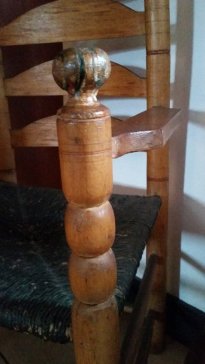
Picture credit: Ashley Trainor. Used with permission.
The chair’s craft is derived of the area. The piece would have been made out of wood that could be obtained easily and locally; pine, or oak, or perhaps maple. Additionally, it would most likely have been finished with linseed oil, which was the custom of the time, as well as shellac (which could be made with tree resin and alcohol). Tar could also be used, but this was mostly used for shipbuilding, and would not likely be used for crafting furniture.
This style reveals an important aspect of New Paltz life at this time: their Protestant religion. Protestants tended to favor simpler, less ornate pieces which were more functional than beautiful. Later on, the Deyos and other important families of New Paltz would obtain the more ostentatious and beautiful furniture of the Victorian era, but the desirability of the furniture shows that there is an enduring charm to this aesthetic. Simple objects and simple homes speak to the fast held beliefs of these people—witnessed by the plain decoration of the rebuilt French Reform Church. It was less about beauty, more about God and community.
Pierre Deyo, one of the original patentees of New Paltz, was the first owner of this piece. It is thought to have been built between 1650 and 1700. He most likely would have bought it from a local craftsperson. When Pierre died in 1708, his land and estate was split between his four sons, Abraham, Christian, Pierre, and Hendricus. This item was considered part of the Deyo household, included within Deyo’s grandson Peter’s will in 1791. The chair remained in the Deyo family up until it was purchased from the Andrew LeFevere Deyo estate shortly after his death in 1926.
The shellac on the chair shows that the craftsperson wanted to ensure that the natural beauty of the wood to come through. Shellac does have a shelf life (albeit of months or years), and requires skill to apply, so the reader can infer that Deyo was not the craftsperson, but rather some other local woodworker.
This piece would most likely have sat by the fireplace in one of the few rooms of the Deyo home. After a long day of work, it would have been a comfortable place to return to and to unwind. Possibly, it could have been sat or worked on by a slave—Pierre owned at least one, as evidenced by a receipt from 1694. A piece like this was quietly handed down from family member to family member, until it finally found its way back to Huguenot Street.
 The Materials of History, Thought, and Art
You must be logged in to post a comment.