Basket weaving was one of the most common practices throughout early human civilization. Instead of Glad tupperware containers, people had baskets. They held everything from foods, to clothing, to seeds and crops, and were also used to transport goods. The item I have chosen is an enormous basket. It could probably fit a relatively large toddler inside of it. It is rounded, composed of rawhide, reed, and is bound with straw. It is also tightly woven, with two small loops of either side, possibly to string some kind of strap through them. It now resides in the Jean Hasbrouck house, sitting flush against the wall of Joshiah Hasbrouck’s shop as part of the current interpretation of the room.
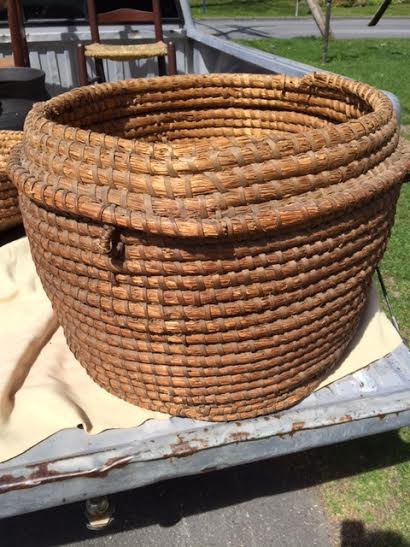
The toddler sized basket. Photo courtesy of Ashley Trainor.
The family lore attached to this basket claims that it arrived in America with Louis DuBois in the 17th century, when the Huguenots originally fled religious persecution. In actuality, it is said to most likely be a 19th century basket. This is a period of 200 years that could separate fact from fiction. From the beginning, I knew I would have to do some mythbusting. After researching general material on Artstor, I’ve found that there are many more results for “19th century basket” than “17th century basket.” The first search also yields many similar looking artifacts. Woven baskets, some of them enormous. Right off the bat, this makes me believe that the family lore is simply lore indeed. But, to add only more confusion, the basket was also mislabeled as a clothing basket upon its donation by Evelyn DuBois McLaury. The donation date is prior to 1990, however there is no exact date.
Being made of rawhide, this indicates that it is made of animal skin. If it was made locally, it most likely would have been cow or sheep skin. On a nearby farm called Locust Lawn, located in Gardiner, crops grown included rye, oats, corn, wheat, and apples. Animals included milk cows, chickens, beef cattle, and pigs, all of which were used completely to their full potential.
Also while on my general Artstor search, I found many sketches of cotton pickers. Pictured were slaves carrying huge baskets full of cotton. My immediate thought is that the basket was used for gathering crops. Since it is so large in size and so tightly woven it would make sense that it was used for storing freshly picked crops. If I were to stick to the 19th century track, this would be the most plausible assumption.
 The Materials of History, Thought, and Art
You must be logged in to post a comment.