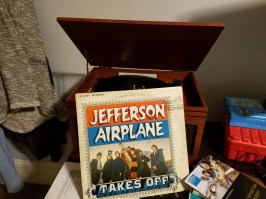
I debated whether or not to write an analog post about a turntable or writing in a journal. As I write in a journal quite frequently, and rarely have time to sit and listen to my weird little record player, it seemed only natural, if a bit cliche.
I don’t have a large vinyl collection. I have about six or seven old albums. For this project, I decided to listen to the one I am proudest of, Jefferson Airplane’s debut album “Jefferson Airplane Takes Off,” which I found in a consignment shop for four dollars. Along with my Crosby, Stills, Nash and Young live album, it is my favorite.
The turntable I own is one of those five-in-one gadgets that plays albums, tapes, CDs, radio, and MP3s. However, it looks quite retro, and is not portable in the least, so I rarely use it. In fact, most of the time my PS4 sits on top of it, so wanting to listen to music takes a little rearranging of my dresser.
While the album is in good shape, it is just a hair warped. Compared to, say, the “Worst of Jefferson Airplane” CD I own, the sound is hardly crystal. The fact that the music is slightly off key is kind of irritating, actually. However, like David Sax writes, it does evoke a peculiar aesthetic, which is helped along greatly by Jefferson Airplane’s very classic rock sound. It makes me want to go to parties in the 70s where the houses have bead curtains. It sounds like smoke and driving around in the rain.
I tend to listen to most of my music on the commute to school or work. I usually listen to the radio, or the same three or four CDs in my car. As Sax comments, analog music takes work. There’s no “pause” if you have to get up and leave the room. The album needs to be flipped, or changed, and is kind of hard to store. However, albums like this tend to have a deeper consistency of sound. There are thematic arcs. Songs bleed easily into one another, occasionally sharing the same beginning and end notes, providing a strange and thorough narrative smoothness.
Weirdly, CDs don’t really do this. Panic! at the Disco’s first album, “A Fever You Can’t Sweat Out,” plays with it, as do others, but more and more new albums are just disjointed singles crammed onto one disc, even though CDs and vinyl are theoretically the same when it comes to their contents.
Vinyl sounds more like captured time, I think, and David Sax acknowledges that in The Revenge of Analog. It makes me weirdly nostalgic for something I never lived through, which is a bizarre and kindly disorienting sensation.
 The Materials of History, Thought, and Art
You must be logged in to post a comment.