For my analog project, I decided to use a typewriter in the Sojourner Truth Library. I had never even been in the same room as a typewriter, let alone used one, so this was certainly a brand new and interesting experience for me.
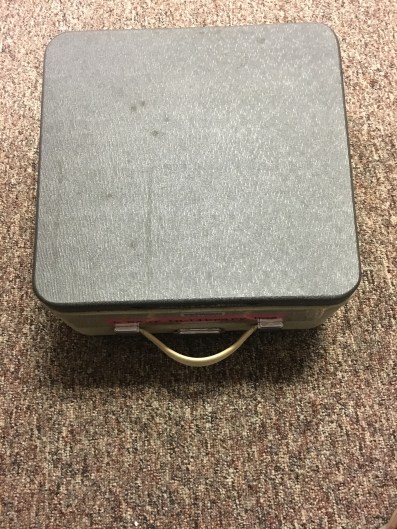
Typewriter Case
The first thing I noticed about it, before even opening up the case, was how heavy it was. And I do mean heavy, in bold, italics and underlined. I knew right away that I was going to need to find a quiet, secluded place in the library to experiment with it as to not bother anyone around me who may have been studying (which was quite difficult). Once I found a quiet enough area with a large enough desk, I opened up the case to this:
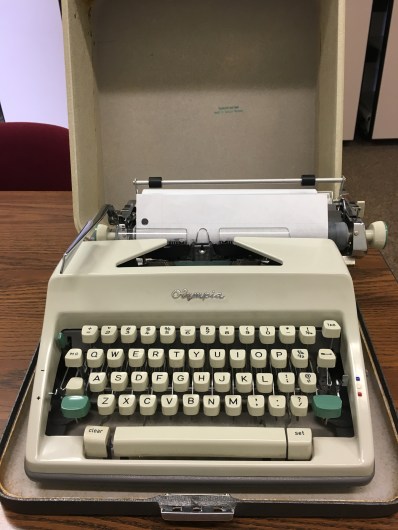
The actual typewriter
It was surreal. I had only ever seen these things in movies before. I was so excited to try out this really old piece of technology because it was brand new to me. I thought it would be obvious on how to insert the paper, but it wasn’t; initially, I inserted it upside down, and after a solid two minutes I finally figured out how to place it how I wanted to type on it (admittedly, I had to Google how to do it). After pushing some buttons, I also realized how difficult it was to get the keys to produce letters on the page. When typing on a laptop (as I’m doing right now), the letters appear automatically, even if I tap a letter lightly. On a typewriter, I needed to press the letters with passion, or else the ink simply wouldn’t stick or would be too light.
After typing random words and letters for a while and pushing random buttons, I discovered the Shift key and how it actually works. When I discovered this, all on my own, I couldn’t contain myself. I thought I was so clever and whoever designed the original typewriter must have been brilliant. For those who have never used one, essentially both the lowercase letter and the uppercase letter exist on the same key, with the uppercase letter slightly above the lowercase one. When you press Shift, the entire keyboard lowers so that the uppercase letter is what gets imprinted on the page. I tried my best to capture this in some photos:

Entire keyboard, internal view
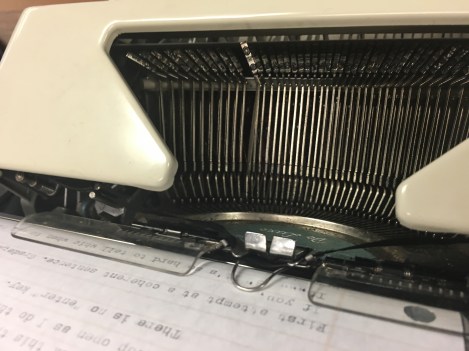
Typing the letter “O”
Since the keys were so hard to type and I needed to practically slam my fingers on the keyboard to get the letters to print, it was very loud. Also, there were several levers all over the typewriter that didn’t seem to have any particular meaning or use that I could figure out. For example, there is a “Clear” button next to the space bar that didn’t seem to affect what was produced on the page.
Overall, there were two things that I really enjoyed about the typewriter. First, I really liked that there was no way of erasing or deleting what you wrote. While this could be inconvenient, I think it also really makes you think about what you want to say before you say it. I didn’t type anything of particular substance on the page I used (mostly gibberish and random sentences), but when I did try to type a coherent sentence, I had to think hard about what that sentence was. Right now, typing this blog post, I have typed an equal amount of errors as I have correct sentences, and I’ve typed and retyped the same sentence over and over in different ways to make it better. I don’t have this luxury on a typewriter, and I think that’s a good thing. It forces my brain to work harder.
The second thing I really liked about the typewriter was that I could type anywhere on the page at any point. If I wanted to type in between the lines, I could. If I wanted to type upside down or sideways, I could. I could move the tray and start a new sentence wherever I wanted. I can’t really do that on something like Microsoft Word or even WordPress. In word processors and other digital media, unless I alter the programming I am limited to the template the word processor has already set up. A typewriter is right in front of me, and I can physically pick it up and manipulate it however I want to. While some analog technologies make creativity more difficult, I found that with the typewriter creativity was more accessible.
The only negatives I have to say about the typewriter in comparison to a laptop or other computer is that the typewriter is heavy and difficult to type on. However, I would absolutely go back to the library and use it again. My experience can be summed up as such:
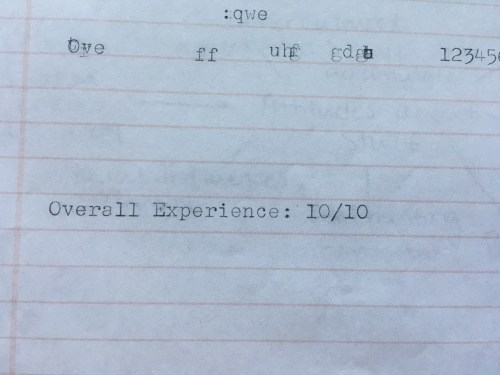
Typed on a real typewriter (the “1” is actually a lowercase “L”)
 The Materials of History, Thought, and Art
You must be logged in to post a comment.