Rough Draft of HHS Project

When I workshopped my piece, I had very little actual material that I would copy here as a draft of a blog post. Below are the short, bulleted lists I had and a few pictures that Ashley sent me. After working with Carina, I have a few more ideas that are pulling me in different and new, and exciting!, directions. But below is what I had on the day that we workshopped:


I know already:

  • 1900-1901 (1901-1902?) were when dances were performed
  • “Dances held at the Village Hall, given by the social club of New Paltz”
  • 49 signatures (damn, girl)
  • Village Hall funded by the New Paltz Literary Association


New info:

  • Names I could make out
    • Walter Hasbrouck
    • W. R. Ward
    • Frank R___
    • Bruyn Hasbrouck
    • Easton van Wagernen (Might have fought in the Civil War??)
    • A. P. Lefevre
    • Austin J. Pine
    • Mr. Fowler
    • Vanderlyn Pine
    • Victor Deyo
    • Mr. Elting?
    • Henry Freer
    • Mr. Tallman
    • Phillip DuBois
    • Morris Hasbrouck
    • Pierre (?) Deyo

How Did Anyone Write a Book Longer than Twenty Pages, Ever?

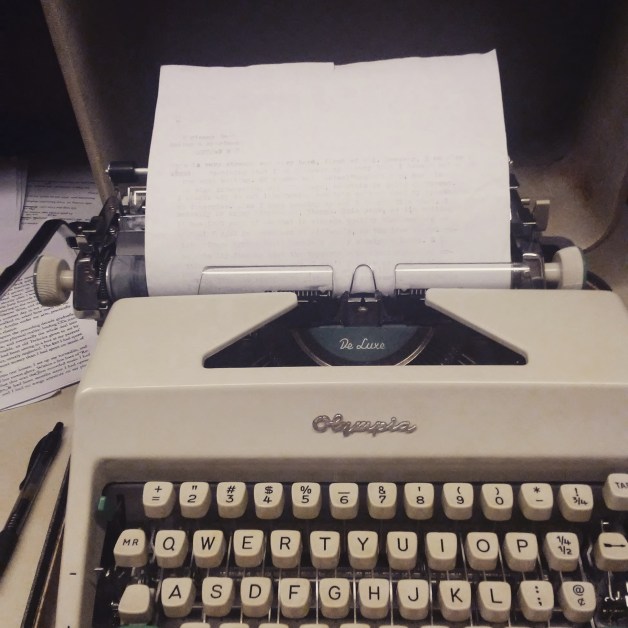
For this analog assignment, I wrote a (very meta) reflection on using a typewriting to write about…writing the assignment. It was much more difficult than I thought it would be, at first. Typing this now seems so much easier than it usually does to type on a keyboard and while there are certainly some advantages I noticed about using a typewriter, I definitely missed having this ease, speed, and changeability in typing.

IMG_20170427_174700_201

At first, I couldn’t even get the typewriter box open! There is a latch with a keyhole, so I was sure that the Circulation desk had forgotten to give me the key, but no. One must press the sides of the latch together to open it and it hurt a lot. I actually had to Google how to insert the paper and use the typewriter, which I find hilarious: using a digital technology to look up how to use an analog technology. Perhaps that just proves our point in class that digital and analog technologies go together and complement each other.

20170427_180531

The other thing that wasn’t amazing about using the typewriter was that the ink is so light. Each time I tried to scan a good, readable copy, it looked completely white. Instead, I took a regular picture and have copied it out word for word (even including all my awful mistakes) below:


w


Brianna Best
Analog E xperiment
4/27/xx x 17

This is very strange and very hard, first of all. However, I am also no xxxxxx       *noticing that I am interact [sic] in  away that I havent bef – ore with writing. Of course with actual handwriting, one is aa also interacting with the page, butathis is quite different. I absolutely do not like having complete control over my spacing an d margins. Also I keep messing up and I do not llike that. I actually do enjoy theprocess, though. This page, as I;m writing it has that sort of aesthetiic vintage quality that reminds me of Paul Varjek in Breakfast at Tiffany’s, or the idea of Modern- ist writers typing their novels v e r y slowly in Paris. X I am actually finding that the typewriter is slowing down my wr- iting process in anice way. I can’t imagine writing academic papers like this all the time, but I am actually enjoying the extra time the machine is giving me to compose my thoughts as I write. Usually I find that, when usingx a computer, after about one–or even a half–sentence, I have to stop to gath- er myx next thoughts. This process is so slow that I find it quite easy to keep writing continuously. This could also have to do with the nature of what I’m writing. I am not writing a theory-laden paper on a novel, so perhaps I would still need to gather my thoughts in that case, I still find this remarkably xxxx calming. While I don’t think I have the pat- ience or time to write rough drafts x of a thesis or dissert- ation on one of these, I actually like the idea of typing out first drafts of stories or papers on a typewriter. The process itself is such a nice break from the usually go-go-go pace of writing that I think this is actually encouragingxxxx more creativity. I am seriously considering seeing if I can get my ornamental typewriter at home in working condition so that I can use it to write shorter things. Which is strange because I’M not sure I have ever heard anyone who grew up with a typewriter say that they would like to go back. I am running out of the only sideof blank paper I xxxxxx hapenned to have with me. 😦


I Don’t Understand Cassette Tapes

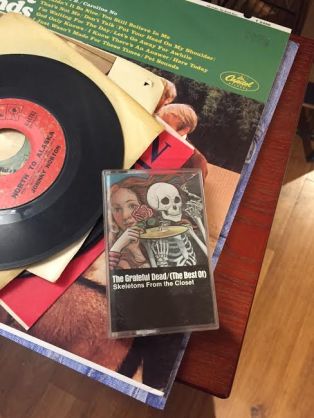
I’m a huge fan of records, so for me to listen to an album on vinyl for this project would be kind of silly. But recently there’s been a trend of bands selling their albums on tapes, which is kind of strange to me, so I figured I might as well check out what listening to a tape is like in comparison to vinyl or digital. I only have one tape that I stole from my dad. I’m not really sure where it came from because my dad is in no way a “dead-head”. I’ve never actually listened it before, but my record player has a tape player built into it so this wasn’t a difficult thing to be able to do.

unnamed.jpg       I grabbed the tape and tried to shove it into the small slot into the side and I ran into my first problem: how does this fit in? I shoved that small tape into the player at least 5 different ways until it finally pushed into the slot. Yet, when it went in, nothing played. I pressed play, changed the settings but still nothing. I sat there bewildered wondering how this thing works. I decided to go along with the full analog experience and use my good old trial and error skills rather than googling it. It then hit me: don’t tapes need to be rewound? Next to the slot is this weird button that protrudes out. When you push it half way it rewinds the tape for you. I only noticed cause when I was playing around with it, I heard the small hiss of the tape spinning. I sat there on the floor for about two minutes as the tape hissed, and finally, it popped out. It didn’t look fully rewound but I was too confused to try again. I pushed the tape all the way back in and the music started to play.

Nearly 15 minutes later, I’m finally listening to the music. Maybe I’m just incompetent, but to me thats far too long to set up music. With a vinyl record you just simply lay it on the table and drop the needle, which can’t take more than a couple of seconds or for digital, you simply press play. The quality of the music wasn’t that amazing either. It was like listening to a bad quality youtube video. What appeals to me with records is the cracking and popping. You can literally hear everything on a record whether it be dust or a scratch. That noise is so unique to your record and that makes so much more of an intimate experience. I felt nothing special with this tape; I was more annoyed with how cumbersome it is to play.

The only thing that makes a tape better than a record is its size. In comparison to digital, the tape is just slightly more lo-fi and much more inconvenient. I think what is cool about tapes though that digital does not offer is the aesthetics; it’s simply cool looking. Tapes in general also provide for more personalization, similar to a blank CD. One could easily and cheaply buy a blank tape, make a cover, and record a playlist. While you can make a digital playlist, theres something so much more genuine about a physical object.It’s similar to why getting a hand written letter seems so more more personal than getting an email that contains the same words. I think because working within the digital world is significantly easier, and the easiness removes the feeling that someone put deep thought and effort into it. Despite this, I feel if I had to choose between only listening to tapes, or digital music, I would choose digital. Tapes are simply just too annoying to rewind, break easily and don’t even sound that great.

Cold, Hard Cash

For this week’s blog post on analog experiences, I decided to restrict myself to only using cash wherever I went, instead of using my credit or debit cards. I’ve noticed over the course of my college career that as I’ve had an increased responsibility over my own personal finances, and as I’ve been more in charge of spending my own money in many different areas of my life, the value of a dollar has become less and less significant to me. I notice this especially well when I used my cards to purchase things or to pay bills instead of using cash. It sometimes feels like virtual money isn’t as real, or isn’t as valuable, and I’m subsequently much more inclined to spend it. I consequently thought that it would be a great experiment for this week to abstain from all “virtual” purchases, and to only use hard cash in every facet of my life.

At first, I can honestly say my experiment was very difficult. In order to buy my coffee in the morning, which I do regularly with my card, or go out with friends for dinner, I had to run to an ATM and take out money. It was a huge inconvenience that made me wonder why I was doing this to myself. I also accrued quite a hefty pile of coins by the end of the week, which is now sitting ominously on my bedroom dresser. I’ve never had so many nickels to look after. I was also not able to use a lot of the apps on my phone that require digital purchases or subscriptions, like using my Netflix app, my New York Times app, and my Spotify app (which all require monthly digital payments). To be completely honest, not having these subscription apps at my disposal for the week was the worst part of the experiment, and made my life quite grim. I felt deprived of all of the digital hobbies I have grown so accustomed to. I was forced to read the news from a non-subscription based source (I truly missed my precious NYT), and watch DVD’s instead of Netflix. My commitment catapulted me back into the dark ages of the early 2000’s, something I never realized would happen just from not being able to use my credit card.

However, even with all of the hassle cash entailed, I realized many interesting things about my digital abstinence. First and foremost, I spent so much less money than I normally would in a single week on frivolous items. Online shopping became something of the past, which led me to both spend less money, and also spend less time mindlessly browsing the internet. I was able to focus more on schoolwork and not worry about “this week’s best deals” or “an extra 15% off at checkout” which would normally tantalize me unremittingly. I also found myself much more reluctant to spending dollar, after dollar, after dollar. Having to go fetch more cash from the ATM every time I wanted to spend made me value my money a lot more, and made me rethink purchases a number of times before I would actually pay for things. I ended up spending a mere $27 dollars for the entire week, mostly on coffee  and gas, which is a number I am very proud of. I found myself able to budget a lot more easily. Without any notion of “virtual” money, my cash became a lot more real and tangible, and subsequently became a lot more dear to me.

The end of the week marked a milestone for me, proving to myself that I could in fact survive without a credit card. I noticeably feel quite torn about credit cards now; struggling with the ideas of both their convenience and their virtual artificiality. If I ever wanted to save money in the future, I now know how to do it, but at a sever cost of convenience. Ultimately the week was very education, and made me appreciate both the analog and the digital for how they affected my life positively.

“A Jet Age Sound”

album

I debated whether or not to write an analog post about a turntable or writing in a journal. As I write in a journal quite frequently, and rarely have time to sit and listen to my weird little record player, it seemed only natural, if a bit cliche.

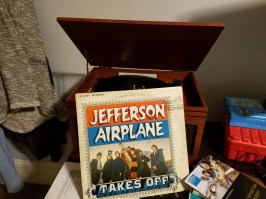
I don’t have a large vinyl collection. I have about six or seven old albums. For this project, I decided to listen to the one I am proudest of, Jefferson Airplane’s debut album “Jefferson Airplane Takes Off,” which I found in a consignment shop for four dollars. Along with my Crosby, Stills, Nash and Young live album, it is my favorite.

The turntable I own is one of those five-in-one gadgets that plays albums, tapes, CDs, radio, and MP3s. However, it looks quite retro, and is not portable in the least, so I rarely use it. In fact, most of the time my PS4 sits on top of it, so wanting to listen to music takes a little rearranging of my dresser.

While the album is in good shape, it is just a hair warped. Compared to, say, the “Worst of Jefferson Airplane” CD I own, the sound is hardly crystal. The fact that the music is slightly off key is kind of irritating, actually. However, like David Sax writes, it does evoke a peculiar aesthetic, which is helped along greatly by Jefferson Airplane’s very classic rock sound. It makes me want to go to parties in the 70s where the houses have bead curtains. It sounds like smoke and driving around in the rain.

I tend to listen to most of my music on the commute to school or work. I usually listen to the radio, or the same three or four CDs in my car. As Sax comments, analog music takes work. There’s no “pause” if you have to get up and leave the room. The album needs to be flipped, or changed, and is kind of hard to store. However, albums like this tend to have a deeper consistency of sound. There are thematic arcs. Songs bleed easily into one another, occasionally sharing the same beginning and end notes, providing a strange and thorough narrative smoothness.

Weirdly, CDs don’t really do this. Panic! at the Disco’s first album, “A Fever You Can’t Sweat Out,” plays with it, as do others, but more and more new albums are just disjointed singles crammed onto one disc, even though CDs and vinyl are theoretically the same when it comes to their contents.

Vinyl sounds more like captured time, I think, and David Sax acknowledges that in The Revenge of Analog. It makes me weirdly nostalgic for something I never lived through, which is a bizarre and kindly disorienting sensation.

Silas Hoadley Mantel Clock

Mantel clock made in 1820 and manufactured by Silas Hoadley. Mantel clocks are clocks that can be placed on top of a shelf or mantel.

Silas Hoadley (1786-1870) was an American clockmaker born in Bethany CT. He formed a clock-making partnership in Plymouth, Connecticut with Eli Terry and Seth Thomas as Terry, Thomas & Hoadley. These three clock makers pioneered the mass-production of clocks using water driven machinery to tool parts. The partners gradually withdrew to create their own firms – Terry in 1810, Thomas in 1814 – leaving Silas Hoadley as sole owner. Hoadley continued to make clocks until 1849. Standard references spell his name Hoadley. Note that the “e” in his name is missing from the paper label on this clock.

There is not much information on Hoaldley aside from Wikipedia, but there is ample information on his partners Eli Terry and Seth Thomas. Interestingly, on a bidding website the same mantel clock is listed as “Rare Seth Thomas Off-Center Pillar & Scroll Clock.” The clock was in a lot with other clocks and apparently sold for $2,091. Seth Thomas appears to be more of a pioneer (he has a town named after him called Thomaston) in clock making than Hoadley who is often only refers to as a partner.

  • Side note: A 1992 article on the Hartford Courant mentions are revival of the old Seth Thomas factory that still exists in Thomaston.

The clock has a pillar and scroll shelf type design. This means that there are two pillars on the sides of the clock with scroll work on top. Scroll work is a form of art that includes spirals and rolling designs. The clock is veneered in mahogany. It also has a painted wood dial along with Roman numerals.

Lower portion of the clock contains an image of a landscape with homes and trees. The glass containing the image is in eglomise decorations. According to Eglmosedesigns.com, eglomise is a French word that means “‘glass gilded,’ decorating glass by painting on the back or reverse side, sometimes gilding with gold or metal leaf.” The image is contained within a border designed with leaves referred to as foliate borders.

The three brass finials on top of the clock are suspected to be unoriginal (Ashley). However, images on the web show the same brass finials on the same clocks as this one. There is also the chance that they were replaced. Movement on the clock is intact, but not in running order.

H. Keator’s Drafting Set

This is not pieced together yet and I still have a lot more that I want to add


Before the widespread availability of computer simulation services and computer assisted design in general, it was necessary that professional engineers and land surveyors master the process of drafting. This now nearly extinct practice is patently artistic, requiring an array of different tools, all tailored to specific purposes, as well as a high degree of patience, dexterity, and a well-developed capacity for mental imaging. The tools required in order to draft successfully are organized into drafting sets, like the one pictured here. This set contains space for ten tools, one of which is missing: from the shape of its space, the missing tool seems to be a smaller version of the tool directly below it. The set is comprised of several sizes and varieties of compass, used to make circles and certain other shapes; as well as a few dividers, used primarily to segment lines. Also in the kit is a cool little metal container of Red Top Eversharp pencil leads. The case in which the tools are situated is in very poor condition. The outside is quite literally falling apart, and the folding flaps are in bad shape. Written on the inside of the case, next to the tools, is “H. KEATOR    KINGSTON N.Y.    1908.” As such, it is highly likely that this H. Keator first came to possess this set of tools in the year 1908. According to the 1940 census – to be elaborated on later –  he would have been twenty years old in 1908—the tools may have been a gift to him from a friend or family member upon his deciding to study engineering and seek certification. Inside of the case thee are two certification cards: one from 1926, the other from 1935………


This particular set of drafting tools belonged to a man named Harold E. Keator. He lived in Kingston, New York, and the 1940 census indicates that he was born around the year 1888. He had a wife, Adelaide, and a son, Harold E. Keator Jr. An attendance report from the 1912 annual meeting of the Society of Automobile Engineers at Madison Square Garden lists Keator’s name, followed by “Draftsman, Wyckoff, Church & Partridge, Kingston, N.Y.” Wyckoff, Church & Partridge was a New York City based company that took over the W. A. Wood Automobile Company in Kingston. Further research revealed much more about Keator. I was able to uncover a grayscale PDF of the Wednesday, March 23, 1960 issue of the Kingston Daily Freeman, which contains the obituary of one Harold E. Keator Sr. of Lake Katrine, NY. According to this obituary, Keator – or “Knobby,” as he was apparently called – died on 3/23/1960 after being ill for a short while. Further information about his family is included: his mother’s name was Carrie, his father’s, Edgar; and his son, Harold Jr., had two granddaughters, Christine and Kathleen. Most relevantly, the obituary confirms that this Harold E. Keator was, indeed, a professional engineer, and that he retired from the New York Central Railroad sometime during 1956—for me, this statement removes any doubt of this being the same Harold Keator who owned the drafting set. Keator was very active in his community: he was a member of the Kingston Kiwanis, several rod and gun clubs, as well as the Ulster County Chapter of the New York State Society of Professional Engineers.

As a professional engineer confirmed to have been employed with the New York Central Railroad, it is very likely that Keator worked on the Walkill Valley Railroad, which was purchased by New York Central in 1884. If this is the case, Keator and his drafting set would have operated in and around the Kingston area, including New Paltz. Though the Walkill Valley Railroad is now defunct, the Rail Trail now residing where the rails once did, the railroad had a massive effect on New Paltz, bringing characters from all walks of life from New York City and elsewhere, many of whom were likely drawn by the Mountain House.


Gertrude M. Deyo’s Autograph Book

Image

gertrude

Before students used yearbooks and social media to record memories and stay in touch, they wrote in autograph books. This autograph book belonged to Gertrude M. Deyo. It is full of elegant signatures from Gertrude’s friends and schoolmates— many of whom left witty poems, notes, and wishes for her to look back on.

IMG_1009Description:

This autograph book has a teal, velvet cover. It is dulled and worn, like an old, dusty carpet or a stuffed animal which has been washed one too many times. There are creases in the velvet along the spine, and when you open the book you can see that many of the pages are ripping from its binding. The inside flaps are made of a shiny, hard paper with a rugged texture that looks much like fingerprint bands. The paper might be water-repellent and is peeling away from the velvet, indicating that the teal covering must have been attached with glue. The pages within the book are slightly yellowed, and are most likely made out of straw or wood-pulp, as was common during the nineteenth century. The two right corners of every page are rounded, and the edge connecting them is painted gold.  

The first right-hand page of the book says “Autographs” in an elaborate font with gold letters and a black outline. Two gold lines border the edges of the page. On the following right-hand page there is a pink, rectangular paper glued slightly off-center. The name “Gertrude M. Deyo” in printed in a different, black, fancy font. A natural brown border has appeared along the edges of the pink label, which is physical evidence of the book’s age—approximately 135 years old! Below Gertrude’s name, “A Christmas gift from her mother” is written in script and with pencil.

Following this page, there are over fifty others with notes from her friends, family members, and school mates. The entry dates range from 1882 to 1887, many are not in chronological order, and there are a number of pages with stains or stray marks. Almost every signature is accompanied with a date and location, if nothing else. This seems to be the expected template for Gertrude’s autograph book, after which personal anecdotes and doodles could follow. Poetic messages are especially common, and one might wonder whether these rhyming messages were thought up on the spot, over the course of the visit, or perhaps in advance.

18297030_1572294069448149_912609362_o

Maggie DuBois, 1882

While some entries are as simple as Maggie DuBois’ note, for instance, and contain nothing more beyond the “template,” others, like Jennie Keaton’s entry, are witty, thoughtful, and can serve as a door into the mind of a young school girl during the late eighteen hundreds. One must wonder what Gertrude talks about with friends like Jennie on “stormy Saturday nights”—a note written on the edge of Jennie’s entry, which says: “Love not the boys, / Not even somebody’s brother. / If you must love / Why, love your mother.”

18339268_1572296832781206_451226651_o

Jennie Keaton, 1883

18297165_1572357219441834_444207819_o

Etta’s written side of a dialogue between herself and Gertrude, possibly while they are sitting in church, 1887

There are also entries in Gertrude’s autograph book which have been in the hands of more than one person, and show a spontaneous dialogue between friends. Sometimes these entries are so full of messages, poems, and jokes, that, without proper context, they are nearly illegible and incomprehensible. Although a general sense of such entries can be acquired, one could only truly understand their nature of the entry if they, themselves, were a part of the group of friends writing in Gertrude’s book.
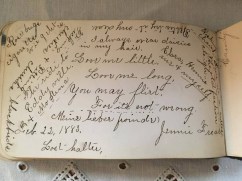
 

18318151_1572310586113164_1466904711_o

“Love me little, / Love me long, / You may flirt, / For it’s not wrong,” and other messages from Gertrude’s friends, 1883
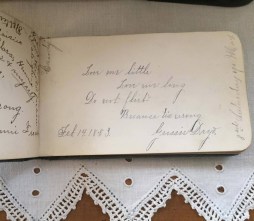
18338866_1572357212775168_1108743541_o

A  response to the previous page from Jessie Deyo: “Love me little / Love me long / Do not flirt / Because tis wrong,” 1883


Gertrude’s autograph book can now be found in the music room of the Historic Huguenot Street Museum’s Deyo house in New Paltz, New York. It sits on a table by the window, beside a music box and a photograph of Gertrude M. Deyo, herself.  The book’s natural resting page is around the halfway mark, where if laid flat, it will stay open. It can be assumed that the book has been kept in this position for an extended period of time, perhaps for as long as it has been on display. This physical element of the book is characteristic of the multiple lives an object can have as time passes. First, it is a gift to a girl from her mother, then an object to be passed between friends, and lastly, a piece in a museum, which recreates the life of the person who once owned it.

Provenance:

Although neither a name or company is printed on this particular book, it was most likely been made by what was called a “journeyman printer” (19th-Century Printing). A journeyman printer is a person who has completed an apprenticeship in printing, and then has worked in a printing office, where books and stationery were printed and sold (19th-Century Printing 15, 13, 19). An autograph book would fall under this category. Autograph books were popular among graduating students during Gertrude’s time, and it would not be a stretch to guess that Gertrude’s mother could have found a book such as this one up for sale in a number of shops—printing related or otherwise.

Because of the inscription on the second page, which records that the autograph book was “a christmas gift from [Gertrude’s] mother,” it is most probable that the book was donated to Historic Huguenot Street by someone within or connected to the Deyo family line. The donor might have written in this note before handing it off. The note could have also been written before hand by any other person of connection to Gertrude who may have had access to the book after her passing in 1926. 

Narrative:

Gertrude M. Deyo’s autograph book gives a snapshot of the social life of young woman growing up in the Hudson Valley in the late nineteenth century. In 1878, ten-year-old Gertrude graduated from The New Paltz Academy, a school for local children, but the earliest entries recorded in her book are from 1883, when Gertrude was fourteen years old. Although only two of Gertrude’s friends, Henry D. Freer and George Deyo, explicitly call themselves her “schoolmate,” it can be assumed that most of the entries were written by her school peers and that many of these peers had autograph books of their own. 

IMG_0976Autograph books were first developed in sixteenth-century Germany as a networking tool for university students. They were called Album amicorum in Latin, and contained the names of students and faculty along with words of advice. In the mid-1800s their popularity made their way to America, and the books became a way for young students to keep record of one another, while also giving them an opportunity to express their affection (Elgabri 2015). The most typical autograph entry follows along the lines of Sara D. LeFevre’s message to Gertrude. She writes: Though many a joy around the smiles / And many a faithful friend you make / When love may cheer life’s dreary way / And turn the bitter cup to sweet, forget me not.” 

Gertrude is nineteen years old when the entries end in 1888—only three years before she marries Abraham Deyo Brodhead. The messages from Gertrude’s friends over the five year time period are youthful, clever, and beautiful to the eye, so much so, that is sometimes easy to forget that these entries are written by adolescents. For example, there is an entry signed “H. (Hennie) Keaton” in 1883 which quotes a line from Shakespeare’s The Tragedy of King Richard The Second. She writes: “The purest treasure mortal times afford is spotless reputation.” Another friend, Jennie A. Burgher, quotes a phrase from Lord Tennyson’s “Locksley Hall,” a poem which discusses the peaks and valleys of youth, and writes, “knowledge comes, but wisdom lingers.”

The handwriting of these messages complement the tone of such phrases, for nearly every entry is written in careful, and sometimes elaborate, script. In the 1800s, penmanship began to play an important role in the lives of Americans. If you had “pleasing” penmanship, it was a “sign of gentility” (Florey 47). It is clear from these entries that handwriting was important to Gertrude’s friends. Some friends even decide to focus on writing their name in calligraphic letters, as opposed to writing an actual message.18289971_1572310589446497_136226741_o
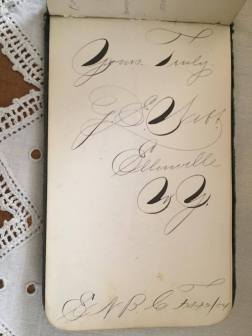
Writing in script became a standard, yet, in a way, these autograph entries gave young students an opportunity to establish one’s self as intellectuals and as social elitists. The “Father of American Handwriting,” Platt Rogers Spencer, was the first to institute schools in America wherein handwriting would be prominent part of the curriculum (Florey 63). “From before the civil war to the end of the Victorian Era,” Kitty Burns, an expert on the history of penmanship, in her book, Script & Scribble, writes, “the hegemony of Spencerian was a testament to an appreciation for beauty that lurked in the souls of Americans….High-class script,” she continues, “[was] surely the mark of a gentleman or a lady (Florey 69).

Interestingly, Platt Rogers Spencer was born on the Hudson River. The birth of penmanship in America, therefore, begins not long before, and in the very same region, as Gertrude’s ascent from childhood to adulthood. With this knowledge, Gertrude’s autograph book can be considered from an entirely new angle. Not only is it an account of the social climate of young New Paltz students through their thoughts, jokes, and wishes, but it is also an object which represents the inception and effects of the cultural movement to value penmanship and presentation—a cultural movement which permeated throughout the entire country, and greatly characterizes the Victorian Era as a whole.

Bibliography:

Elgabri, Alexa. “Leaves of Affection: A Look at Autograph Books of the 19th Century.”              Leaves of Affection: A Look at Autograph Books of the 19th Century. Ohio Memory, 4            Dec. 2015. Web. 23 April. 2017                               <http://www.ohiohistoryhost.org/ohiomemory/archives/2546>

Florey, Kitty Burns. Script and Scribble: The Rise and Fall of Handwriting. Brooklyn:                Melville House, 2013. Print.

Old Sturbridge Village.19th-Century Printing.”  Old Sturbridge Village. , n.d. Web. 22   April. 2017. <https://www.osv.org/19th-century-printing>


Physical Description:


The table above stands about 2ft off the ground when the table top is parallel with the floor. The table top is hinged allowing it to be turned on it side when is not being used to hold various objects. The table in its entirety has minimal scratches/ chips. The base of the table has been constructed out 5 separate pieces of mahogany wood. The central piece is an urn-like base that appears to have been turned on a lathe with a pineapple carved into the center of it. This base is connected to three arched, tapered legs. Each leg consists of acanthus leaf carvings that transition into the paw of an animal (likely the paw of a lion). Attached to the center base and legs is a smaller table top, likely to function as a seat. The table top is an ovular shape with pinched corners that it approximately 2ft x 1.5ft. Beneath the tabletop is a makers mark inscribed “Charles Warner, Cabinet Maker, Poughkeepsie.” This type of table (hinged table top with smaller attached smaller seat) is referred to as a tilt-top table. This table was constructed approximately 1800-1820.


Furniture being designed during this time (1805-1830) which overlaps with the same time of Charles Warners life was referred to as American Empire style furniture. Influenced by neoclassical and french empire during the reign of Napoleon, this style uses decorative motifs including rope twist carvings, animal paw feet, anthemion leafs, stars, eagles with spread wings, etc. It was common during this era design to use oak, mahogany, and other dark woods for building furniture.


Provenance:


Maker Bio/Historical Narritive:


Charles Warner worked as a cabinet maker in Poughkeepsie in 1820. It appears that Charles Warner was born and raised in poughkeepsie, dying in 1834. He was the son of Thomas Warner who purchased a lot in Poughkeepsie “beginning at the northeast corner of Myndert Van Kleek’s garden fence along the new street” 1785. Warner was not only a cabinet maker but also, a businessman. He owned a considerable number of stock shares, including stock in the Poughkeepsie Whaling Company, the Farmers and Manufacturers Bank, the Eastern Market, the Poughkeepsie Steam Boat Company, and the Dutchess Whaling Company. Financial records indicate that Charles Warner was a successful cabinetmaker and businessman, with considerable financial resources for the period.


Federal Style Clock Draft

Caption

As baby Cupid rests on grapes on leaves, the United States has only just been born.  Made in 1788, this clock represents the Federal style, an artistic movement that impacted how architecture, furniture, and interior design styles were made. This clock would find its way into the home of Josiah DuBois, a Huguenot descendant and owner of an extravagant Federal inspired home. The house, as well as this clock, are the symbols of an attempt at creating a true “American” culture in the 1800s.

Clock

Federal style clock feat. Cupid. Picture Credit: Jessica Wiessner.

Object Description

The clock contains several parts: a wooden plate for a stand, the main part of the clock where the face is, a golden Cupid laying in leaves and grapes while holding his bow and arrow, and a glass covering.  The clock’s face uses Roman numerals as a signifier for time and is quite small in relation to the whole clock.  The frame containing the face and holding up Cupid is wood painted black with gold trims around it. There are also ridges carved into the wood, giving it a bumpy texture.  Inside are the gears which are no longer functional.  Cupid lays in a comfortable pose on leaves and grapes with his bow facing straight ahead.   The glass is dome-shaped and covers the entire clock to protect it.  The whole clock is approximately 13.5 inches high and 9.5 inches wide and is quite heavy to pick up or handle.

Provenance

This clock is dated to 1788.  It originated from an apartment on Pine Street in New York City owned by a man named Samuel Boyd.  I have not been able to find much historical information on Samuel Boyd other than he lived there and may have owned some type of store.  It ended up at the Blake House, owned by William H.D. Blake, who died in 1926.  The family continued to own the house and its objects until 1984 when the items in the Blake House were donated to Historic Huguenot Street. The clock now resides in the Federal Style Room in the Deyo House.

There are a couple of possibilities as to how Blake acquired this clock. According to the Historic Huguenot Street website, Matilda Blake was very close to her cousin Amy L. Hepburn, whose parents were named Samuel Boyd and Sarah Booth Hepburn, therefore making Samuel Boyd the brother-in-law to William and Matilda (Booth) Blake. Perhaps this is the Samuel Boyd from Pine Street who owned the clock, and William Blake purchased the clock from him or otherwise received it as a gift. It has been extremely difficult, unfortunately, to find evidence of this relationship as the name Samuel Boyd was extremely common. It could also be possible that the Samuel Boyd on Pine Street is a completely different person from William Blake’s brother-in-law, and that William Blake simply purchased the clock directly from this person or from an antique shop.

Narrative

William Henry Dill Blake (1843-1926) was born in Montgomery, New York and served as an officer in the Civil War.  He married Matilda Booth in 1875 and together they had three children: Alfred Booth, William Culbert and Matilda. They moved to New Paltz in 1881 when Blake purchased the late Josiah DuBois’ house and 250-acre farm. He continued to live in New Paltz until his death in 1926. All three of his children graduated from the New Paltz Normal School and were heavily involved in the New Paltz community, especially Matilda.

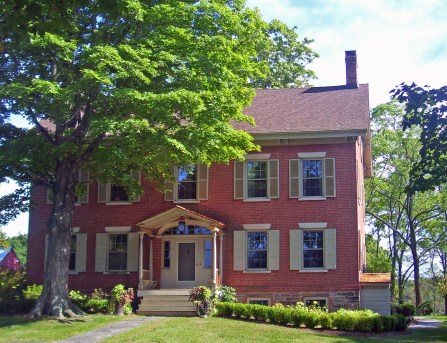
William Blake’s house is a story in and of itself and is important in understanding where the clock fits in.  It was constructed in 1822 on a large portion of land owned by the DuBois family since 1677.  Josiah DuBois owned and lived in the house until his death in 1869.  His daughter Elizabeth and her husband moved in the same year but only lived in it for twelve years until William Blake purchased it.  The house has become a historical landmark in New Paltz due to the property’s involvement in the original Huguenot settlement and the Revolutionary War.  The house was constructed in the Federalist style of architecture, so the clock this project focuses on must have fit in nicely with the theme of the house.

Josiah DuBois Farm House

Josiah DuBois Farm House. Source: WikiMedia Commons. https://commons.wikimedia.org/wiki/File:Josiah_DuBois_Farm,_New_Paltz,_NY.jpg

The Federal style was a movement in the three decades following the inception of the United States.  The developing system of government largely influenced the term Federal style, and the style itself served as a way for the newfound United States to create its own identity.  A prime example of the Federalist style is the White House, which has come to be a symbol of America and American identity. In addition, Neoclassicism, or a revival of ancient Greek and Roman art and culture, also heavily influenced furniture in this period. This would explain why the clock contains Cupid as its focal point.  Federal style furniture often comprises of thick, dark wood, simple designs, and marble.  Although elements of Neoclassicism (a relatively European movement) exist in the Federal period, the style is representative of the beginning of an American culture.  It is interesting that Josiah DuBois would choose this style for his house and William Blake would choose to maintain it.  The DuBois family were part of the original twelve French Huguenot settlers in New Paltz and brought their European culture and traditions with them when they emigrated to New Paltz in the 1600s.  The property they owned still contains several older structures, including a 1775 Dutch barn.  It is as though DuBois and Blake, like much of America at the time, were attempting to erase their own histories and ascribe to the new “American” story that was emerging through creating and preserving this Federal style.

References

“Landmark Designation Form.” Historic Huguenot Street. Town of New Paltz, New York.  2003.

“William H.D. Blake Family Papers.” Historic Huguenot Street revised 8 June 2005. <www.huguenotstreet.org/william-h-d-blake-family-papers/>

Thurlow, Matthew. “American Federal Era Period Rooms.” In Heilbrunn Timeline of Art History. New York: The Metropolitan Museum of Art, 2000-. <www.metmuseum.org/toah/hd/fede/hd_fede.htm> (November 2009).