After exhausting every detail of the 1907 Silver United States Barber Dime, I have decided to discuss the history behind a special family photograph from 1921. Often when I sit down with my one-hundred-year-old great aunt, who we lovingly call Auntie Dot, she talks about the difficulties her family endured during the 1920s and Great Depression. Growing up in a tenement apartment without a father and six other siblings where basic amenities such as a private bathroom or fresh fruit were too expensive, Auntie Dot observed from a young age my great grandmother persevering through extreme circumstances, trying to earn enough money each week to ensure the whole family had enough food, coal, and a roof to sleep under each night. With all this under consideration, this is precisely why I am perplexed to present a well captured photograph of my family.
In 2014, after nearly eighty-five years of living in the same apartment building in the Bronx, Auntie Dot moved to an assisted living facility in Westchester County, New York. While I was helping remove furniture from Auntie’s apartment, I noticed behind one of the couches a partially torn canvas with a faded photograph of my family from two generations ago. Presented in Figure 1 is the restored canvas and photograph of my family from nearly one hundred years ago. In all my visits to Auntie Dot’s apartment as a child, I had never seen this family photograph, and after showing my other family members, no one else recognized it either. Auntie Dot, on the other hand, through a verbal description, knew immediately what I was talking about, and began telling me the story of how and why this photograph was taken.
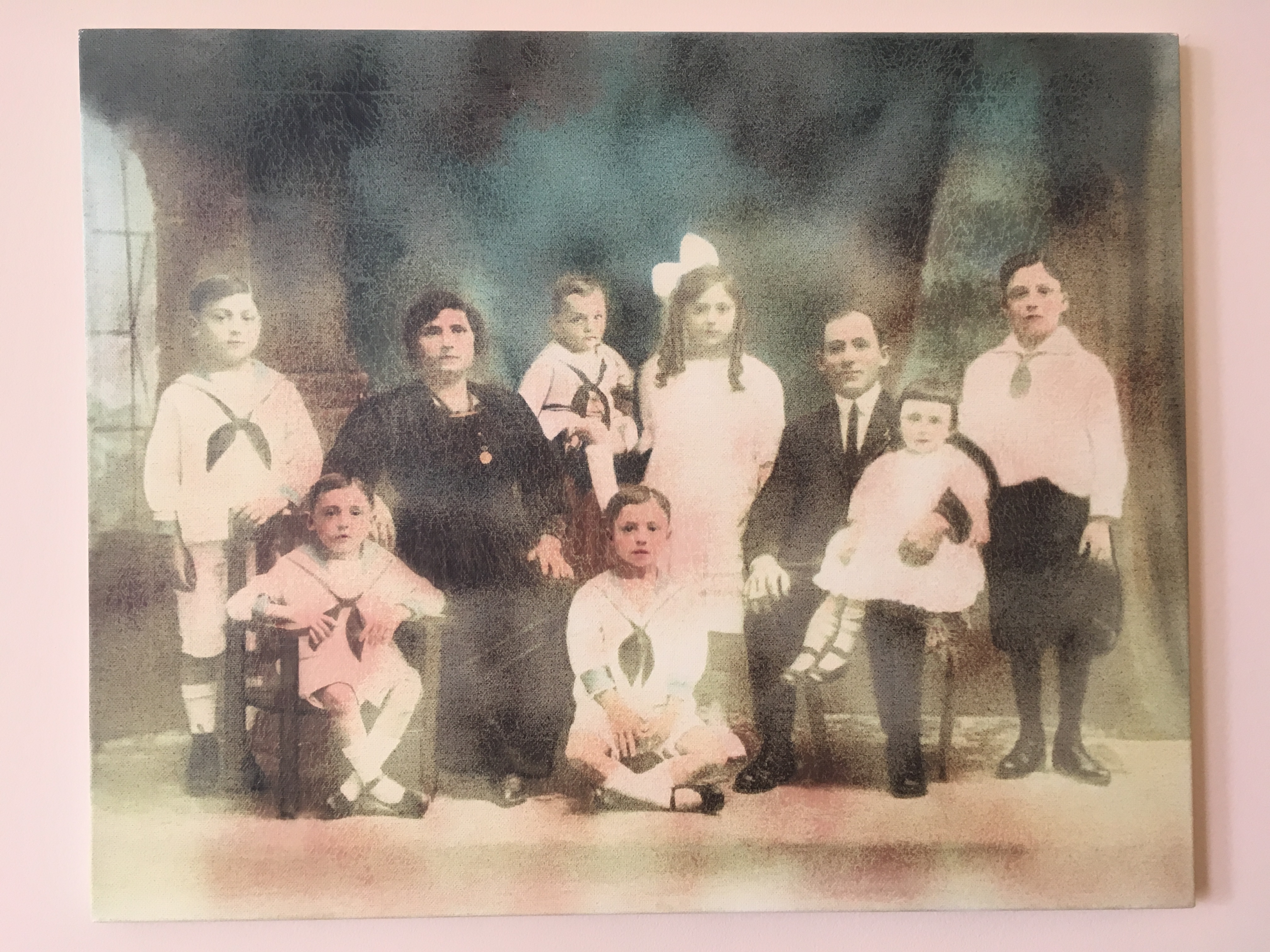
As I mentioned before, my great grandparents lived in a tenement apartment building in New York City where they could not afford clothing for all their children, forcing my great grandmother to hand sew all the sailor suites and dresses depicted in Figure 1, so the fact that they went to a professional photographer’s studio and paid, according to Auntie Dot, a significant amount of money is stunning. Upon conferring with Auntie Dot, I was told one of the primary reasons why this photograph was taken was because my great grandfather was terminally ill. In 1921, my great grandfather was diagnosed with a rare blood condition – Auntie Dot and my other relatives are not sure of the specific blood condition, unfortunately – which was not treatable at the time. This left my great grandfather with a time table ranging from six months to a year to live. Even though these photographs may have cost the family a lot of money, it was important to my great grandfather to memorialize himself in a family photograph so his children and future children could have an idea of who their father was as a person. In July of 1922, my great grandfather passed away; while Auntie Dot was three years old at the time, she does not have many memories of her father, so this photograph is a great way for her to keep a connection to her father.
Another key detail Auntie Dot mentioned, which adds an entire new dimension to the photograph’s story and early twentieth century photography, was the fact that my grandfather, the little plump child between my great grandmother and the young, curly haired girl (Aunt Marie), was not alive when this photograph was taken. According to Auntie Dot, this photograph was taken in November of 1921; my grandfather was not born until April of 1922. Originally, the photographer had placed a flower pot between my great grandmother and Aunt Marie, most likely to fill the small amount of negative space between the two ladies. Once my great grandfather died in the summer of 1922, my great grandmother decided to bring the photograph to another photographer to see if it were possible to superimpose a separate photograph of my grandfather into the family portrait, considering my grandfather had no photos together with his father. Attached below in Figure 2 is the original photo the photographer referenced to superimpose my grandfather into the family portrait. To this day, I find it remarkable how photographic technology from nearly one hundred years ago supported an early version of photoshop. While this family photo was not digitally enhanced, of course, it still shows how the fundamental concepts of manipulating photos existed at the early stages of the twentieth century.

Regarding the mechanics of the photograph, Auntie Dot made an interesting observation on how the photographer posed her mother, my great grandmother. While I did not know my great grandmother – she passed away in 1969 – Auntie Dot and other older relatives always tell me that she was the most loving and thoughtful woman they knew. In this photograph, however, my great grandmother appears to be very stern, a person you would probably not want to engage with in a conversation if you were in trouble. I am not sure if this was a compositional technique employed by photographers in the early twentieth century, portraying the matriarch of the household as a strong, resourceful, and authoritative figure, but based on my relative’s accounts of my great grandmother, this photograph does not accurately represent who she was as a person.
I found this assignment to be rewarding. I have never had the opportunity in another academic setting to discuss this family photograph in detail. While other people may view this as a basic photograph of an immigrant family from the early twentieth century, there is much more buried underneath the cloth of the canvas and ink of the photograph. Considering this is the only photograph in existence of all my family members, I place a significant amount of value on this photograph. I hope to pass this photograph down to my children down one day and explain to them the incredible story behind this family portrait.
 The Materials of History, Thought, and Art
Chris,
I was immediately drawn to your post for the fact that you used a photograph as your object. Until now, I had not thought to consider them objects. However, pictures are arguably some of the most valuable objects you can possess. As exemplified in your post, pictures offer a more distinct history than other objects. Their age can be determined merely by looking at the print, the image it holds, and, if it is of people, the clothes they are wearing. This post has made me want to search through my family photo archives to see if I am just as lucky to find such a rich history in them.