I really enjoy nice things. Despite that I have often shared my experiences of living a rather minimalistic lifestyle throughout previous posts, the objects I do like to surround myself tend to exhibit a strong sense of value either through monetary or symbolic means. One such object that I highly value is my pair of Ray-Ban sunglasses that I have recently acquired about one year ago. When pondering on what my focus for this week’s blog post should be, I felt that diving into the physical nature, history and functionality of my sunglasses would offer an interesting and educational perspective that serves as a culmination to what we have learned so far during our honors seminar.

For starters, I want to give to detailed description of what makes up my pair of Ray-Ban sunglasses. In terms of physical dimensions, the glasses are roughly 5 and a half inches long, 5 inches wide and are about 1 and a half inches in height. Moreover, the frame of the glasses has a nice black matte finish which gives the object a smooth feeling while also preventing fingerprints from emerging across its frame. On both sides of the frame, the Ray-Ban logo extrudes from the corners to help maintain the objects identity in regards to its brand and affiliation. I personally like the Ray-Ban logo on the glasses because I feel that it helps signify its quality as an object. Since I don’t tend to own too many objects, I like to feel reassured that the objects I do own have a purpose and possess quality in both design and worth. As a result, this logo helps to assure that this object is of excellent condition compared to other glasses on the market.
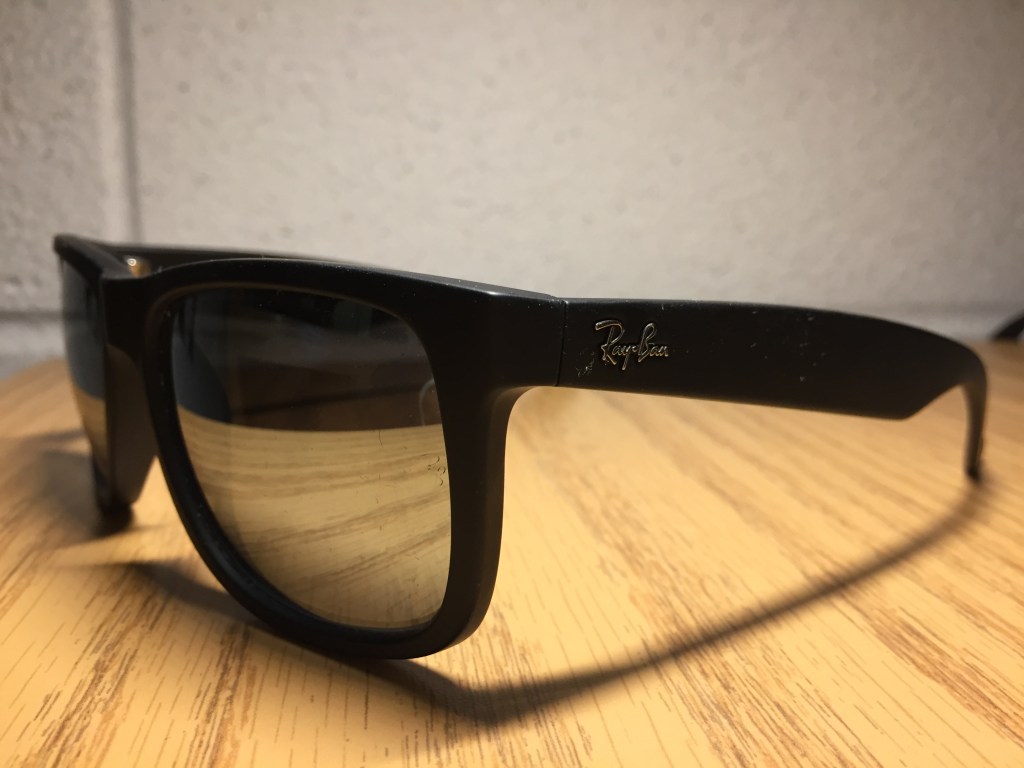
Continuing with the physical attributes of my Ray-Ban sunglasses, the inner corners of the glasses have a stainless-steel joint that allows the frame to pivot in order to open and close. Although the frame is a very important aspect of any pair of glasses, it is undeniable the most important portion of this object is centered around its lenses. For this object, despite of having a myriad of diverse lenses to choose from, I ultimately ended up with a lens with a metallic finish. Since standard black lenses were not available for the frame I had chosen, I ended up choosing these silver mirror lenses instead. Although I was a little skeptical of them at first, I eventually became very fond of them as they would soon become my everyday sunglasses.
Before diving into the history of obtaining my object, I would like to touch on one critical aspect of these sunglasses that I have not mentioned yet – they’re prescription. I consider myself to be a generally healthy person but one area that I’m definitely lacking in is my personal vision; while I don’t have terribly bad vision, I don’t have the best vision either. Since I am near sided (meaning I can see clearer up close), and the fact that I don’t enjoy wearing normal glasses, I believed that obtaining a pair of prescription sunglasses would be a suitable compromise. I bring up this point because I feel as if this object perfectly brings up the debate of fashion vs function. I’m often surprised to how many people forget that sunglasses can be prescription and not just a mere accessory. One of the reasons I am drawn to this object is that it serves two purposes, it is a fashionable accessory while also allowing me to see much clearer. As a result, the pragmatic nature of this object is what led me to purchase it in the first place nearly one year ago.
As I stated before, I obtained these sunglasses last June in Danbury, Connecticut at a local retailer called LensCrafters. Ray-Ban, being originally owned by Bausch & Lomb, were eventually sold to the Italian eyewear giant, Luxottica, in 1999. Moreover, since my glasses are made to order based on my prescription and have the writing “Made in Italy” on its frame, I tried to look further to see where exactly they were manufactured. Unfortunately, I was not able to locate any resources online that pinpoint the exact location in Italy where these glasses were made. However, according to Luxottica’s website, the company’s manufacturing footprint includes six facilities located in Italy, the center of Luxottica’s luxury eyewear production, with five of their most prominent factories being located in Northeastern Italy, where most of the country’s eyewear industry is based, and one near Turin.
Although it is a shame that I wasn’t able to find to exact location of where my Ray-Ban sunglasses were manufactured, I’m sure they were produced with passion and exquisite Italian craftsmanship. With such a strong attention to detail, a pragmatic and fashionable purpose and a rich Italian history, there’s no surprise to why this object continues to be one of my favorite possessions. Perhaps one day I’ll have the opportunity to dig even deeper into the history and manufacturing process of these glasses. But for now, I look forward to continue wearing them as I will be able to appreciate and acknowledge this object’s significance, functionality and history.
 The Materials of History, Thought, and Art
This post stuck me at a particularly interesting time, I have been strongly considering getting a pair of prescription sunglasses lately. I have fairly poor eyesight, enough so that I need to wear glasses every day in order to be functional. I am also near sighted. I too tend to care a great deal, especially when it comes to glasses and sunglasses about the quality of them– specifically because they are something I need to serve a function for me every single day. I have a pair of Ray-Ban sunglasses, that I think I will likely turn into prescription sunglasses so I can switch them out with my regular glasses when I go outside so I do not have to wear contacts. But I appreciate your information regarding where Ray-Bans are manufactured. I was unaware they were manufactured in Italy. I really enjoyed this post! And I can certainly appreciate the function that prescription sunglasses serve!
I really like that you first describe the object by what can be seen. Saving the information about them being perscription until the end of the description caused me as a reader to see a shift in function. Not only are they useful to protect your eyes from the sun, but also to help you see. I think this aspect adds a lot of value to your sunglasses. Personally, I have a bad habit of losing or breaking my sunglasses, which are not perscription. To combat this frequent replacement of sunglasses, I only buy very cheap pairs. However, I always know where my regular prescription glasses are and I am much more careful with them.
Brandon. Although I am now a Zenni girl when it comes to prescription eyeware, I loved your detail about your RayBan sunglasses. The mirrored lenses must look sharp with your dark hair. I had RayBans years ago. They were still made in America at the time. I would have still had them if I hadn’t lost them somewhere along the way. I LOVED them. I don’t know if you had a chance to see it, but there was a fascinating news story on 60 Minutes about Luxottica. The company has truly become a behemoth. In addition to the manufacture of most branded eyeware, it has also bought most eyeglass/exam stores. Because of this monopoly, the company really controls pricing across the board. But there is something to be said for looking good and being able to see too. Thanks so much for the detail and work you put into your post!