Josie’s Ring

The object I am choosing to analyze and describe is a ring that once belonged to my late grandmother, Josephine.
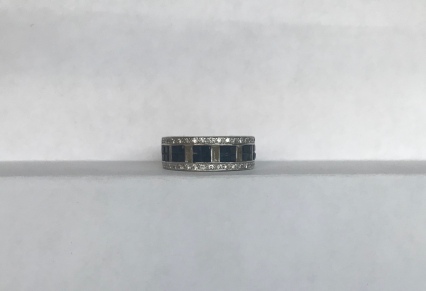
IMG_3742 2

Front View of Ring

This ring measures approximately one inch across, and fits a ring size of 7 & ½. The ring band is 18k white gold, set with 24 square cut sapphires and further set with 5 baguette cut and 32 full cut diamonds. The word “LEVIAN” is inscribed on the inner band (this is the brand) as well as “18k”

When struck by sunlight the diamonds sparkle and the sapphires glow with an ominous deep blue undertone. The “top” half of the ring is where most of its weight exists, because of all the stones it is set with. The outer part of the bottom of the band is etched with multiple scratches that you can feel like grooves when you run your finger over them. These I’m sure could be buffed out with a cleaning but I like them the way they are.
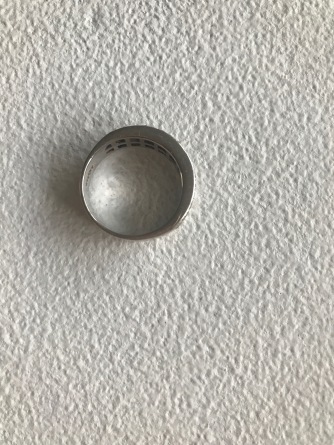
IMG_3741

LEVIAN inscription in the top left of this image, also featuring the inside of the stone settings

While this ring is stunning, it has one slight imperfection (other than some scratches due to wear). On the fourth set of sapphires from the left, the bottom right sapphire stone is cracked in its upper right hand corner. I’m sure this probably diminishes the worth of the ring slightly, however that does not concern me. Normally, if a piece of expensive jewelry that I owned was in some way tarnished, I would be upset and feel discouraged. But in this case, I embrace the imperfection for a few reasons. First, on the most basic level, it reminds me that not everything in life is perfect, even the shiny seemingly perfect things. Secondly, it makes me yearn to know what caused the stone to crack. I wonder how my grandmother cracked it, what she was wearing that day, if she noticed immediately there had been damage, if she continued to wear it after it had been damaged, and so on. It makes me wonder about a past that I was not at all a part of. I think this is the reason my attachment to objects of great sentimental value is so strong, because they make me wonder so many different things about what occurred around them before my time.

Losing my grandmother was one of the most difficult events for my family. When a person no longer is a living, breathing being on this earth most often what we have left of them are their possessions, photographs, perhaps some video if we are lucky– and lastly our memories of them. After sustaining two serious head injuries, my difficulty recalling memories sometimes gets the best of me, so I rely heavily on more tangible mementos. I have a few objects that belonged to my grandmother, perhaps even a few that hold more sentimental value, such as a silver heart necklace my grandfather gave my grandmother on their 25th wedding anniversary with a very special inscription on the back– but ultimately this ring is what brings me the most joy.

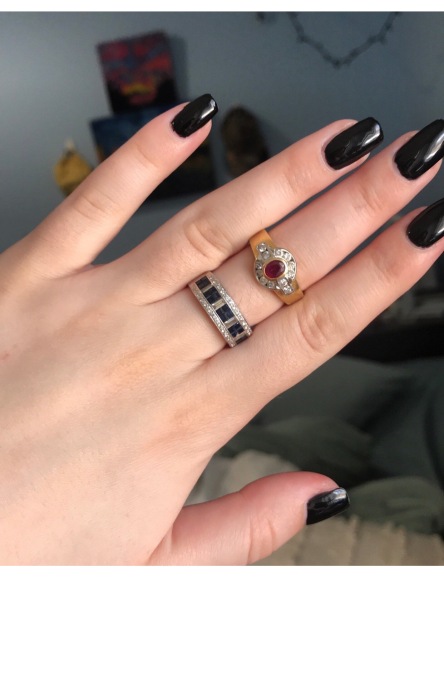
Years after my grandmother passed away my grandfather passed this ring down to me as what I believe was a mark of my maturation in his eyes. It was a ring I do not remember seeing her wear, she often wore yellow gold (which you can see in the image below, which includes the other ring my grandfather passed down to me which is yellow gold that he had custom made for her in Italy)

IMG_9090

Both rings on my finger. The chipped stone is visible on the right side of the band.

I believe the fact that I do not remember seeing her wear this ring is part of what makes it feel very special to me. It makes me wonder about a lifetime of hers that I was not a part of and that I cannot fully understand because I was not there. It reminds me whenever I look at it on my finger that she had a history that did not involve me. I find that to be an immensely special and sometimes complex part of being human. I have only ever known the life that I have lived, but the people in my life, (mostly referencing my family members), have lived a lot of life before my existence. My grandfather giving me this ring also reminds me to dig deeper into his history. When I look at it on my finger I feel highly inclined to sit with him and take the time to ask questions– about his life, about my grandmothers, about theirs together. This method is the only way left I have access to my grandparent’s history and I cherish it.

While the ring is simply a ring, it has immense sentimental value to me. I often wear a ring on nearly every finger, but I refuse to pair this ring with any others, if I am wearing it I let it stand alone as I feel it should. It’s great monetary value also reminds me in an interesting way of my family’s history. My grandfather dropped out of school in 8th grade to provide for his family. In his adult life, he worked everyday doing manual labor as a cement mason. He did not come from nor have a lot of money. My grandma was a bit more fortunate than my grandfather growing up, but still not well off by any means. I know from asking that my grandparents did not live beyond their means, and they certainly did not buy luxury items. However, this ring is valued around $3000, which years ago was even more money than it is today. My grandfather buying my grandmother this ring signifies to me the true value of their relationships. Although it definitely cannot be quantified by price, just the sentiment of spending such an enormous sum of money (for a ring that was not a wedding ring) shows to me the eternal nature of their relationship. Ultimately, wearing it reminds me how I fortunate I am to be surrounded by the most loving and endearing family, and you can never put a price tag on that.


331 Words

In contemplating photos, my grandmother’s ring, and my beloved Steiff teddy bear, I felt no motivation to discuss them here. A deep dive into these mementos might be forthcoming though. For this post, I could only think about books. From a well-curated collection, what to choose? An extremely well worn copy of The Vampire Lestat authored by Anne Rice came to mind. During its initial read, it wasn’t just me taking in the words. At the time, it seemed everyone in my orbit was reading it too, a book club before Oprah’s. I haven’t read it in many years now, but I still have it. Nope. Not this one. Back to the shelves.

Before I had my first child, I already started to purchase books for their library. Since my mom was a serial purger, very few books from my childhood remain. Ironically, she always lamented not bringing her books with her to the United States when she left what at the time was West Germany, to be with my father. Years ago, I came across a quote that said something like ‘I don’t trust people who don’t have books in their house.’ I subscribe to this adage completely, never understanding how anyone would not have at least a couple of titles in their possession. Needless to say, my home has plenty of volumes in residence.

The children’s books

In my downsizing frame of mind, I am easily able to decide what stays and what goes. My children’s library is another story (pun intended). Unless a title was beyond repair, it remains, a gentle reminder of a sweeter time. My perusal of an IKEA Billy book shelf brought back many memories. My youngest is now 15. I haven’t read a story to him in years. So what do I choose? How about Eric Carle’s The Very Hungry Caterpillar or Brown Bear, Brown Bear, What Do You See? Then there’s Chicka Chicka Boom Boom by Bill Martin, Jr. and John Archaumbault. I never tired of reading this to my imps. It still has the best graphics ever. Richard Scarry, Dr. Seuss? Ferdinand the Bull, Make Way for Ducklings?, or my daughter’s all time favorite The Araboolies of Liberty Street?

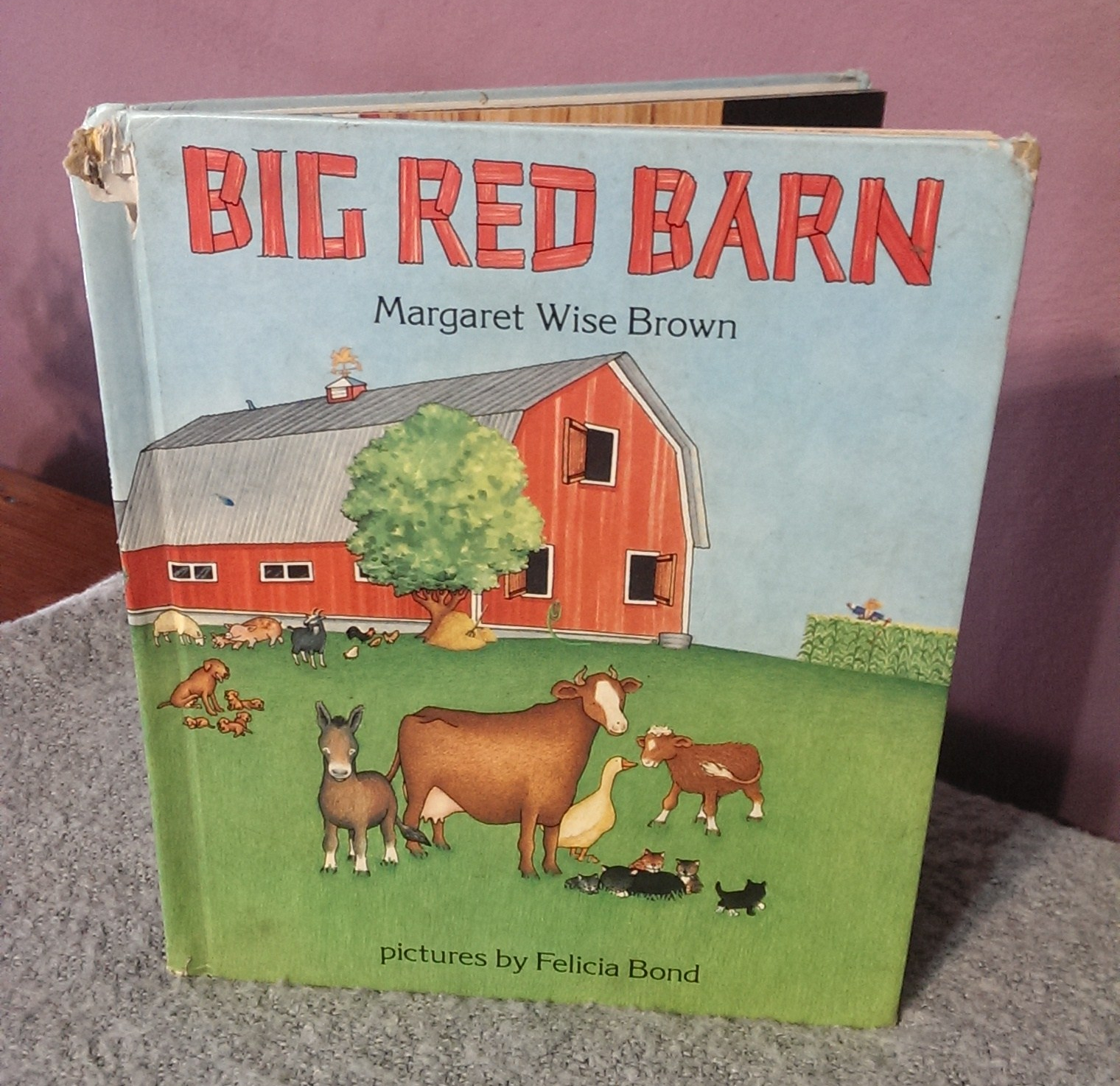
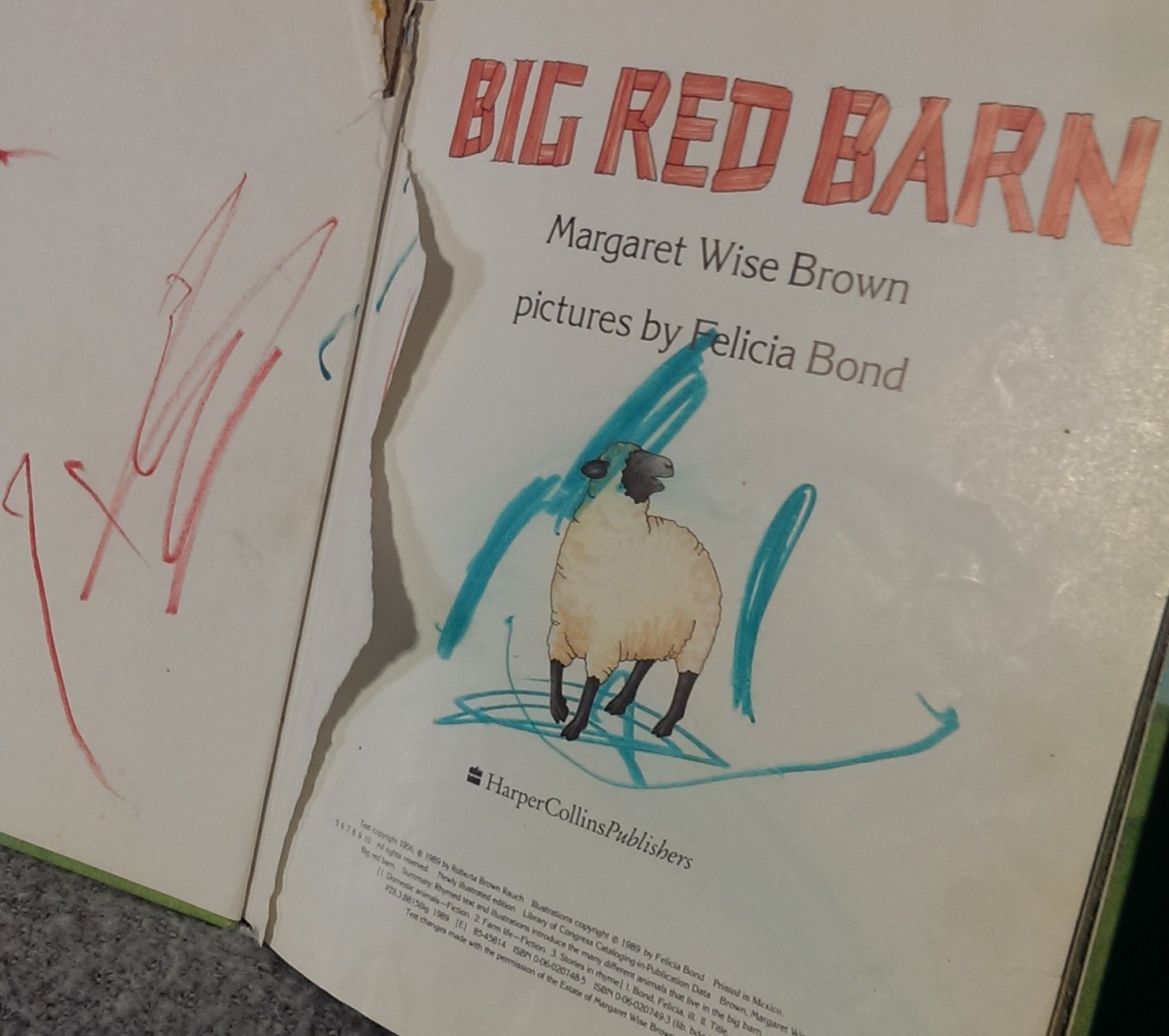
Then there it was. So obvious, so cherished. Corners frayed and worn. A future artist scribbled on the now torn title page. I knew she wouldn’t let me down, Miss Margaret Wise Brown. Now you might jump to conclusions. It’s a no -brainer. Goodnight Moon, right? But you would be mistaken. Yes, I have read that one roughly 7381 times. It has held up beautifully, having had the sense to purchase it in board book form. It is a title that I still give regularly at baby showers. My kids loved it. But if you ask them what their favorite is, unanimously they say Big Red Barn.

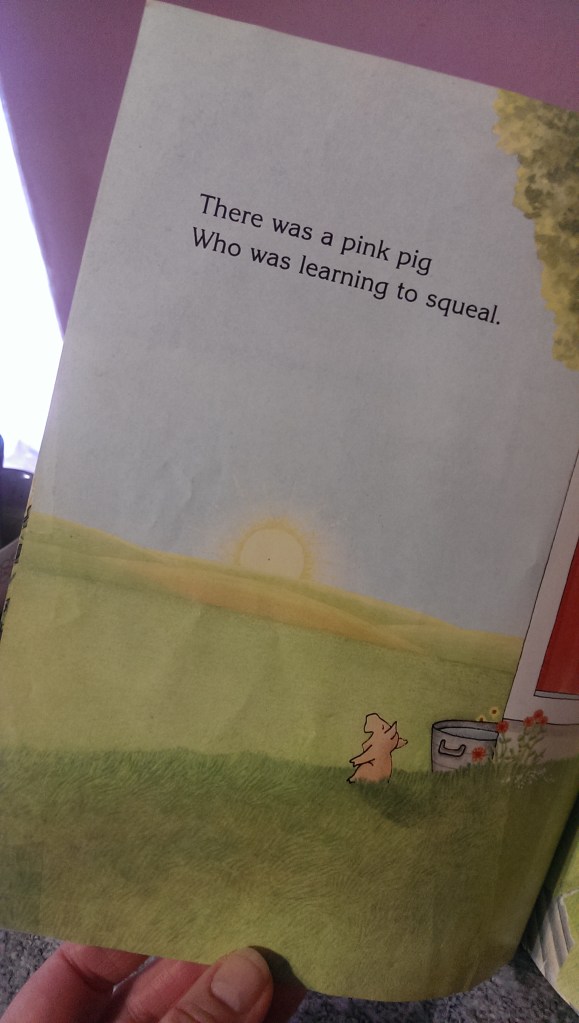
Originally published in 1954, two years after Brown’s death, the version shown here was published in 1989 by Harper Collins, with new illustrations by Felicia Bond. Nestled in my brain forever, its 331 words are simple and calming. When read in the hushed tones of bedtime, “By the big red barn in the great green field, there was a pink pig who was learning to squeal” and the lines that follow, take on a lilting quality of comfort and warmth. Whether in a rocker recliner with at least one child, their stuffed animal, and a blanket, or curled up in a toddler bed, holding the book above our heads, Big Red Barn‘s words could soothe the fussiest of babies.

The End

The process of reading also worked in reverse. Being an exhausted mom of three children under five years old (at the time), the promise of a story made wrangling them into bed a little easier. I vividly remember sharing a pillow with my first born, him playing with my ear to comfort himself (no thumb sucking or pacifier. An ear, go figure), cheek to cheek, feeling his sweet baby’s breath on my skin. I turn the pages without prompting, the syllables providing muscle memory. “Only the mice were left to play. Rustling and squeaking in the hay, while the moon sailed high in the dark night sky.” He’s asleep. The book goes back on the shelf….. until tomorrow.

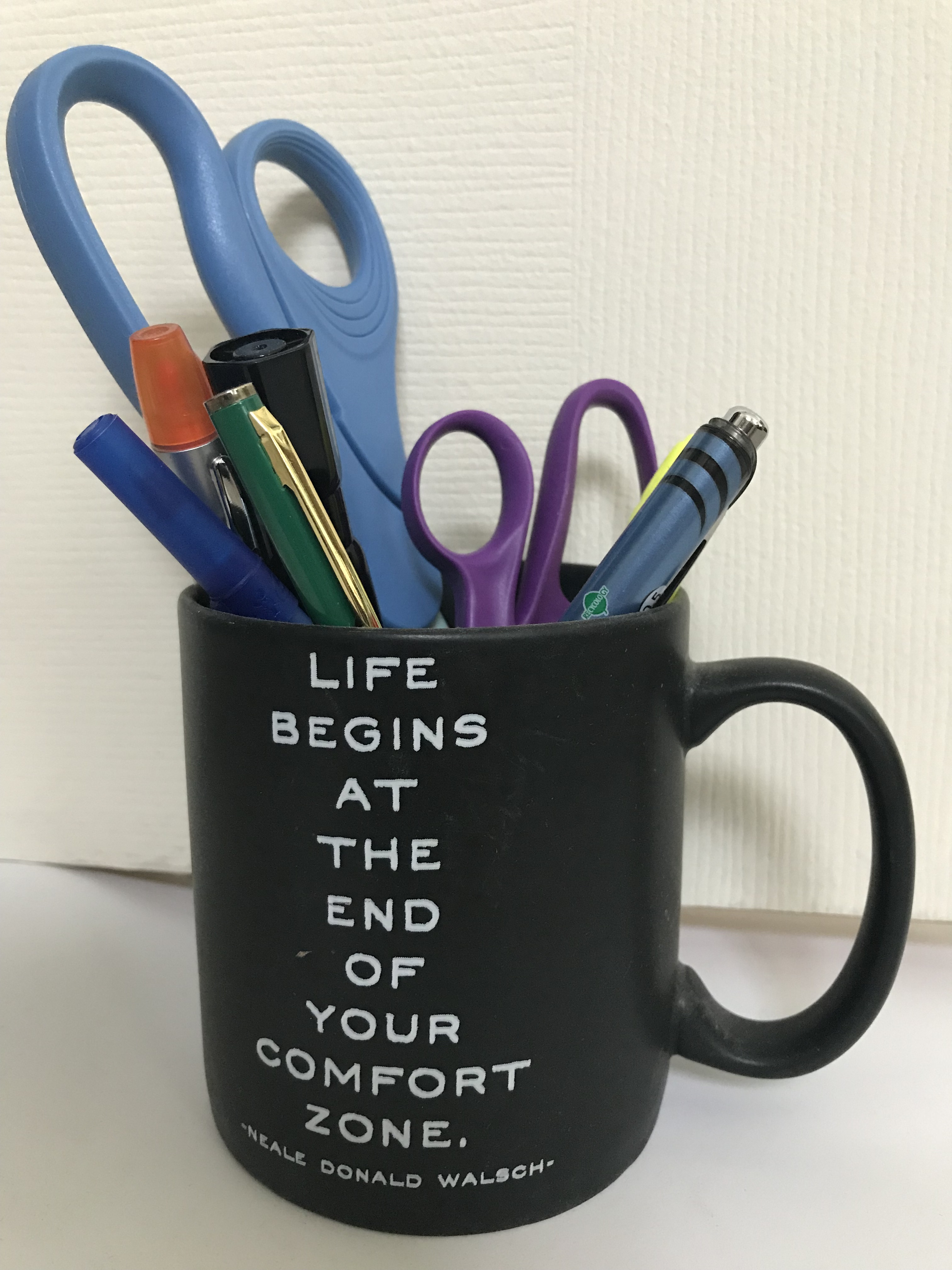
My Mantra Mug

The inspirational mug.

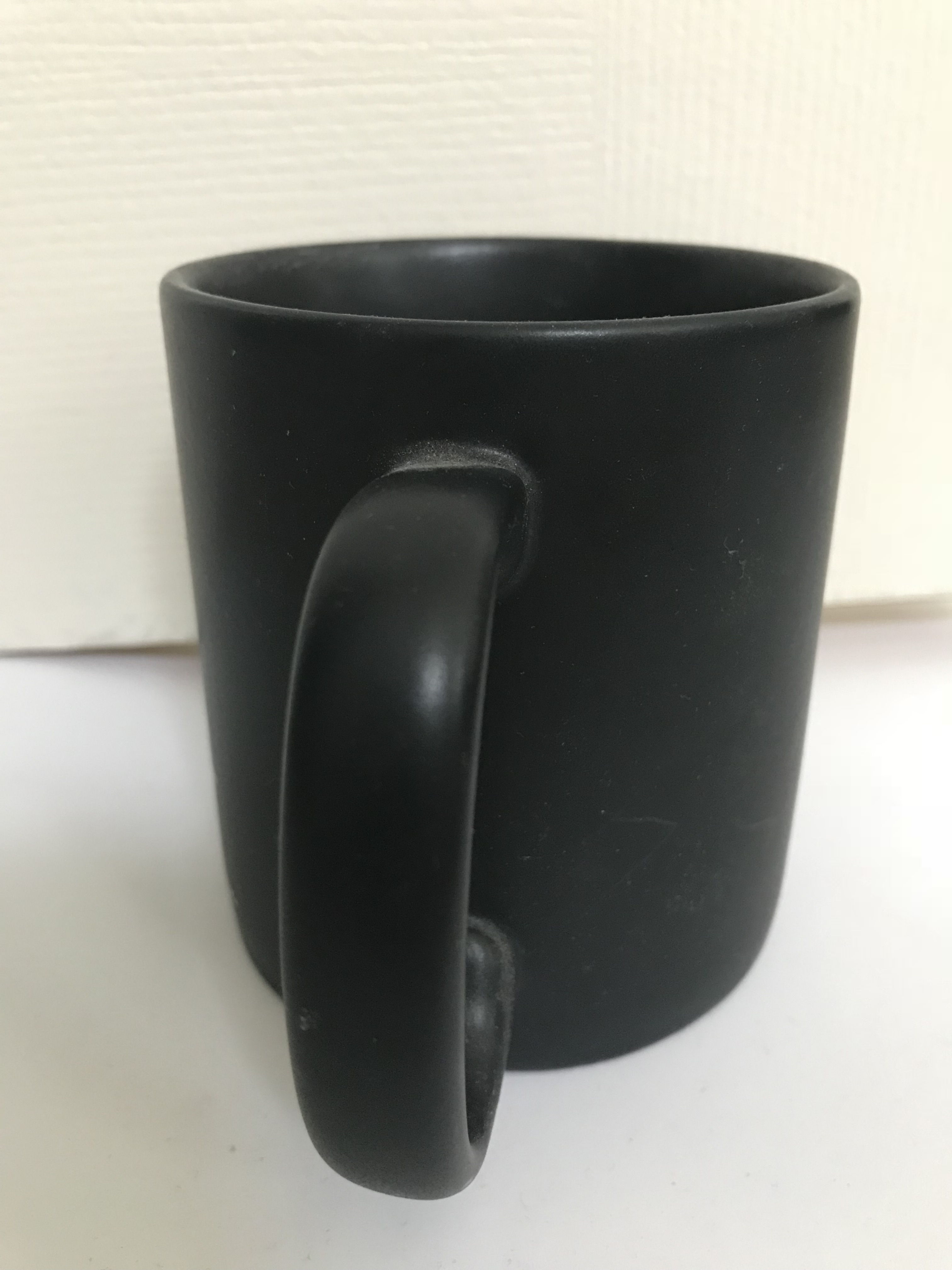
The object that I chose appears rather ordinary at first glance. It’s a plain, black, ceramic mug. The two things that would make it stand out is the quote printed on it that takes up the front, and its size, as it appears to be a bit larger than a regular mug, measuring about 5 inches in width (including the handle, 3 inches without it) and about 4 inches in height. The mug is quite heavy, even without all my contents in it, giving it a feeling of sturdiness and reliability. It has a smooth finish to the touch and a sleek look, which the black color helps to contribute to. Because the mug is almost entirely black, it has this shine to it. When the natural light touches it, it’s as if the mug takes it in, and proudly wears it on its surface.

The shine.
So sleek.

Without the text on the front, this would just be a plain black mug. The words help to give it a supplemental meaning, pushing it beyond its role of simply being a mug for people to put contents in. The words transform the mug from a cup that holds things to an object that conveys wisdom and inspiration. The quote on the front reads, “Life begins at the end of your comfort zone. –Neale Donald Walsch-,”. All of the words are in capital letters, to convey a boldness and resonance with the reader. The typeface is soft, but clear. Both of these qualities help to further communicate this simple, yet powerful message. The way that the words are arranged on the mug is aesthetically pleasing. The quote is written vertically, reaching from top to bottom. This style opposes how words are normally written, horizontally, but in this deviation lies the aesthetic, and is what makes it appealing to the viewer—it stands out. To go a bit deeper, the “different” way that the words are arranged could symbolize the act of pushing out of our comfort zones and challenging the status quo. The arrangement of the words mimic how we might see a simple poem written, adding emphasis to each word as we read it and conveying a significance to each word—they’re carefully and purposely placed. Like certain poems, the appearance of both the mug and the words on it are powerful in its simplicity, but unveil a deeper meaning—to implore us to take that leap, to live life with a level of fearlessness.

My relationship to this mug made me think of Daniel Miller’s conversation in Stuff about the functionality of objects compared to their social or cultural meaning. I don’t use the mug the way I “should.” I have never put liquid in this mug or drank from it. I have deprived the mug of its main “function,” and replaced it with a function that means much more to me. I keep this mug on my desk, and fill it with my pens, markers, scissors, highlighters, etc. I have turned it into a medium for school, rather than a medium for sipping. However, I believe it serves a better purpose on my desk, where I do my academic work, where I can view it and have it as a constant reminder to heed its message. This mug has a deeper meaning to me, personally. Before I left for college, my best friend from home, Katie, got me this mug as a parting gift. We were both leaving everything we had ever known—our home, the familiar, the comfortable—and we were leaving each other. Katie has helped shape me as a person, and has believed in me in times that I haven’t. She has a knack for recognizing things in myself before I even do. She knew I was apprehensive about leaving for school, but also knew the potential I had in me. This mug conveys a message she has always been sharing with me and encouraging me to do. The quote on this mug has been my mantra throughout these four years in college. It has guided and steered me through all of my experiences here. Those words pushed me to put myself out there and just go for it, which has led me down incredible paths where I’ve been given amazing opportunities and met wonderful people.

My Instrument

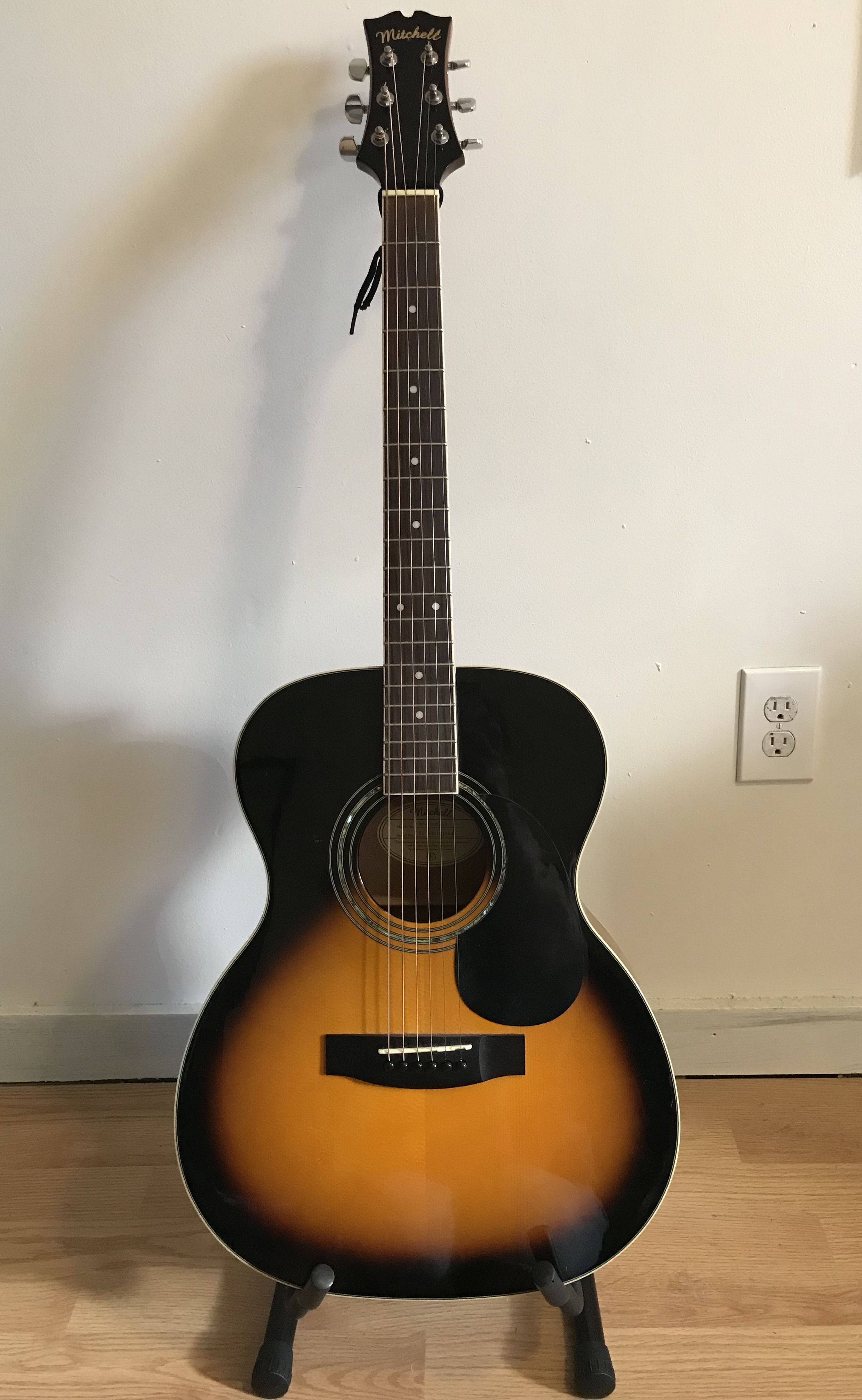
My guitar is my instrument, it is my crutch, it is my saving grace, and my worst enemy.

My beloved guitar.

My guitar was given to me as a gift from my mother when I was in middle school, probably around eleven years old. It’s a Mitchell guitar and is part of their 120 series model. It has a vintage sunburst design with a glossy finish. This guitar probably cost a little over $200, which is on the less expensive side for guitars.

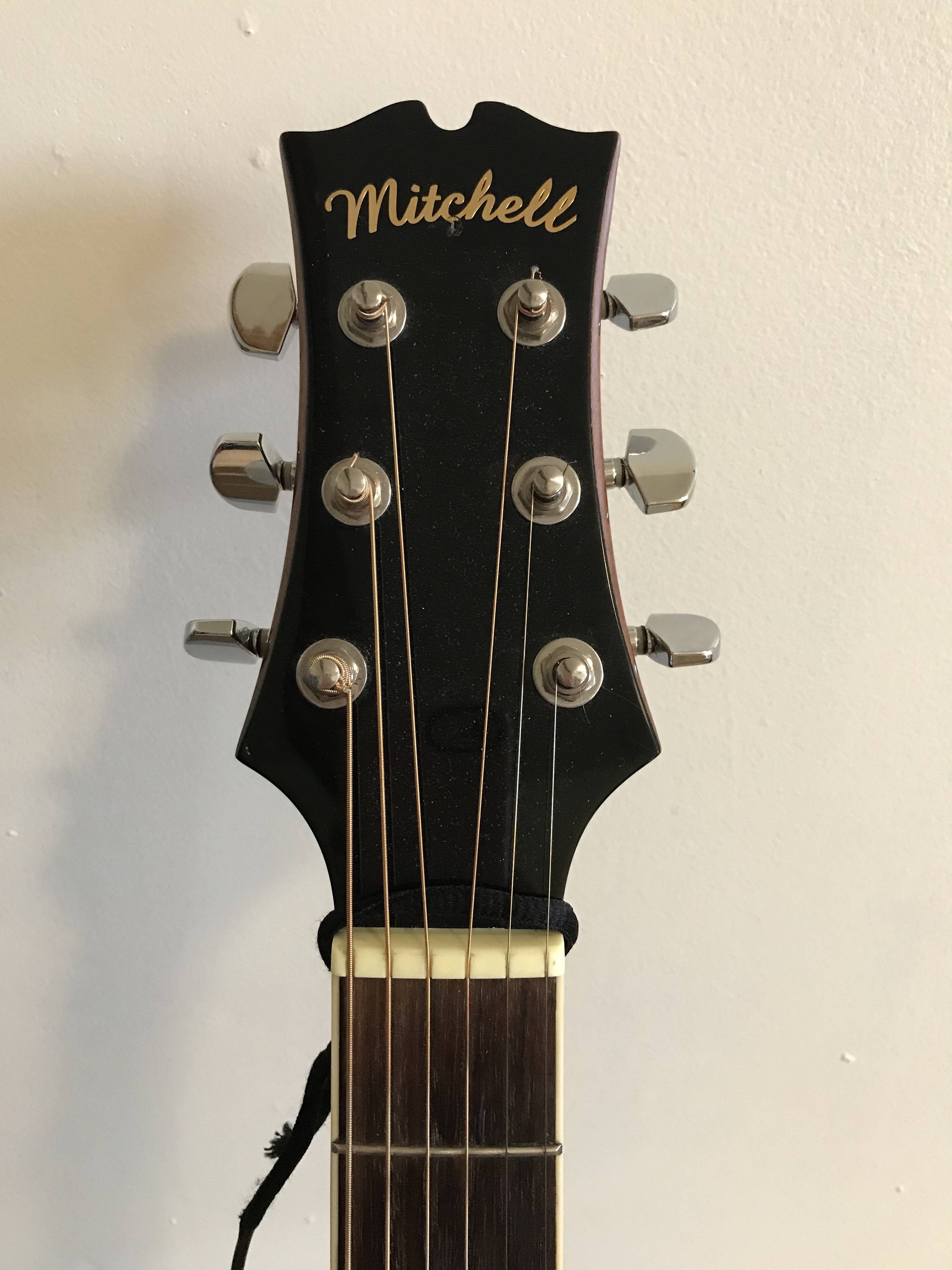
The guitar’s headstock.

Here is a closeup of the headstock, where the instrument can be tuned. Right now, my guitar has Martin strings made out of silk and steel with a .12 gauge. I chose these strings because they are lighter, and have a more mellow sound than strings made out of phosphor bronze. I strung my guitar myself, which has made me feel closer to my instrument and the sound it produces. Tied around the neck of the guitar is a shoelace for me to attach my guitar strap to. Usually guitars have a peg closer to the base of the neck to attach a strap, mine unfortunately does not. A few Google searches later I learned that a shoelace could do the trick.

The guitar has one minor blemish on the left hand side, and I’m honestly not entirely sure how it got there. My guess is it’s from hitting it on a chair or some other hard surface.

I’ve had previous experience with eBay’s photography tips because I sold a guitar on eBay this past summer. How the photo looks will absolutely determine whether or not your product sells, which is why eBay reinforces the importance of taking quality photos. It’s also important to be transparent about the quality of the product as well as any defects or blemishes it may have.

I chose to photograph my guitar frankly because I think it’s beautiful, and it holds a deep sentimental value for me. I taught myself how to play it, and I can remember when it was such a challenge for me to play a simple song with minimal chords. Now I bring it with me when I perform, I use it to write songs, and I even teach other people how to play it. It’s my first guitar, and will always hold a special place in my heart.

A Garden Statue

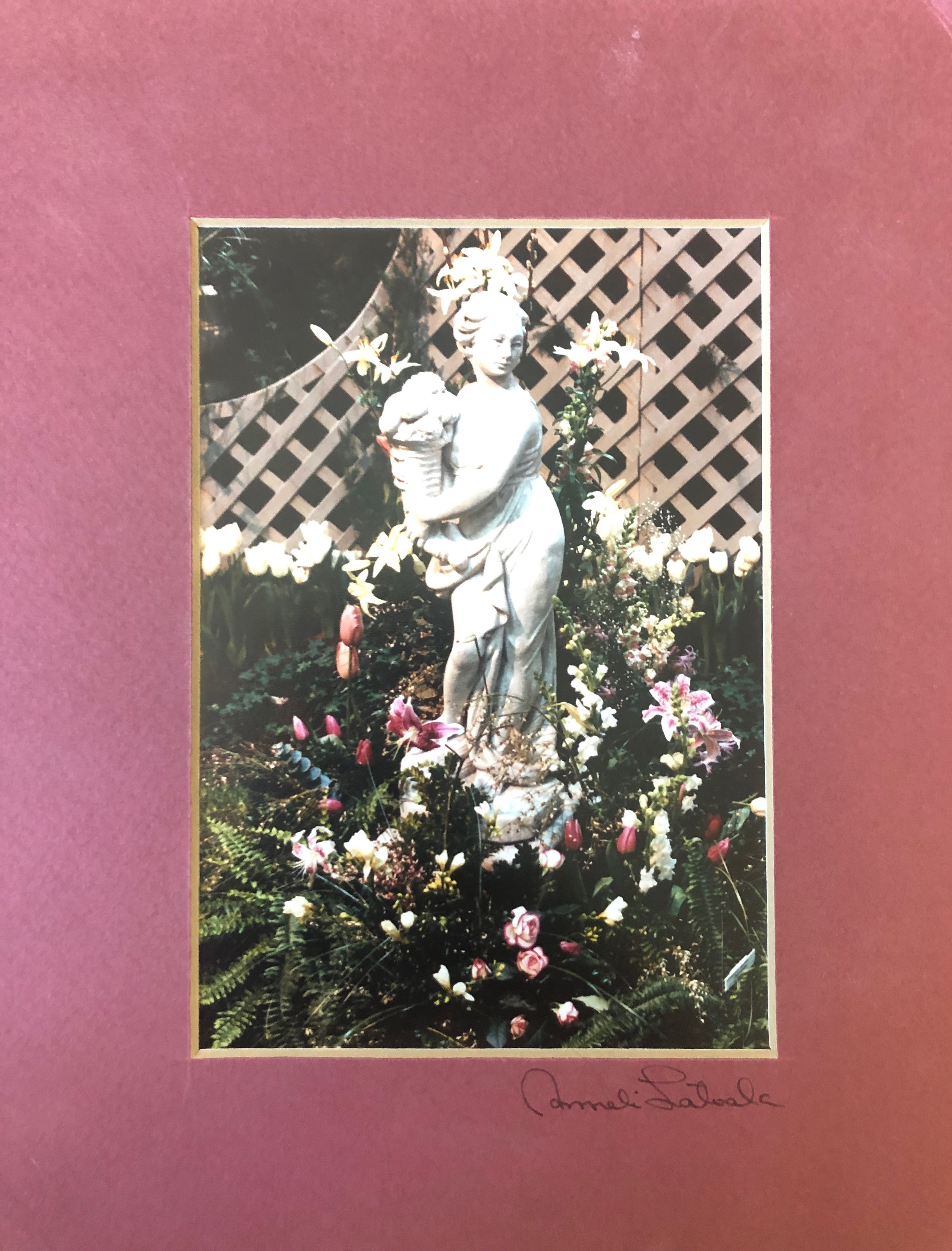
The object I am describing is not one of the items I brought to class, but still holds sentimental value to me. This is a photo on matte board that my cousin’s grandmother had taken. I found this picture two years ago and have been hanging it on my walls ever since. 

The Garden Statue

It is an 8×10 inch photo that is framed by the maroon colored matte board. It is about a third of an inch thick, which makes it great for hanging on the wall. It is not too heavy, and is easily supported by blue painters tape or museum strength hanging putty. The matte board is made up of a mostly paper based concentration, and can have wood pulp or cotton fibers added to it as well. It is smooth to the touch, but also very durable as it is only starting to bend or peel a bit in the corners. My cousin’s grandmother’s signature is also in the bottom right corner below the picture.

I love this picture so much, because of the aesthetic of it. The colors in the flower are bright and beautiful, yet still subdued hues and match the color of the matte board almost perfectly. The statue is holding what looks like a cornucopia of produce, and she seems to be cradling it as one holds a child. All the little details in her appearance make me love this photograph so much; the waves in her hair, the folding of her dress, and how it wraps around her, and how the placement of this statue is so strategic, the flowers in this garden seem to dance, sway, and grow every which way around her.

How a white background changes the effect

The color scheme and amount of detail in this picture are what drew me to it. It has so much going on when you really take a look at everything, but it is also very still, and calming. The colors are pure and relaxed, and do not make me feel overwhelmed when I look at them all. I feel graceful, peaceful, and serene when I see this photograph. It’s also a great connection to my family. While my cousin’s grandmother is not my immediate grandmother, I have always loved her and adored her work. She is an artist, and every time I got to see her I loved being able to explore her in-home studio and see everything she was working on. Unfortunately, she suffered from some severe health problems, and had to move in order to receive the help she needed. I found this picture among many others, when cleaning out her house with my cousins two summers ago. We decided to try and sell some of her artwork, so that others could appreciate it, but when searching through a bin of other 8×10 photos in matte board just like this one, I knew I had to keep it. I have never gotten the chance to ask where this garden statue is, or when she even took this photo, but something about the unknown of it, makes me love it even more. Being able to look at this picture in a new light has made me appreciate it more, and want to be able to explore other items I hold closely, to see what I can say about them, and what they say about me.

Family First

The object I have chosen to discuss is a little purse my abuelita (grandma) got for me a few years ago from Ecuador. This purse is one of a few other objects my family has gotten for me from their visits to Ecuador, a place I have still yet to visit; however, means a lot to my family and I. I am a first generation on my dad’s side. My father immigrated here when he was around 14 and I am very proud of my family’s cultural history and ecuadorian roots. A lot of people don’t realize I am hispanic based off my appearance. My mom is irish and so I have lighter skin color than my dad and other members of my family. However, I am proud to be hispanic and love spending time at my Titi’s (Aunts) or Abuelita’s houses; eating their amazing cooking, dancing along to spanish music and practicing my spanish.

The purse is approximately 5 inches tall and 5 inches wide, resembling a square. It is also about a ¼ inch thick, when the purse is empty. It looks as if it was hand stitched and some of the threading is even coming undone within the inside of the main pocket of the purse. It has two compartments. The main one is opened by a zipper on the top and the other is in the front of the purse and is much smaller, also opened by a zipper. Although the outside stitching of the purse is a repeating black and white lined pattern, the rest of its design is much more eccentric. There are lines of different colors striped down the front in different thicknesses. It’s primarily made up of “warmer” colors; like orange, yellow and red. However, it also contains some blue, black, green and white. The biggest block of color is a yellow rectangle shape with a blue and a red stripe going down it. This is consistent on both the front and the back. This is significant to me because it is the colors of Ecuador, also found on its flag.

The yellow symbolizes the fertility of the land, the blue represents the sea and the sky and lastly, the red represents the bloodshed during their fight for independence. The yellow stripe on the Ecuadorian flag is also twice as thick as the red and the blue. This is also consistent with my purse in that the yellow portion of this part of the purse is much larger than the blue and red stripes going through it.

Throughout completing this assignment, I began to think about more of the background on how I got this object. My grandma got it for me several years ago after she visited Ecuador. She gave it to my dad to give to me, and it has been in my possession ever since. All I know about this purse is that it came from Ecuador, but I’m more curious now into finding out more specific details. Where did my abuelita purchase this purse? Who made it? Where in Ecuador did she get it? Why did she pick this specific gift to bring back for me? As all these questions are now raised in my head I’m looking forward to seeing my abuelita soon and asking if she remembers getting it for me and more about where she got it from. Just like Daniel Miller wrote in, Stuff, we need to appreciate the role of objects by considering them as signs and symbols that represent us. These objects can be worthless without us giving them meaning and using them to represent ourselves to the rest of the world and I am proud that this object can represent me and my heritage.

Grabbing the Brass Ring

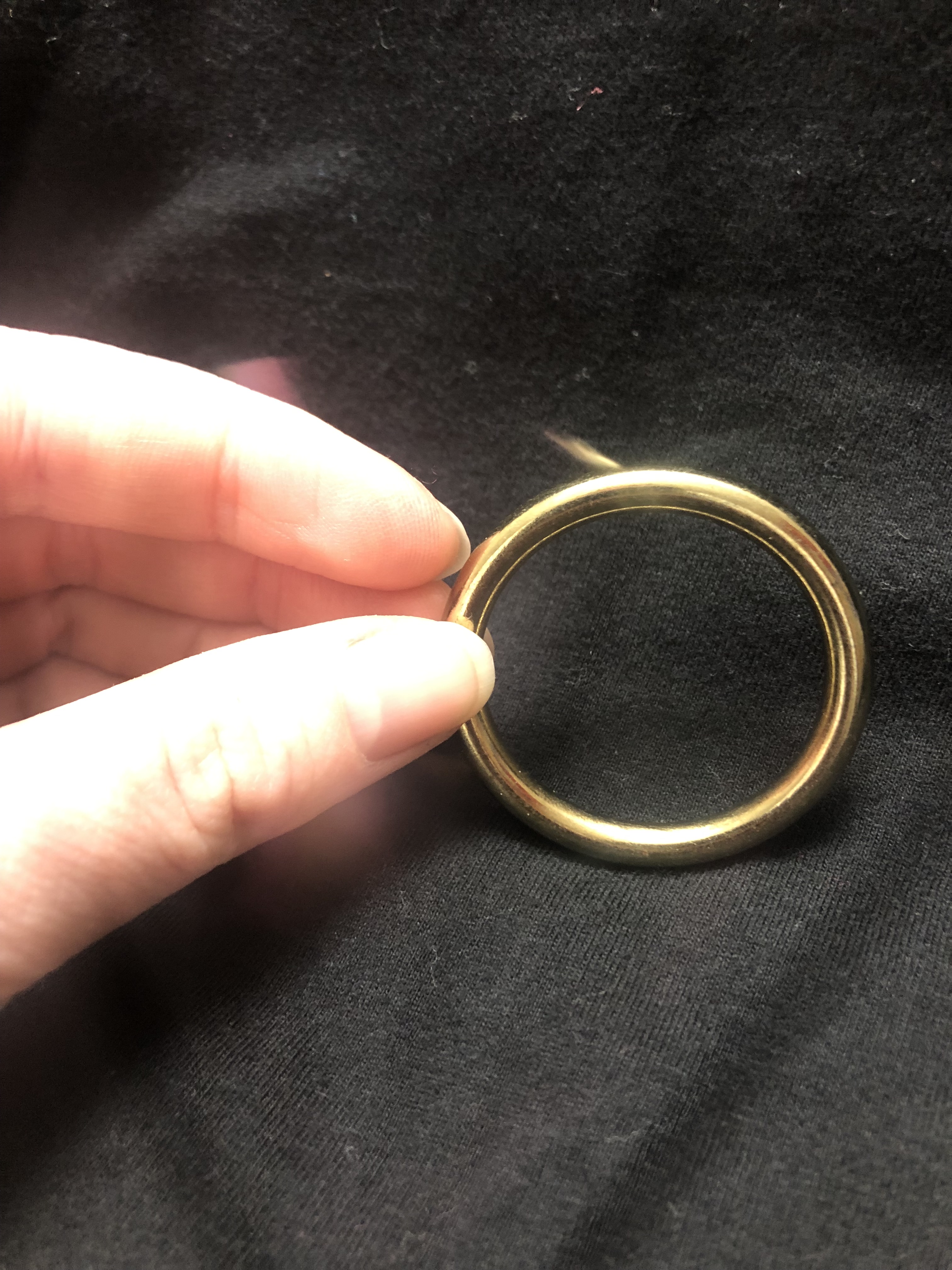
The object I have chosen to focus on is a simple Brass Ring from the ring machine on Nunley’s Carousel.

This is the ring. Approximately 1 in. in diameter

This is a simple object measuring one inch in diameter. It is about the same size as the circle your hand makes when giving an okay sign.  There is not much description I can give to this simple brass colored ring. It’s slightly heavier than it looks and is worth more than it seems for being so small in size. There’s a slight black line where this has been molded together to form a perfect circle. There are only 19 carousels left in the world who use ring machines, making this even more of a rarity to have in my possession.

Why did I choose an object so round and simple? It is because to me, it is the exact opposite. Every object has its own story to tell. The only thing that can stand out beyond the shimmering brass is the dirt and scuffs on it from being well used by those who have been lucky enough to “grab the brass ring.” These blemishes are hidden behind countless memories. There is only a 1 in 25 chance of grabbing this ring every ride making it a challenge to win the free ride that the brass ring comes with. Although made of brass, giving this object some value, it is generally returned in exchange for the satisfying free ride.

The phrase “grabbing the brass ring” usually refers to a success in life. When I have seen those lucky enough to grab one on the carousel to them, this moment is just that. I can guarantee every single person who has rode the carousel will remember the time they grabbed this brass ring. The shiny brass taken from the right angles by my simple iphone camera showed its beauty. With each click of the camera I remembered the hundreds of photos of smiling people holding this exact ring.   

I spent 5 years raising money to restore the historic Nunley’s Carousel. I raised $91,000 in second grade to bring back this carousel. Now, I have worked there for over 6 years and see the value this carousel holds generation after generation. I used to wear the ring around my neck during this project. I have always felt connected to this ring. This assignment has reminded me of how important this carousel is to me. Although it is nuisance to load the ring machine every ride, the happiness I realize it brings are absolutely worth it.
Every single person that rode the over 100 year old carousel has had a story to tell about the time they got the brass ring or at least attempted to. The circle ring represents the full circle the carousel made by being restored and brought back to life. When I hold the ring I picture all the events that led us to finally being restored and brought back close to its original location. Every single day grandparents bring their children and their children’s children to ride the same horses they have been riding for generations. I have watched countless number of kids finally grow up and are able to reach the brass ring.

Me wearing the brass ring as a necklace.

Here is more information on the Carousel https://en.wikipedia.org/wiki/Nunley%27sAlso on the history of ring machines and the importance of the brass ring: https://henssgenhardware.com/history-of-brass-rings/

A Wooden Elephant

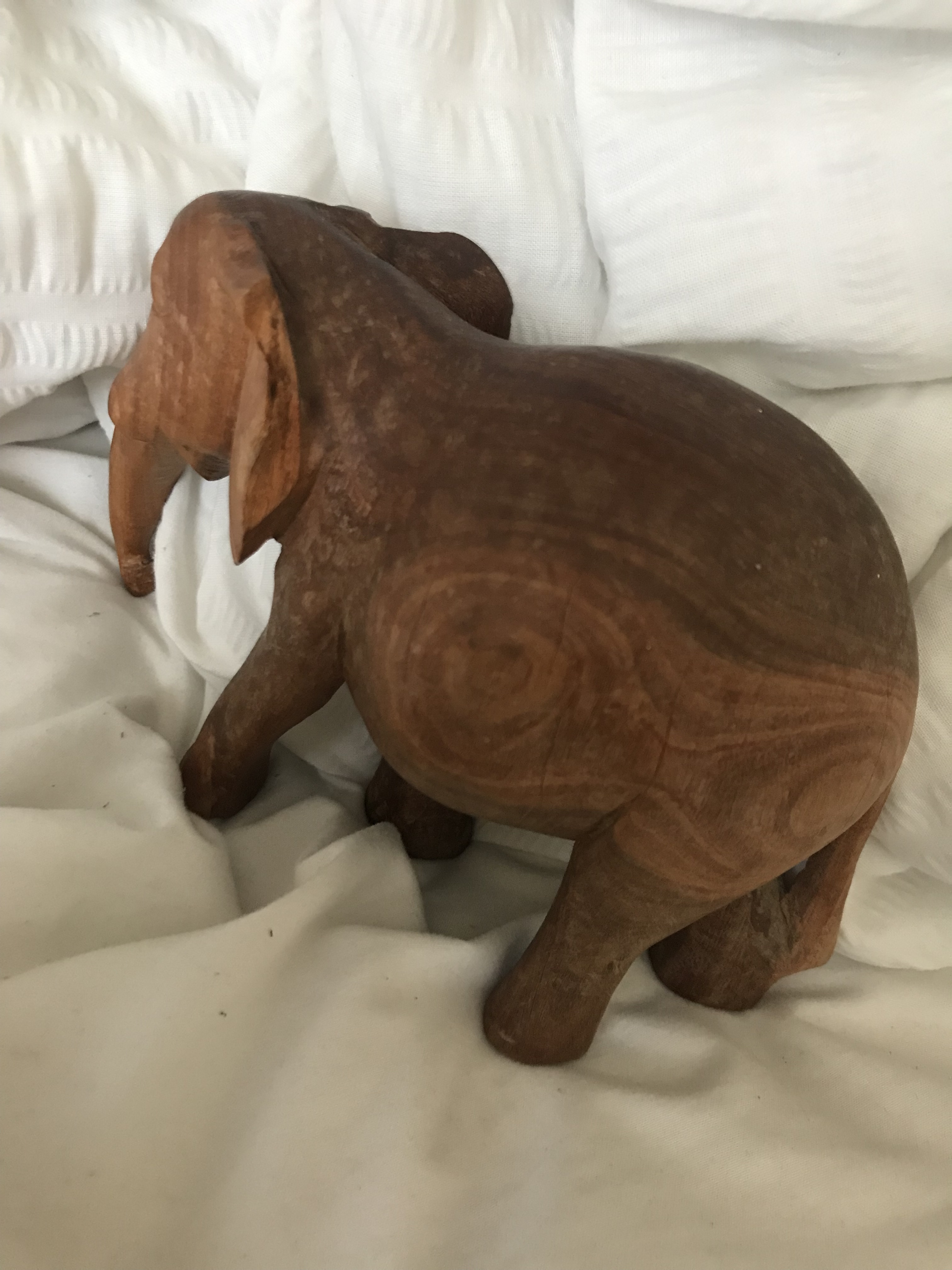
For this post, I have chosen to discuss an elephant figurine that I have been in possession of for about two years now. Given to me as a gift, it holds great sentimental value to me. It is also part of my ever-expanding collection of elephants, a hobby I have kept up since I was in early elementary school.

As pictured below, the elephant is approximately 5 inches wide and 4 inches tall. The material it is made out of is wood, and when touching it you can tell it was hand carved and still has a bit of a rough exterior. The wood displays many curved lines in it that give it an authentic and natural look. I like this about the object because, being that it is an elephant, I appreciate the fact that it was carved out of a natural substance. Also as shown in the following images, it has a few chips and scratches on it. One of the ears has been chipped, and the result is a jagged wooden edge. Personally, I don’t mind this. I feel that it gives the object more character.

I feel as though this an object that can span across many cultures, as well as time periods, and hold the same meaning. Animal figurines have been used for thousands of years all across the world. To many cultures, they were used for good luck and to ward off any unwanted negative presences. In Indian culture, Buddhism in particular, elephants have been known to symbolize power, wisdom, and good luck. Many believers often collected elephant figurines to place in their household to protect it. There is an ancient superstition that by facing the elephant so that its trunk faces the front door, it will prevent any bad from entering.

Inspecting my object further, I am interested to know how old it is–and not just the figurine itself. I want to know how old the wood from which it is carved from is. Somewhere, at some time, this little elephant was part of a tree. That tree could’ve been local, or it can be halfway across the world. Being that my friends found it in an antique shop, I am led to believe that it is quite old. I wonder if someone had it before me, and if it held the same meaning to them as it does to me. Were they merely a collector, finding joy in having multiple elephants around their home? Or were they a Buddhist, using this little elephant for religious purposes, warding off bad spirits and hoping to bring prosperity into their home? Regardless, as touched upon in the assigned article, “Material Culture/Objects: Where is it now and how did it get there?” I am led to believe that my particular object has held a similar meaning to all prior owners. In the beginning, the article discusses how many cultures wouldn’t understand some of the household objects I am currently surrounded by, such as a toaster or a Keurig. However, this elephant figurine holds a fairly simple meaning across all time periods and cultures.

Studying my object so closely has made me incredibly curious about where it came from. I doubt I would be able to trace it back to its roots, but it still something that is interesting to dwell on. It raises questions such as who made it, how many people have been gifted this, and will I someday pass it down to a similar antique shop as the one it came to me from? Furthermore, it makes me ask the same questions about my collection as a whole. I have elephant figurines made up of all kinds of mediums: glass, aluminum, clay, etc. I wonder if those elephants have long histories as well, and if the prior owners (if there are any) felt the same about them as I do.

Stop The War !

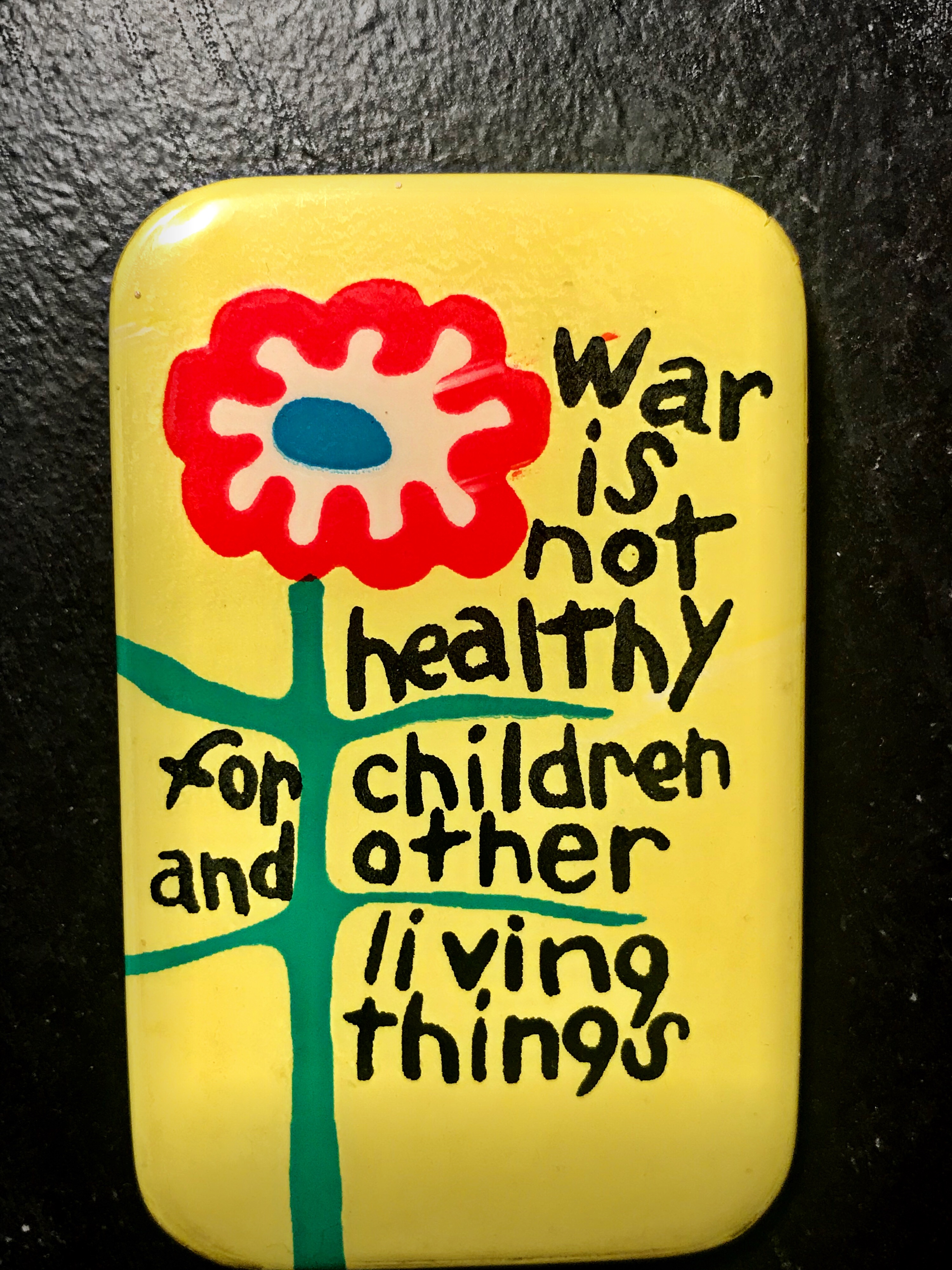
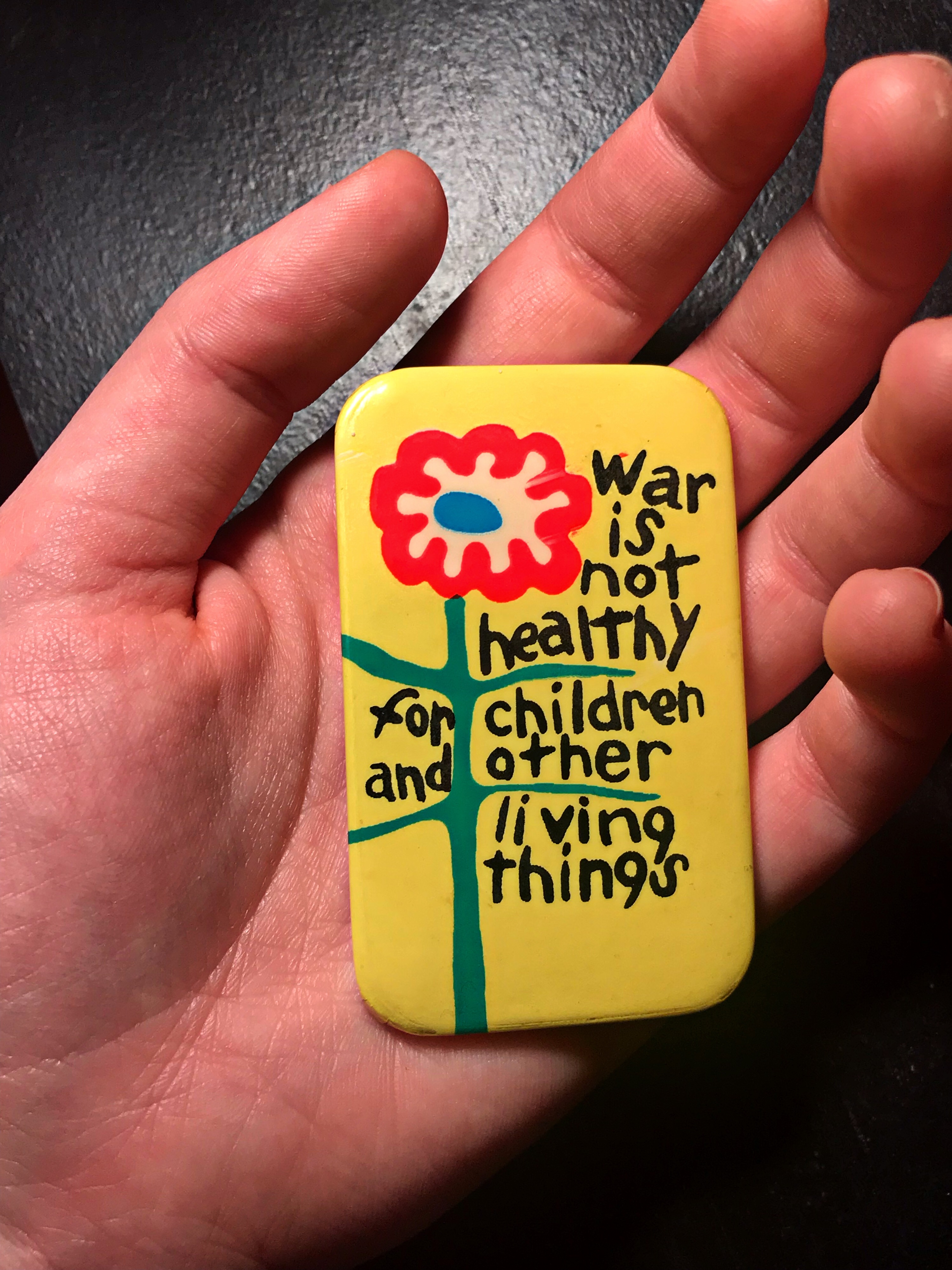
I’ve chosen to describe my mom’s 1960s anti-war pin. It typically resides in a jewelry box in my mom’s closet, making a few appearances over the years (notably for “hippie day” during my 7th grade spirit week and this honors seminar).

The rectangular pin is roughly the length of my palm  and about half the width. Turned to its side, the pin is slim–less than half an inch wide–yet it feels dense and rather substantial when held in one’s hand.  


It was made from what I assume to be a single sheet of thin metal (perhaps aluminum), with a sharp needle and coil (the actual “pin” ) attached to the back. The front of the pin reads “war is not healthy for children and other living things”–a popular anti-war slogan at the time–in a bubble letter font. A flower doodle snakes between the letters, breaking up the phrase “for children” and “and other”. The colors–yellow for the background, black for the lettering and green, orange, blue, and white for the flower–are surprisingly vibrant despite the pin’s age.

I estimate the pin to be about 50 years old, yet it remains in exceptionally good condition (likely from spending the majority of its lifetime in my mother’s jewelry box). There are no scuff marks on the front, albeit a slight paint smudge towards the upper right side of the flower. The bottom of the front side of the pin has a hint of rust; this is more visible around the upper edges of its opposite side. Turned to the right side, I’m able to detect the slightest hint of chipped paint in the upper and lower corners. The backside of the pin is a bit tarnished (to be expected after nearly half a century)–but still manages to maintain a bit of shine.

My mom grew up with two half-brothers who were much older than her. Both voluntarily enlisted in the military despite being vehemently against the war, as they considered the draft relatively unavoidable and would rather have some semblance of control over their decisions to serve. My mom’s eldest brother, Neil, gifted her this pin before his deployment as a reminder to hold strong in their family beliefs. This object has taken on a few different meanings over the years. My mom was about 9 when she first received the pin and cites this as the beginning of her interest in activism–which later blossomed into serious involvement with social justice throughout her early adulthood. Sadly, my uncle Neil was killed in a car accident roughly three years later; thus the pin now has a much greater significance for my mom. For me, the pin is a piece of my family history. It allows me to feel connected to my late uncle who I never had the chance to meet, and offers a glimpse into my mom’s childhood. It also helps me feel closer to my mom, who sparked my passion for activism and social justice–in this way I suppose I’m able to better understand myself.

Little Men

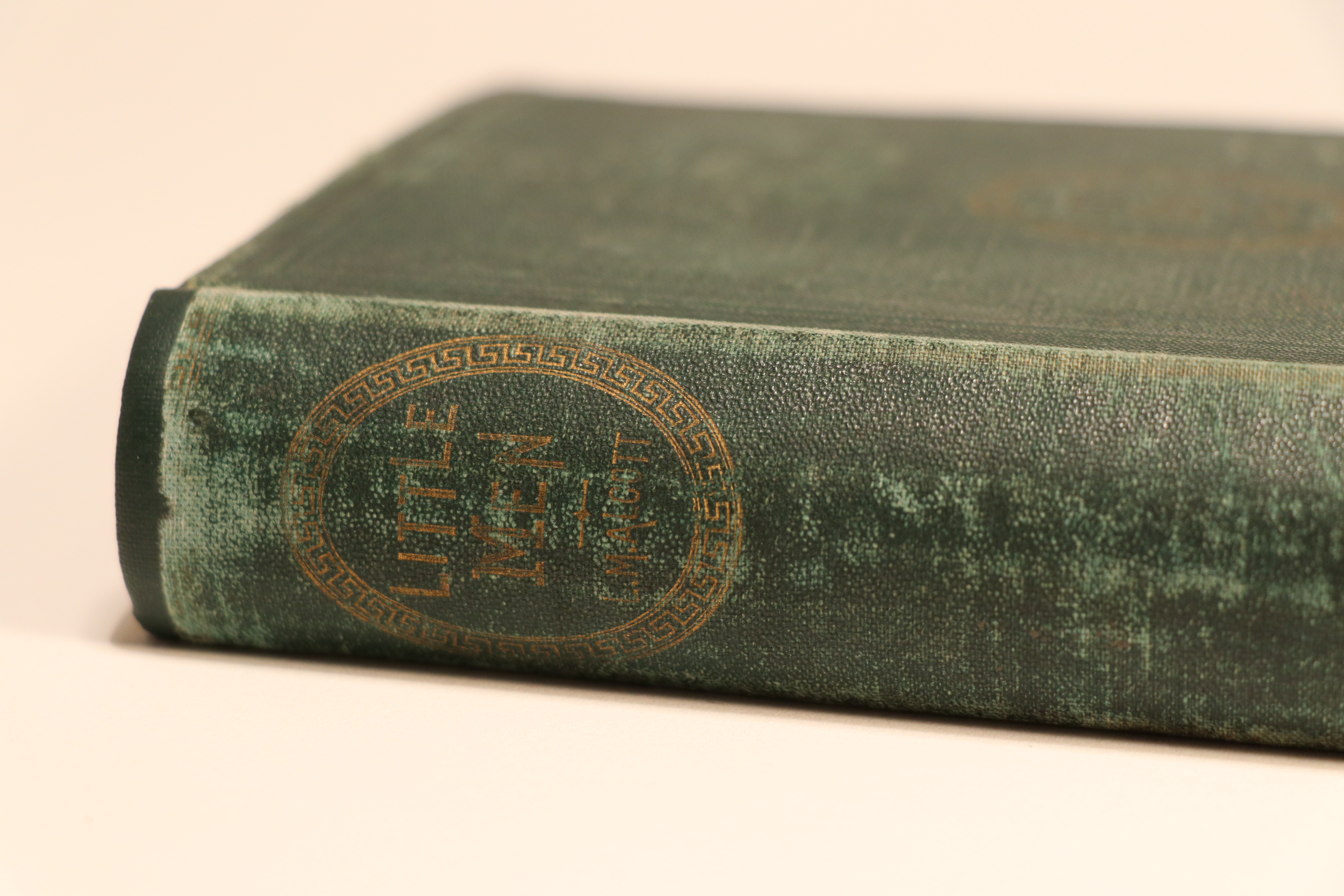
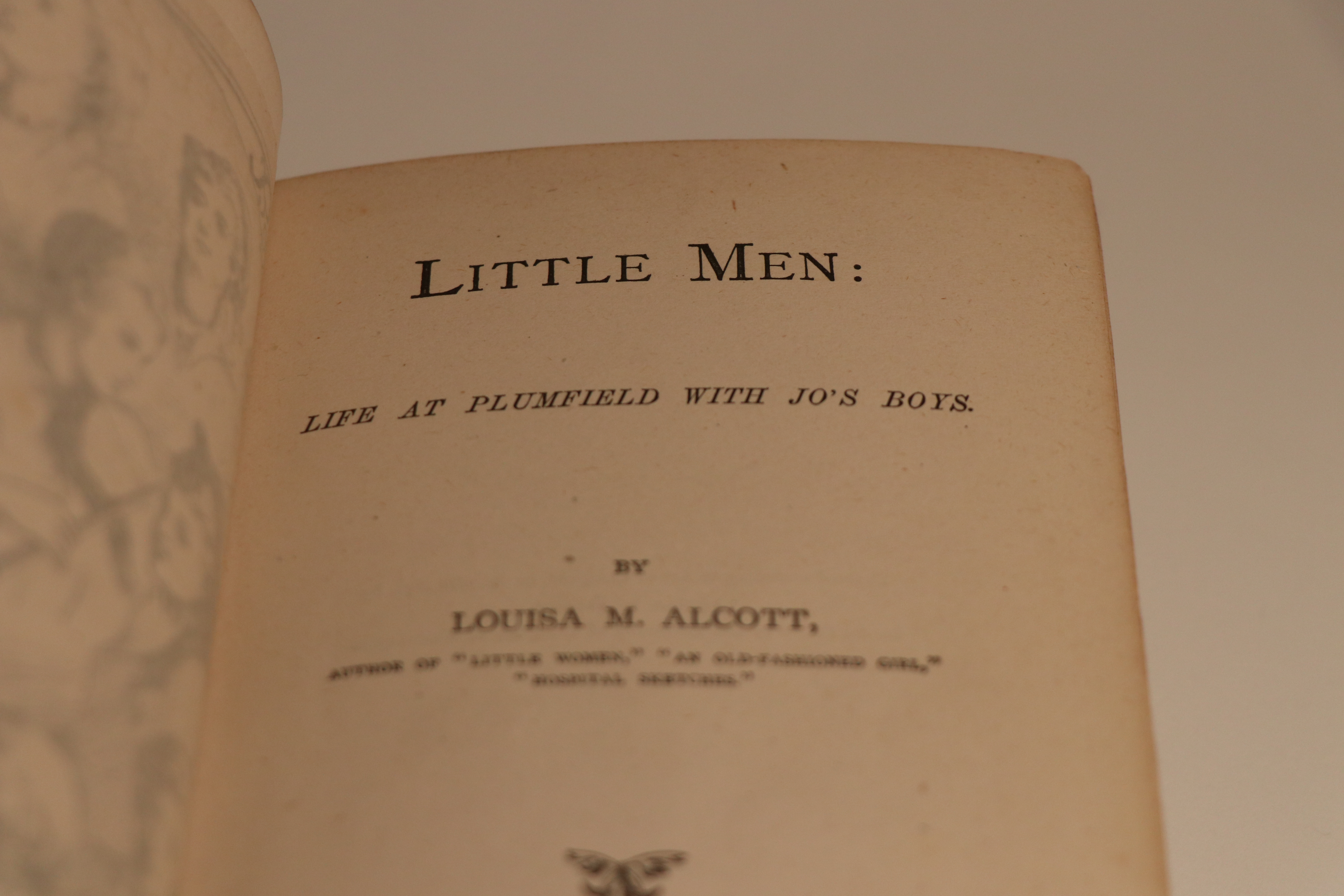
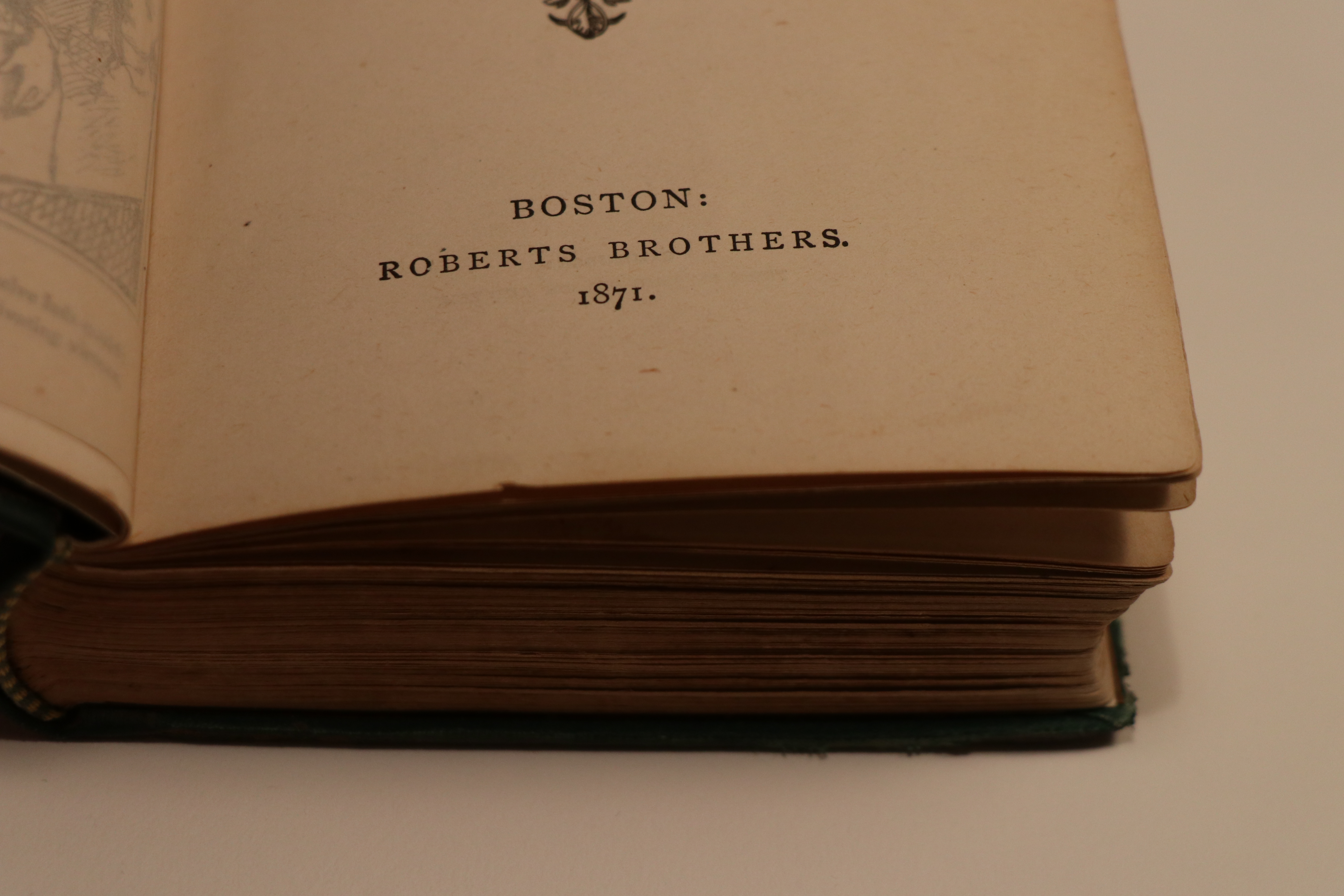
The object I have chosen to describe is my first edition copy of Little Men by Louisa May Alcott. My fascination with her novels and life started in sixth grade when I first read Little Women. I then started collecting nineteenth century editions of her books, many of which have come from New England–including her hometown–though some have even been sent to me from family in the South. This specific edition was printed in 1871 under the full title Little Men: Life at Plumfield with Jo’s Boy’s, making it the second oldest book in my collection. However, this book holds a special significance in that it is also one of my favorite stories in my collection. Additionally, it is of the same author and publishing company as most of my collection–the Roberts Brothers, located in Boston, Massachusetts. The book is five inches wide, six and three quarters inches tall, and one and one quarter inches thick, with 376 pages in total. It is a green clothbound book, though there were also purple and terra cotta books released in the first edition printing. Unfortunately, I do not remember where I acquired this specific book as I currently have 20 titles by Alcott, 12 of them under the Roberts Brothers publication.

Little Men is the second book of Louisa May Alcott’s (unofficial) trilogy, proceeded by Little Women and followed by Jo’s Boys. The narrative follows Jo and Friedrich Bhaer’s life at Plumfield Estate School where they raise and school a grouping of children–both those in the family as well as orphans. This specific edition has only one illustration found opposite the title page, which gives a portrait of each of the characters introduced in the novel.

A few other details found in this edition which I like are the advertisements printed in the first four pages. They list three of Alcott’s other books, Little Women, An Old-Fashioned Girl, and Hospital Sketches and Camp and Fireside Stories, accompanied by their prices (each are $1.50) and reviews and press statements of each novel. On the fourth page is an announcement for the “nearly ready” Harriet Beecher Stowe book called Pink and White Tyranny, also from the Roberts Brothers Publishing. I find these advertisements interesting as in most of my other books of this era and publishing, the advertisements are found at the back of the book.

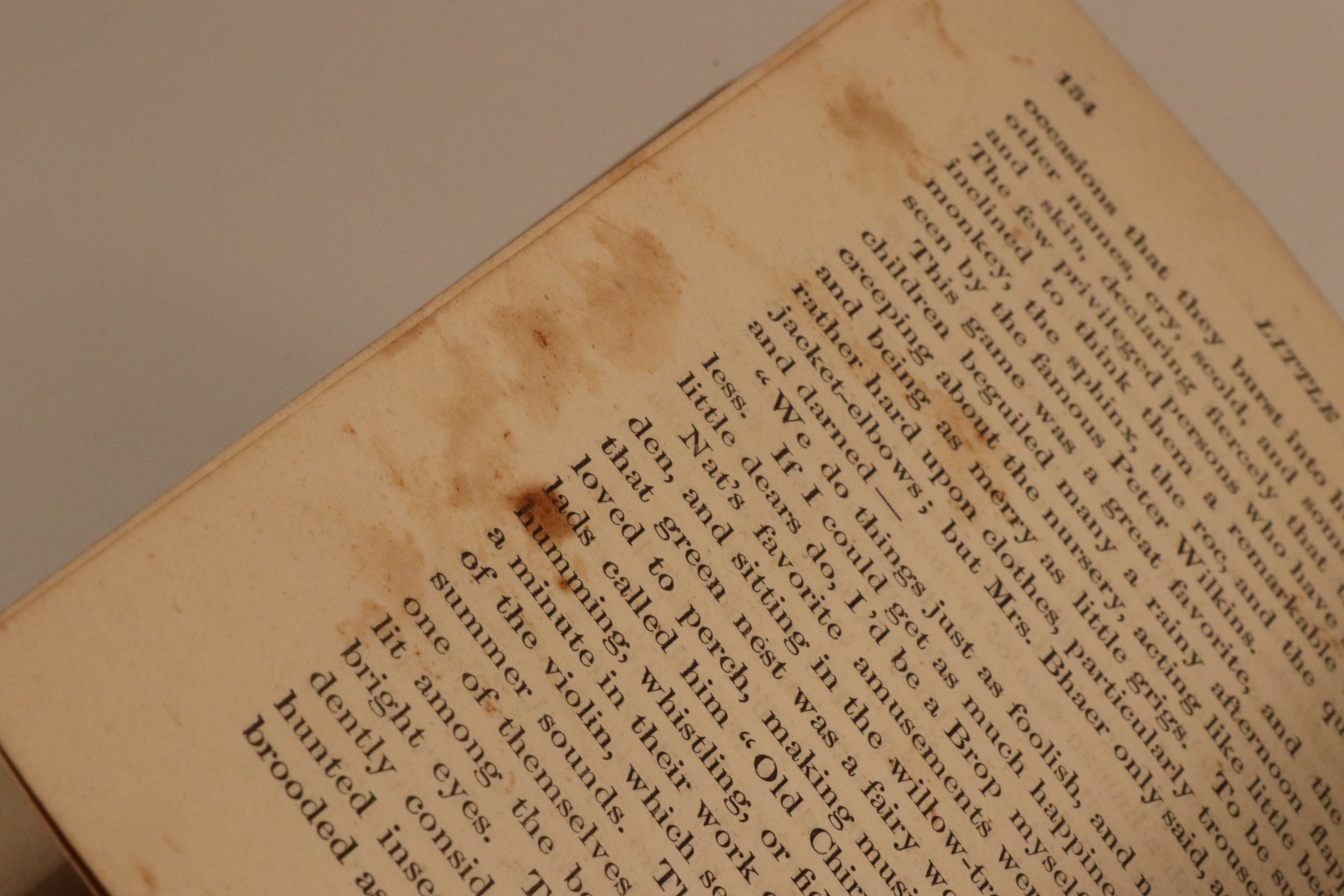
As it is nearly 150 years old, this book has some wear and tear found along the binding and along the front and back covers. There are also a few markings on the inner pages, ranging from writing by previous owners to other various stains on the pages. However, I find this book to be in surprisingly good condition for its age and popularity. Despite most collectors’ desire for their books to be in the best condition possible, I find the unique markings and acquired defects on old books to be some of the most interesting parts as it shows how the book has been passed down, used, and enjoyed. They often create a history of their own.