Only on rare occasions, does someone know the entire journey something has taken to end up in their possession. In most cases, a woman who gives birth knows where the baby came from. A gardener would know that they grew the zucchini they are eating for dinner, but may not know where the original seed originated from. When it comes to shopping, an item usually has tag. It might say “made in China” or “assembled in Honduras of U.S. components”. Finding something that is truly Made in America is a rarity. I am the proud owner of just such a product.
As a mom, I am not fussy about getting a gift for any particular holiday. My kids and husband know that if they have made the effort to pick out the perfect card, say “thank you” when warranted, and clean out the drainboard occasionally, makes for a happy mama. So imagine my surprise when my four kids pitched in on a Mother’s Day gift, purchasing a handbag I had been eyeing. Although it wasn’t a designer bag, it was still out of my price range. My purse called The Hobby, is from a company called R. Riveter. Named after Mrs. Oveta Culp Hobby of Texas, she was the country’s first secretary of the Department of Health. Education, and Welfare and the second woman to hold a U.S. cabinet position. I have carried it almost daily since 2017.

Now what makes this bag special? First, it is black and brown, the two colors I wear most often. Second, it is the perfect size (9”x 11”x 4.5”)crossbody bag. I can wear it over my shoulder, across my body so my hands stay free, or I can carry it as a clutch. Third, it is made of leather and a rugged canvas with brass fittings. It has held up beautifully, its wear adds to its lovely patina. Finally, I am able to know everything about my bag, including the women who made it, because of the amazing company from whence it hails.
R. Riveter is the brainchild of Cameron Cruse and Lisa Bradley. Being the wives of military spouses can be a rewarding yet difficult one. Many military families move a lot, in addition to coping with deployments, lack of personal family close by, and difficulty securing long term employment. The pair started with the intent of creating their own careers. It needed to be flexible and mobile for their transient lives. They decided to charge $4000 total to their credit cards, buying a commercial grade sewing machine, some canvas, and leather. They designed, created, and produced handbags, then sold them. The bags were popular and soon Lisa and Cameron needed to bring on more people to help. This is where R. Riveter became a company that was truly something special.
Their mission? “R.Riveter doesn’t hire military spouses to make handbags. We make handbags to hire military spouses, and create a greater sense of mission” (R. Riveter website). After a successful Kickstarter campaign in 2014, the 2015 opening of their first brick and mortar store in North Carolina and a presentation on the television show called Shark Tank in 2016, the business continued to grow, as did the demand for the product.
Each R. Riveter bag comes with a dog tag and a leather fob. The dog tag tells the year of manufacture. The leather fob tells us that RR053 (remote riveter), Danie, from Fort Campbell, KY, prepared the leather hides for the strap and flap of the bag. Inside the bag printed on the lining are two more stamps. RR075, liner riveter, Victoria, from San Antonio, TX, sewed the canvas lining. Lastly, RR132, Christa, from Fort Bragg, NC, is the sewing machine operator and assembler who completed the bag’s construction. Although I am awaiting a reply from the company, from what I can ascertain from the website is that all of the components in the purse are also American made. My bag was purchased directly from the website and shipped to my home. I am not sure what the shipping company was.
***I heard back from the company’s customer service person Stacy. As far as she know, R. Riveter does everything possible to source the materials for each bag from U.S. makers. The leather comes from a company called Weaver Leather which is located in Mt. Hope, Ohio.It’s been in operation since 1973. A limited edition bag that was available recently. was made from cone denim, which ended up selling out. The American company, which ran for over 100 years, was the last one to make this material in the U.S. Sadly, it closed its door recently. If she is able to pass along more information, she will.

The dog tag. 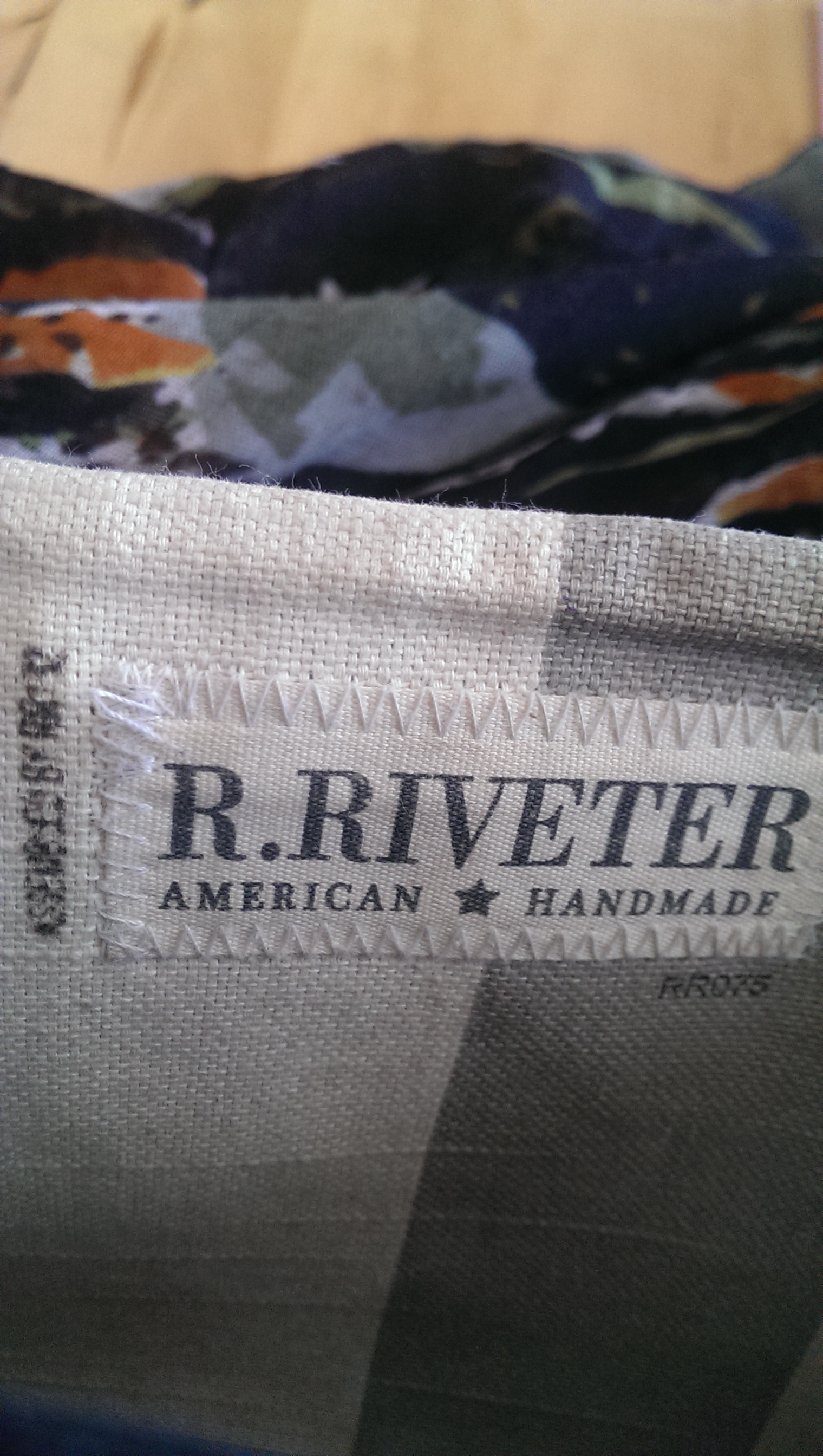
The label w/Riveter #’s.
In addition to my love for this item, I am also thoroughly impressed by the company and what it stands for. The website has a wealth of information about how R. Riveter came to be, how their mission is able to empower women and support military families, and much more. One of my sons is third generation Army. When I carry my Hobby purse, I hope I am supporting a fellow comrade of his, along with their military family. In the future, I would love nothing more to own another R. Riveter bag and continue to help those in need.
 The Materials of History, Thought, and Art
Tina, you decided to talk about a fascinating object this week. I completely agree with you on the point that people, for the most part, do not know the origins of their objects, and if an individual happens to own an object that is 100% manufactured in the United States, then it’s a rare item. The fact that you can map the entire history of the purse – the origins of the materials and the remarkable story of the company manufacturing the purse – is incredible. I can say with absolute certainty, unfortunately, that I cannot map out the history of most of my belongings. I have an idea of where my belongings were manufactured – China, Japan, and Vietnam – but it’s nowhere near as concrete as your detailed history of your purse. Overall, this was a very interesting read. Well done.
Thanks so much for your lovely comment on my blog post Chris. You made my day!