Tina Staniscia, Rachel Obergh, Brandon H., and Lilly Weilacher
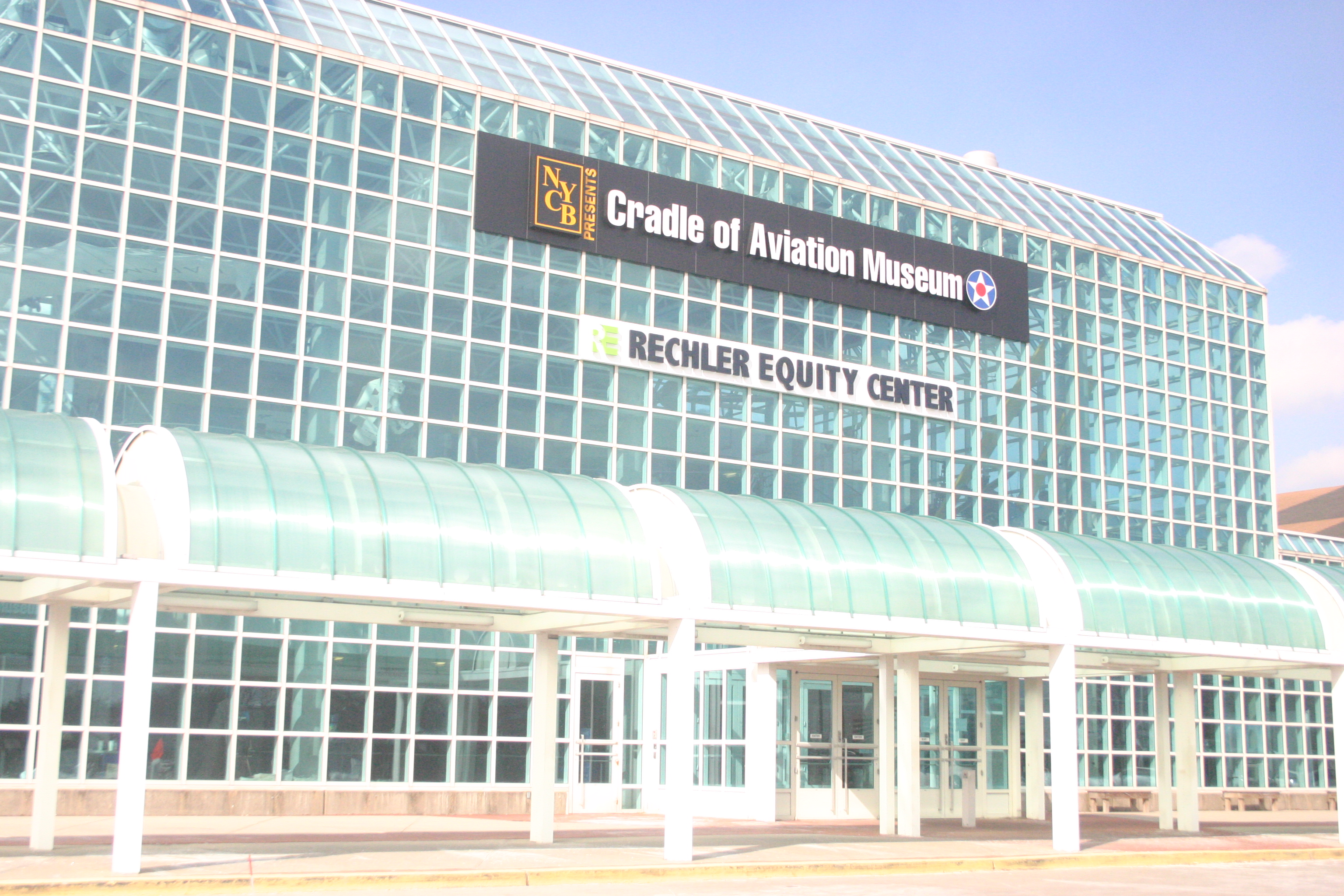
Aviation has made an impactful presence on Long Island within the past 80 years. From transportation, luxury planes and war planes, Long Island has helped change flight into what we know it as today. There has been many accomplishments and advances made on Long Island for aviation. Many famous pilots have taken off from the airfields where the Cradle of Aviation Museum now stands. During wars factories such as Grumman on Long Island helped develop and produce much of the United State’s aerial arsenal.
One of the most important factors that made Long Island so valuable for flight was its geographic features. Surrounded by the Atlantic Ocean on the Eastern side of the United States instantly made it perfect for intercontinental travel and transportation. Nassau County, the main area for take offs and landings was full flat grassy areas away from trees and buildings. The ideal conditions for a pilot to want to land on.
Many famous pilots have flown out of various sites on Long Island. The most famous being Charles Lindbergh. On May 20th 1927 he took off for Paris from Roosevelt field in his Spirit of St. Louis. It took him 33 ½ hours to fly across the Atlantic and land in Paris. With his only guide being his magnetic compass, he became the first person to complete a solo flight across the Atlantic. This was one of the many accomplishments of Long Island Aviation.
Brunner Winkle Bird

This three-seat biplane was the turning point into the Golden age of Aviation . Designed for leisure purposes, this became one of the most common airplanes flown in and out of Long Island. Many famous individuals owned one such as the Lindbergh Family. Charles Lindbergh taught his wife to fly and obtain her pilot’s license on this plane because of its reliability. This version in the Cradle of Aviation was flown by Elinor Smith. She flew around the same time as Amelia Earhart however did not get the same publicity but is known for being a better pilot. One time she flew in this plane under all the East River Bridges which was highly illegal! Although an excellent form of aircraft, production came to a halt when there was more of a need for transportation and industrial planes.
In 2004, Congress officially recognized Dayton, Ohio as the “birthplace of aviation”. This is when the Wright Brothers, in 1911, accomplished the first powered flight in the world. After visiting the Cradle of Aviation Museum on Long Island though, there is no doubt that this is where the future of commercial air transportation and the reality of space flight came to fruition.

The facility covers about 150,000 square feet and houses over 75 original and replica aircraft. On location is a planetarium, IMAX theatre, 30 seat motion simulator, and a century old working carousel right next door. Eight interactive galleries cover over 100 years of aviation and aerospace history. With how the exhibits are organized and laid out, a museum goer can get up close to just about everything on display. Since the areas within the space are in chronological order, one can really go on a journey, following and learning so much about aviation.
People of all ages are welcome. School field trips, birthday parties, and even weddings take place regularly at the museum. It is about a two hour drive from New Paltz, making for a perfect day trip. Tickets range from $9 to $20. It is open Tuesday through Sunday, 9:30 am to 5:00 pm.
As we explore the rich history of aircraft through the many eras of aviation, it is imperative that we first look back to the late eightieth century to see how this innovative drive commenced. During the peak of aviation interest during this time period, Professor Samuel Pierpont Langley (1834-1906) was one of many leading scientific figures in the United States in the early nineteenth century, well known for his advancements in aviation research. Over the course of the 1890’s, Langley had drafted and tested a myriad of different aircraft designs, most of which ended in failure. Eventually, Langley had created his new model dubbed the “Langley Aerodrome No. 5” and in May of 1896, it had managed two spectacular feats, making circular flights of 3,300 and 2,300 feet, at a maximum altitude of some 80 to 100 feet and at a speed of some 20 to 25 miles an hour.
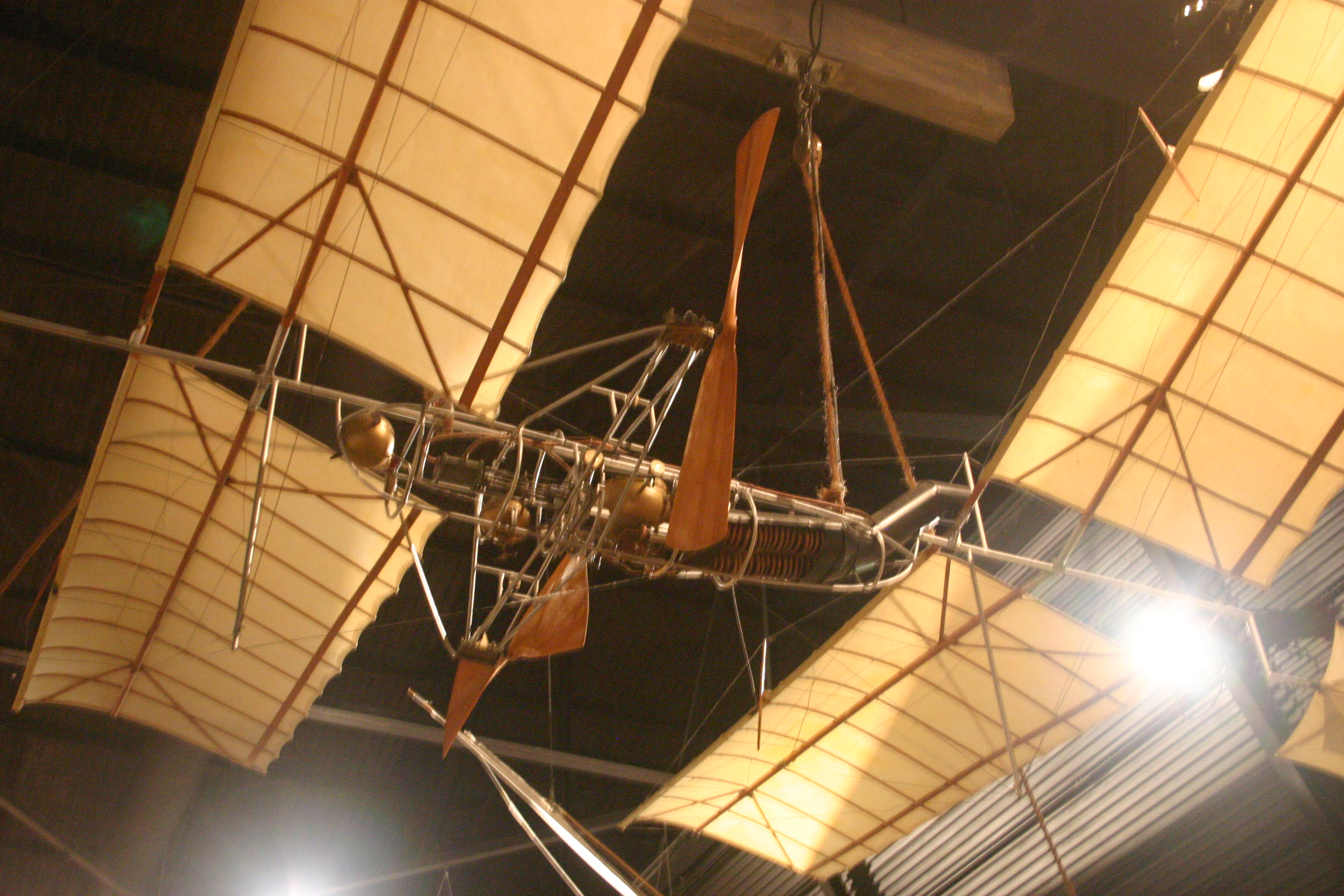
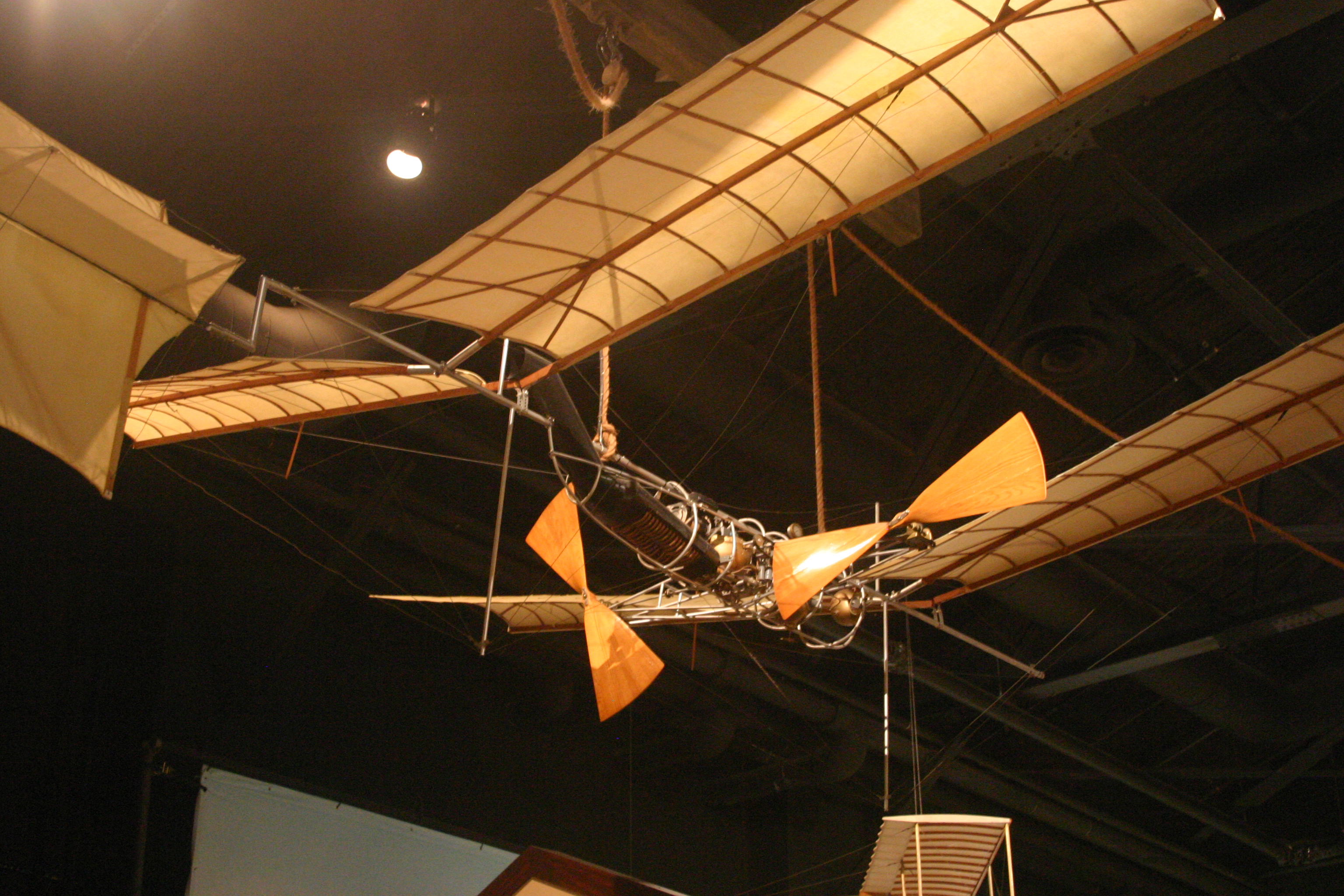
It is important to note that the model on display in the Cradle of Aviation Museum is a replica, so my physical descriptions will be based on the original model. The No.5 had a metal tube-fuselage structure that stored the boiler, engine and other components that made up its propulsion system. The wings and tail were wood-frame, covered with fine silk, that spanned 13 feet and 8 inches. Moreover, the No.5 was connected by many strings that held many of its parts together, a common feat for my aircrafts during this time period. The power plant was a single-cylinder, one-horsepower steam engine outfitted with a double-action piston with a slide valve, and a flashtube boiler fired by a pressure burner that vaporized gasoline. The engine drove twin propellers, centrally mounted between the front and rear sets of wings, through a system of shafts and bevel gears. The aircraft weighed approximately 11kg (24.3 lb) ready for flight. Although the model on display is only a replica, this object both physically and symbolically represents the passion and innovation that defined this era of aviation.
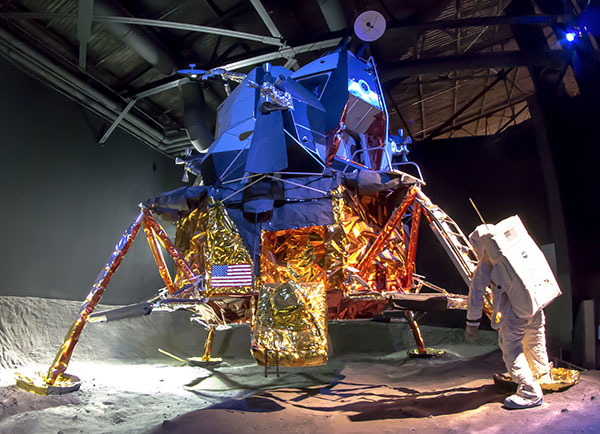
Now, moving forward almost eight decades from the Langley Aerodrome #5, we come to another piece, known as the most historically significant vehicle ever built on Long Island: the Grumman Lunar Module. This specific module on display at the museum is the LM-13, which is one of only three surviving lunar modules. The modules were part of a larger project initiated in 1962 known as the Project Apollo Lunar Module, of which the Grumman Corporation was at the head. This craft would have had the ability to release from the Command Module and land on the moon, and then return to the Command. In its physical appearance, the lunar module seems quite simple from the exterior, being designed for neither impressive attractiveness nor aerodynamics. It measures to about 23 feet in height and 31 feet wide, weighing 8,600 pounds. Though this module still exists because its intended mission–the Apollo 19 journey to Copernicus Crater in 1973–was cancelled, it would have had the potential to reach 17,500 miles per hour. The craft is made up of very light and thin metals which was necessary for it to reach it destination without consuming a large amount of fuel. The exterior is covered in golf, silver, and black thermal shielding. Though this is an object which was an example of the immense advancements in technology and innovation, it is also a representation of the drive of discovery and spirit of aviation.
Bibliography
“The Brunner Winkle Bird at the Cradle of Aviation Museum.” Cradle of Aviation Museum, http://www.cradleofaviation.org/history/history/aircraft/brunner_winkle_bird.html.
“Charles Lindbergh Collection.” Missouri Digital Heritage Hosted Collections, cdm16795.contentdm.oclc.org/cdm/landingpage/collection/p16795coll12.
“Cradle of Aviation Museum.” Cradle of Aviation Museum | New York Heritage, nyheritage.org/contributors/cradle-aviation-museum.
“Cradle of Aviation Museum, Garden City, Long Island, NY 11530 • 516-572-4111.” Cradle of Aviation Museum, http://www.cradleofaviation.org/.
Cradle of Aviation Museum. Langley Aerodrome #5 at the Cradle of Aviation Museum. 2019, http://www.cradleofaviation.org/history/exhibits/exhibit-galleries/the_dream_of_wings/langley_aerodrome.html.
Gray, Carroll. “Samuel Pierpont Langley.” FLYING MACHINES – Samuel P. Langley, 2015, http://www.flyingmachines.org/lang.html.
“Grumman Lunar Module LM-13 at the Cradle of Aviation Museum.” Cradle of Aviation Museum, http://www.cradleofaviation.org/history/exhibits/exhibit-galleries/exploring_space/grumman_lunar_module_lm-13.html.
“Long Island, New York’s Cradle of Aviation Museum Celebrates the Rich Heritage of the Region.” Warbirds News, 2 Aug. 2013, warbirdsnews.com/warbird-articles/long-island-yorks-cradle-aviation-museum-celebrates-rich-heritage-region.html.
McFarland, Stephen L. “A Concise History of the U.S. Air Force.” 1997, p. 2., http://www.upload.wikimedia.org/wikipedia/commons/7/71/A_Concise_History_of_the_U.S._Air_Force.pdf.
“Milestones:Grumman Lunar Module, 1962-1972.” Milestones:Grumman Lunar Module, 1962-1972 – Engineering and Technology History Wiki, 2011, ethw.org/Milestones:Grumman_Lunar_Module,_1962-1972.
National Air and Space Museum. Langley Aerodrome Number 5. 21 Feb. 2019, http://www.airandspace.si.edu/collection-objects/langley-aerodrome-number-5.
Stoff, Joshua. Historic Aircraft and Spacecraft in the Cradle of Aviation Museum. Dover Publications, 2001.
 The Materials of History, Thought, and Art
You must be logged in to post a comment.