Creation: As humans we will never truly be able to see ourselves with our own eyes, we will only ever be able to see a reflection. Cavemen since the beginning of time used puddles, observing their reflection as something of magic. With evolution, mirrors were made of polished stones, eventually after the secular desire to see a reflection was understood, varying techniques to achieve this were implemented in different countries. Ultimately, the final and most successful process involved coating glass with a metallic silver. As society became more established and advanced, mirrors became an object richly sought after, used both for practical purposes and as demonstrated through ornate and intricate framing, as decorations. This Federal style mirror located on Historic Huguenot Street in New Paltz, New York can be found in the Deyo House Federal Bedroom.

This Federal Style Mirror sits in the corner of the Federal Bedroom in the Deyo House on Historic Huguenot Street in New Paltz, New York. Its Federal Style featuring a gold eagle or pheasant wide spread across the top is reflective of America’s newfound stature in 18th century as a sovereign and strong United Nation. Though this piece is fairly small it is largely representational as a glimpse into this period in time.
Physical Description: This rectangular shaped mirror measures 35 inches in length and 16 inches in width. The frame is made of a rich colored wood, possibly mahogany, that surrounds the glass mirror piece, which is inlaid in the center of the wood. The very inner edge of the frame that is in direct contact with the glass itself is painted gold, though it difficult to distinguish due to years of wear. The wood has fretwork carvings on the top and bottom. The carvings resemble flames or torches on the top, which can be seen as symbolic of power. It is clear this wood was carved by hand due to the imperfections of the carvings. Upon close inspection, the carvings do not exactly mirror each other on either side and are not perfectly sanded, with a rough edge to them, reflecting further that this frame was created by hand.
The top of the mirror features a three-dimensional gold eagle or pheasant with its wings spread broadly across the wood. The Federal era lasted roughly from 1780 through 1830 in the United States and furnishings created during this period were heavily influenced by Greece and Rome (Thurlow 2009). After the Revolutionary War and the Treaty of Paris, the United States was recognized as a sovereign nation. The eagle then became a symbol of unity — an expression for Americans to be recognized in their own way with their own values (Liebster 2012). Having a mirror in your home with this type of symbol further emphasized the sense of American Patriotism that existed within the home.

The Gold Eagle/Pheasant Spread Proud Upon the Mirror.
Provenance: This mirror has provenance with the Elting family who actually lived on Huguenot Street, so it has existed in New Paltz for quite some time. The donor of the mirror to Huguenot Street was Helena LeFevre. When she passed away in 1965, she left the mirror to Historic Huguenot Street (2013). She was a member of the Huguenot Historical Society; her donation of her things to the society paying great homage to her passion for historical preservation. Her receipt of donation entailed that the mirror belonged to Magdalene Elting LeFevre, daughter of Roelof Elting and Mary Louw, wife of Peter LeFevre with whom she had ten children.
Narrative: Magdalene Elting LeFevre was born on February 22, 1766 and died March 10, 1823. She lived in the Bevier-Elting house on Huguenot Street while she was growing up. Her father, Roelof was sentenced to prison and then exiled for refusing to accept Continental currency from a customer in addition to a land dispute. In Roelof’s absence, two of his daughters passed away. Without a father present, Magdalene had to suffer through losing two siblings. A traumatic experience for any individual, as loss is something difficult to understand, especially at a young age.
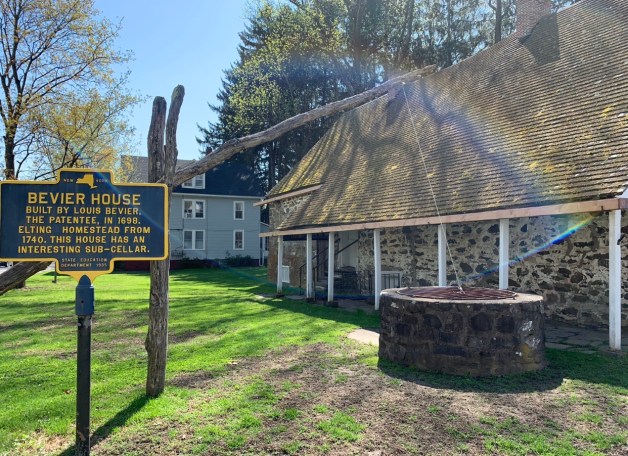
The Bevier-Elting House. 2019.
Magdalene went on and married Peter LeFevre in 1789, where they lived on the Bontekoe farm in a stone house. According to Peter’s tax records, he ranked in the higher end of the middle-income tax bracket, though his stone house was fairly run down. It is difficult to say exactly when or how Magdalene came to own this mirror. However, it can be surmised that it was a wedding gift to Magdalene and Peter, or perhaps she came to own it through an acquisition of a similar nature. Though, there is no accessible information to be certain of this. This suggests the level of financial comfort which Magdalene and Peter lived with.
Further emphasizing Peter and Magdalene’s comfort was the fact that they owned three slaves. According to the 1798 census, Peter owned three slaves, whom were not subject to taxation. This means they were either children under twelve years of age, or that they were older than fifty. There are documents that define one of Peter’s purchases of Molly, in 1798. Were Peter and Magdalene living beyond their means? Had they purchased slaves that they could not afford, as suggested by the run down condition of their home? Peter and Magdalene’s owning of slaves while the mirror was in their home, paints a vivid picture of the time in history this mirror was a part of. A nuanced definition of American Patriotism can further be applied to the owning of the mirror. The eagle/pheasant represents American Patriotism, but it is clear that part of their American values at this time included owning other human beings.
This mirror was likely displayed in a room where Magdalene and Peter’s guests would see it. This is because it was a reflection of their American values, ones they were prideful in. In this same room, one of the slaves they owned would likely have been responsible for maintaining the condition of the mirror.
“Molly, please see to it that the mirror is in pristine condition before this afternoon, we have guests coming.” Molly then would make her way to the room where the mirror was hung on the wall and have no choice but to stare at her own reflection as she wiped it down. It is not difficult to imagine the brutality felt by a human being who is owned, being forced to look at their own reflection while serving their owners. The reflection seen by Molly was one that forced her to embody the bitter reality that she was purchased by these people as property and existed to serve them. The reflection seen by Magdalene and Peter, or their guests was much different. Looking into the mirror they saw themselves and became enveloped by a sense of American pride and patriotism. Reflective of the attitudes of this period, where the owning of slaves was not given a second thought.
While there is not substantial information available about this mirror specifically, other than its chain of ownership, the stories of its owners and their trials and tribulations are highly reflective of the period in time this mirror was owned. This mirror stands in the Deyo Federal Bedroom as a reflection and encapsulation of life in 18th century New Paltz.
References
“Bill of Sale for Molly to Peter Lefevre : Historic Huguenot Street.” Hudson River Valley Heritage, hrvh.org/cdm/singleitem/collection/hhs/id/633/rec/6.
“Helena S. LeFevre.” Findagrave.com, Poughkeepsie Journal , 22 Oct. 2013, http://www.findagrave.com/memorial/119140830/helena-s_-lefevre.
Liebster, Amy. “Eagles After the American Revolution.” Metmuseum.org, June 2012, www.metmuseum.org/toah/hd/eagl/hd_eagl.htm.
“Peter and Josiah P. LeFevre Family Papers: ‘The Bontecoe LeFevres’ (1703-1937).” Historic Huguenot Street, http://www.huguenotstreet.org/peter-and-josiah-p-lefevre-family-papers-the-bontecoe-lefevres.
“Tax Roll, 1779 : Historic Huguenot Street.” Hudson River Valley Heritage, hrvh.org/cdm/compoundobject/collection/hhs/id/3027/rec/86.
Thurlow, Matthew. “American Federal-Era Period Rooms.” Metmuseum.org, Nov. 2009, http://www.metmuseum.org/toah/hd/fede/hd_fede.htm.
 The Materials of History, Thought, and Art
You must be logged in to post a comment.