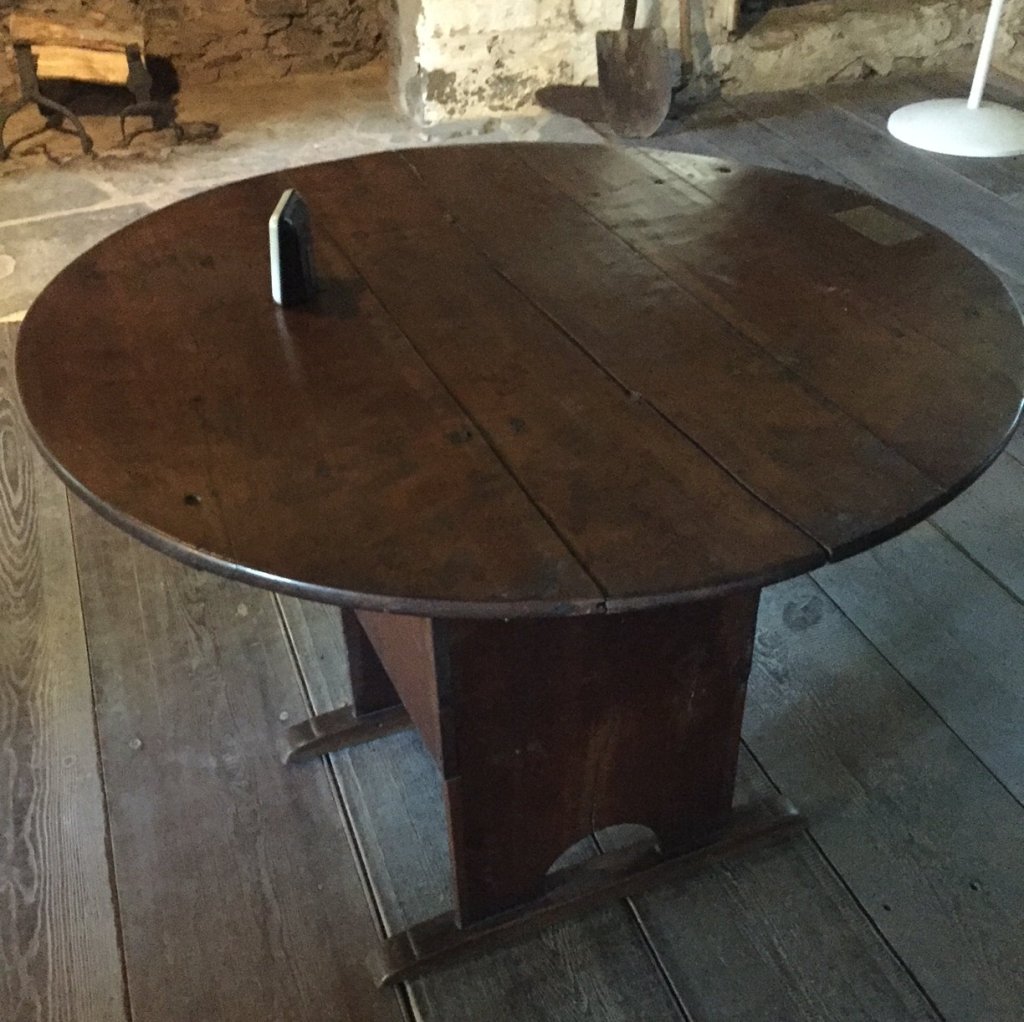
Pictured above is a piece of furniture that serves a dual function as both a table and a chair. Known as a hutch table, it has a top that can either be flipped up or removed to reveal a convenient place to sit for the user. It is a very effective piece of furniture when it comes to saving space and convenience.
When exploring Huguenot Street and all of the historic objects it holds, I was immediately drawn to a piece of furniture within their collection. The object appeared to be a table, but upon looking closer, I found that it also functioned as a chair. I was informed that it is called a hutch table. It serves the purpose of a table when the top is down, and then when the top is flipped up, the chair portion is revealed. The duality of use for this piece of furniture is something that does not appear as often in today’s consumer society. However, the space saving aspect of its functionality is still prevalent.
Description
Generally speaking, hutch tables are a piece of furniture that serve the purpose of both a chair and a table. The specific table being presented is wooden with a round table top attached to a square base. While it is known that the Tilson Hutch Table at Huguenot Street is made of wood, the wood is not specified. According to Common Sense Antiques by Fred Taylor, it is likely made of a “soft wood” such as pine. The table top is split down the center by a large crack. Some discoloration has occurred, though not much, which leads to the belief that this hutch table has been refinished since its original creation. There are a variety of chips and scratches on the surface of the hutch table. On the round top, there is a rectangular metal plaque that is about the size of a credit card. There is an inscription that reads, “Job and Esther Freer Tillson/ Presented by/ O.J. Tilson II/ 1968”. When in the table position, the hutch table measures 39 inches in length and 29 inches in height. The square base rests on feet with an arch and long supports, known as shoe feet. The top is connected to the base by a hinge that allows the top to tilt up and form a chair. There is also a knob that allows the table top part to be taken off (Trainor).

Provenance
The specific hutch table which caught my attention came to reside on Huguenot Street through the donation of Oliver J. Tilson. It resides in the Bevier House Cellar Kitchen. The hutch table was donated in 1968. This piece of furniture is far from the only object donated by Oliver Tilson. He donated enough objects for an entire room to be deemed the Tilson room. The original owners of the hutch table were Esther Freer Tilson and Job Tilson. Esther lived from 1778-1851 and Job lived from 1766-1853. The hutch table was owned by the couple during that period of time. Together, they had four children, and the donor of the hutch table, Oliver Tilson, was one of their descendants.
Narrative

Picture this: You enter the main room of your home in New Paltz, New York after a long day. You want to sit down. You spot your hutch table still in the table position from breakfast this morning. You flip the table up and take a seat in the too small chair that forces you to sit in a terribly uncomfortable manner, though with great posture. You look regal with the background of a table top behind you, and the wind is being blocked from your face with little effort. You have tons of leg room because there is no table in your way.
While the description above may not be a scene one would see in a house today, it does reflect furniture used in homes during the 19th and early 20th centuries. In the late 19th century, multi-use furniture rose to popularity. One furniture purchase for a multitude of uses sounded like a phenomenal concept. This trend can be seen with cabinet beds, murphy beds, and more (Safford). However, this double function can be traced back to the late 17th century. Dual functioning furniture can be seen with the chair table, or the hutch table. One purpose behind this furniture concept is storage (Taylor). Storing a table vertically takes up significantly less space than if it were placed horizontally. Another purpose of the hutch table, when in the chair position, is that the vertical table top blocks the wind from the user, as colonial houses are not as air tight as houses now, the wind was likely prominent indoors (Taylor). While this furniture can be referred to as having a dual purpose, a table and a chair, it provides many more, such as the two listed above.
Hutch tables can range from simple to extravagant, though they all have the basic structure of a base and a top. In many cases, the top can be removed. Despite the varying degrees of affluence, the majority of furniture in the colonial period was expensive, and, therefore, a luxury. It is important to note that this expense did not mean that the furniture would be comfortable. One purpose was actually the opposite of comfort. In order to look of a certain status, the uncomfortable furniture would force people into with a “properly respectable and refined posture” (Crowley). It would also frame their clothing in a way to add to this refined look.
Space saving furniture was popular in colonial households, as there was often a lot of people in a small amount of space. Another example of space saving furniture popular at the same time as the hutch table is the leaf table. A leaf table is a table with a removable piece of wood that can be added to lengthen the table when more people will be using it. However, while the hutch table is no longer prominent in society, the leaf table is still commonly used to this day. It is possible that the death of the hutch table is due to the lack of need in modern day society for some of its many functions. Houses are no longer drafty to the point of needing to block the wind with a table, or at least not commonly, and comfort is valued more.
Comfort is a key factor for many modern day people when it comes to purchasing chairs. This focus can be seen in the creation of arm chairs, rocking chairs, and recliners. However, in the nineteenth century, as long as a chair “suggests lineage, hospitality, and good taste in the owner, it is much sought after and universally admired” (Modern Chairs). With this shift in societal comfort standards, the disappearance of the hutch table can be seen. While a direct connection between the two is not concrete, it is definitely a possibility.
In any case, hutch tables and their variety of functions can give us a glimpse into the lives of those who lived in colonial society.
Works Cited
Crowley, John E. “The Sensibility of Comfort.” The American Historical Review, vol. 104, no. 3, 1999, pp. 749–782. JSTOR, www.jstor.org/stable/2650987.
“Modern Chairs.” The Decorator and Furnisher, vol. 23, no. 1, 1893, pp. 29–30. JSTOR, www.jstor.org/stable/25582554.
Taylor, Fred. “TRUE MULTI-PURPOSE FURNITURE: The Hutch Table.” Antique Shoppe Newspaper, vol. 32, no. 1, Sept. 2018, p. 12. EBSCOhost, search.ebscohost.com/login.aspx?direct=true&AuthType=ip,url,uid,cookie&db=vth&AN=131678647.
Trainor, Ashley. Personal Interview. 18 April 2019.
Safford, Francis Gruber. American Furniture in the Metropolitan Museum of Art. Vol. 1, New Haven, Conn. ; London : Yale University Press, 2007.
 The Materials of History, Thought, and Art
You must be logged in to post a comment.