Caption: Kasten are very interesting objects, but not something you would find in many common households today. They were large, spacious objects that were typically owned by people classified to be wealthier. Part of the reason for this is that they were very difficult to transport because of how large they are in size. Typically, they held expensive linens and cloths as well. They were central to domestic life in colonial New York, serving a utilitarian function as the primary storage for linens and furnishing many American homes (Hudson Valley Kasten). Having these Kasten as furniture not only signified the owner’s heritage, but also demonstrated their wealth and social status. There is limited literature published on Kasten. There is even confusion over the terminology used to describe this piece of furniture. At the time of its origin, English was the mandated language of government decisions. Therefore in the most contemporary wills and inventory of objects from this historic time period, they were referred to as “cupboards.” However, cupboard is a very generic term for any generic wooden case piece with doors. The specific functions that people used these kasten for were made unclear in wills and inventories, so they’re uses range (American Kasten). Kasten are one of the many objects that the Dutch contributed to the American culture.The terms kas and kast, were used interchangeably in the seventeenth and eighteenth century. The term attempted to survive throughout the centuries, but regardless was reintroduced to the general public by the early historians of American furniture. Kasten have been recognized as a feature of colonial New York furniture since their first formal studies in the field. There was even later association made in 1900 by Singleton identifying kasten as possessions of New York Dutch families (American Kasten).
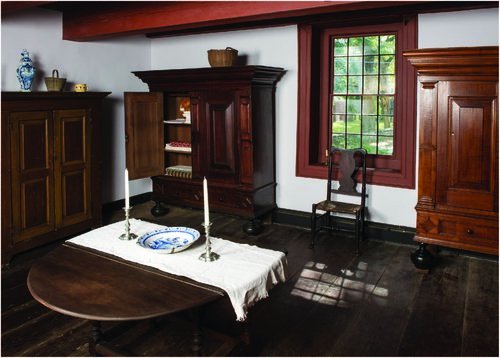
Physical Description of the Object: The Kas in particular that I chose to work with is described as being, “early 18th century Red gum and pine” (Hudson Valley Kasten). It is 75 ½ x 25 ⅝ inches. Kasten, in general, are characterized to be mid-18th century Dutch style cupboards. Variations in design can exist, however, they usually are large, free standing cupboards. This one in particular has, “two-paneled doors surmounted by an over-scaled cornice” (Hudson Valley Kasten). They typically stand on ball shaped feet and a drawer. The drawer of this Kas is decorated with diamond shapes, which could have been attributed to symbolizing wealth.
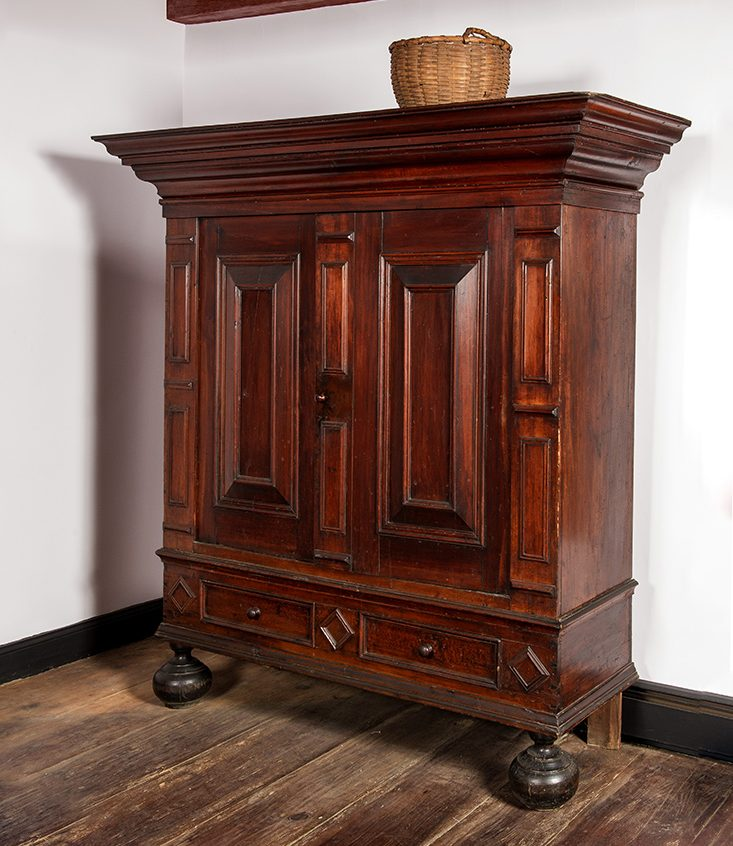
Narrative: Nowadays girls dream about walk in closets. People’s wealth is sometimes determined by how many shoes line the walls of their walk in closet, or even how many different closets a person has for the different items they possess. However, as much as they need space to put their belongings, you need space for the closet as well. Often walk in closets make sense. A great storage place for all of your personal objects, yet doesn’t take up space within your bedroom. Who wouldn’t want one? Now picture a big, clunky, expensive cupboard taking up half your wall. They’re expensive, symbols of wealth, yet no longer sound as desirable, however, these furnished many Dutch-American homes during this time period. Closets are seen more for their function than for their appearance. Back then, it was more for their appearance than their function. These Dutch immigrants, “concerned themselves much more with domestic economy than with public government” (The ‘Kast’). This cupboard was one of the most important pieces of furniture for these Dutch settlers because it not only held all of their most tangible treasures, but, “Dutch notions of domestic life as well” (The ‘Kast’). These new homes they were establishing were trying to mimic the flourishes they had left behind. Nowadays it seems we are more focused on the quantity of our objects rather than the quality. We are never satisfied with what we have, but always want the latest and greatest, or to be able to say you have it all. In this time period their culture reflects a similar mindset, but a different means of execution. They didn’t have the space and housing we do today to have as many objects as we fill our houses with today. For them, it was about what they had to symbolize their wealth. Items like Kasten, to show their connections to their flourished heritage.
Provenance:
The Kas in particular that I chose to work with was from the Historic Huguenot Street Permanent Collection. It has been attributed to the Elting-Beekman Shops in Kingston, New York. Within these local areas surrounding Kingston, there were many people making Kasten at the time. There were were two families of craftsmen that are known of in Kingston, New York. These families were the Eltings and the Beekmans.This Kas in particular was one of the earliest examples attributed to many of the workshops in these areas, like the ones owned by the Elting and Beekmans. Along with its ties to these early craftsmen families, it is also reported to have connections to both the Hasbrouck and the Hardenberg families of Ulster County.
References:
“Historic Huguenot Street Permanent Collection, Gift of Innis Young.” Hudson Valley Kasten, 31 Oct. 2018, hudsonvalleykasten.org/portfolio-items/innis-young/.
“Hudson Valley Kasten.” Hudson Valley Kasten, hudsonvalleykasten.org/.
Metmuseum.org, www.metmuseum.org/art/metpublications/American_Kasten_The_Dutch_Style_Cupboards_of_New_York_and_New_Jersey_1650_1800
“The ‘Kast’.” AMERICAN HERITAGE, http://www.americanheritage.com/kast.
 The Materials of History, Thought, and Art