During our class tour of the Huguenot Street houses, I took great interest in the Deyo House. Since I live in a home that was built in 1871, a brick Victorian located in the City of Poughkeepsie. Know a little … Continue reading →
Late 18th century silver teaspoons crafted by Tunis DuBois, a skilled silversmith who defied the standards and took pride in his work, and his customers
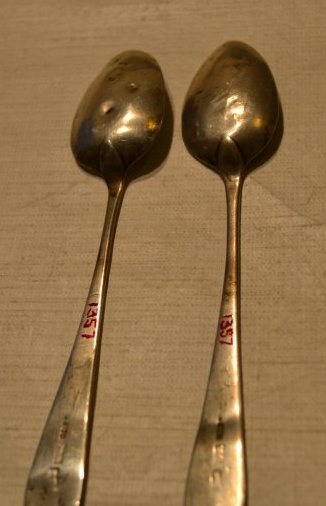
The object that I’m analyzing is a pair of silver teaspoons made by Tunis D. DuBois, a descendant of the original Huguenot family. He was a silversmith based out of New York City. At first glance, this pair of teaspoons doesn’t seem too significant. The story of their use are displayed by the worn and battered look of the handle and oval bowl of the spoon. These spoons were probably made just for utilitarian purposes, but these little marks tell a deeper story. They reflect a time when our items were still custom-made, before mass production and manufacturing. The maker would leave little hints, traces, messages on their products—a proud symbol to accredit their work.
Physical
Description:
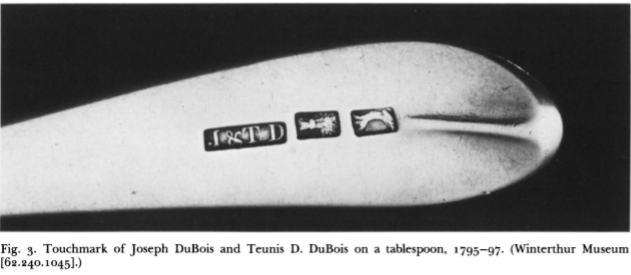
The teaspoons are made out of silver and are 5 and a half inches in length. They have a pointed oval bowl and a pointed arch drop. The space between the spoon’s oval and its handle becomes very narrow, before opening back up into a straight oval handle. On the handle on the front part of the spoon is a simple pattern, a few straight line indents made, one on top of the other, that get smaller as they move up the handle towards the narrow stem, with smaller indented lines coming off of the main ones. This pattern is reminiscent of a plant or flower, which relates to DuBois’ signature wheat sheaf. The teaspoons aren’t in perfect shape—but that’s the point. The bowl is worn and dented, and the silver is tarnished. However, these imperfections are what give these teaspoons character. They weren’t “perfectly” made by a machine in a factory. They required time and labor—they were touched, molded, and crafted by human hands, back when we put a little piece of ourselves into our items. These teaspoons serve as an index—they contain an evidentiary quality that marks a trace of the real—the hands of the maker. DuBois left his signature on the back of the handle of the spoon with three rectangles. One with his initials, TDD, and two wheat sheafs in the other two rectangles. The wheat sheaf symbol typically represented harvest, fertility, and a long life. This was a popular motif to be used at the time (Laidlaw, 42). These marks can be seen on other works by DuBois. The teaspoons reflect a time when quality products were created with care and a unique touch.
Provenance:
These teaspoons were donated by Muriel Pulver, a
resident of Rhinebeck. She was born in 1897. Her mother was Magdalena Elting—the
Elting’s are another prominent New Paltz family. They weren’t one of the
original 12 patentees, but their family intertwines with the founders, and “in
almost any one of the original families one finds a connection with the Dutch
Elting,” (Bevier-Elting Family Association). Magdalena was born in 1872 to
Phillip and Harriet Hasbrouck Elting, and was a New York City native, before
residing in Ulster County. This family donated a lot of items, so it can be
surmised that they were collectors. The year range for these items is estimated
between 1796 and 1799. (Historic Huguenot Street Permanent Collection).
Narrative:
The Huguenots were known to be skilled craftsmen.
However, when they were residing in France in the late 17th century,
the patronage of goldsmiths was forbidden by King Louis XIV (“The Huguenot
Silversmiths of London”). Around this time is also when King Louis XIV revoked
the Edict of Nantes, the document that maintained most of the Huguenots’ rights
in France (“Huguenot”). The renewed persecution against the Huguenots led to a
mass migration from France to London, where they joined a network of persecuted
craftsmen that was already beginning to take shape (“The Huguenot Silversmiths
of London”). The first two generations of craftsmen in London represented different
styles and appealed to different audiences—the first generation made products
for the aristocratic class and began to earn a reputation, whereas the second
generation craftsmen appealed to a wider audience, including other craftsmen,
and they were able to achieve an even greater reputation (“The Huguenot Silversmiths
of London”). The Huguenots took pride in their work, and valued their peers
whom they made their products for—“The network which the Huguenot silversmiths
maintained amongst their own community and the care with which they nurtured
their patrons, created a monopoly which provoked a hostile reaction from native
silversmiths,” (“The Huguenot Silversmiths of London”). The native smiths began
to take on Huguenots in order to sustain their business. The silversmith in our
narrative, Tunis Dubois, carried out a similar style of interacting with his
customers. DuBois’ records show that he made silver products for a consistent
base of customers, and for fellow silversmiths as well (Laidlaw, 28 & 35).
The Huguenots also found their way into other parts of
Europe and America, where they established themselves as craftsmen as well.
They were able to freely worship and carry out their skills as artisans. The
Huguenot silversmiths that moved to America began to diverge in their style.
Their work is “usually very simple and lacks the ornate decoration and details
of execution characteristic of French silver during the first part of the 18th
Century,” (Ormsbee 2009). This can be seen in DuBois’ teaspoons, which contain
just a few ornamental details, but is more functional than decorative.
Tunis DuBois was born in central New Jersey, in Freehold Township, in 1773. His father, Benjamin DuBois, was a reverend of mixed Huguenot and Dutch descent, which can serve as an explanation for DuBois’ affinity to be a silversmith, as this craft was popular among these groups. Especially among the Dutch, solid silver spoons “were considered very precious objects” according to George Way, a well-known collector and author of 16th-17th century Dutch and English furniture, paintings, and decorative objects (“NEWS RELEASE: HHS Holds Closing Reception with George Way”). Way discusses that these spoons were not only highly regarded as works of art in their own right, “but were an indication of great wealth.” It’s part of Dutch custom to give spoons to mark births, deaths, and other momentous occasions (“NEWS RELEASE: HHS Holds Closing Reception with George Way”).
Tunis and brother Jospeh DuBois signature on abck of spoon, with wheat sheaf and bird’s head pseudohallmarks.
What sets DuBois apart from the rest, was his business
model—one that could be seen as being ahead of his time. He produced his goods
to be sold on a wholesale basis. (Laidlaw, 25) This, of course, was before the mid-19th
century industrial boom, when manufacturing goods like this was the new form of
production. However, DuBois was still able to maintain his craftsmanship and
leave his unique mark on each good, while selling to a larger audience. He
followed the footsteps of his brother, Joseph, and moved to New York City to pursue
a profession as a silversmith. Soon after, Joseph took him on as a junior
partner, and they began to create hollowware and flatware pieces together.
Among their more intricate pieces were a neoclassic cruet stand, a sugar bowl,
and a teapot. For most of his career as
a silversmith, DuBois’ business was successful. However, the yellow-fever
epidemic in 1798 began to take a toll on his business, and he decided to move
back to New Jersey, where he acted as both a farmer and a silversmith. This did
not deter DuBois to continue his profession. He was still a successful
silversmith miles away from New York City—he increased his wholesale sales to
his highest levels thus far and continued to attract new customers from the
city. DuBois did all this, while still maintaining local business, although
these sales made up a smaller portion of his work. Dubois was different than
most rural smiths, who tended to only make products for their local customers,
whereas he sold his products to shops in New York City. However, where DuBois
aligned with his fellow rural smiths was in the manufacture of spoons, which
made up almost his entire production. Spoons were almost entirely made by village
and small-town silversmiths, as they appealed more to the rural audience than hollowware,
which would be commissioned by silversmiths in the city. Dubois stopped making
silver around his 40s, and turned more of his attention to farming, until his
death in 1843 (Laidlaw 1988).
DuBois was able to carry out his wholesale model
without employing a whole team of people—he wasn’t operating in a workshop with
a large workforce. DuBois made most of his spoons himself (Laidlaw, 45). This
is another testament to DuBois’ craft and skill, and his ability to be ahead of
the curve, while still maintaining his personal touch on his items. This kind
of handmade craftwork is a lost art. These teaspoons go beyond their function,
they tell a story of an earnest silversmith who took on an ambitious and new
business style, while still being able to care for his work and his customers.
Tunis DuBois’ signature: TDD and two wheat sheaf pseudohallmarks. These same markings are also found on the teaspoons I analyzed.
Historic Huguenot Street Permanent Collection, May
2019.
Laidlaw, Christine Wallace. “Silver by the Dozen: The Wholesale Business of Teunis D.DuBois.” Winterthur Portfolio, vol. 23, no. 1, 1988, pp. 25–50. JSTOR, http://www.jstor.org/stable/1181161.



 The Materials of History, Thought, and Art