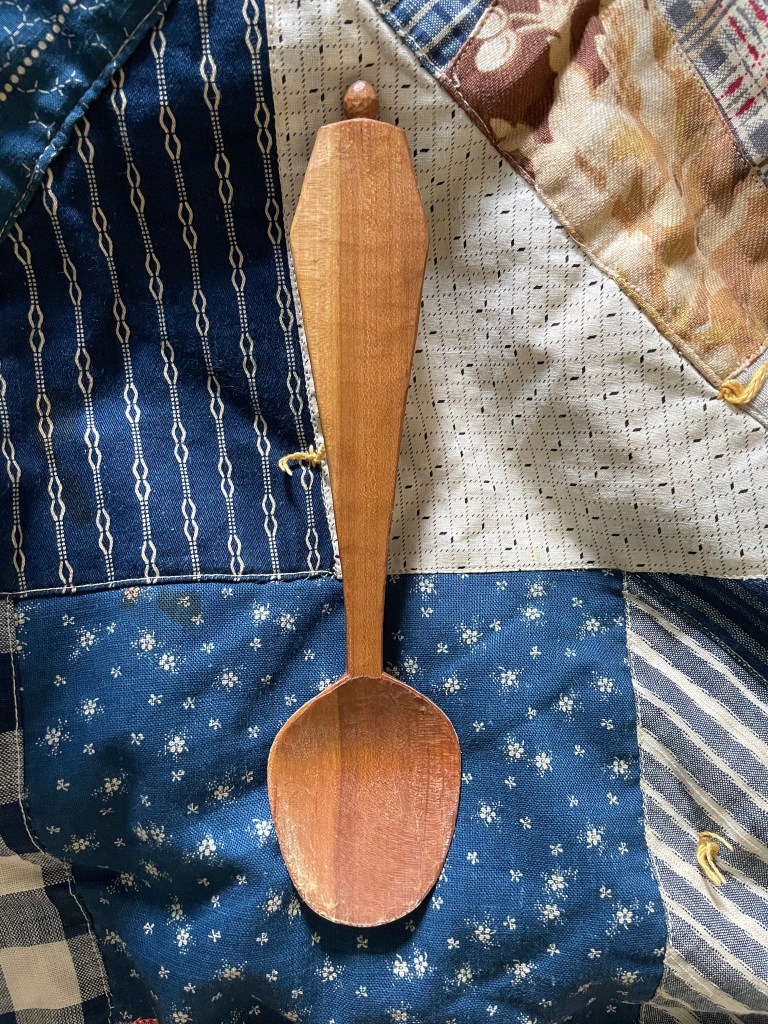
As a young teen, I attended a wilderness camp where I found a passion for carving spoons out of wood. Over the years, I have fine-tuned my skills as a woodworker, especially in the wooden spoon arena. I have become skilled with the many tools used in the process to make a spoon and have developed much knowledge of wood in general. Most of my spoons are given as gifts to loved ones, who use them regularly. Their regular use changes the spoon in terms of its color and feel throughout its life. Wooden spoons are more than a simple eating utensil, they conjure stories and emotions when looked at and held by their users.
One object particularly close to my heart is a sugar maple eating spoon I made a few years ago. The eight-inch- spoon is ideal for eating cereal, whether it is hot oatmeal on a camping trip or cold Cheerios in my dorm room. Weighing just a little more than a feather, it may seem fragile, but time has proven its durability. This spoon is different from any other spoon I have made in that it is the first one I made that I use consistently.
When looking at the spoon from a bird’s eye view, there is a dividing line that runs vertically along the left side of the spoon that is slightly off-center. The line splits the appearance of the wood into a right and left side. The darker side (on the right) comes from the center of the original log and the smaller, lighter side is from the outer edge of the wood. Sunlight, weather, and age cause the wood to have a lighter tone. The contrast of the colors makes the spoon appear to have two separate sides. The lighter side is a light brown with a slight golden hue. The hue comes from the linseed oil used to put a protective coating on the wood. Over time the color of the spoon becomes richer with use. This is apparent when comparing the current color to photographs taken when the spoon was first made.
The tooled finish gives it a unique smoothness that stays consistent throughout its life. The back of the bowl reveals small knife marks that are smooth themselves but have some roughness when looking at them together. The curvature of the back of the bowl is fairly round which makes it difficult to have long cuts. When making the finishing cuts, the longer a cut is, the smoother the wood feels while short cuts leave a slightly less smooth feel. The curvature of the bowl is exacerbated by the crank of the spoon. The term crank is often used in the spoon carving community to describe the slight upward bend of the bowl. This allows the spoon to hold more food without being too deep. The crank of this particular spoon can be seen by the handle holding a constant plane until a quarter of the way into the bowl where it curves up about an inch. The profile of the spoon is defined by the crank. Looking at a regular metal spoon can illustrate the necessity for this feature. The bowl of the spoon could be described as a soft trapezoid. The end of the bowl is smaller while the part closer to the handle is larger. The edges are rounded as most spoons are for the comfortable feel in the mouth.
The back and front of the bowl are the only parts of the spoon that show tool marks other than the small ball on the top of the handle. The ball (purely for aesthetic) is the size of a small pea that sits on the top middle part of the handle. A decorative ball on the handle of a spoon is a common addition to improve aesthetic. The handle is tapered meaning near the bowl, it is narrower than at the top. This gives the spoon a comfortable feel in the hand. The widest part of the handle is close to an inch and a half. The widest part of the handle is about an inch from the top. It tapers around half an inch in at the top which leaves a half-inch surface for the ball to sit on. The back of the handle has a slight triangular ridge running vertically along the spoon. The area near the end is close to flat but as the handle connects to the bowl it becomes more pronounced and sharper. The ridge contributes to the comfortable feeling when holding the spoon.
This spoon holds a special place in my heart; wherever I am in life, the spoon is with me. Each time I use the ergonomic and solid spoon, it grows; the story develops, the character of the spoon evolves, and the overall look of the spoon changes. Whether the pigment becomes more enhanced from coffee grounds or a small ding on the handle appears after a camping trip, the spoon tells an evolving story and mirrors my busy life.
 The Materials of History, Thought, and Art
I found your description of the spoon’s dimensions and textures really detailed, to the point where I could picture the spoon in my head without referring to the original picture. The amount of effort you put into describing your object really shows how much work went into crafting it, and it was fascinating to see how much thought and care was put into the making of your spoon.