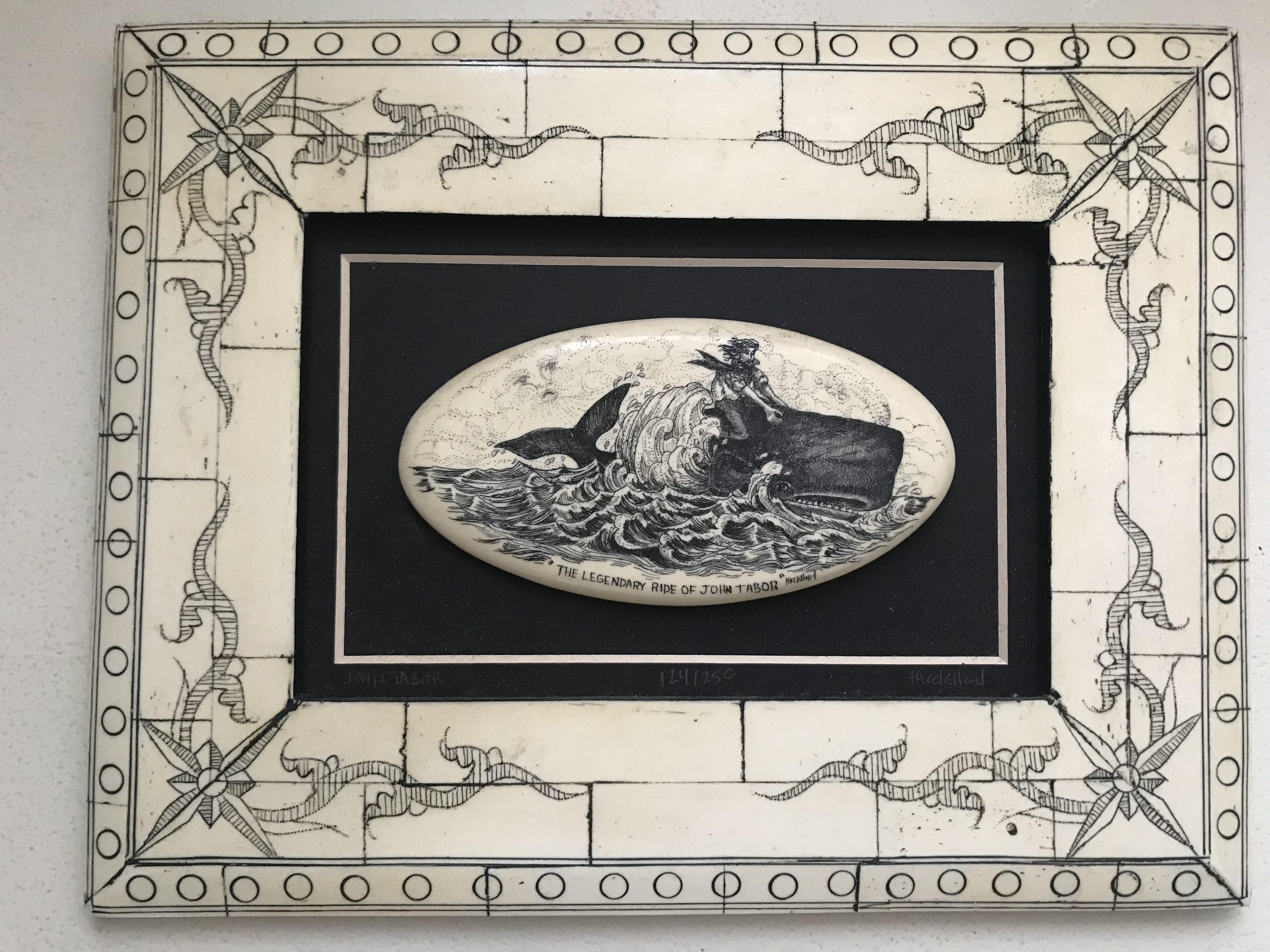
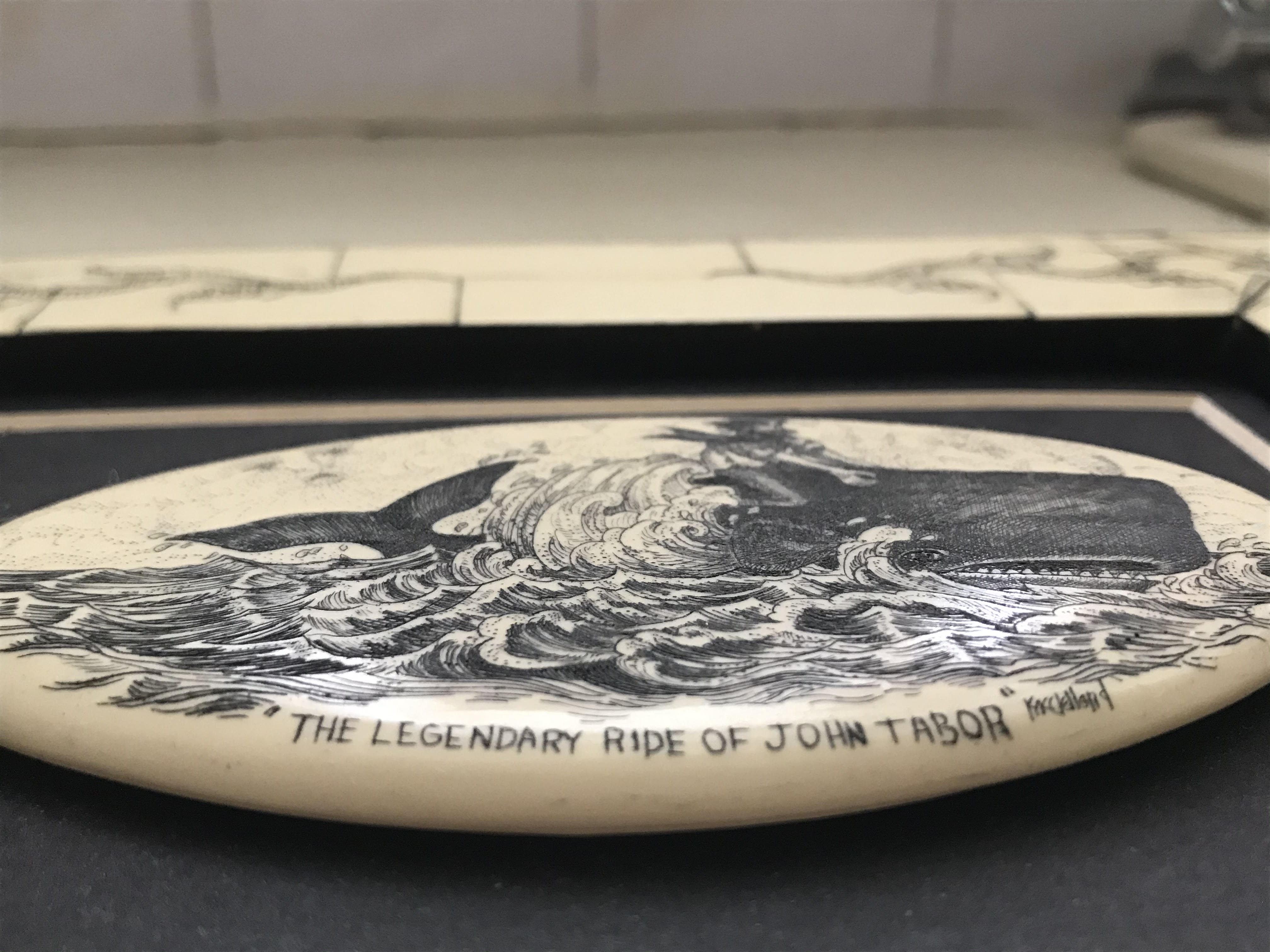
The object I wish to explore is a Christmas gift I received from my Aunt Laurie a few years ago after her trip to Norway. The framed medallion, considered a form of scrimshaw, depicts a man atop of a whale, breaching the surface of an ocean. Beneath the carefully carved, intricate scene has the words, “THE LEGENDARY RIDE OF JOHN TABOR” followed by an illegible signature of the author.
The medallion is surrounded by a rectangular frame, measuring at about 10” x 7”, while the medallion is merely 3 inches. While this form of art is considered scrimshaw, which is artwork carved into an image of ivory, however, I am under the impression it is a form of faux ivory due to the small writing on the back that claims that this is one piece out of 150 pieces. Ivory, now considered unethical and difficult to obtain, is hard to identify without using a blacklight or burning a part of the ivory. With a more careful investigation, I discovered the carvings must have been darkened with color as a result of underglazing, which highlights the indentations made in the faux ivory. The carvings are intricate and incredibly thin. The depth of each line is hard to measure, because of how shallow each stroke is. The darker parts of the carving, such as the whale or the shadowed parts of the wave, have a palpable texture to them.
The background of the scene depicted on the medallion is incredibly light and intricate. The carvings are especially shallow, and created with a pattern of dots, while the foreground is created by a series of lines, ultimately creating a depth to the piece of artwork. There is a face embedded within the background, ever so lightly, as to bring attention to the man, who I’m sure is John Tabor. The man is carefully created with careful, thicker lines as to bring emphasis onto his face, and leaving much lighter portions in order to distinguish his body from the whale. The whale is very very dark, having been done with a cross-hatching technique to distinguish his body from the ocean. The whale is dark, giving me the impression that the whale is a sperm whale. Additionally, the sperm whale has the defining large, square head, which is reflected in this drawing.
This scrimshaw depicts the story of John Tabor, who is a character in the book “Etchings of a Whale Cruise,” written by John Ross Browne in 1846. The story is considered a Nantucket story because of its intense focus on whaling. John Tabor is depicted to be riding a whale in the novel, as well as being one of the profound characters. In consideration of how the sperm whale is a major target for whalers, I am assuming this was a depiction of how John Tabor had to, in all of his masculine glory, physically grab the whale in order to catch and kill it for his whaling expedition.
The artist who created this scrimshaw must’ve found the story to be quite compelling, given that this piece is one of 250. Because this was a gift, I am not entirely sure it’s origin. Despite many attempts at research, I was unable to find where it was made originally, how it was sold to my Aunt in Norway and why she chose to give it to me. But I am aware that it is associated with whaling, and inspired Herman Melville’s famous novel Moby-Dick. Because Norway is on the shore, and has its own association with whaling, boating and sailing, I am sure it is a crossover between the two cultures. I would love to explore this piece further, and I am tempted to ask my Aunt Laurie how she got her hands on this object and if she has any further information on it.

 The Materials of History, Thought, and Art
Hello!
I must first say, I am honestly quite jealous as I would love to have an object like this, especially from Norway. Other than that, I think your descriptions of the object are wonderfully visual enough that I am given a better sense of the object’s textures and variations. I am referring specifically to where you point out in which parts the etching is more shallow or dense as it really gives a sense of the texture in the image. The photos themselves are very clear and well framed. I think the second photo is the most effective of the three as it allows for the viewer to see the way the heavy cross-hatched etching creates a dullness as opposed to the shine of the unmarred “ivory”. In reference to the ivory, I think you are probably right in saying that this is meant to be some type of faux-ivory. However, I would be interested to know what this object is made up of whether it be some type of wood or a plastic.