Despite growing up with an Irish mother and an Irish extended family, I know very little beyond the fact that we call Ballylongford, or Tullahennel South, our home. While I know some stories about Ireland, they are my mother’s and only reach as far back as the 1970s.
When I was assigned this project, I immediately thought of this photo. Printed on thick glossy paper and weathered by time, the photo weighs more than one might think – literally and metaphorically. The photo is covered by various splotches but the photo is still clear. A bunch of young men dressed in Irish Volunteer Army uniforms with some grinding mischievously at the cameraman.
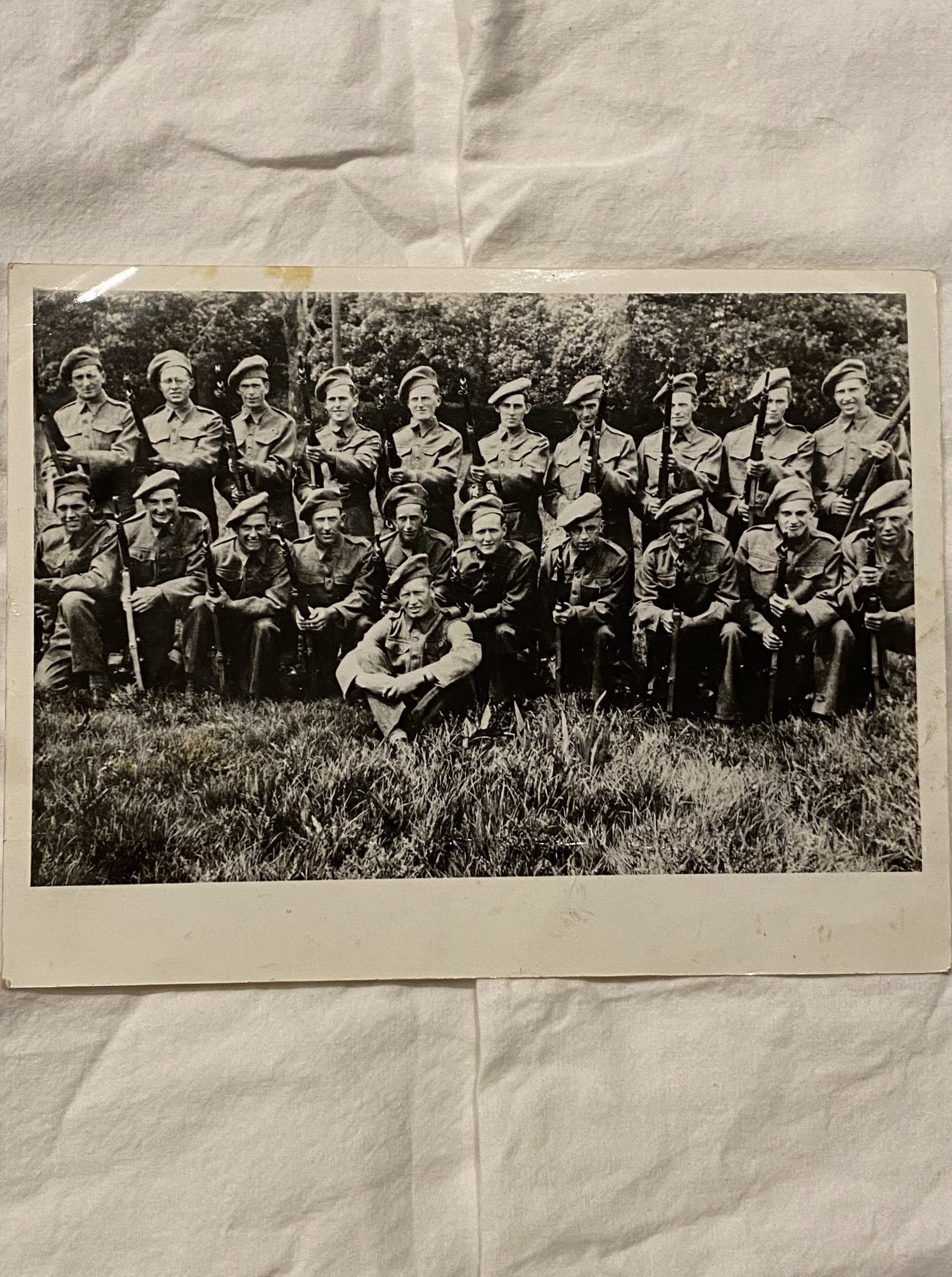
Pictured: Ballylongford Volunteer Army. Jeremiah Hunt is in the top row and fourth from the right.

All I had to start off with with finding the history behind this photo was a name: Jeremiah Hunt. Jeremiah, also spelled Geremiah, was usually just called Ger. Beyond his name, I had nothing. I had no idea when and where he existed or what his life was like. Jeremiah Hunt, was born May 31st, 1897 under English rule to Patrick and Catherine (nee: Collins) Hunt in Tullahennel. Once I showed my mom a record of Ger, she immediately took a picture to send to her seven siblings on WhatsApp. This photo is perhaps the first solid connection my family has had to this man.
Ger grew up in southwestern Ireland. He attended school at least until the age of 13 and grew up without a father. There is no record of when Patrick Hunt died, his wife is simply labeled as a widow on the 1911 census. When the Irish War of Independence began in 1919, Ger immediately joined the Irish Volunteer Army of Ballylongford. Ger was only 23 when he joined the army, his brother heading off to America and never be heard from again.
Speaking with my Great Uncle Larry, one of Ger’s twelve children, I was told that my great-grandfather owned one of the only guns in his part of the IRA. In his captain’s, Brian O’Grady, witness statement he lists that the only weapons they had were two .32s revolvers and one shotgun. Ger owned one of the two .32s.
The years 1920-21 were some of the worst years my great-grandfather and his fellow neighbors were to endure. Within a period of six months, the Tans twice entered the village of Ballylongford where my great-grandfather was stationed. During this six month period, the Tans burned down houses and businesses, killed both Volunteers and civilians, as well as looting whatever they could put their hands on. These two events are called the “Burning of Ballylongford”.
It was during one of these events that Ger was shot in the chest by a Tan. While he survived, the gunshot wound he suffered ailed him for the rest of his life. My Great Uncle Larry recalls when they were picking turf for the winter, his father would take his shirt off and he had a giant hole in his chest. My great-grandfather didn’t talk about it so his children didn’t ask. It is unfortunate that my grandfather did not speak of what had happened to him. His story can only be told through the vague recollections of those who surrounded him.
After the war, Michael Collins, leader of the Volunteers and famous Irish revolutionary, signed a treaty with the British: 26 of the 32 counties would be free. The remaining six would remain with Britain. These six counties come to form what we consider Northern Ireland today. Perhaps Ger was anti-treaty and regretted his time under Collins. Or maybe he was ashamed of what the IRA became in the years before his death in the 1960s. There is no clear reasoning Ger hid his stories away from those closest to him.
This photo pictured is a copy of the original one that sits in the archives of County Kerry. My grandmother, Ger’s daughter, was the one who inherited the copy of her father. Perhaps it was because she was only one of twelve who remained in Tullahennel. The others moving away to America, England, and Australia. My grandmother, much like her father, did not tell what she knew of Ger’s story. Instead, she hid the picture in her wedding album. The hiding of the photo in an intimate place speaks of a pain close to the heart.
It was only in 2015 after my grandmother died that my mother found the photo in the album. Much like her mother before her, it was hidden away from view but not out of pain but of a detachment from the past. In 2021, the picture of my great-grandfather is no longer hidden from view. Ger never had a chance to tell his story but now, like the photo, I possess both and can tell his story for him.
 The Materials of History, Thought, and Art
This entry has left me wanting to know more about Ger and his time in the army. Side note, I love the name Ger, it is such a delicate name. From the sounds of it, he was anything but delicate, being shot in the chest and all. It is fascinating the history a simple photo can hold. As they say, “a picture is worth a thousand words”. Well done entry.
This such a cool story and such an awesome photograph to have, they look so young that I thought it was a group of boys before I zoomed in. Ger also seems like a pretty cool guy. Resisting British imperialism is always a win in my book.
26+6=1
This is such a great story and even more amazing that you have the pictures too! It is also so crazy to think that this story is all word of mouth and has been told and kept in your family for all these years and how all of your moms siblings all worked together to figure out the missing pieces.