Going into this assignment I was unsure about how easy this was going to be. On the one hand, I knew from the very beginning what I would choose: my great grandfather’s World War 1 medals. My family doesn’t keep anything in our house unless it’s practical for present use but these medals are the one exception to this pattern. These medals are all I really know about my great grandfather, as I never met him while he was alive, and yet they have been kept in my family for generations. On the other hand, all I have connected to these objects are the stories passed down from my father, which he learned either from his father or from my great grandfather himself. The medals themselves aren’t very unique for a soldier of the time, so it’s difficult to create an image of what this distant relative was like back when my father was learning stories from him at a young age. But while I can’t draw on uniquities from the objects to create this image, the story of my great grandfather fills in the emotional gap that these medals lack.
My great grandfather was named Karl Bohnaker. He was born in Stuttgart Germany in 1898 to a woman who’s name has been lost to time. All I know is that she was a mistress to a wealthy German aristocrat, and Karl grew up a poor child with no connections to his father. Because of this he joined the army at the start of World War 1, hoping to escape his impoverished life. My father said he spoke little about the war, only that he served on the western front. Knowing the horrid living conditions and tactics of war used on the western front it makes sense as to why Karl wouldn’t speak much of his experiences at war, especially to a child. Rumor has it that he had to walk from the trenches back to Stuttgart on foot after the war was over. What I do know is that at the end of his service Karl received two medals from the German military: a “wound badge” given as the German equivalent to the American “purple heart” and an “iron cross” pin that was given to all soldiers regardless of rank.

What I find interesting about these medals is that they are made up of brass and zinc due to the German military using all other metals for the war effort, and thus these metals feel light and fragile to hold. I find it interesting that this is the detail that my dad would always point out when telling the story. I rarely hear about who my great grandfather was as a person, but my father never forgets to tell me what his medals were made of. Perhaps it was because of the irony behind a poor boy going to war to make some money and start a life, when in the end he is rewarded with the leftover metal that his country wasn’t using for the war that he just fought in.
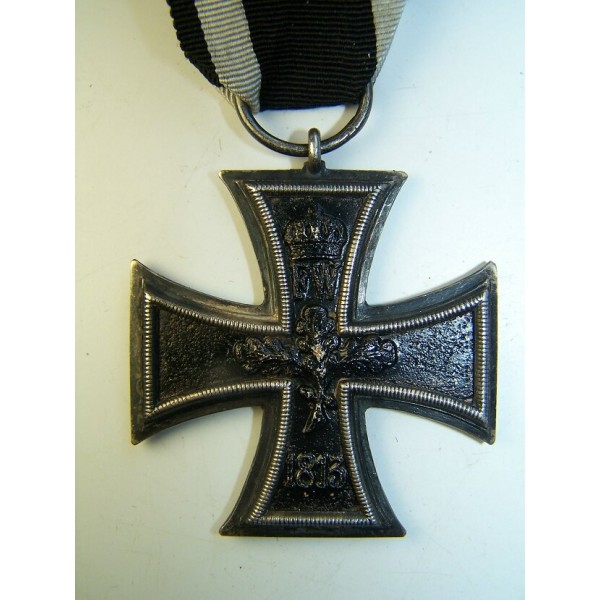
This irony would continue after the end of Karl’s service for the German army. After returning home after the war had ended, he experienced the hyperinflation of the post war German economy. This hyperinflation made it nearly impossible for Karl to make any money for himself, and prompted drastic action to survive in this post war era. In the early 1920s Karl immigrated to the United States, taking what little money he had left and his two medals. He supposedly came to New York through Ellis Island, however I can not find any proof of this. His plan was to make some money in th US’s booming economy, wait for the German economy to settle down and then move back to Germany to continue his life. However, due to the economic crash of the American stock market in 1929 and the rise to power of the Nazi party in the 30s, Karl decided to stay in America. Throughout the 30s and early 40s, Karl started a tool and die manufacturing business in Brooklyn. From there he made enough money to settle down and start a family for himself.
And from there the story becomes much more vague. After settling down in Brooklyn my great grandfather’s story became less specific, so much so that I hardly hear about what his life was like after 1940. But what I find interesting about it is just how ironic the story is. Karl, who came from a childhood with little to no money, was constantly working to make a living for himself and was always being beaten down by political and economic conditions that were much larger than he was. And yet Karl never stopped working, even after the first world war and two economic catastrophes he still worked to make the life he always wanted. What I find most interesting is that he kept his two war medals with him the entire time. Maybe he kept these medals out of national pride, as a way of remembering where he came from. Or rather they were to remind him of his victories of the past, like surviving the hell that was World War 1. I may never know why Karl kept these two pins of scrap metal, but I believe he would be proud of the legacy that he’s left behind and the stories that are told of him to this day.
 The Materials of History, Thought, and Art