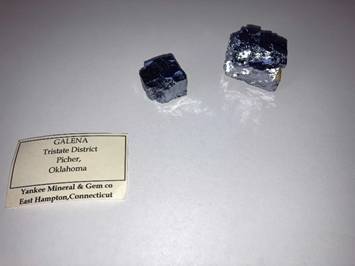
The object I have chosen, is a set of galena crystals. Galena is a sulfide mineral meaning it is a metal atom bonded to a sulfide atom, in this case Lead as lead sulfide PbS. It is safe to handle however, and as long it isn’t ingested it is harmless. The chemical structure of the mineral leads it to have a very cubic shape, and it even breaks off into cubic pieces and makes some step like features on the surface of the crystal. They have a very metallic appearance and a shiny luster; The crystals are silvery gray in color and are fairly soft, for a metal. The smaller cube is about half an inch on each side while the larger cube is about an inch on each side. The larger cube has some brown corrosion on the edge which could be oxidation. There are some spots that are not reflective which are likely spots of lead carbonate tarnish. The actual density of the galena crystals is quite high and feel quite heavy when held in the hand. They are cool and metallic to the touch, and if rubbed sometimes leave a black streak on the fingers, the actual container for the larger crystal is covered with silvery gray marks. They are several times heavier than a typical rock of the same size and weigh about as much as a heavy smartphone. The smaller cube was packaged in a small plastic bag with the name card displayed, the larger piece was simply put in a small carboard box. They were both wrapped in paper towels and bagged in brown paper bags to prevent scratches and damage. I kept the minerals with the others and just kept them in my bag.
The two samples are actually from two different places. The larger piece is from Peru, however there isn’t much more information on this one, however there are a few regions in Peru known for sulfide mines. The smaller piece is from the tristate district in Picher, Oklahoma. The Tri-state district is known for its sulfide deposits and are mined for many metals like Zinc and Lead. There are many mines in this area, so it is difficult to know from which this crystal was sourced. Galena of low quality is often just pulverized and used for ore use, while the nicer pieces are sometimes saved for mineral collectors. The crystal was purchased by the Yankee Mineral company which is regional collector of minerals and gemstones. I was able to buy this sample at the Poughkeepsie Mineral Show, the smaller cube was three dollars while I purchased the larger piece for eight dollars. I purchased many other samples of various minerals from various sellers including some large gypsum, garnets, some calcite rhombs, a hardness kit, silicon carbide and some glass crystals. As for the transport between the fair and my residence, the geology club offered a ride to the fair for students, and we took the department’s vans to the fair.
 The Materials of History, Thought, and Art
You must be logged in to post a comment.