October 2, 2021 2:11 am
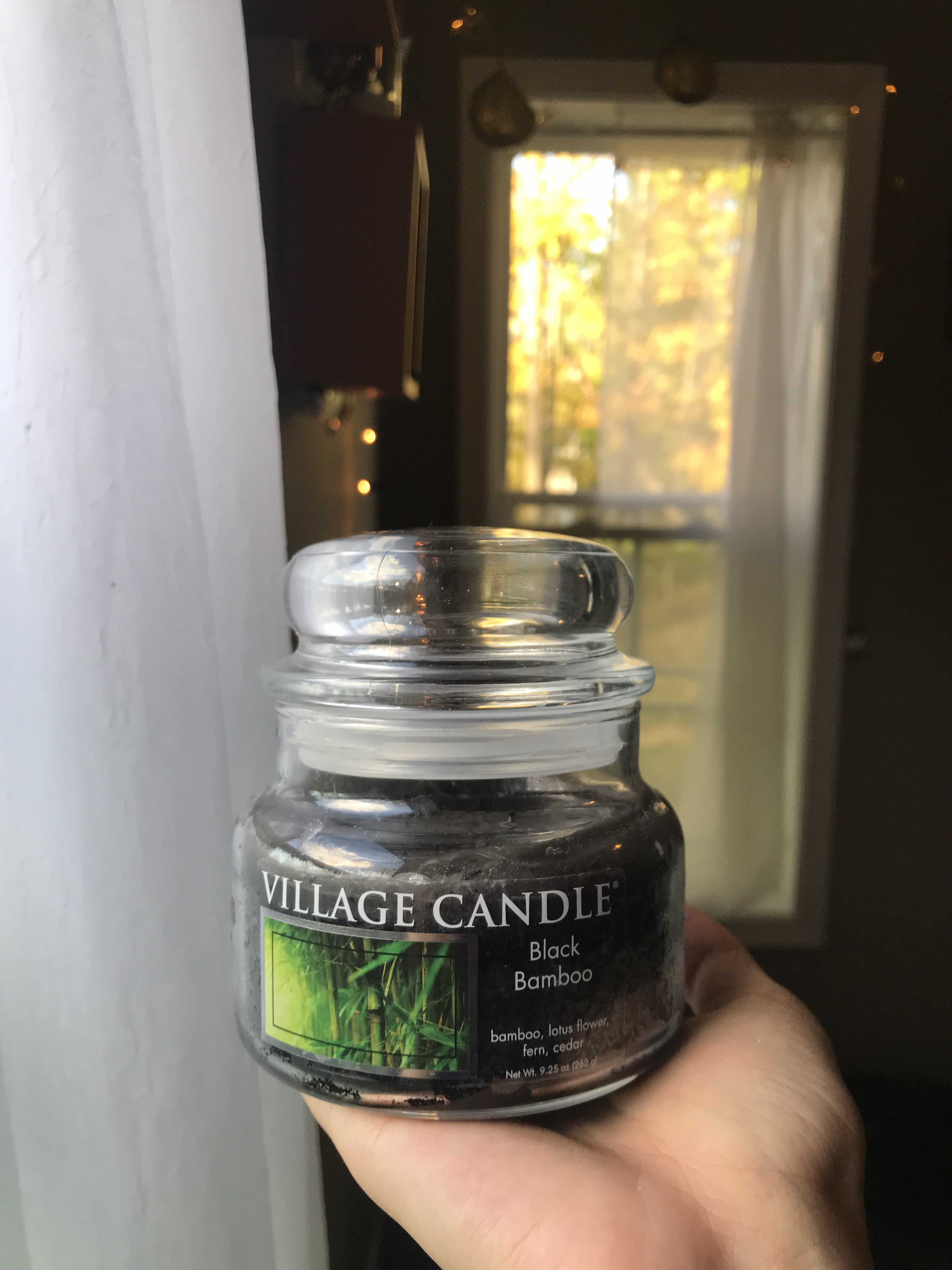
Just this past Tuesday, I had walked into aisle 14 of Tops and bought a Black Bamboo candle by the brand of Village Candle. The object itself is a glass jar about 4 inches wide, with black scented candle wax inside, 2 wicks, and a glass lid with a rubber seal. A sticker label on the bottom of the glass jar states the candle is made in “Wells, Maine, U.S.A”, which gives me some sort of geographical insight. As I looked closer, on the edge of the rubber seal, “MADE IN THE USA” is printed, which confirms to me that in addition to the candle, the glass jar is also produced in the United States.
I began to research a little bit about the company. How did this company start? Where was it founded? According to the Village Candle website, the Village Candle company started in 1993 on a kitchen stovetop in the home of, founder, Paul Aldrich. He pursued his candle-making hobby as a business and as demands grew, he was able to move his at-home business to a 2,500 sq ft space in Yarmouth, Maine. With continuing success, Village Candle grew into a large candle company owned by the parent company of Stonewall Kitchen, with both United States and international sales.
Self proclaimed on the website, the candles are born in Maine with meticulous care and craftsmanship. Each candle is crafted with a blend of food grade paraffin wax for a clean and safe burn. With the emphasis of cleanliness and safety, I decided to first take a look at the wax. Paraffin wax is derived from petroleum, coal or oil shale- that consists of hydrocarbon molecules containing 20-40 carbon atoms. Historically, paraffin wax was first created by the German chemist Karl von Reichenbach in 1830. The creation of paraffin wax paved way for developments in candlemaking, because it was clean, reliable, and cheap. With the addition of stearic acid, the candlemaking industry was able to produce efficiently made candles with high melting points. During the early 1900s as meat and oil industries grew, paraffin and stearic acid were byproducts of these productions- leading to a growth in paraffin wax production. For paraffin’s manufacturing process, slack wax is used as the feedstock, which is a byproduct from the refining of lubricating oil. To remove the oils from slack wax, the wax goes through a process of heating, resulting in crystallization and separation between oil and wax. The wax is then filtered and further processed. Because the paraffin wax is naturally white, liquid dye is used to add the black color of my candle. In addition to candle making, paraffin wax is commonly used for lubrication, electrical insulation, cosmetics, and crayons. Throughout my deconstruction research process of paraffin wax, I found out that word itself can be deconstructed. Paraffin derives from the latin word, “parum” which means “lacking affinity” or “lacking reactivity”. Paraffin wax has such an unreative nature, which allows for many different uses.
Besides wax, the fragrance is one of the most important components of a candle. They state that the fragrances include pure essential oils and plant extracts from around the world. My Black Bamboo candle states it includes bamboo, lotus flower, fern, and cedar fragrances. These plant extracts for the fragrances derive from oils, which come from their various native areas of the world; bamboo and lotus flowers are native to Asia, ferns are native to eastern North America, and cedar is native to the Mediterranean region. At around 185 degrees Farenheit, the dye and fragrance oils are able to chemically bond with the paraffin wax. Once prepared, they are distributed into the glass jars, along with the paper and pure cotton core wicks.
Stated on their website, each candle is quality checked and the wicks are hand trimmed by the Village Candles team. I imagine after my candle jar is filled, hardened, and cured, the jar was checked for any errors by detail driven workers. Once screened, the wicks are hand-cut and placed in boxes, ready to be shipped at the designated locations. Shipped from Wells, Maine, in a truck- the candle travels to New Paltz and distributed at the local grocery store, for a likely young part-time student to unpack and place on the shelf. Through this journey of preparations, manufacturing, packaging, and transportation, the candle finally finds a home in my bedroom of New Paltz.
Sources:
https://www.prweb.com/releases/2018/04/prweb15418054.htm
https://web.archive.org/web/20120630024342/http://bitumenengineering.com/materials/paraffin-wax
https://www.oxfordlearnersdictionaries.com/us/definition/english/paraffin
Posted by Kim Blum
Categories: Uncategorized
Tags:
You must be logged in to post a comment.
Mobile Site | Full Site
Get a free blog at WordPress.com Theme: WordPress Mobile Edition by Alex King.